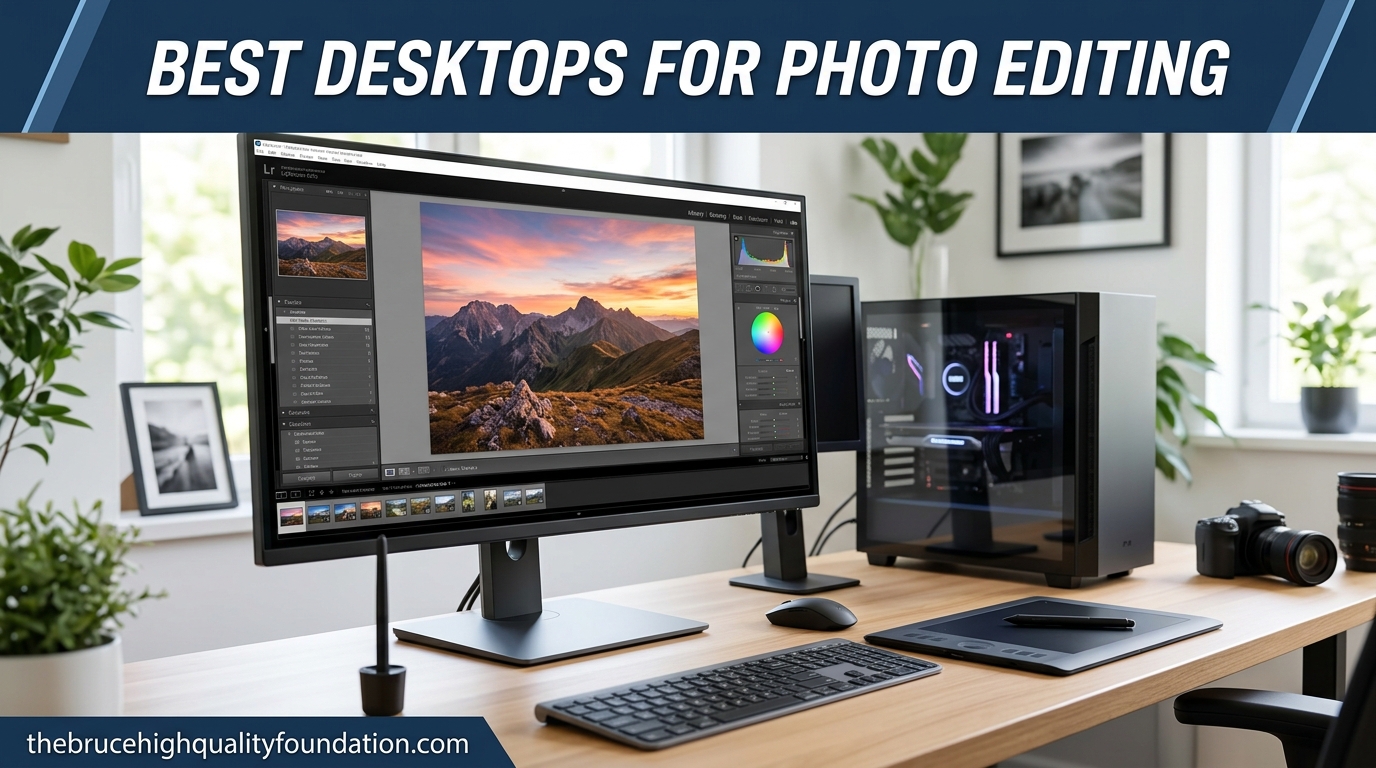
Selecting the right office desktop requires balancing processing power, physical footprint, energy efficiency, and long-term reliability to support daily professional workflows. The top office desktops for include systems designed for seamless multitasking, secure corporate environments, and space-saving modern workspaces, ranging from compact mini-PCs to robust traditional towers.
Choosing an office desktop involves looking beyond basic hardware specifications to understand how a machine will perform over years of daily enterprise use. Modern workplaces demand hardware that not only handles intensive spreadsheet modeling, multi-display setups, and virtual communication tools effortlessly, but also integrates smoothly into existing IT management infrastructures. Whether outfitting a remote home office or refreshing an entire corporate floor, evaluating the form factor, security architecture, and expansion capabilities of your next desktop ensures maximum productivity and a lower total cost of ownership.
Understanding Office Desktop Categories and Form Factors
The modern office environment is no longer dominated by bulky tower cases tucked under desks. Today’s business hardware spans several distinct form factors, each tailored to specific operational needs, spatial constraints, and security requirements. Understanding these categories is the first step toward making a cost-effective purchasing decision for your organization or personal workspace.
Traditional tower desktops, often classified as mid-towers, remain the gold standard for upgradability and raw performance. These systems offer ample internal space for component cooling, multiple storage drives, dedicated graphics cards if required for specialized design tasks, and easy repair access. However, their physical footprint is large, making them less ideal for cramped cubicles or minimalist modern office layouts.
In contrast, Small Form Factor (SFF) desktops and mini-PCs have surged in popularity. SFF machines pack enterprise-grade processors and memory into a chassis a fraction of the size of a standard tower, often capable of being mounted vertically on a desk stand or horizontally beneath a monitor. Mini-PCs, driven by advancements in mobile architecture and efficient thermal design, offer near-silent operation and minimal power consumption while still driving dual or triple 4K monitors for administrative tasks.
Key Hardware Requirements for Professional Workflows
Office productivity workloads have evolved significantly. Modern office computers must handle browser tabs numbering in the dozens, real-time cloud collaboration suites, local database queries, and background security software simultaneously. Meeting these demands requires careful attention to core hardware specifications:
- Processors (CPUs): For standard office productivity—word processing, email, accounting, and web browsing—Intel Core i5 or AMD Ryzen 5 processors provide an optimal balance of speed and efficiency. For data analysts, software developers, or financial modelers working with massive datasets, stepping up to an Intel Core i7/i9 or AMD Ryzen 7/9 ensures snappy compilation and execution times.
- Memory (RAM): 8GB of RAM is the absolute minimum for basic tasks, but 16GB is the modern standard for professional office environments. If you routinely run virtual machines, large databases, or memory-heavy enterprise software, 32GB is strongly recommended to prevent system bottlenecks.
- Storage: Solid State Drives (SSDs) using the NVMe protocol are mandatory for modern office desktops. They offer boot times of mere seconds and instantaneous file transfers compared to legacy mechanical hard drives. A 512GB SSD is sufficient for general users, while 1TB or higher is better suited for professionals handling large media files or local archives.
- Connectivity and Ports: A robust selection of USB-A and USB-C ports, HDMI or DisplayPort outputs for multi-monitor configurations, and reliable Wi-Fi 6/6E or Gigabit Ethernet ensures seamless peripheral integration and network stability.
Top 5 Office Desktops for
Evaluating the top office desktops requires examining build quality, enterprise management features, hardware reliability, and overall value. The following five machines represent the best options available across different form factors and use cases.
1. Dell OptiPlex Micro 7020
The Dell OptiPlex line has long been a staple of enterprise IT departments, and the OptiPlex Micro 7020 continues this legacy of reliability in a remarkably compact chassis. Measuring roughly the size of a paperback book, this micro-desktop can be tucked behind a monitor using a VESA mount, freeing up valuable desk space.
Equipped with Intel's latest vPro-enabled processors, the OptiPlex Micro 7020 offers advanced remote management capabilities that IT administrators rely on for security patching and maintenance. It supports multiple displays, features an array of front- and rear-facing USB ports, and includes comprehensive security software integration like TPM 2.0 and chassis intrusion detection.
- Pros: Ultra-compact footprint; excellent enterprise management and security features; highly energy-efficient.
- Cons: Limited internal upgradeability due to size; uses mobile-class thermal solutions under heavy sustained loads.
2. HP EliteMini 800 G9
For organizations seeking premium build quality combined with robust security, the HP EliteMini 800 G9 stands out as a premier choice. HP designs its Elite series with enterprise deployments in mind, featuring military-grade durability testing and proprietary security features like HP Sure Start, which self-heals the BIOS from malware attacks.
Powered by high-performance desktop-class processors packed into a small chassis, the EliteMini 800 G9 handles heavy multitasking with ease. It supports up to three video outputs natively and offers configurable port options, allowing businesses to tailor the rear I/O to legacy equipment or specific networking needs.
- Pros: Enterprise-grade BIOS protection and physical security; strong sustained performance; flexible port configuration options.
- Cons: Premium pricing compared to consumer-grade mini-PCs; cooling fans can ramp up audibly under maximum load.
3. Lenovo ThinkCentre M75q Gen 5 (AMD)
For businesses looking to maximize processing power per dollar without sacrificing reliability, the Lenovo ThinkCentre M75q Gen 5 utilizing AMD Ryzen PRO processors is an exceptional value. AMD’s silicon delivers impressive multi-threaded performance and power efficiency, making this desktop ideal for data-heavy administrative workloads.
The ThinkCentre M75q maintains Lenovo’s renowned industrial durability, passing stringent MIL-STD 810H tests. It features robust security protocols via AMD Memory Guard and PRO security features, ensuring that sensitive corporate data remains encrypted and protected against physical and remote threats.
- Pros: Outstanding multi-core performance from AMD Ryzen PRO chips; great price-to-performance ratio; highly durable chassis.
- Cons: Limited graphics upgrade path; availability of specific configurations can fluctuate depending on regional enterprise supply.
4. Apple Mac mini (M4 / M4 Pro)
For creative offices, design agencies, and professionals operating within the macOS ecosystem, the Mac mini powered by Apple silicon is an industry-leading office desktop. Delivering incredible performance while consuming minimal electricity, the Mac mini operates silently and generates virtually no heat under standard office workloads.
The unified memory architecture allows applications to access data instantly, resulting in fluid multitasking across video editing software, graphic design suites, and heavy web applications. Its compact aluminum enclosure takes up almost no physical desk space while offering robust Thunderbolt/USB-C connectivity and multi-display support.
- Pros: Industry-leading energy efficiency; silent operation; exceptional single-core and multi-core processing speeds for compatible software.
- Cons: Non-upgradeable memory and storage after purchase; software compatibility limitations for specific legacy corporate Windows applications.
5. ASUS ExpertCenter D9 Tower
Organizations that require traditional desktop expansion, dedicated graphics capabilities, or straightforward internal repair access will find the ASUS ExpertCenter D9 Tower to be a reliable workhorse. Unlike micro-desktops, this mid-tower provides ample room for PCI Express expansion cards, multiple storage drives, and superior passive airflow.
The ExpertCenter D9 is built for heavy enterprise use, featuring high-end motherboard components, comprehensive system health monitoring tools, and toolless chassis access for rapid IT servicing. It is well-suited for finance departments, engineering firms, or administrative hubs that demand long hardware lifecycles and easy internal maintenance.
- Pros: Full physical upgradeability and repairability; excellent thermal performance; robust legacy and modern port selection.
- Cons: Large physical footprint requires dedicated floor or desk space; heavier to transport during office reconfigurations.
Comparative Overview of Top Office Desktops
| Model | Form Factor | Processor Options | Recommended RAM | Primary Advantage |
|---|---|---|---|---|
| Dell OptiPlex Micro 7020 | Ultra-Micro PC | Intel Core i3 / i5 / i7 (vPro) | 16GB – 32GB | Enterprise management & space-saving |
| HP EliteMini 800 G9 | Mini PC | Intel Core i5 / i7 / i9 | 16GB – 64GB | Advanced hardware security & durability |
| Lenovo ThinkCentre M75q | Mini PC | AMD Ryzen 5 / 7 PRO | 16GB – 64GB | Exceptional multi-core value & performance |
| Apple Mac mini (M4) | Compact Desktop | Apple M4 / M4 Pro | 16GB – 32GB | Silent operation & energy efficiency |
| ASUS ExpertCenter D9 | Mid-Tower | Intel Core i5 / i7 / i9 | 16GB – 64GB | Maximum expandability & internal repair access |
Security, Manageability, and Total Cost of Ownership
When purchasing office desktops, evaluating the initial purchase price is only part of the equation. Organizations must consider the Total Cost of Ownership (TCO), which includes deployment time, energy consumption, maintenance overhead, and security vulnerability risks.
Enterprise-focused machines from Dell, HP, and Lenovo often command a slight price premium over consumer desktops, but they justify this cost through built-in manageability features. Technologies like Intel vPro and AMD PRO allow IT departments to perform out-of-band management, update firmware remotely after hours, and isolate compromised machines from the corporate network instantly. Furthermore, commercial-grade hardware typically features longer product lifecycles, ensuring that organizations can purchase identical models months down the line for standardized desk deployments.
Energy efficiency also impacts TCO over a multi-year hardware lifecycle. Micro-PCs and mini-desktops consume significantly less electricity at idle and under load compared to aging traditional towers, translating to measurable savings on commercial utility bills across large office deployments.
Common Mistakes to Avoid When Buying Office Computers
Navigating the desktop market can lead to costly oversights if certain purchasing pitfalls are not addressed early in the selection process. Avoiding these common mistakes ensures your hardware investment supports your business efficiently for years to come:
- Purchasing Mechanical Hard Drives (HDDs): Buying any modern office desktop configured with a traditional spinning hard drive as the primary boot drive will immediately bottleneck employee productivity. Always insist on solid-state NVMe storage.
- Underestimating RAM Requirements: Opting for 8GB of RAM to save a nominal amount upfront frequently results in premature hardware obsolescence as operating systems and browser applications demand more memory. Standardize on 16GB for all future-proof office setups.
- Ignoring Warranty and Support Terms: Consumer warranties often require shipping a defective machine to a depot, causing weeks of downtime. Business-class desktops should always be purchased with next-business-day on-site support warranties to minimize operational interruption.
- Overlooking Display Output Compatibility: Failing to verify that a desktop’s video output ports (HDMI, DisplayPort, USB-C) match existing office monitors can lead to frustrating adapter hassles and unexpected accessory expenses.
Frequently Asked Questions
What is the ideal processor for a standard office desktop?
For standard office tasks such as word processing, spreadsheet management, email correspondence, and web conferencing, an Intel Core i5 or AMD Ryzen 5 processor provides optimal performance. These chips handle multi-tasking effortlessly without generating excessive heat or consuming unnecessary electrical power.
Are mini-PCs reliable enough for full-time corporate use?
Yes, modern mini-PCs from reputable commercial manufacturers are engineered for rigorous, continuous office environments. They undergo strict thermal and durability testing and utilize enterprise-grade components, offering reliability comparable to traditional desktop towers while saving physical desk space.
How much RAM do office employees need for multitasking?
While 8GB of RAM can handle basic single-app workflows, 16GB is the recommended standard for modern office environments. This capacity ensures smooth operation when users run multiple browser windows, cloud storage synchronization tools, email clients, and enterprise resource planning software simultaneously.
Should businesses choose Windows or macOS for office desktops?
The choice depends primarily on your existing software ecosystem and employee familiarity. Windows remains the dominant platform for corporate environments utilizing specialized legacy database applications, accounting software, and deep Microsoft 365 integrations. macOS is heavily favored by creative agencies, media production teams, and organizations prioritizing unix-based development environments.
How often should office desktops be replaced?
A typical lifecycle for an office desktop is four to five years. Beyond this timeframe, hardware degradation, accumulating software bloat, increasing security vulnerabilities, and declining battery or power supply efficiency begin to outweigh the cost of deploying modern, faster replacements.
Conclusion and Next Actions
Investing in the right office desktops requires aligning physical space constraints, performance requirements, and enterprise security needs with your long-term operational budget. Whether you select the ultra-secure HP EliteMini 800 G9, the space-saving Dell OptiPlex Micro 7020, the multi-core value of the Lenovo ThinkCentre M75q, the efficiency of the Apple Mac mini, or the expandability of the ASUS ExpertCenter D9, prioritizing business-class hardware pays dividends in reliability and productivity.
To take the next step, audit your current office hardware inventory, identify performance bottlenecks or impending warranty expirations, and request evaluation units from commercial vendors to test compatibility with your core software applications before executing a full deployment.