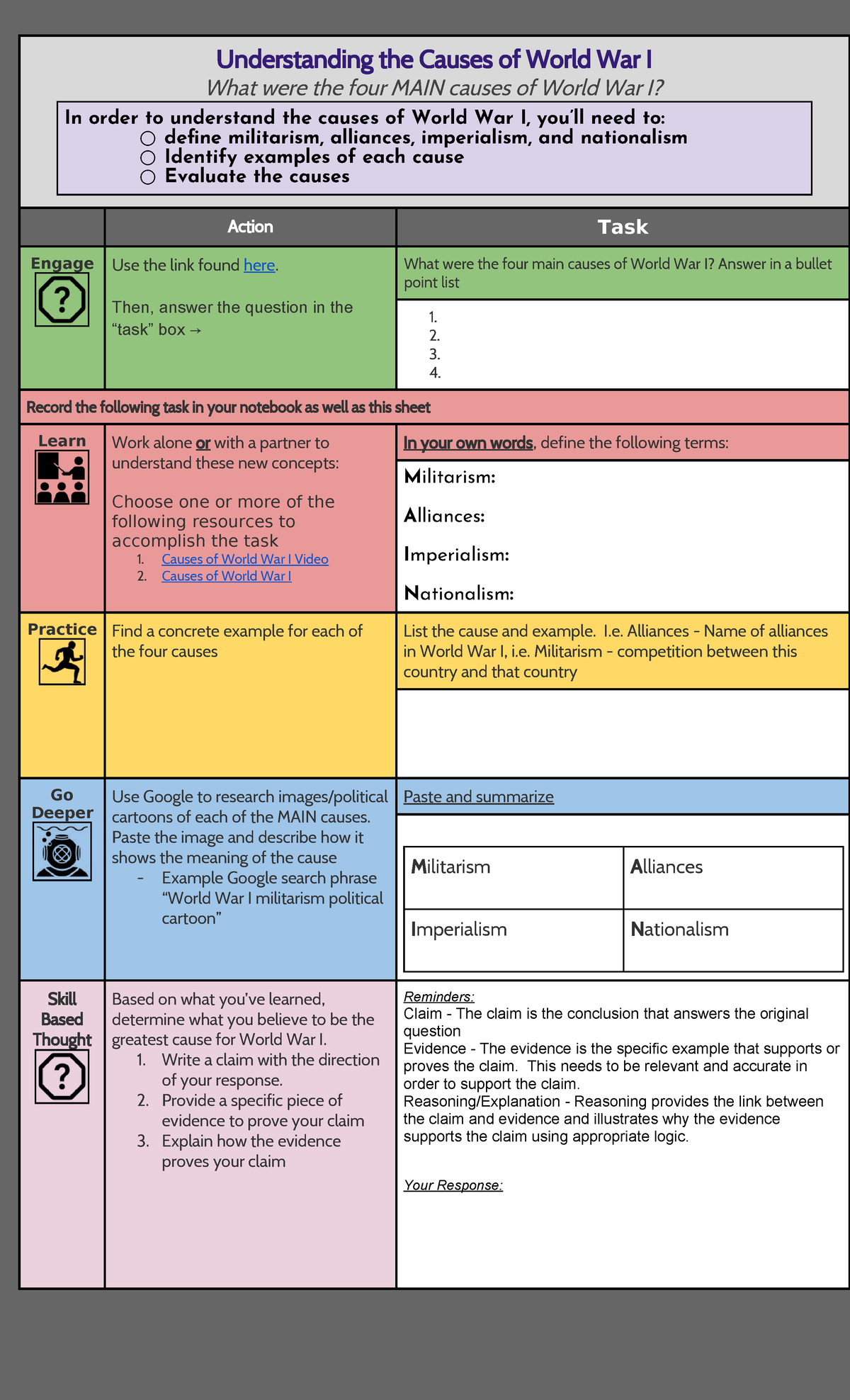
World War I was not caused by a single isolated event, but rather by a complex web of long-term structural pressures, shifting geopolitical dynamics, and fatal miscalculations that ultimately culminated in the July Crisis of 1914. While the assassination of Archduke Franz Ferdinand served as the immediate spark, the Great War's outbreak is best understood through three foundational causes: the intricate system of mutual defense alliances, the aggressive rise of European imperialism and colonial competition, and the intensifying militarism coupled with nationalist fervor across the continent.
Introduction: The Powder Keg of Europe
When historians examine the outbreak of World War I, they frequently reference the metaphor of the European "powder keg." For decades leading up to 1914, European powers engaged in a delicate and increasingly unstable balancing act. Industrialization had supercharged economic output and military manufacturing capacity, while ideological shifts transformed the concept of the nation-state.
To fully understand why a regional crisis in the Balkans escalated into a global conflagration involving millions of combatants across multiple continents, one must look beyond the immediate catalyst of Sarajevo. The historical consensus focuses on three principal, interlocking drivers: alliances, imperialism combined with militarism, and nationalism. These structural forces transformed Europe into an armed camp where peace was precariously maintained only by mutual deterrence—until that deterrence catastrophically failed.
Cause 1: The Mutual Defense Alliance System
The late 19th and early 20th centuries were defined by a rigid network of international treaties and mutual defense pacts. Intended originally as a diplomatic strategy to preserve the balance of power and deter war through collective strength, this web of alliances ultimately achieved the exact opposite. It guaranteed that any localized dispute between two nations would inevitably drag all major powers into the conflict.
The Dual Alliance and the Triple Entente
The alliance landscape was broadly split into two opposing factions:
- The Triple Entente: Comprising France, Russia, and Great Britain. This bloc emerged gradually, beginning with the Franco-Russian Alliance of 1894, which was designed to counter the rising power of Germany. Great Britain joined the framework through the Entente Cordiale with France in 1904 and the Anglo-Russian Convention of 1907.
- The Triple Alliance: Comprising Germany, Austria-Hungary, and Italy (though Italy ultimately remained neutral in 1914 and later joined the Allied side). This bloc was anchored by the Dual Alliance of 1879 between Germany and Austria-Hungary, forged by German Chancellor Otto von Bismarck to isolate France.
How Deterrence Became a Trap
The structural flaw of these alliances lay in their automatic nature. Secret clauses, military planning contingencies, and national prestige bound leaders to commitments that superseded diplomatic off-ramps.
When a Serbian nationalist assassinated Archduke Franz Ferdinand, the heir to the Austro-Hungarian throne, on June 28, 1914, Vienna viewed the attack as an existential threat sponsored by neighboring Serbia. Backed by Germany's infamous "blank check" of unconditional support, Austria-Hungary issued an ultimatum designed to be rejected.
When Austria-Hungary declared war on Serbia, Russia mobilized its military to protect its Serbian Slavic allies. This mobilization triggered the German war plan—the Schlieffen Plan—which dictated that a war on two fronts required an immediate, preemptive strike against France through neutral Belgium. Great Britain, bound by treaty obligations to protect Belgian neutrality and unwilling to see the European continent dominated by a single hostile power, entered the war. Thus, a regional Balkan dispute swallowed the entire European continent within weeks.
Cause 2: Imperialism and Economic Competition
Imperialism—the policy of extending a nation's power and dominion through direct territorial acquisition or political and economic control—created intense friction among European industrial powers. As European economies industrialized rapidly, they required vast quantities of raw materials, such as rubber, oil, coal, and iron ore, as well as captive export markets for their manufactured goods.
The Scramble for Africa and Global Markets
During the late 1800s, European powers carved up virtually the entire continent of Africa and expanded their spheres of influence in Asia. This "New Imperialism" frequently brought Great Britain, France, Germany, and Belgium to the brink of war.
- The Moroccan Crises (1905 and 1911): Germany repeatedly challenged French colonial ambitions in Morocco in an attempt to fracture the Anglo-French Entente. These diplomatic standoffs increased mutual suspicion and forced military planners in London and Paris to coordinate their strategic responses more closely.
- Economic Rivalry: Germany's rapid industrialization outpaced Great Britain's by the early 20th century. By 1914, Germany produced more steel and coal than Britain, threatening British economic and naval supremacy. This commercial competition fostered deep-seated geopolitical anxiety, transforming trade disputes into matters of national security.
| Imperial Power | Primary Colonial Focus | Major Strategic Competitor | Economic Driver |
|---|---|---|---|
| Great Britain | India, Africa, Global Sea Lanes | Germany | Raw materials, maritime trade dominance |
| Germany | Africa, Pacific, Economic Penetration in Ottoman Empire | Great Britain, France | Industrial expansion, captive export markets |
| France | North and West Africa, Indochina | Germany | National prestige, agricultural and mineral resources |
| Russia | Central Asia, Eastern Europe / Balkans | Austria-Hungary, Great Britain | Territorial security, warm-water port access |
Cause 3: Militarism and Hyper-Nationalism
The final pillar supporting the architecture of World War I was the toxic combination of unbridled militarism and aggressive nationalism. These cultural and institutional forces prepared both the minds of the European publics and the arsenals of their governments for total war.
The Arms Race and Military Planning
Militarism is the belief that a country should maintain a strong military capability and be prepared to use it aggressively to defend or promote national interests. In the decades preceding 1914, European powers engaged in a massive, unprecedented arms race.
- The Naval Race: Germany's decision to build a high-seas fleet capable of challenging the British Royal Navy triggered an intense naval rivalry. Britain responded by launching the revolutionary HMS Dreadnought in 1906, rendering previous warships obsolete and sparking frantic new construction cycles.
- Conscription and Standing Armies: Continental powers instituted universal military conscription, creating massive standing armies numbering in the millions. Generals developed rigid, inflexible mobilization timetables (such as Germany's Schlieffen Plan). Once mobilization orders were given, civilian politicians lost control of events to military technicians who argued that delaying mobilization meant tactical defeat.
Nationalism and the Balkan Powder Keg
Nationalism manifested in two destructive ways: the belief that one's own nation was culturally, economically, and morally superior to others, and the desire of subject ethnic groups for self-determination and independence.
In the multinational empires of Eastern and Central Europe—particularly the Austro-Hungarian and Ottoman empires—ethnic minorities sought independence. The Slavic populations of the Balkans, backed by the Russian Empire, sought to break away from Austro-Hungarian rule. This Pan-Slavic nationalism directly threatened the territorial integrity of Austria-Hungary, creating a volatile zone of continuous crisis where a single spark could ignite the empire.
Frequently Asked Questions
What was the single spark that started World War I?
The immediate catalyst was the assassination of Archduke Franz Ferdinand of Austria and his wife Sophie by Gavrilo Princip, a member of the Serbian nationalist group the Black Hand, in Sarajevo on June 28, 1914. However, historians emphasize that this event merely triggered the pre-existing alliance and militarism frameworks that made a major war inevitable.
Did Germany plan to start World War I?
Historians debate Germany's exact level of responsibility. While Germany did not explicitly plot a global war years in advance, its leadership—particularly through the "blank check" offered to Austria-Hungary—knowingly accepted the high risk of a general European war to secure its continental hegemony and break the encirclement of the Triple Entente.
How did the Industrial Revolution contribute to World War I?
The Industrial Revolution provided the manufacturing capacity, railway networks, and technological innovations necessary for mass warfare. Factories produced millions of standardized rifles, artillery pieces, machine guns, and high explosives, transforming combat from small-scale professional engagements into mechanized, attritional slaughter.
Why did Italy switch sides during World War I?
Although Italy was originally a member of the Triple Alliance with Germany and Austria-Hungary, its treaty was strictly defensive. Because Austria-Hungary initiated the aggression against Serbia, Italy declared neutrality in 1914. In 1915, the Allies enticed Italy into the war via the secret Treaty of London, promising territorial acquisitions along the Austrian border.
Conclusion and Historical Legacy
World War I was the catastrophic outcome of structural vulnerabilities that European leaders failed to manage or contain. The mutual defense alliance system converted localized tensions into a continental war; imperial competition and economic rivalry poisoned international trust; and unchecked militarism combined with aggressive nationalism provided both the ideological motivation and the physical machinery for slaughter. Understanding these three root causes reveals how diplomatic failure and unmanaged geopolitical competition can dismantle global stability within a matter of weeks.