A net worth of approximately $3.8 million positions an American household squarely in the 95th percentile of U.S. wealth distribution. According to economic data collected in the Federal Reserve’s triennial Survey of Consumer Finances, holding $3.8 million in total net assets means a household possesses greater accumulated wealth than 95% of American families, placing it firmly within the nation’s top 5%.
Net worth measures total assets minus total liabilities. While reaching the 95th percentile represents significant financial security, the practical purchasing power and lifestyle afforded by a $3.8 million net worth vary depending on asset liquidity, age, geographic location, and tax liabilities. Understanding how this milestone is calculated, where it fits in the broader economic spectrum, and how to preserve and manage wealth at this level requires examining structural financial data.
Deciphering the 95th Percentile: How U.S. Household Wealth Is Measured
The primary benchmark for evaluating household wealth in the United States is the Federal Reserve Survey of Consumer Finances, which provides detailed data on family balance sheets, income, and asset distribution across demographics.
Net worth is calculated using a straightforward balance sheet formula:
$$\text{Net Worth} = \text{Total Assets} - \text{Total Liabilities}$$
- Total Assets include primary real estate, investment properties, retirement accounts (401k, IRA), taxable brokerage accounts, private business equity, vehicles, cash, and short-term liquid reserves.
- Total Liabilities include mortgages, home equity loans, personal debt, student loans, business liabilities, and outstanding credit card balances.
How $3.8 Million Compares to Other Wealth Tiers
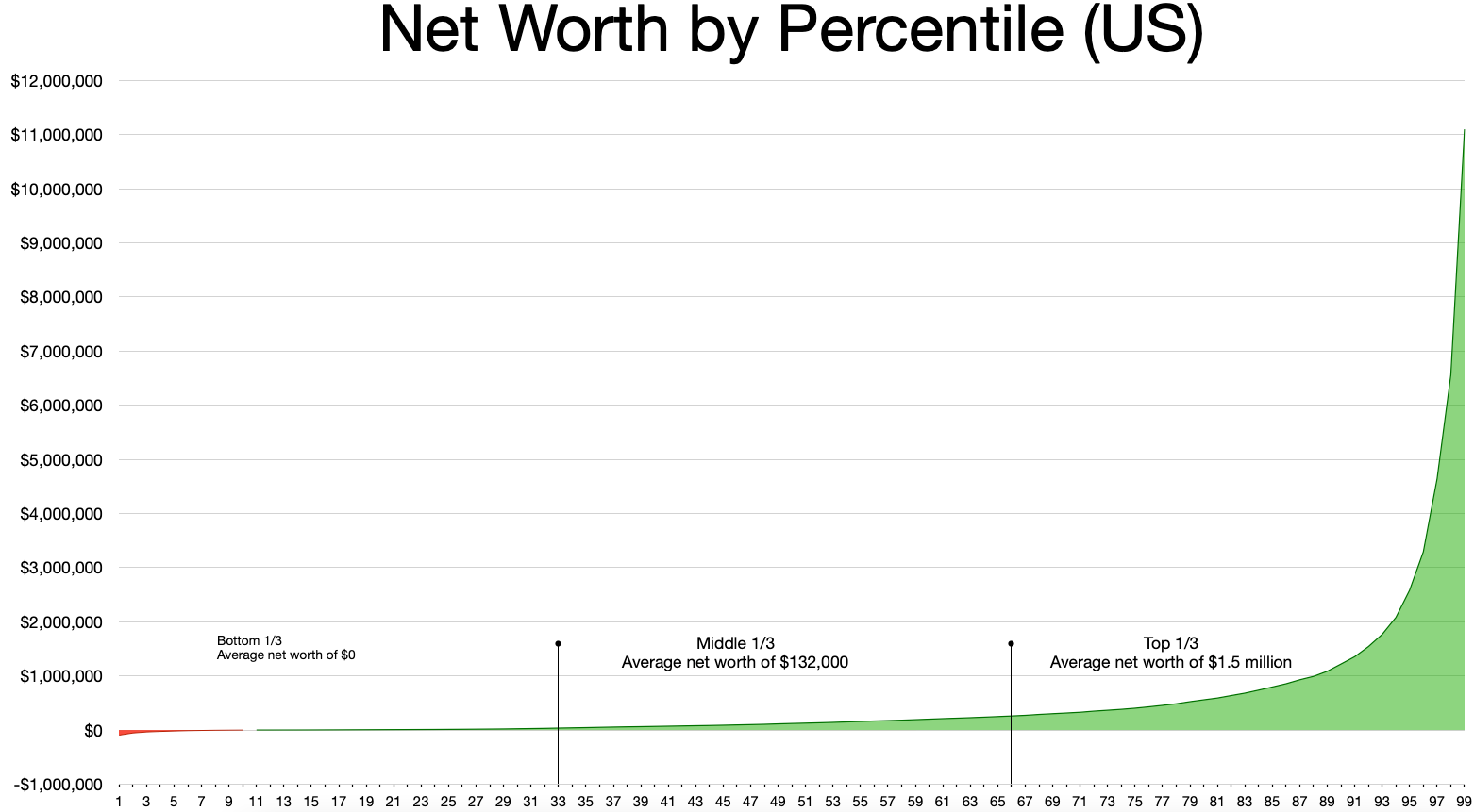
Wealth in the United States is heavily skewed toward top-tier brackets, creating a substantial difference between the median household net worth and high-percentile tiers.
To put a $3.8 million net worth into national context:
- 50th Percentile (Median): The median U.S. household net worth sits around $192,900. A household with $3.8 million possesses nearly 20 times the wealth of the average American household.
- 90th Percentile: The threshold for the top 10% of American households begins at approximately $1.9 million. A $3.8 million balance sheet is double the entry requirement for the top decile.
- 95th Percentile: Sitting at approximately $3.8 million, this group comprises successful business owners, senior executives, long-term real estate investors, and high-earning professionals with decades of compound investment growth.
- 99th Percentile (Top 1%): The entry point for the top 1% of U.S. households exceeds $13.5 million to $14 million.
While the gap between the median household and the 95th percentile is wide, the jump from the 95th percentile to the top 1% is even steeper. The 95th percentile represents upper-middle-class to high-net-worth affluent status, whereas the top 1% represents institutional levels of wealth.
Net Worth Percentiles by Age Group
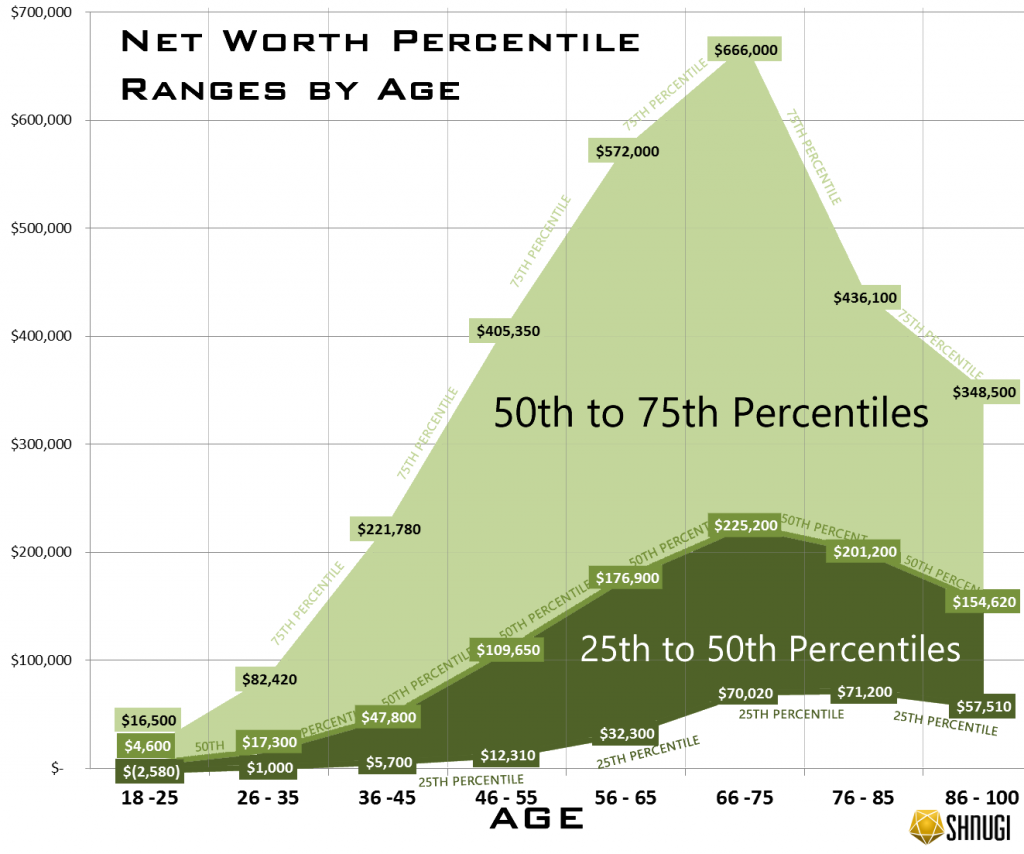
Net worth is strongly correlated with age and career progression. Younger households naturally hold lower net worth due to fewer years of earnings, student debt, and lower asset appreciation. Conversely, older households peak in net worth near retirement age as home equity accumulates and tax-advantaged retirement accounts compound over decades.
Holding a $3.8 million net worth carries vastly different implications depending on whether the household head is 32 or 67 years old. For a household under age 35, $3.8 million is well above the 99th percentile for that age cohort. For households aged 55 to 64, $3.8 million aligns closely with the overall 95th percentile benchmark.
The following table outlines estimated U.S. household net worth thresholds across key percentiles, adjusted for age brackets based on Federal Reserve wealth distribution studies.
| Age Bracket | 50th Percentile (Median) | 90th Percentile | 95th Percentile | 99th Percentile (Top 1%) |
|---|---|---|---|---|
| Under 35 | $39,000 | $260,000 | $800,000 | $3,500,000 |
| 35 – 44 | $135,000 | $900,000 | $2,200,000 | $6,500,000 |
| 45 – 54 | $247,000 | $1,750,000 | $4,500,000 | $12,000,000 |
| 55 – 64 | $364,000 | $2,600,000 | $5,400,000 | $15,800,000 |
| 65 – 74 | $410,000 | $2,800,000 | $5,100,000 | $14,900,000 |
| 75+ | $335,000 | $2,400,000 | $4,200,000 | $11,500,000 |
Data compiled from Federal Reserve Survey of Consumer Finances baseline distributions and demographic analytical models.
As shown above, achieving a $3.8 million net worth prior to age 45 places an individual in the top 1% to 2% of their age cohort. By contrast, reaching $3.8 million in the 55–64 bracket represents the standard 95th percentile threshold, serving as a comfortable cushion for full retirement.
Asset Composition of a $3.8 Million Portfolio
The structural breakdown of a $3.8 million balance sheet determines how resilient, liquid, and tax-efficient that wealth actually is. High-net-worth households in the 95th percentile rarely hold their capital in a single asset class. Instead, their balance sheets reflect a combination of real estate equity, paper assets, private business equity, and cash equivalents.
| Asset Class | Allocation | Value |
|---|---|---|
| Taxable Brokerage & Stocks | 35% | $1,330,000 |
| Primary Residence & Real Estate Equity | 25% | $950,000 |
| Tax-Deferred Retirement Accounts | 20% | $760,000 |
| Business Equity / Private Holdings | 12% | $456,000 |
| Cash & Liquid Money Market Reserves | 8% | $304,000 |
1. Primary and Investment Real Estate
For many 95th-percentile households, real estate accounts for 20% to 35% of total net worth. This includes home equity in a primary residence alongside rental properties or commercial real estate. While real estate provides inflation protection and tax benefits through depreciation, primary residence equity does not generate cash flow to cover daily living expenses unless downsized or monetized.
2. Taxable Brokerage Accounts
High earners frequently max out annual contributions to tax-advantaged accounts early in their careers. Consequently, a large portion of a $3.8 million balance sheet typically resides in taxable individual or joint brokerage accounts invested in low-cost broad-market index funds, individual stocks, municipal bonds, and exchange-traded funds (ETFs). Taxable accounts provide maximum liquidity without early withdrawal penalties.
3. Tax-Advantaged Retirement Plans
Accounts such as Traditional 401(k)s, Roth 401(k)s, SEP-IRAs, and traditional IRAs form the foundation of long-term tax deferral. In a $3.8 million portfolio, retirement accounts often comprise $500,000 to $1.2 million. However, balances held within traditional non-Roth retirement accounts carry an embedded future tax liability, as withdrawals are taxed at ordinary income tax rates during retirement.
4. Private Business Equity and Illiquid Assets
Many business owners and corporate executives enter the 95th percentile through equity ownership in private companies, private equity funds, or equity-based compensation like Restricted Stock Units (RSUs) and stock options. While business equity can offer high appreciation potential, it is highly illiquid compared to publicly traded stocks.
Liquid vs. Illiquid Net Worth: The Financial Independence Reality
A common misconception is that a $3.8 million net worth automatically translates into unlimited liquid cash. The financial reality of a household depends heavily on asset liquidity and the annual cash flow those assets generate.
Calculating Spendable Income with the 4% Rule
To determine how much annual income a $3.8 million portfolio can generate without eroding the principal, financial planners frequently utilize safe withdrawal rate models, such as the 4% Rule derived from the historic Trinity Study.
However, the 4% rule applies only to investable assets (liquid stocks, bonds, and cash), not home equity or personal property.
- Scenario A (High Real Estate Allocation): A household has $3.8 million net worth, but $1.8 million is tied up in a primary residence equity and paid-off luxury vehicles, leaving $2.0 million in investable liquid assets. $$\text{Annual Income (4% of $2.0M)} = $80,000 \text{ pre-tax}$$
- Scenario B (High Liquid Allocation): A household has $3.8 million net worth, with $800,000 in home equity and $3.0 million in liquid brokerage and retirement accounts. $$\text{Annual Income (4% of $3.0M)} = $120,000 \text{ pre-tax}$$
As illustrated, a household with $3.0 million in investable capital enjoys far greater spending flexibility and retirement readiness than a household with an identical $3.8 million net worth locked inside real estate.
Geographic Impact on Purchasing Power
The lifestyle afforded by $3.8 million is also heavily governed by location. Inflationary trends, local property taxes, and regional housing markets create stark contrasts:
- High-Cost-of-Living (HCOL) Areas: In metropolitan areas like San Francisco, New York City, or Boston, a single-family home can cost between $1.5 million and $2.5 million. In these markets, $3.8 million provides a solid upper-middle-class retirement, but high state income taxes and real estate costs prevent excessive luxury spending.
- Low-to-Medium Cost-of-Living (LCOL/MCOL) Areas: In cities across the Midwest or Sunbelt, a comfortable home may cost $500,000. Here, a $3.8 million net worth yields substantial financial freedom, allowing low debt burdens, early retirement, and capital preservation.
Tax Implications and Wealth Preservation Strategies
Managing a $3.8 million portfolio requires ongoing tax management. Without deliberate estate and income tax planning, wealth can suffer significant friction from capital gains taxes, high federal income tax brackets, and state-level estate taxes.
Federal and State Estate Taxes
At the federal level, the individual estate tax exemption threshold remains significantly above $3.8 million (with single and married thresholds indexed for inflation under federal tax law). Consequently, a $3.8 million net worth is generally not subject to federal estate tax liabilities upon death.
However, state-level estate taxes and inheritance taxes present a different situation. Several U.S. states enforce state estate tax exemptions that kick in at thresholds as low as $1 million to $4 million. High-net-worth residents in states like Massachusetts, Oregon, Washington, or New York must structure their asset transfers carefully using trusts to mitigate state-level tax exposure. For governing regulations on federal estate tax provisions, individuals can reference official policy guidelines directly from the Internal Revenue Service (IRS).
Income and Capital Gains Optimization
Households at the 95th percentile often fall into higher federal income tax brackets (32% or 35%). Preserving wealth requires executing specific tax strategies:
- Tax-Loss Harvesting: Realizing capital losses in taxable brokerage accounts to offset capital gains and up to $3,000 of ordinary income annually.
- Asset Location Strategy: Holding tax-inefficient investments (such as high-yield dividend funds or real estate investment trusts) inside tax-deferred accounts (401k/IRA), while placing tax-efficient index funds in taxable accounts.
- Step-Up in Basis Utilization: Capital gains taxes on appreciated assets (like stocks or real estate) held until death are mitigated through a step-up in cost basis, which resets the tax basis to the asset's fair market value at the date of the owner's death.
Actionable Steps for Households at or Approaching the 95th Percentile
Reaching or sustaining a $3.8 million net worth requires shifting focus from pure wealth accumulation to capital preservation, risk management, and tax-efficient drawdown strategies.
- RISK & LIABILITY PROTECTION
- Acquire $3M - $5M Personal Umbrella Policy
- Review Property & Casualty Limits
- ASSET LIQUIDITY & ALLOCATION
- Maintain 12-24 Months Cash Reserve
- Rebalance Equities vs. Fixed Income
- ESTATE & INFRASTRUCTURE PLANNING
- Establish Revocable Living Trusts
- Assign Power of Attorney & Healthcare
Step 1: Secure Comprehensive Liability and Umbrella Insurance
As net worth grows, personal exposure to legal liability increases. Standard homeowners and auto insurance policies usually cap liability coverage at $300,000 to $500,000.
A high-net-worth household should secure a personal liability umbrella insurance policy worth $3 million to $5 million. Umbrella policies extend liability protection above underlying home and auto policies, safeguarding accumulated assets against catastrophic lawsuits or personal injury judgments for a relatively low annual premium.
Step 2: Transition from Accumulation to Distribution Planning
If retirement is within 5 to 10 years, managing sequence-of-returns risk becomes essential. A market downturn during the first few years of retirement can permanently damage a liquid portfolio's longevity.
To mitigate this risk:
- Maintain a short-term cash liquidity bucket containing 1 to 2 years of living expenses in money market funds or short-term U.S. Treasury bills. U.S. economic and wage statistics monitored by the Bureau of Labor Statistics show how inflation affects real purchasing power, highlighting the importance of holding high-yielding cash equivalents rather than non-earning accounts.
- Establish a fixed-income ladder (bonds or CDs) covering an additional 3 to 5 years of cash needs.
- Keep the remaining capital in diversified equity funds to outpace long-term inflation.
Step 3: Establish a Modern Estate Plan
Relying solely on a simple will is often inadequate for complex estates. A complete estate planning package for a $3.8 million balance sheet should include:
- Revocable Living Trust: Transfers real estate and financial accounts to beneficiaries without undergoing lengthy, expensive public probate court proceedings.
- Durable Power of Attorney & Healthcare Directives: Designates trusted agents to manage legal, financial, and medical decisions in the event of cognitive decline or physical incapacitation.
- Beneficiary Designation Review: Ensures primary and contingent beneficiary listings on 401(k)s, IRAs, and life insurance policies match current intentions, as beneficiary forms supersede instructions in a will.
Frequently Asked Questions
Does a $3.8 million net worth make you rich in the U.S.?
Yes. A $3.8 million net worth places a household in the 95th percentile of American wealth, meaning it has more wealth than 95% of U.S. families. However, whether that feels "rich" depends heavily on asset liquidity, debt levels, regional cost of living, and personal spending habits.
Is $3.8 million enough to retire at any age?
Retiring on $3.8 million depends on annual expenses and liquid portfolio composition. Using a standard 4% withdrawal rate on a $3.0 million liquid portfolio generates roughly $120,000 annually before taxes. If your annual household expenses are below this threshold, early retirement is feasible. If a large portion of the $3.8 million is locked in illiquid real estate or personal property, additional liquid income planning is required.
What is the median U.S. net worth compared to the 95th percentile?
According to Federal Reserve wealth data, the median U.S. household net worth sits around $192,900, while the 95th percentile threshold is approximately $3.8 million. This means a 95th-percentile household possesses nearly 20 times the asset value of the average American household.
How much liquid cash should a high-net-worth household keep?
Most financial advisors recommend keeping 3 to 12 months of living expenses in liquid cash reserves for active earners, and 12 to 24 months of living expenses for retirees. For a $3.8 million portfolio, holding $100,000 to $300,000 in high-yield savings, short-term Treasuries, or money market funds ensures liquidity without sacrificing too much long-term growth.
Do households with $3.8 million pay federal estate taxes?
No. Under current federal tax laws, the federal estate tax exemption threshold remains well above $3.8 million per individual. However, state-level estate taxes exist in several states (such as New York, Massachusetts, and Oregon) with much lower exemptions, which may require local trust and estate planning.
Final Guidance: Maximizing a 95th-Percentile Net Worth
Reaching a $3.8 million net worth puts a household in the top 5% of wealth in the United States. However, wealth preservation requires moving beyond simple accumulation toward comprehensive balance sheet management:
- Audit your liquidity ratio: Calculate how much of your $3.8 million resides in liquid investable assets versus primary home equity and illiquid holdings.
- Optimize your tax structure: Coordinate across taxable, tax-deferred, and tax-free accounts to minimize annual income tax drag and prepare for state-level estate regulations.
- Protect your downside: Ensure your liability coverage matches your net worth through an updated umbrella insurance policy, and structure core real estate assets within revocable trusts.
Working with a fee-only certified financial planner (CFP) and a qualified estate planning attorney can help align a $3.8 million portfolio with long-term lifestyle goals, legacy planning, and sustainable financial independence.