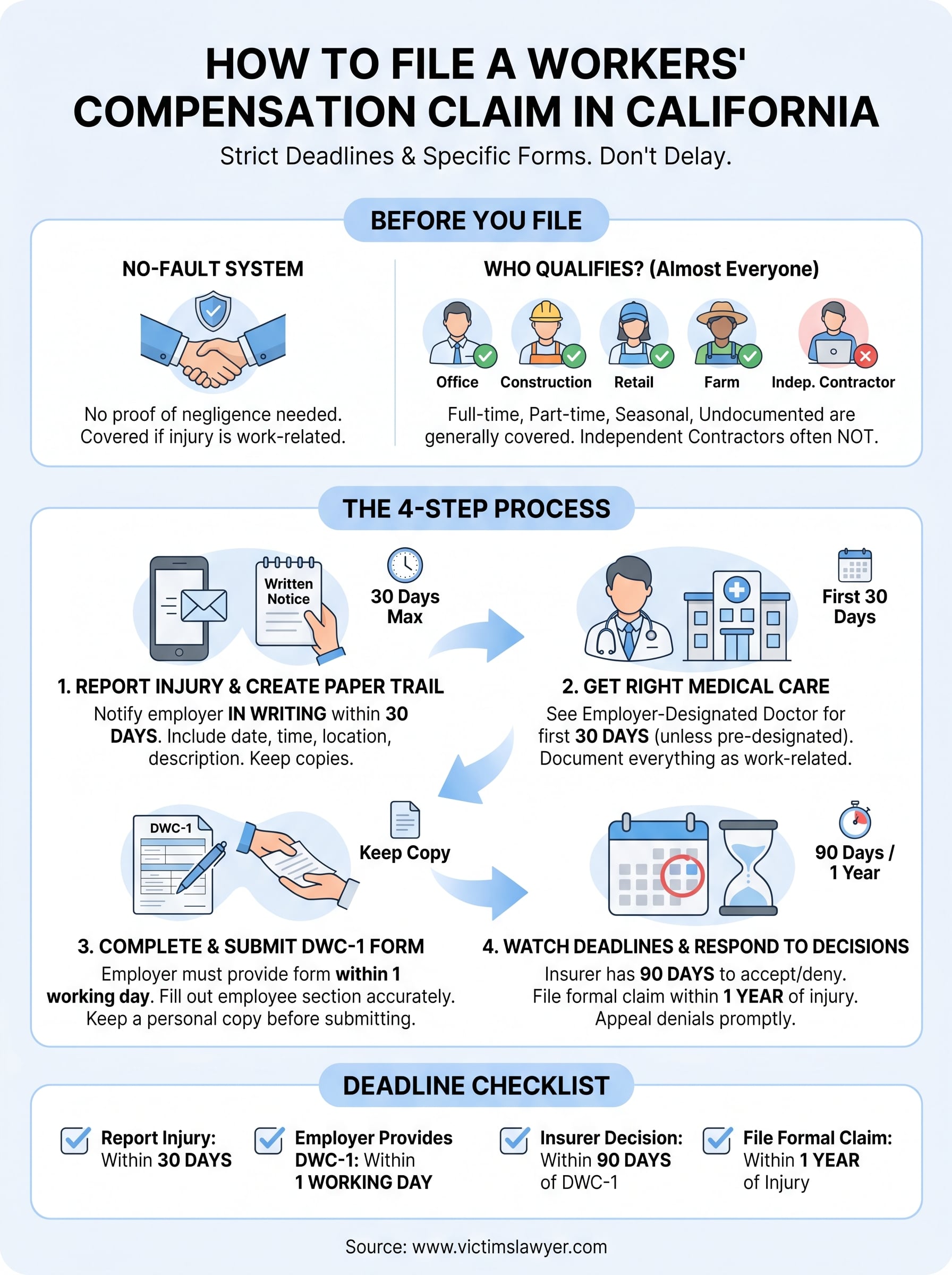
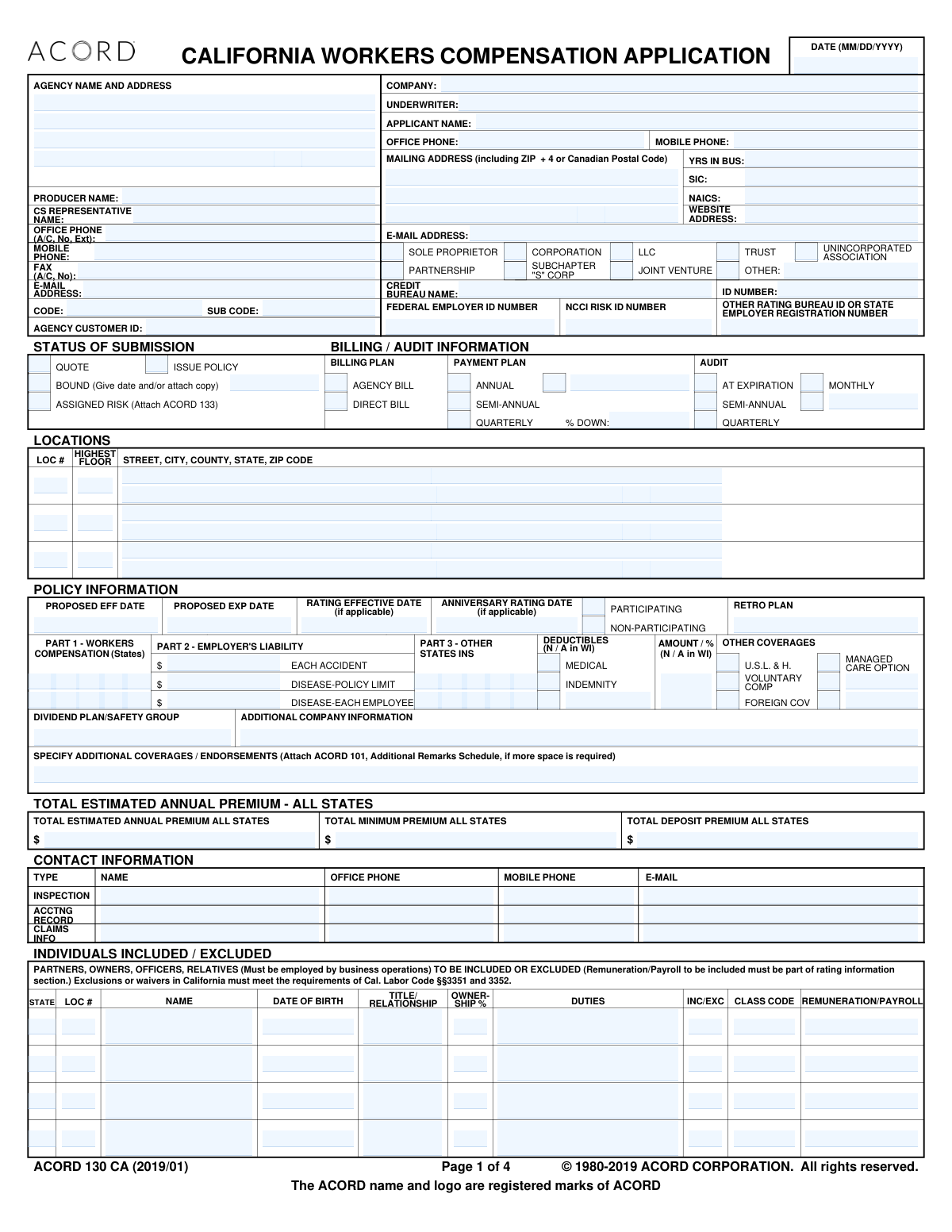
California workers' compensation travel claim forms allow injured workers to request reimbursement for transportation costs incurred while attending medical treatment, diagnostic testing, physical therapy, and required legal proceedings. For medical travel occurring in calendar year 2014, California established an official statutory reimbursement rate of $0.56 per mile. Claimants must submit an itemized mileage log detailing appointment dates, destination addresses, round-trip distances, and out-of-pocket expenses directly to the workers' compensation claims administrator.
Disclaimer: This article is for informational and educational purposes only and does not constitute formal legal or financial advice. Workers' compensation laws and administrative regulations are subject to specific statutory deadlines and judicial interpretations. For guidance on a specific legal claim, consult a qualified California workers' compensation attorney or an Information & Assistance (I&A) officer at the Division of Workers' Compensation (DWC).
1. Legal Basis for Medical Travel Reimbursement in California
Under California Labor Code Section 4600, employers are legally obligated to provide all medical, surgical, chiropractic, and hospital treatment reasonably required to cure or relieve the effects of an industrial injury. A critical component of this medical mandate is the reimbursement of reasonable travel expenses incurred by the employee to obtain treatment or undergo examination.
Travel reimbursement is not restricted solely to primary care physician visits. Injured employees are entitled to claim transportation expenses for a wide variety of medically related trips, including:
- Primary Care & Specialist Appointments: Visits to treating physicians, orthopedic surgeons, neurologists, and other authorized specialists within the Medical Provider Network (MPN) or Health Care Organization (HCO).
- Physical Therapy & Rehabilitation: Mandatory rehabilitation sessions, occupational therapy, and chiropractic appointments.
- Diagnostic Testing Services: Trips to imaging centers, laboratories, and diagnostic facilities for X-rays, MRIs, blood tests, or electromyograms (EMGs).
- Prescription Pickups: Travel to and from pharmacies to retrieve authorized medications, provided reasonable local options are utilized.
- Medical Evaluator Examinations: Mandatory trips to Qualified Medical Evaluators (QMEs) or Agreed Medical Evaluators (AMEs) assigned to assess permanent disability, apportionment, or treatment disputes.
- Legal Depositions (Labor Code § 5710): Travel to formal depositions noticed by the claims administrator or defense counsel, including meal allowances or lodging when extensive travel is required.
The Historic 2014 Mileage Rate Rule
Under California Labor Code Section 4600(e)(2), the medical mileage reimbursement rate for workers' compensation is tied directly to the rate authorized for California state employees, which mirrors the standard business mileage rate set by the Internal Revenue Service (IRS).
For travel that took place between January 1, 2014, and December 31, 2014, the approved statutory mileage reimbursement rate was $0.56 (56 cents) per mile.
A critical legal principle governs retroactive or delayed submissions: The mileage rate applied to a travel claim depends entirely on the actual date the travel occurred, not the date the form is filled out or submitted. For example, if an injured worker traveled to physical therapy in November 2014 but did not submit the travel log until a later date, the reimbursement rate for those specific 2014 trips remains fixed at $0.56 per mile.
2. Standard DWC Travel Claim Forms and Required Elements
The Division of Workers' Compensation (DWC) provides an official template commonly known as the Medical Mileage Expense Account form (often referenced informally as the DWC mileage reimbursement sheet). While insurance carriers, third-party administrators (TPAs), and self-insured employers frequently print custom logos on their own version of this form, the legal information required remains standardized across California.
An injured worker is not strictly required to use a carrier’s proprietary form. Under California administrative practice, any legible, written log containing all statutory data fields constitutes a valid itemized statement.
SAMPLE DWC MEDICAL MILEAGE LOG STRUCTURE
Injured Worker: Jane Doe | Claim Number: W-1234567-2014Employer Name: Example Corp | Adjuster Name: John Smith
| Date | Provider / Destination | Street Address (To/From) | Miles | Tolls/Pk |
|---|---|---|---|---|
| 03/15/2014 | Dr. Smith (Treating) | 123 Main St -> 456 Med Center Dr, Los Angeles | 24.0 | $5.00 |
| 03/18/2014 | Physical Therapy Center | 123 Main St -> 789 Rehab Way, Glendale, CA | 12.5 | $0.00 |
Essential Fields Required on the Claim Form
To avoid processing delays or formal objections from claims adjusters, every completed travel form must contain the following core information:
- Claim Identification: The injured worker's full legal name, date of injury, employer name, and the specific workers' compensation insurance claim number.
- Date of Each Trip: The exact calendar day (MM/DD/YYYY) on which the travel occurred.
- Medical Provider or Destination Name: The name of the physician, facility, physical therapy clinic, or diagnostic center visited.
- Complete Origin and Destination Addresses: Full physical street addresses, including city and zip code, for both the starting point (usually the employee’s residence) and the destination.
- Purpose of Travel: A concise notation explaining the medical necessity (e.g., "Follow-up examination," "Lumbar MRI," "Prescription refill").
- Round-Trip Distance: The total round-trip distance traveled, recorded in miles (or tenths of a mile).
- Associated Travel Expenses: Out-of-pocket costs directly connected to the medical trip, such as bridge tolls, highway turnpike fees, and parking garage fees.
- Total Calculation: The mathematical subtotal of total miles multiplied by the applicable rate for that date of service, plus any attached out-of-pocket expenses.
- Claimant Signature and Date: A signed declaration by the injured worker attesting that the entries are accurate and represent actual travel required for industrial injury treatment.
3. Step-by-Step Instructions: Completing and Submitting the Claim
Filing a travel reimbursement claim requires meticulous documentation. Claims adjusters routinely audit distance calculations against standardized mapping software. Following a structured procedure helps ensure full reimbursement without administrative friction.
- Step 1: Log Appointments: Track date, doctor, and exact physical addresses.
- Step 2: Calculate Distance: Verify shortest practical route using mapping software.
- Step 3: Attach Receipts: Secure original parking stubs and toll receipts.
- Step 4: Perform Math: Multiply miles by historical rate (e.g., $0.56).
- Step 5: Submit & Retain: Send via trackable method; keep exact copies.
Step 1: Verify Medical Necessity and Appointment Log
Before adding a trip to the claim sheet, verify that the medical visit was authorized or legally required. Attendance at authorized treating physician appointments, QME/AME evaluations, and prescribed therapy sessions is fully covered.
Note regarding pharmacy trips: California workers' compensation rules expect injured workers to utilize reasonable, local pharmacies. If an employee travels excessive distances (e.g., 30 miles) to pick up medication when a participating network pharmacy is located within 2 to 5 miles, claims adjusters may reduce or dispute the mileage for the excess distance unless medical necessity for that specific pharmacy is documented.
Step 2: Calculate Accurate Mileage via Shortest Driving Route
Insurance carriers evaluate mileage using standard online route mapping utilities (such as Google Maps or MapQuest) calculating the shortest practical driving route.
- Do not round up mileage arbitrarily. Record distances to the nearest tenth of a mile if applicable.
- If road construction, detours, or severe traffic forced an alternate route that increased total mileage, attach a brief explanatory note to the claim form.
Step 3: Apply the Historical Mileage Rate Calculation
Calculate reimbursement based on the specific year the trip occurred. If filling out forms for historical travel, calculate each line item using that year's designated rate.
$$\text{Mileage Reimbursement} = \text{Total Authorized Miles} \times \text{Applicable Yearly Rate}$$
Example 2014 Calculation:
- Trip Date: October 12, 2014
- Round-trip distance: 42.4 miles
- 2014 Statutory Rate: $0.56 / mile
- $42.4 \text{ miles} \times $0.56 = $23.744 \rightarrow $23.74$
- Add Parking Receipt: $8.00
- Total Line Item Reimbursement: $31.74
Step 4: Attach Required Original Receipts
Out-of-pocket expenses beyond vehicle mileage—specifically parking meters, parking structure passes, public transit fares, and bridge tolls—require verifiable receipts.
- Tape parking stubs and toll receipts to a blank sheet of paper attached to the claim form.
- If electronic tolling systems (e.g., FasTrak) were used, print an itemized statement highlighting the specific toll transaction, time, and location corresponding to the medical appointment.
Step 5: Transmit the Claim and Establish Proof of Service
Always retain a complete copy of the signed mileage log and attached receipts for personal records before submitting. Send the document to the claims administrator using a verifiable delivery method:
- Certified Mail with Return Receipt Requested: Provides definitive legal proof of delivery date.
- Trackable Fax: Retain the full fax transmission confirmation page indicating successful transmission of all pages.
- Encrypted Email: Request a read receipt or secure confirmation from the assigned claims adjuster.
4. Historical vs. Current California Workers' Comp Mileage Rates
Reimbursement rates change periodically based on IRS cost-of-living and fuel adjustment determinations. The table below outlines historical mileage rates under California Labor Code Section 4600 from 2012 through recent years, illustrating how rates fluctuate over time.
| Calendar Year / Effective Dates | Statutory Mileage Rate (Per Mile) | Regulatory Basis |
|---|---|---|
| Jan 1, 2012 – Dec 31, 2012 | $0.555 (55.5 cents) | CalHR / IRS Standard Rate |
| Jan 1, 2013 – Dec 31, 2013 | $0.565 (56.5 cents) | CalHR / IRS Standard Rate |
| Jan 1, 2014 – Dec 31, 2014 | $0.560 (56.0 cents) | CalHR / IRS Standard Rate |
| Jan 1, 2015 – Dec 31, 2015 | $0.575 (57.5 cents) | CalHR / IRS Standard Rate |
| Jan 1, 2016 – Dec 31, 2016 | $0.540 (54.0 cents) | CalHR / IRS Standard Rate |
| Jan 1, 2017 – Dec 31, 2017 | $0.535 (53.5 cents) | CalHR / IRS Standard Rate |
| Jan 1, 2018 – Dec 31, 2018 | $0.545 (54.5 cents) | CalHR / IRS Standard Rate |
| Jan 1, 2019 – Dec 31, 2019 | $0.580 (58.0 cents) | CalHR / IRS Standard Rate |
| Jan 1, 2020 – Dec 31, 2020 | $0.575 (57.5 cents) | CalHR / IRS Standard Rate |
| Jan 1, 2021 – Dec 31, 2021 | $0.560 (56.0 cents) | CalHR / IRS Standard Rate |
| Jan 1, 2022 – Jun 30, 2022 | $0.585 (58.5 cents) | CalHR Mid-Year Base Rate |
| Jul 1, 2022 – Dec 31, 2022 | $0.625 (62.5 cents) | Special IRS Mid-Year Inflation Adjustment |
| Jan 1, 2023 – Dec 31, 2023 | $0.655 (65.5 cents) | CalHR / IRS Standard Rate |
| Jan 1, 2024 – Dec 31, 2024 | $0.670 (67.0 cents) | CalHR / IRS Standard Rate |
| Jan 1, 2025 – Dec 31, 2025 | $0.685 (68.5 cents) | CalHR / IRS Standard Rate |
| Jan 1, 2026 – Present | Current Statutory Standard Rate | CalHR / IRS Standard Rate |
Crucial Takeaway: When filling out a retroactive mileage log covering multiple years, each trip date must be multiplied by the specific rate applicable to that year. Do not apply a single uniform rate across multi-year claim logs.
5. Statutory Timelines, Payment Deadlines, and Penalties
California enforcement rules establish clear timelines for claims administrators processing medical expense reimbursements.
The 45-Day Payment Rule
Under California Labor Code Section 4603.2(b)(1) and California Code of Regulations Title 8, Section 9792.5, claims administrators have 45 calendar days from the date of receiving an itemized, documented travel reimbursement request to issue full payment.
If the claims administrator is a governmental self-insured entity (such as a municipality or public school district), the statutory payment window extends to 60 calendar days.
Late Payment Penalties and Interest
If the claims administrator fails to pay a valid travel reimbursement within the statutory time window without issuing a timely formal objection, legal penalties automatically attach:
- 10% Statutory Penalty: An automatic 10% penalty is added to the principal unpaid amount.
- 7% Annual Interest: Interest accrues at a rate of 7% per annum on the unpaid balance, calculated retroactively from the date the reimbursement originally became due under Labor Code Section 5800.
If an insurer repeatedly fails to reimburse travel claims without reasonable legal grounds, the injured worker or their attorney may file a petition for administrative penalties under California Labor Code Section 5814, which can assess severe monetary sanctions against the insurer for unreasonable delay or refusal of compensation benefits.
6. Common Mistakes Leading to Claim Denials or Delays
Travel claim forms are subject to frequent administrative scrutiny. Avoiding common reporting mistakes ensures smooth processing and prompt payment:
- Applying the current year's rate to historic travel dates (e.g., 2014 trips).
- Listing broad city names instead of exact street-level addresses.
- Omitting parking/toll receipts required for reimbursement validation.
- Claiming travel to non-covered locations (e.g., attorney consultations).
- Delaying submission past reasonable reporting intervals.
Applying the Incorrect Year's Rate
The most widespread mistake on historical forms is applying the current calendar year's mileage rate to older trips. Adjusters will reject or recalculate the entire submission if 2014 trips are miscalculated using current rates, forcing administrative delays.
Incomplete or Vague Destination Addresses
Writing "Doctor visit in Los Angeles" or "Therapy clinic" without complete street numbers, street names, and zip codes is a primary reason forms are returned unpaid. Claims software relies on precise street addresses to verify mileage routes automatically.
Claiming Travel to Attorney Offices
Travel to consult with personal workers' compensation attorneys, legal representatives, or union halls is not reimbursable under Labor Code Section 4600. The only legal travel exception involves attending a formal deposition requested by the employer's defense attorney under Labor Code Section 5710.
Missing Out-of-Pocket Receipts
Claiming $15.00 in parking fees without attaching an itemized parking ticket or electronic receipt will result in partial payment. The adjuster will typically pay the calculated vehicle mileage while striking out unverified out-of-pocket expenses.
7. Resolving Disputed, Rejected, or Late Travel Claims
When a claims adjuster denies a travel expense, reduces the claimed mileage, or ignores a submission entirely, injured workers have formal recourse through the California Workers' Compensation Appeals Board (WCAB).
- Step 1: Request Explanation of Review (EOR) to determine denial cause.
- Step 2: Issue formal written demand letter citing LC § 4603.2 penalties.
- Step 3: Consult DWC Information & Assistance (I&A) Officer for guidance.
- Step 4: File Declaration of Readiness to Proceed (DOR) for a hearing.
1. Request an Explanation of Review (EOR)
If a mileage payment arrives for an amount lower than submitted, the insurer is legally required to provide an Explanation of Review (EOR). This document details precisely which trips were reduced, denied, or adjusted, along with the statutory procedure code for the objection.
2. Issue a Formal Written Demand Letter
If 45 days pass without payment or communication, submit a formal written demand letter to the claims adjuster. Attach a copy of the original travel form, proof of original delivery (e.g., certified mail receipt), and an itemized breakdown of the 10% penalty and 7% interest owed under Labor Code Section 4603.2.
3. Seek Guidance from an Information & Assistance (I&A) Officer
Unrepresented injured workers can contact their local Division of Workers' Compensation Information & Assistance (I&A) office. I&A officers provide free regulatory guidance, help review rejected travel logs, and frequently contact claims adjusters directly to resolve administrative impasses.
4. File a Declaration of Readiness to Proceed (DOR)
If the insurer refuses to pay valid travel expenses, an applicant (or their legal counsel) can file a Declaration of Readiness to Proceed (DOR) to request a formal trial or Mandatory Settlement Conference (MSC) before a Workers' Compensation Administrative Law Judge (WCALJ).
Frequently Asked Questions
Can I claim travel mileage in California for medical visits that occurred back in 2014?
Yes, provided your workers' compensation claim remains open or within an active statutory timeframe, you can submit travel logs for historic medical visits. However, all trips conducted in calendar year 2014 must be calculated at the historical rate of $0.56 per mile, rather than current mileage rates.
Are trips to the pharmacy reimbursable on California travel forms?
Yes. Travel to pick up authorized prescription medications or medical supplies prescribed for your industrial injury is reimbursable. However, you must utilize local participating pharmacies. Submitting travel for excessive distances to distant specialty pharmacies without documented medical authorization may result in partial claim denials.
How long does an insurance company have to pay a submitted mileage claim?
Under California Labor Code Section 4603.2, non-governmental claims administrators have 45 calendar days from the date of receiving an itemized claim to issue payment. Public entities have 60 calendar days. Late payments accrue an automatic 10% penalty plus 7% annual interest.
Can I claim travel expenses if I used public transit or ride-share services instead of driving my own vehicle?
Yes. If you used bus, train, taxi, or ride-sharing services (such as Uber or Lyft) to attend authorized medical appointments, you are entitled to full reimbursement of actual transit fares. You must attach receipts or transit payment logs proving the out-of-pocket costs incurred.
Is travel to meet with my workers' compensation attorney reimbursable?
No. California law does not require workers' compensation insurance carriers to pay for travel expenses to meet with your attorney. Travel is only reimbursable for medical treatment, medical evaluations (QME/AME), diagnostic testing, physical therapy, and defense-noticed depositions under Labor Code Section 5710.
Practical Next Steps for Injured Workers
To ensure accurate payment and avoid processing delays with your workers' compensation travel claim forms:
- Maintain a Running Travel Log: Keep a dedicated notebook or digital log in your vehicle to record odometer readings, destination addresses, doctor names, and appointment dates immediately after each visit.
- Organize Physical Receipts: Keep a dedicated envelope for all parking stubs, bridge toll records, and transit receipts.
- Audit Historical Rates: Verify that your travel form applies the correct historic rate based on the year of service ($0.56/mile for 2014 trips) rather than applying modern rates across past calendar years.
- Submit Regularly: Submit completed mileage forms every 30 to 60 days rather than accumulating months of travel. Regular submissions maintain predictable reimbursement cycles.
- Use Trackable Delivery: Always send forms using certified mail or trackable fax to establish undeniable proof of service for the statutory 45-day payment countdown.