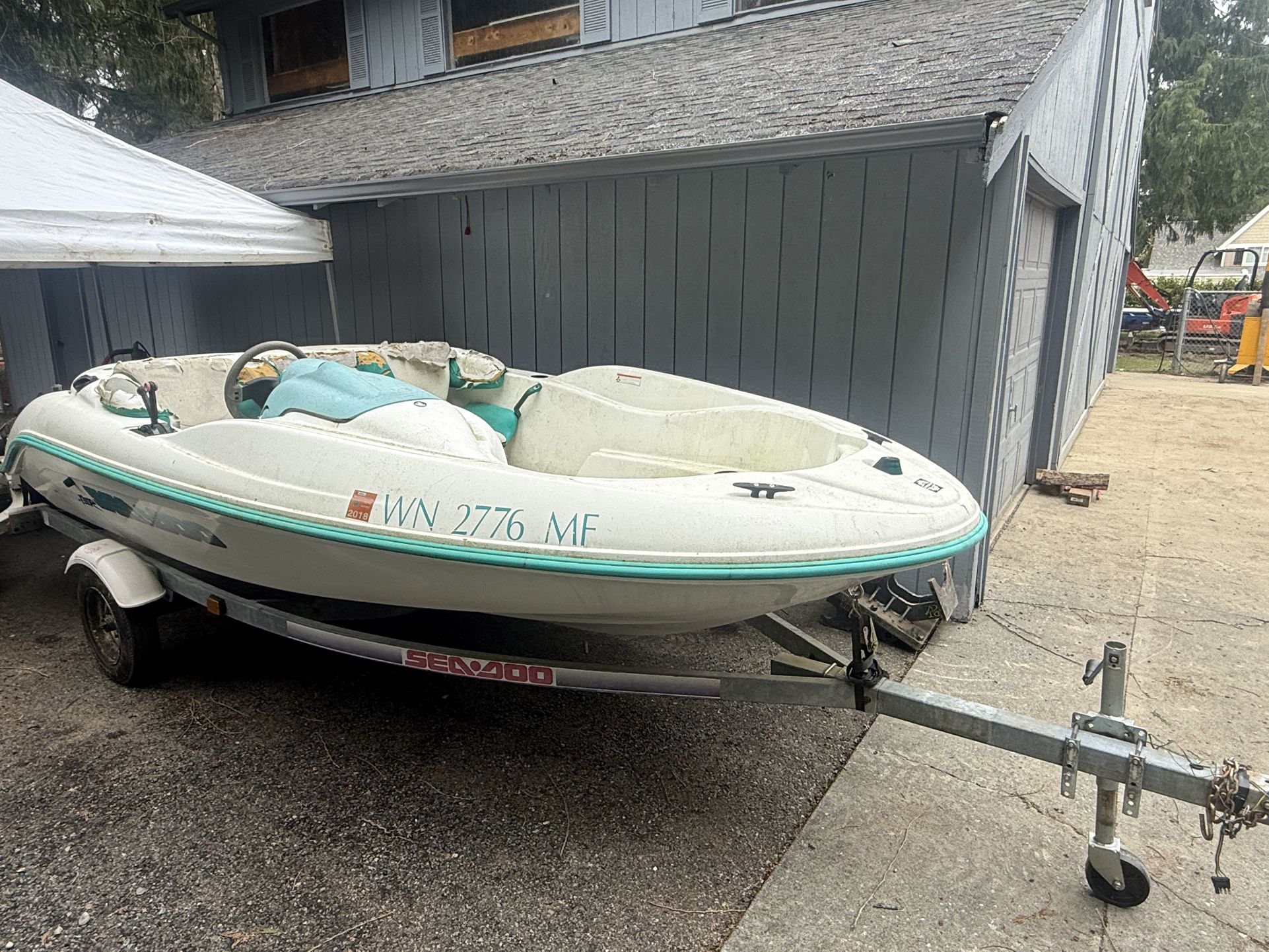
The 1997 Sea-Doo Sportster is a 14.5-foot jet-powered runabout designed for high-agility recreation and entry-level watersports. Powered by a single 85-horsepower Rotax 717 two-stroke engine, it offers a blend of personal watercraft (PWC) maneuverability and traditional boat seating for up to four passengers. It remains a popular choice on the used market due to its mechanical simplicity and iconic 1990s styling.
In the evolution of marine recreation, few vessels capture the transition from individual personal watercraft to family-oriented jet boats as effectively as the 1997 Sea-Doo Sportster. Produced by Bombardier Recreational Products (BRP), this model was part of a strategic push to dominate the "pocket rocket" segment of the boating industry. As we look at this craft from the perspective of 2026, it has solidified its status as a vintage classic, appealing to enthusiasts who value tactile mechanical feedback and the raw performance of two-stroke engineering over the computerized complexity of modern four-stroke jet boats.
Historical Context and Design Philosophy
By 1997, Sea-Doo had already established itself as a leader in the PWC market. The Sportster was designed to bridge the gap between their high-performance PWCs and their larger twin-engine boats like the Speedster or the more luxurious Challenger. The design philosophy was centered on "accessible thrills." Bombardier wanted to provide a vessel that could be towed by a standard sedan or small SUV, stored in a conventional garage, and operated with the same intuitive ease as a jet ski, yet still provide enough space for a small group of friends.
The 1997 model year was particularly significant because it represented a peak in two-stroke reliability. The Rotax engines of this era were well-refined, and the fiberglass hull designs had moved past the experimental stages of the early 90s. The Sportster’s hull featured a deep-V design that allowed it to slice through moderate chop better than many of its contemporaries, though its short length and light weight meant it remained primarily a "fair weather" boat suited for lakes and calm coastal inlets.
Technical Specifications and Dimensions
Understanding the physical footprint and mechanical capabilities of the 1997 Sportster is essential for any owner or prospective buyer. Its compact dimensions are its greatest asset in terms of handling, but they also define its operational limits.
| Feature | Specification |
|---|---|
| Overall Length (LOA) | 14 feet 6 inches (4.42 m) |
| Beam (Width) | 7 feet 1 inch (2.16 m) |
| Draft | 12 inches (30.5 cm) |
| Dry Weight | Approximately 1,300 lbs (590 kg) |
| Fuel Capacity | 23 US Gallons (87 Liters) |
| Engine Type | Rotax 717 (718cc) Two-Stroke |
| Horsepower | 85 HP @ 7,000 RPM |
| Seating Capacity | 4 Persons |
| Propulsion System | Bombardier Axial Flow, Single Stage Jet Pump |
The 12-inch draft is one of the Sportster's most compelling technical features. Because the propulsion system is housed entirely within the hull and lacks a protruding propeller or rudder, the boat can navigate extremely shallow waters where traditional stern-drive boats would risk catastrophic damage. This makes the Sportster an ideal tool for exploring sandbars or navigating tidal creeks.
The Rotax 717 Powerplant: The Heart of the Sportster
The 1997 Sportster utilizes the Rotax 717 (often referred to as the 720 series) engine. This is a twin-cylinder, two-stroke engine utilizing a rotary valve induction system. Unlike modern engines that use reed valves, the rotary valve system allows for precise intake timing, which contributes to the engine's snappy throttle response and respectable power-to-weight ratio.
Induction and Fueling
The engine typically utilizes a single Mikuni BN-40I (diaphragm-type) carburetor. In the context of 2026, many of these engines have been modified or rebuilt, but the original configuration was designed for simplicity. The engine relies on an oil-injection system, which mixes two-stroke oil with gasoline automatically. However, many long-term owners choose to "delete" the oil pump and switch to pre-mixing the fuel (usually at a 50:1 ratio) to eliminate the risk of engine failure should the vintage oil pump or brittle 30-year-old plastic oil lines fail.
The Rotary Valve System
The rotary valve is a gear-driven plate that spins between the carburetor and the crankcase. Its timing is critical; if the timing is off by even a few degrees, the engine will suffer from hard starting or poor mid-range performance. This mechanical complexity is one of the few areas where a novice mechanic might struggle, but once set, the system is remarkably durable.
Cooling and Exhaust
The 717 engine uses an "open-loop" cooling system, meaning it draws water directly from the jet pump, circulates it through the engine block and tuned exhaust pipe, and then discharges it. While effective, this system requires diligent flushing after use in saltwater to prevent internal corrosion and the buildup of salt crystals in the cooling jackets.
Interior Layout and Utility Features
Despite its small size, the 1997 Sportster was praised for its ergonomic use of space. The cockpit is laid out in a "cockpit-forward" configuration to maximize the rear deck area.
- Seating: The boat features two bucket seats up front for the pilot and a passenger, with a bench-style seat in the rear. While rated for four people, the boat performs significantly better with two or three, as the 85 HP engine can struggle to plane quickly under a full load.
- Storage: A large storage locker is located in the center of the floor, often used for skis or wakeboards. There is also a small glove box and storage under the rear sun pad, which houses the engine.
- Swim Platform: The integrated swim platform at the stern includes a fold-down reboarding ladder. This feature was revolutionary for small boats at the time, making it much easier for swimmers to get back on board without fighting the hull's curvature.
- Ski Pylon: A centrally mounted ski pylon allows for towing tubes, kneeboards, or light skiers. The jet propulsion provides a smooth wake, though the 717 engine is generally considered underpowered for professional-level slalom skiing.
Performance and Handling Characteristics
Driving a 1997 Sea-Doo Sportster is more akin to riding a motorcycle on water than driving a traditional boat. Because it uses a jet nozzle for steering, the boat has no directional control when the engine is off or at dead-idle. This "no-power, no-steering" characteristic is the most common hurdle for new owners to overcome.
Acceleration and Top Speed
On a calm day with a single rider, the 1997 Sportster can reach top speeds of approximately 40 to 44 mph. The acceleration is brisk from a standstill, thanks to the immediate torque of the two-stroke engine and the high-thrust nature of the jet pump. However, the boat's performance is highly sensitive to "cavitation"—a phenomenon where air is drawn into the jet pump, causing the engine to race without providing forward thrust.
Handling and Agility
The Sportster can perform "spin-outs" or "power slides," where the driver cuts the wheel hard at speed, causing the stern to break loose and spin 180 or 360 degrees. While exhilarating, these maneuvers require an clear area and an understanding of the boat’s center of gravity. In chop, the short hull can become "bouncy," leading to a wet ride for passengers if the driver does not manage the throttle and trim effectively.
Common Maintenance Requirements and Known Issues
As these vessels approach three decades of service, certain maintenance items become non-negotiable for safety and reliability.
The Wear Ring and Impeller
The wear ring is a sacrificial plastic or composite sleeve that surrounds the stainless steel impeller. The clearance between the impeller and the wear ring should be roughly the thickness of a business card. Over time, sand and rocks sucked into the pump will scar the wear ring, increasing the gap and causing cavitation. Replacing a wear ring is a standard DIY task that can restore lost performance instantly.
The Carbon Seal (Driveline)
The carbon seal is what prevents water from entering the hull where the driveshaft exits the engine. It consists of a carbon ring pressed against a stainless steel hat by a rubber bellows. If this seal becomes scored or the bellows loses tension, the boat can take on water rapidly while the engine is running. In 2026, any Sportster with an original carbon seal should be considered a "sink risk" until the seal is inspected or replaced.
Gray Fuel Lines (Tempo Lines)
Historically, Sea-Doo used gray-colored "Tempo" fuel lines that are notorious for reacting with ethanol-blended gasoline. The inner lining of these pipes dissolves into a green goo that clogs the carburetors, eventually leaning out the engine and causing a seizure. Most surviving 1997 Sportsters have already had these replaced with high-quality black automotive fuel lines, but verifying this is the first step of any pre-purchase inspection.
MPEM and Electrical Systems
The Multi-Purpose Electronic Module (MPEM) is the "brain" of the boat. It controls ignition timing and the DESS (Digitally Encoded Security System) lanyard. These modules are sensitive to voltage spikes. Jumping a Sea-Doo Sportster from a running car battery can instantly fry the MPEM, a part that is increasingly difficult to source as "New Old Stock." Owners must use a dedicated marine battery and ensure all grounds are clean and tight.
Buying a Used 1997 Sportster in 2026
The market for 1990s jet boats remains surprisingly resilient. The 1997 Sportster is valued for its "analog" feel. When inspecting one for purchase, the following hierarchy of concerns should be followed:
- Compression Test: Using a compression gauge, check both cylinders. They should ideally be between 130 and 150 PSI and within 10% of each other. Low compression indicates a pending top-end rebuild.
- The "Milk" Test: Check the jet pump oil. If it looks like chocolate milk, the seals have failed, and water has entered the pump bearings.
- Hull Integrity: Inspect the underside for deep gouges or "spider cracking" in the gel coat, which can indicate structural stress or previous impacts.
- The Test Drive: Never buy a jet boat without a water test. An engine that sounds great on a garden hose (on the "trailer") may fail to plane or bog down under the actual load of the water.
In 2026, a well-maintained 1997 Sportster with a trailer typically sells for between $3,500 and $5,500, depending on cosmetic condition and engine hours. Units with rebuilt engines or updated upholstery can command a premium.
Comparison: Sportster vs. Speedster vs. Challenger
It is easy to confuse the 1997 Sportster with its siblings from the same era.
- Sportster: 14.5 feet, single 717 engine (85 HP). Best for fuel economy and simple maintenance.
- Speedster: 14.5 feet, twin 717 engines (170 HP total). Much faster and more maneuverable but twice the maintenance and fuel consumption.
- Challenger: 18 feet, single 787 engine (110 HP) or larger. More of a "real boat" feel with more storage and a more stable ride in rough water.
The Sportster remains the "purest" experience for those who want a PWC that happens to have seats for friends.
Frequently Asked Questions
What kind of fuel and oil does the 1997 Sportster require?
The 1997 Sportster requires 87-octane unleaded gasoline. However, because it is a vintage two-stroke, using ethanol-free fuel (Rec 90) is highly recommended to prevent carburetor issues. For oil, you must use a high-quality API TC-rated low-ash or ashless two-stroke oil. Many owners prefer the Sea-Doo XPS synthetic blend, as the rotary valve engines are sensitive to oil quality. Never use TC-W3 outboard oil, as it is designed for water-cooled engines that run at lower temperatures than the Rotax 717.
How many people can the 1997 Sea-Doo Sportster safely carry?
The official Coast Guard capacity plate lists the Sportster for 4 persons or a specific weight limit (usually around 600-700 lbs of passengers). For practical use, the boat is most comfortable with 2 adults or 2 adults and 2 small children. With 4 full-sized adults, the boat sits very low in the water at rest, and the 85 HP engine will take a significant amount of time to get the boat "on plane."
Can I use the Sportster in saltwater?
Yes, the Sportster can be used in saltwater, but it requires significantly more maintenance. The open-loop cooling system must be flushed with fresh water after every outing. Furthermore, the sacrificial anodes (zincs) on the jet pump must be checked regularly, and the engine bay should be sprayed with a corrosion inhibitor like Fluid Film or WD-40 Specialist Corrosion Inhibitor to prevent the electrical components and fasteners from rusting.
Why does my Sportster rev high but not move fast?
This is almost certainly caused by cavitation. Cavitation occurs when the jet pump sucks in air instead of water. Common causes include a damaged wear ring, a nicked impeller, or a leaking carbon seal. If air is entering the pump from the front (via a loose ride plate or intake grate), it will also cause the engine to "spin out" without providing thrust.
Is it hard to find parts for a 1997 model in 2026?
Most mechanical parts for the Rotax 717 engine are still widely available because this engine was used in millions of PWCs and boats throughout the 90s. Aftermarket support from companies like SBT (Standard Bore & Tool) provides remanufactured engines and pumps. However, cosmetic parts—such as specific seat vinyl colors, plastic dashboards, and MPEMs—are becoming much harder to find and often require searching the used market or specialized forums.
Recommendations for Owners
If you own or have recently acquired a 1997 Sea-Doo Sportster, the most important next action is to verify the health of the fuel and oil systems. Replace the fuel lines if they are still gray, and clean the "internal" fuel filter located inside the Mikuni carburetor. Additionally, check the condition of the jet pump oil; changing it is a 15-minute job that can save you a $500 pump rebuild later.
While the Sportster is a "vintage" machine by 2026 standards, its simplicity is its virtue. Without the proprietary software requirements of modern vessels, the 1997 Sportster remains a "forever boat" for those willing to get their hands slightly greasy in exchange for an afternoon of 90s-era adrenaline.