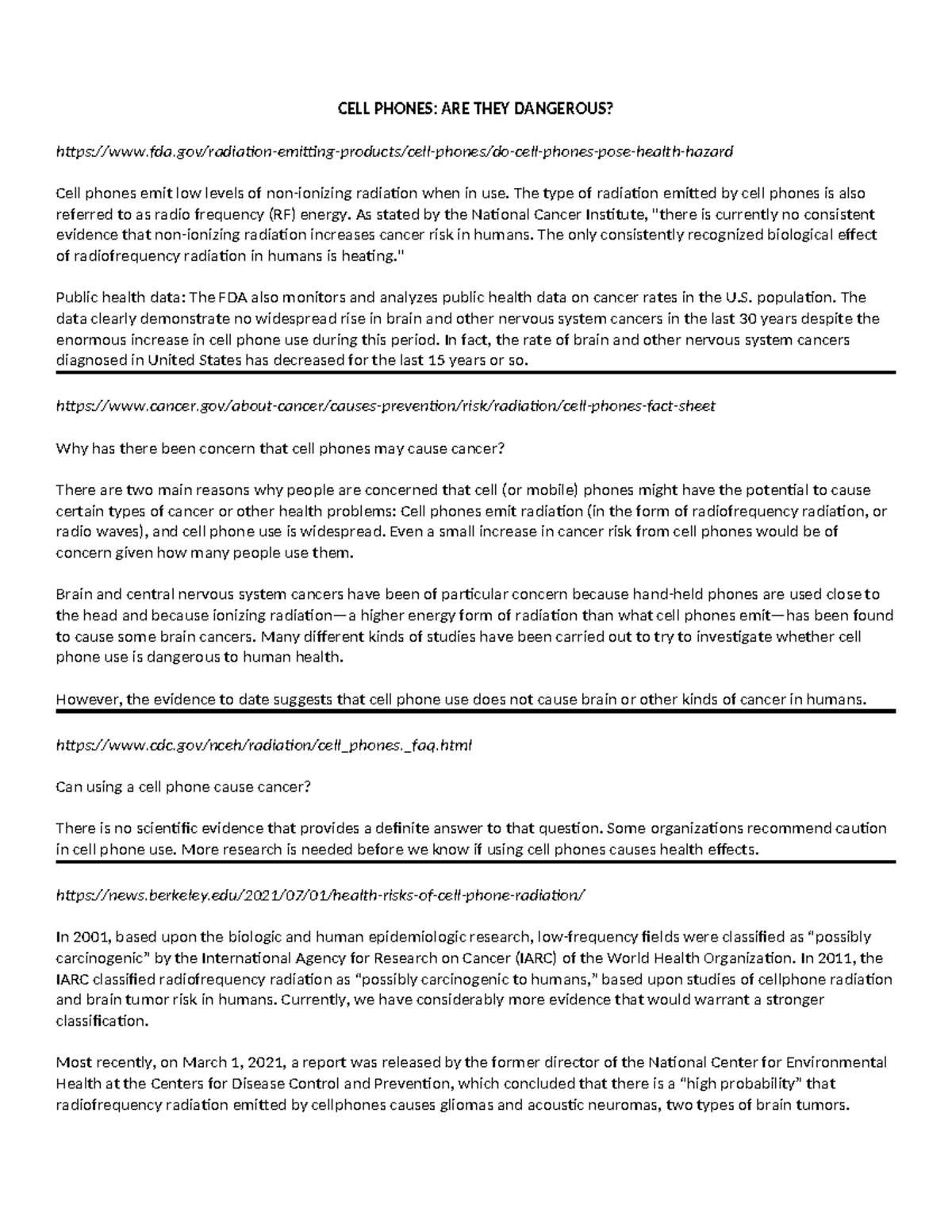
Current scientific evidence from major health organizations, including the WHO and FDA, indicates that the low-level radiofrequency (RF) radiation emitted by cell phones is not conclusively linked to cancer or other acute health problems. However, "danger" also encompasses physical posture issues, sleep disruption, and behavioral impacts that are well-documented in clinical settings.
The Nature of Cell Phone Radiation: Ionizing vs. Non-Ionizing
To understand whether cell phones pose a health risk, it is essential to distinguish between the types of electromagnetic radiation. Cell phones operate using radiofrequency (RF) energy, which falls into the category of non-ionizing radiation. Unlike ionizing radiation—such as X-rays, gamma rays, or high-energy ultraviolet (UV) light—non-ionizing radiation lacks sufficient energy to strip electrons from atoms or directly damage DNA.
The primary biological effect of RF energy is thermal heating. This is the same principle used in microwave ovens, though cell phones operate at much lower power levels that are insufficient to significantly raise body temperature. Regulatory bodies like the Federal Communications Commission (FCC) and the International Commission on Non-Ionizing Radiation Protection (ICNIRP) set strict limits on the Specific Absorption Rate (SAR), which measures the rate at which the body absorbs RF energy. As of 2026, these standards remain the cornerstone of device safety certification, ensuring that no consumer device exceeds a threshold that could cause tissue heating.
Despite the lack of ionizing potential, some researchers investigate whether "non-thermal effects" might occur over decades of use. These theories suggest that RF energy might influence cellular signaling or oxidative stress pathways. However, as of our current 2026 standing, consistent and reproducible evidence of these non-thermal effects leading to disease in humans has not been established by the broader scientific community.
The Cancer Question: IARC Classifications and Longitudinal Studies
The most persistent concern regarding cell phone safety is the potential for brain tumors, specifically gliomas and acoustic neuromas. This concern gained significant traction in 2011 when the International Agency for Research on Cancer (IARC), a branch of the World Health Organization (WHO), classified RF electromagnetic fields as "possibly carcinogenic to humans" (Group 2B).
It is important to understand what a Group 2B classification signifies. This category is used when a causal association is considered credible, but when chance, bias, or confounding factors cannot be ruled out with reasonable confidence. Other substances in this category include pickled vegetables and aloe vera. The classification was based largely on early case-control studies, such as the INTERPHONE study, which showed inconsistent results regarding heavy cell phone users.
Since that classification, several large-scale prospective studies have provided more clarity. The COSMOS study, which has followed hundreds of thousands of mobile phone users across Europe for over 15 years, has continued to report its findings into the mid-2020s. Generally, these longitudinal observations have not shown an increased incidence of brain tumors among long-term users compared to the general population. Furthermore, national cancer registries have not recorded a spike in brain cancer rates that correlates with the massive global explosion of mobile phone subscriptions since the late 1990s.
The National Toxicology Program (NTP) and Animal Testing
In 2018, the U.S. National Toxicology Program (NTP) released the results of a high-profile, multi-year study on the effects of RF radiation in rodents. The study found "clear evidence" of tumors in the hearts of male rats (schwannomas) and "some evidence" of tumors in the brains and adrenal glands. While these results initially caused alarm, the FDA's official response and subsequent expert reviews highlighted several critical caveats.
First, the rats were exposed to levels of RF radiation far exceeding the legal limits for human cell phone use. Second, the radiation was applied to the rats' entire bodies for nine hours a day, every day, starting before birth. In contrast, human exposure is localized to the head or hands and is typically intermittent. Interestingly, the rats exposed to radiation actually lived longer than the control group, a paradox that remains a point of scientific discussion. By 2026, the consensus among public health agencies is that these animal findings cannot be directly extrapolated to human health risks under normal usage conditions.
5G Technology and Millimeter Waves in 2026
The rollout and maturation of 5G networks introduced new frequencies into the public sphere, specifically millimeter waves (mmWave). These higher-frequency waves offer faster data speeds but have shorter ranges and lower penetration depths than 4G or 3G signals. Because mmWaves are absorbed almost entirely by the surface of the skin and do not reach internal organs, the primary area of research has shifted toward dermatological and ocular effects.
By 2026, extensive monitoring of 5G infrastructure has shown that exposure levels in public spaces remain well below international safety guidelines. The ICNIRP updated its guidelines specifically to account for these higher frequencies, emphasizing limits on power density to prevent skin heating. To date, no substantiated evidence links 5G frequencies to immune system suppression, DNA damage, or the spread of viral infections, debunking various myths that circulated during the early 2020s.
Non-Radiological Health Impacts: The Physical and Mental Toll
While the debate over radiation continues, the medical community has identified several "indirect" health dangers of cell phones that are statistically much more significant. These issues stem from how we interact with our devices rather than the signals they emit.
1. Sleep Disruption and Blue Light
Cell phones emit blue light, which inhibits the production of melatonin, the hormone responsible for regulating the sleep-wake cycle. Prolonged use before bed is clinically linked to delayed sleep onset and reduced REM sleep quality. Chronic sleep deprivation is a known risk factor for obesity, cardiovascular disease, and impaired cognitive function.
2. Musculoskeletal Issues ("Text Neck")
The repetitive posture of looking down at a screen places immense strain on the cervical spine. This has led to a rise in "text neck," characterized by chronic neck pain, headaches, and potential long-term disc degeneration. Similarly, "cell phone elbow" (cubital tunnel syndrome) can occur from holding a phone to the ear for extended periods, compressing the ulnar nerve.
3. Mental Health and Cognitive Load
The 2020s have seen a surge in research regarding smartphone addiction and its correlation with anxiety and depression. The "always-on" nature of mobile connectivity can lead to increased cortisol levels and fragmented attention spans. For many, the danger lies not in the hardware, but in the psychological impact of social media and constant notifications.
4. Distracted Driving: The Most Immediate Danger
According to the National Highway Traffic Safety Administration (NHTSA), distracted driving remains a leading cause of vehicular fatalities. The physical and cognitive distraction of using a cell phone while operating a vehicle poses a far greater immediate risk to life and limb than any theoretical radiation concern.
Comparison of Regulatory Limits and Exposure Scenarios
The following table outlines the standard safety limits and how various usage scenarios compare to established thresholds as of 2026.
| Exposure Category | Regulatory Limit / Metric | Typical Observed Level | Safety Context |
|---|---|---|---|
| SAR (Head) | 1.6 W/kg (FCC) / 2.0 W/kg (ICNIRP) | 0.2 - 1.2 W/kg | Varies by phone model; tested at maximum power. |
| SAR (Body-Worn) | 1.6 W/kg (FCC) | 0.3 - 1.5 W/kg | Measured with a specific separation distance (e.g., 5-15mm). |
| 5G Power Density | 10 W/m² (for frequencies >6 GHz) | <1% of limit | Public exposure from base stations is typically negligible. |
| Blue Light Exposure | No standard legal limit | High (at night) | Significant impact on melatonin and circadian rhythm. |
| Posture Strain | Up to 60 lbs of pressure | Constant during use | Force on spine increases as head tilts forward (0° to 60°). |
Practical Recommendations for Exposure Management
For individuals who wish to exercise the "precautionary principle"—taking sensible steps to reduce exposure despite the lack of proven harm—several practical strategies are recommended by health departments such as the California Department of Public Health.
- Increase Distance: The strength of RF fields drops off dramatically with distance. Use the speakerphone or wired/wireless earbuds to keep the device away from your head during long calls.
- Text Instead of Talk: Sending a text message requires less power and keeps the device away from the brain.
- Avoid Low-Signal Areas: When a phone has a "weak" signal (one or two bars), it increases its output power to reach the nearest base station. It is better to use your phone when the signal is strong.
- Limit Use in Moving Vehicles: In a car, bus, or train, a phone constantly switches between towers, which can cause spikes in RF output.
- Nighttime Habits: Place the phone across the room or in another room while sleeping to reduce blue light temptation and physical proximity.
Medical Disclaimer
The information provided in this article is for educational purposes only and does not constitute professional medical advice, diagnosis, or treatment. Always seek the advice of your physician or other qualified health provider with any questions you may have regarding a medical condition or the physical impacts of technology use.
Frequently Asked Questions
Are children more at risk from cell phone radiation?
Research suggests that children's skulls are thinner and their brain tissue is more absorbent than adults'. While no specific illness has been linked to this, organizations like the American Academy of Pediatrics (AAP) suggest limiting children's screen time and encouraging the use of hands-free devices as a precautionary measure.
Do "EMF Shields" or stickers actually work?
There is no scientific evidence that stickers or small shields attached to the phone reduce radiation exposure. In some cases, these products may interfere with the phone's signal, causing the device to work harder and actually increase its RF output to maintain a connection.
Does carrying a phone in my pocket affect fertility?
Some studies have observed a correlation between heavy cell phone use and reduced sperm motility or quality in men. However, these studies often struggle to account for other lifestyle factors like heat (from the phone or laptop) and sedentary behavior. Most health agencies suggest more research is needed but recommend carrying the phone in a bag or briefcase if concerned.
Can cell phones cause "Electromagnetic Hypersensitivity" (EHS)?
EHS is a term used by individuals who report symptoms like headaches, fatigue, and skin tingling when near electronic devices. However, double-blind provoked studies have consistently shown that sufferers cannot accurately detect the presence of RF fields, suggesting the symptoms are real but likely caused by other environmental factors or the "nocebo" effect.
Is it safe to use a cell phone while it is charging?
Yes, using a phone while charging does not increase RF radiation exposure. However, it can generate more heat than usual, which may contribute to battery degradation over time. From a safety perspective, ensure you use manufacturer-certified cables and adapters to avoid electrical hazards.
Moving Forward with Informed Use
In 2026, the scientific consensus remains that cell phones are safe for general use when operated within regulatory SAR limits. The primary "dangers" associated with these devices are behavioral and physical rather than radiological. By practicing good posture, managing screen time for better sleep, and maintaining focus while driving, users can mitigate the most significant health risks associated with modern mobile technology. For those still concerned about RF energy, the simple act of using a speakerphone or wired headset provides a significant reduction in localized exposure.