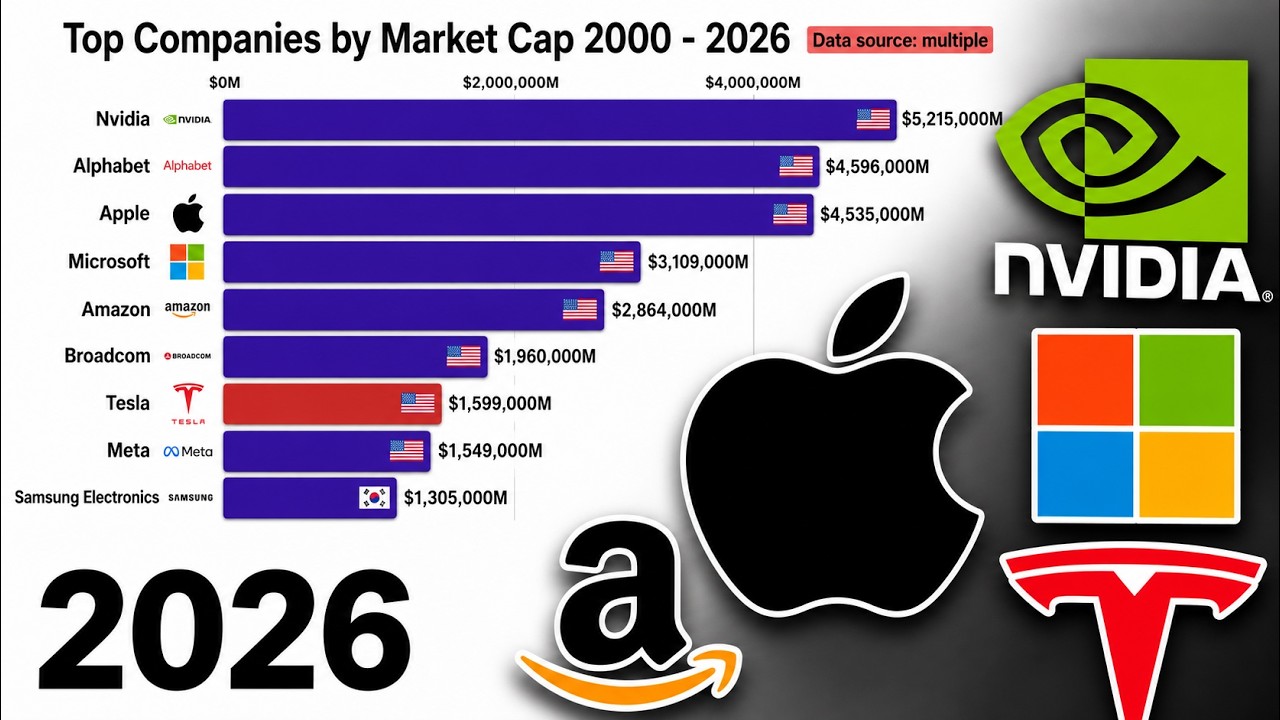
As of mid-2026, Apple Inc. maintains its status as one of the most valuable entities in history, with a market capitalization fluctuating between $3.7 trillion and $4.1 trillion. While it frequently contends with Microsoft and NVIDIA for the title of the world's wealthiest company by market cap, Apple’s unparalleled cash reserves and ecosystem loyalty secure its position at the apex of global finance.
The financial landscape of 2026 is defined by a "Three Trillion Dollar Club" that has evolved into a race toward the four-trillion-dollar milestone. To understand Apple’s market value today, one must look beyond simple stock prices and examine the convergence of hardware cycles, the maturation of spatial computing, and the deep integration of generative artificial intelligence across the iOS and macOS ecosystems. This valuation represents not just the sale of premium devices, but the monetization of a global user base that has become increasingly locked into a seamless, multi-device subscription model.
The Evolution of Apple’s Market Capitalization (2024–2026)
To appreciate where Apple stands in 2026, we must recognize the trajectory established over the past two years. In early 2024, Apple was navigating a period of plateauing hardware sales and regulatory scrutiny in the European Union. However, the successful rollout of "Apple Intelligence" and the refinement of the Vision Pro line provided the necessary catalysts for a valuation surge.
By 2025, the market began to price in the "AI Supercycle." Unlike competitors who focused primarily on enterprise cloud solutions, Apple’s approach focused on "Edge AI"—processing complex machine learning tasks directly on the iPhone and Mac. This necessitated a massive hardware upgrade cycle, as older chips lacked the Neural Engine capabilities required for the 2025 and 2026 software suites. This cycle drove record-breaking revenues in the iPhone 16 and 17 series, pushing the market cap past the $3.5 trillion mark for the first time.
In 2026, Apple’s valuation is supported by a robust buyback program. The company has consistently used its massive free cash flow to reduce share count, which inherently increases the value of remaining shares. According to Apple’s Investor Relations, the company’s commitment to returning capital to shareholders remains a primary pillar of its financial strategy, often overshadowing its actual quarterly growth percentages in the eyes of institutional investors.
Who is the Richest Company in the World in 2026?
The definition of "richest" can be interpreted in two ways: total market capitalization (the total value of all shares) or liquid cash reserves. In 2026, the leaderboard for these two categories often features the same few names, though their rankings shift based on quarterly earnings and sector trends.
Market Capitalization Leaders
As of the current 2026 fiscal year, the top three companies by market cap are:
- Microsoft: Driven by its dominance in enterprise AI and the continued growth of Azure, Microsoft often occupies the #1 spot, particularly during periods of high business spending.
- Apple: Holding the #1 or #2 spot depending on the day's trading, Apple’s value is anchored by consumer hardware and a high-margin services business.
- NVIDIA: Having successfully transitioned from a GPU manufacturer to the "engine room" of the global AI economy, NVIDIA remains a permanent fixture in the top three, though it experiences higher volatility than the others.
Cash Reserves and Profitability
If "richest" is defined by cash on hand, Apple often stands alone. While Saudi Aramco generates staggering amounts of raw profit from energy exports, Apple’s balance sheet is uniquely structured. In 2026, Apple continues to hold one of the largest corporate cash piles in the world, even after aggressive dividends and buybacks. This liquidity allows Apple to acquire emerging technology startups and weather global economic downturns more effectively than almost any other corporation.
Key Drivers of Apple’s 2026 Valuation
Several distinct factors contribute to the $4 trillion valuation range that Apple inhabits in 2026. These drivers represent a mix of traditional hardware sales and new, high-growth software sectors.
The Services Pivot
The most significant shift in Apple’s financial profile over the last decade has been the growth of Services. In 2026, this segment includes the App Store, iCloud+, Apple TV+, Apple Music, Apple Pay, and the increasingly profitable Apple Arcade.
Services margins are significantly higher than hardware margins. While an iPhone might yield a 35-40% gross margin, Services often exceed 70%. In 2026, Apple has successfully bundled these services through "Apple One," creating a recurring revenue stream that provides the stock with a higher Price-to-Earnings (P/E) multiple. Investors value recurring revenue more highly because it is predictable and less susceptible to the boom-and-bust cycles of hardware launches.
Spatial Computing and the Vision Ecosystem
By 2026, the Vision Pro is no longer a niche developer tool. The release of a more affordable "Vision" model in late 2025 expanded the user base from early adopters to professional and high-end consumer markets. This has created a new platform for developers, similar to the early days of the App Store. The market value of Apple in 2026 reflects the potential for spatial computing to eventually replace the iPad or even certain Mac workflows, positioning Apple as the leader in the post-mobile computing era.
AI Integration and "Edge" Supremacy
While Microsoft and Google dominate the cloud AI space, Apple has captured the "Edge AI" market. In 2026, privacy has become a premium commodity. Apple’s marketing focus on "On-Device AI" ensures that personal data remains on the user's hardware rather than being processed in a remote data center. This has allowed Apple to charge a premium for its devices, maintaining high Average Selling Prices (ASPs) even as the global smartphone market matures.
Comparative Market Analysis: 2026 Top Performers
The following table outlines the estimated market positions of the world’s leading companies as of mid-2026. Note that these figures represent market capitalization, which is subject to daily fluctuations in the NASDAQ and NYSE.
| Company Name | Estimated Market Cap (2026) | Primary Growth Driver | Regional Dominance |
|---|---|---|---|
| Microsoft | $3.9T - $4.2T | Enterprise AI & Cloud (Azure) | North America / Global |
| Apple | $3.8T - $4.1T | Services & AI Hardware | Global Consumer Market |
| NVIDIA | $3.0T - $3.4T | AI Infrastructure & Data Centers | Global Tech Supply Chain |
| Saudi Aramco | $1.9T - $2.2T | Energy & Diversification | Middle East / Asia |
| Alphabet (Google) | $2.1T - $2.4T | Search Ads & Gemini AI | Global |
| Amazon | $2.0T - $2.3T | AWS & Logistics Automation | North America / Europe |
Challenges to Apple's Valuation in 2026
Despite its massive value, Apple faces headwinds in 2026 that prevent it from pulling away from Microsoft decisively. Understanding these risks is essential for any technical SEO or financial analysis of the company.
Regulatory Pressure and the DMA
The European Union’s Digital Markets Act (DMA) has forced Apple to open its ecosystem in ways that were unthinkable five years ago. Alternative app stores and third-party payment systems are now standard in the EU. While this hasn't led to the "mass exodus" from the App Store that some analysts feared, it has put downward pressure on Apple’s high commission rates. In 2026, the market is closely watching to see if other jurisdictions, such as the United States or Japan, will follow the EU’s lead, which could impact future Services growth.
Supply Chain Diversification
Apple’s reliance on manufacturing in specific regions remains a risk factor. In 2026, the company has successfully moved significant portions of iPhone and iPad production to India and Vietnam, but the high-end components—particularly the M-series and A-series chips produced by TSMC—remain vulnerable to geopolitical tensions. Any disruption in the semiconductor supply chain would immediately impact Apple’s ability to meet demand, potentially shaving hundreds of billions off its market value in a matter of weeks.
The Role of Institutional Investment
A major reason Apple remains the "richest" or most valuable company is the sheer volume of institutional ownership. Pension funds, mutual funds, and ETFs (Exchange Traded Funds) often hold Apple as their largest single position. In 2026, Apple is a "defensive tech" stock. When the market is volatile, investors flock to Apple because of its massive cash flow and the perceived safety of its brand.
Furthermore, Apple’s inclusion in the Dow Jones Industrial Average and its heavy weighting in the S&P 500 mean that trillions of dollars in passive investment automatically flow into Apple shares. This institutional floor prevents the stock from experiencing the same level of "drawdown" as smaller tech companies during market corrections.
Technical Financial Metrics in 2026
To understand Apple's $4 trillion valuation, one must look at the specific financial ratios that analysts use to justify the price.
- Price-to-Earnings (P/E) Ratio: In 2026, Apple trades at a P/E ratio of approximately 30x to 32x. This is higher than the historical average of 15x-20x seen in the 2010s, reflecting its transition to a services-heavy model.
- Free Cash Flow (FCF): Apple continues to generate over $100 billion in FCF annually. This is the "gold standard" for corporate health, allowing for continuous R&D and shareholder returns.
- Dividend Yield: While not a "high-yield" stock, Apple has increased its dividend every year for over a decade. In 2026, it remains a favorite for "Dividend Growth" investors.
Frequently Asked Questions
Is Apple the richest company in the world in 2026?
Apple is consistently one of the top two most valuable companies in the world by market capitalization. While it often trades the #1 spot with Microsoft, Apple typically holds the title for the largest cash reserves and highest brand valuation among consumer electronics firms.
What is the difference between market value and cash on hand?
Market value (or market cap) is the total value of all a company's shares. As of 2026, Apple’s market value is around $4 trillion. "Cash on hand" refers to the liquid assets the company actually holds in the bank. Apple’s cash reserves are often over $160 billion, which is separate from its stock market valuation.
How did AI affect Apple's stock price by 2026?
AI was a primary driver of Apple’s growth between 2024 and 2026. By integrating "Apple Intelligence" into its operating systems, Apple triggered a massive hardware upgrade cycle. Investors rewarded this by increasing Apple's P/E multiple, as AI features increased user retention and boosted high-margin Services revenue.
Who are Apple’s biggest competitors for the $4 trillion mark?
The primary competitors are Microsoft and NVIDIA. Microsoft leads in enterprise cloud and AI software, while NVIDIA leads in the hardware that powers the global AI infrastructure. Saudi Aramco remains a competitor for total value, though its valuation is tied more closely to oil prices than technological innovation.
Why does Apple spend so much on share buybacks?
Share buybacks reduce the number of shares available on the open market. This increases the Earnings Per Share (EPS) for the remaining shares, making the company more attractive to investors. In 2026, this continues to be Apple’s preferred method of returning value to shareholders while maintaining a high stock price.
Practical Recommendation for Investors and Analysts
In 2026, evaluating Apple’s market value requires looking past the "iPhone numbers." The real story is the Services and AI ecosystem. If you are tracking Apple’s performance, pay close attention to the Services Gross Margin and the installed base of active devices. As long as Apple continues to grow its active user base (which exceeded 2.5 billion devices by 2026), the company’s ability to monetize that base through subscriptions and AI-enabled hardware upgrades will likely keep it at or near the top of the list of the world's wealthiest companies.
For those looking for official data, the U.S. Securities and Exchange Commission (SEC) remains the most authoritative source for Apple’s quarterly 10-Q and annual 10-K filings, which detail their exact cash holdings and share counts.