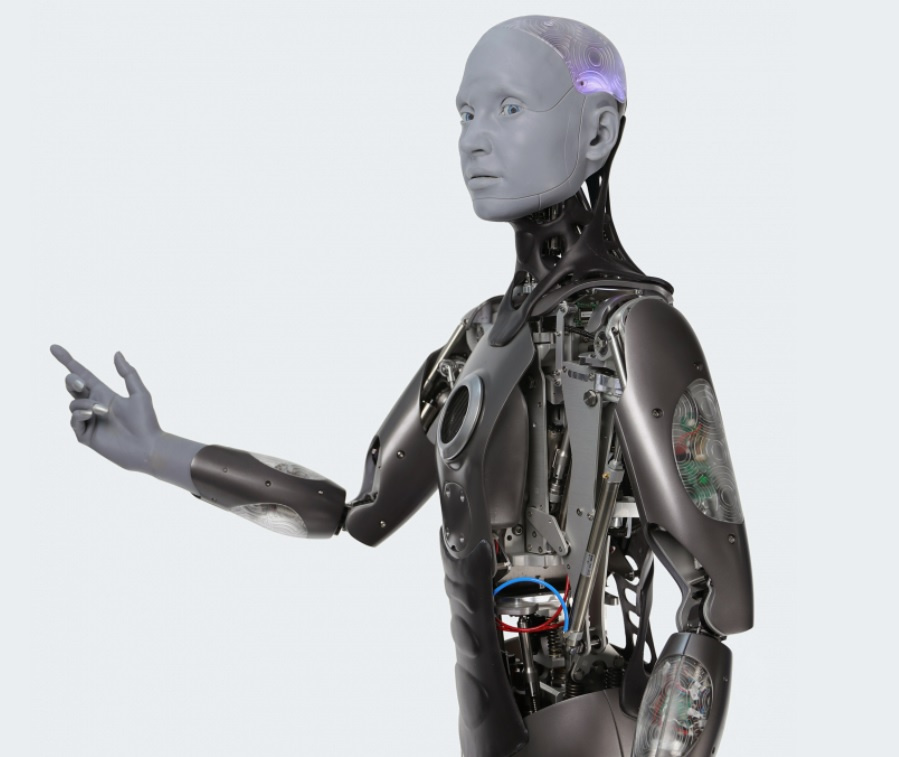
The Ameca robot, developed by Engineered Arts, represents a pivotal advancement in humanoid robotics by prioritizing hyper-realistic facial expressions and natural non-verbal communication. Designed as a modular development platform rather than a task-specific automaton, Ameca serves as the primary interface for exploring the future of artificial intelligence, human-machine social interaction, and digital telepresence in research and public-facing environments.
The Genesis of Ameca: Engineering Humanism
Engineered Arts, a robotics company based in Cornwall, United Kingdom, introduced Ameca to bridge the gap between static, industrial robots and the fluid, expressive nature of human communication. Unlike earlier humanoid designs that focused heavily on locomotion—often at the expense of aesthetic comfort—Ameca was built from the ground up as a social robot.
The philosophy behind Ameca is centered on "human-like" interaction rather than "human-equivalent" capability. The development team recognized that in order for machines to effectively integrate into social spaces, they must adhere to the nuances of human non-verbal cues. This includes micro-expressions, gaze tracking, and the timing of subtle head tilts. By utilizing high-torque, low-backlash actuators and proprietary control software, the robot can mimic human musculature, providing a canvas for advanced AI developers to project personality and emotional intelligence.
Technical Foundations and Modular Design
Ameca is not a singular, fixed device but a modular, cloud-connected platform. Its architecture allows for consistent hardware iteration, meaning the platform can be upgraded as sensor and actuator technologies evolve.
Key Technical Specifications
- Facial Actuation: The face contains a complex array of motors that control movement in the eyebrows, eyelids, mouth, and neck. This allows for the synthesis of complex facial states, including surprise, skepticism, and happiness.
- Sensor Suite: Ameca integrates high-definition cameras within its eyes, providing spatial awareness and gaze capabilities essential for maintaining engagement during a conversation.
- Cloud Connectivity: To manage the heavy computational load required for real-time generative AI interactions, Ameca interfaces with cloud-based Large Language Models (LLMs). This allows the robot to parse natural language, formulate context-aware responses, and trigger corresponding motor movements nearly instantaneously.
- Tritium Operating System: Engineered Arts utilizes its own software stack, Tritium, which allows researchers to control the robot via a web browser. This abstraction layer enables users to animate the robot, trigger audio, or stream AI-generated expressions without needing low-level programming knowledge.
Navigating the Frontier of Social Interaction
The primary utility of Ameca in 2026 lies in its ability to facilitate "Natural Human-Robot Interaction" (NHRI). In public spaces, such as museum exhibits, retail centers, or hospitality kiosks, the robot functions as a bridge that makes advanced AI approachable. When an individual speaks to an AI via a screen, the interaction is often transactional. When the same AI is housed in a humanoid form that makes eye contact, smiles in response to a joke, and shifts its posture to listen, the psychological impact on the user changes significantly.
Research conducted using the Ameca platform often focuses on the "Uncanny Valley"—the aesthetic point where a robot becomes so human-like that it triggers feelings of unease in the viewer. Engineered Arts addresses this by utilizing a "non-human" skin texture in many of their standard units, keeping the focus on the expressiveness of the motion rather than biological realism. This decision maintains the user’s awareness that they are interacting with a machine, while still benefiting from the cognitive ease of social cues.
Comparative Overview of Humanoid Robotics Platforms
While several companies are developing humanoid robots, the following table illustrates how the Ameca platform distinguishes itself in the current robotics market.
| Platform | Primary Focus | Interaction Capability | Mobility Focus |
|---|---|---|---|
| Ameca | Social Engagement | High (Expressive) | Low (Stationary/Torso) |
| Atlas | Industrial/Physical | Low (Functional) | High (Dynamic) |
| Optimus | General Labor | Moderate (Verbal) | High (Bipedal) |
| Pepper | Customer Service | Moderate (Simplified) | Moderate (Wheeled) |
The table clarifies that Ameca is not designed to lift heavy objects or navigate uneven terrain. Its "frontier" status is strictly confined to the domain of social robotics, where the goal is communication and engagement rather than physical utility.
Prerequisites and Integration for Developers
For institutions, research labs, or commercial entities interested in utilizing the Ameca platform, there are several foundational requirements. Because the hardware is a high-precision instrument, it requires a controlled environment to operate safely and effectively.
- Software Ecosystem: Access to the platform requires familiarity with the Tritium environment. Developers must be capable of integrating existing LLM APIs—such as those from OpenAI, Anthropic, or Google—into the Tritium middleware to enable conversational AI.
- Environmental Requirements: Ameca is designed for indoor use. High humidity or dust can negatively impact the delicate servomotors. Stable Wi-Fi or high-speed Ethernet is mandatory, as the latency of the cloud connection directly dictates the responsiveness of the robot’s expressions.
- Ethical Considerations: As of 2026, the deployment of human-like robots in public spaces requires adherence to local privacy and safety regulations, particularly regarding biometric data collection (e.g., if the robot uses facial recognition to identify repeat visitors).
Common Challenges and Troubleshooting
Even with advanced hardware, users may encounter specific issues during operation.
- Latency in Interaction: If the robot seems to lag between hearing a question and responding, the issue is rarely the robot itself. It is usually a bottleneck in the cloud API processing the user's speech or the network bandwidth. Developers are advised to prioritize edge-side processing for basic movements while utilizing cloud-native solutions for complex linguistic reasoning.
- Expression "Dead Zones": If facial movements appear jerky or incomplete, it is often a sign that the calibration of the individual motors has drifted. The Tritium software includes a self-calibration sequence that should be run periodically to ensure every actuator returns to its neutral baseline.
- Public Reception: The "uncanny" effect can occasionally lead to adverse reactions in younger or sensitive demographics. It is recommended that installations include visual cues indicating the presence of a robot to prime the user for a mechanical interaction rather than a biological one.
The Future of Human-Robot Coexistence
As we move through 2026, the trajectory of the Ameca project is moving toward increased autonomy. The current state-of-the-art involves the robot autonomously selecting expressions based on the sentiment analysis of the text it is processing. If a user tells a sad story, the robot’s language model identifies the negative sentiment, and the motor control system selects a corresponding "pensive" expression.
The next frontier for platforms like Ameca involves the integration of multimodal input. Currently, the robot relies primarily on vision and sound. Future iterations will likely incorporate haptic sensors, allowing the robot to detect touch or proximity in a more nuanced way, further refining the "social" loop.
Frequently Asked Questions
1. Can Ameca walk or move independently in a room? No. Ameca is currently a stationary or torso-based platform. It is designed to be fixed to a pedestal or a mounted stand. It does not possess bipedal locomotion, as the focus is entirely on facial expressiveness and upper-body gestures during static interactions.
2. How does Ameca process and understand human speech? Ameca does not have a "brain" of its own in the biological sense. It utilizes external AI services (via API) to perform Speech-to-Text, Natural Language Processing (NLP), and Text-to-Speech. The robot receives these packets of data and translates them into motor commands for its facial actuators.
3. Is the skin of the Ameca robot realistic to the touch? The face of the Ameca robot is made of a high-quality silicone-like material designed for durability and movement, not necessarily for human-like texture. While it is engineered to be visually convincing under controlled lighting, it is distinct from high-end prosthetics intended to mimic biological skin.
4. Can I purchase an Ameca robot for home use? Ameca is marketed primarily to businesses, research institutions, and event organizations. Due to the high cost of the hardware, the complexity of the maintenance, and the requirement for stable software integration, it is not currently a consumer-grade product available for individual home ownership.
5. How long do the actuators last before needing service? Like any complex mechanical device, the actuators have a finite duty cycle. With regular, moderate use in an exhibition setting, the internal components are rated for thousands of hours of operation. Engineered Arts provides specific maintenance schedules, and the modular nature of the face allows for individual actuator replacement rather than requiring a full system overhaul.
Final Recommendation
For organizations looking to lead in the field of human-computer interaction, the Ameca robot offers an unparalleled platform for testing the boundaries of social AI. To begin implementation, start by establishing a clear objective for the robot—whether it is customer engagement, educational demonstration, or research into behavioral psychology. Avoid attempting to build a "general-purpose" social bot; instead, create a specific interaction flow within the Tritium platform that utilizes the robot’s expressive strengths to achieve one well-defined goal. By keeping the use case focused, developers can leverage the robot’s life-like capabilities to create meaningful, high-impact interactions that feel both natural and innovative.