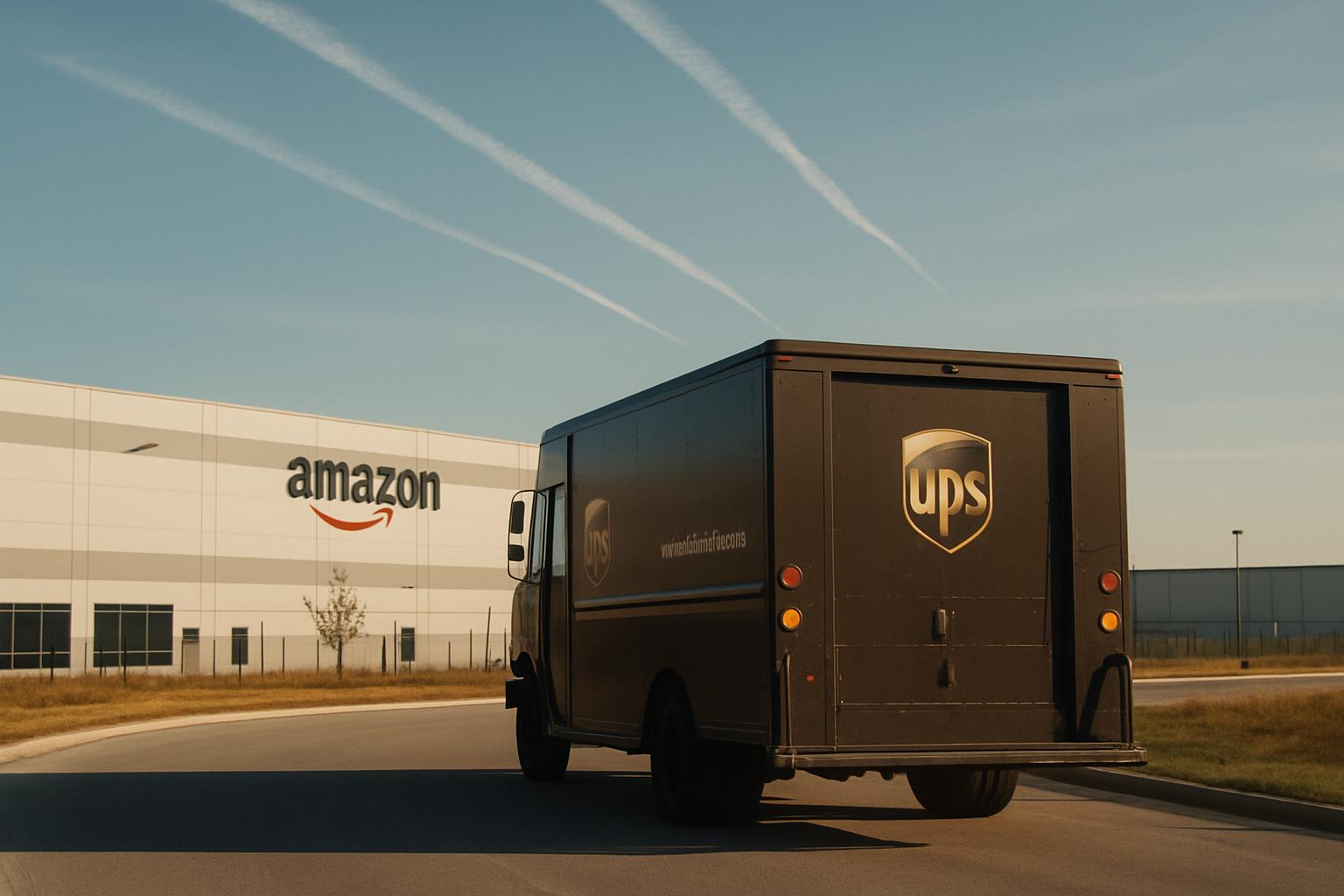
The relationship between Amazon and UPS has evolved from a vital dependency into a complex dynamic of strategic competition and selective cooperation. As of 2026, Amazon has solidified its position as the largest private delivery carrier in the United States, while UPS has successfully pivoted toward high-margin sectors, reducing its reliance on Amazon’s lower-yielding volume.
For over two decades, the interplay between Amazon and United Parcel Service (UPS) has served as the primary engine for the global e-commerce explosion. What began as a traditional client-vendor relationship—with Amazon as the high-volume shipper and UPS as the indispensable infrastructure—has transformed into one of the most scrutinized corporate rivalries in modern business history.
In 2026, this partnership is characterized by "co-opetition." While Amazon continues to utilize UPS for specific logistics needs, such as peak-season overflow, rural last-mile delivery, and high-value returns, it has largely internalized the bulk of its own shipping volume. This shift has forced both entities to redefine their value propositions to shareholders, sellers, and consumers.
The Historical Catalyst: From 2013 to the Internalization Era
The trajectory of the Amazon-UPS partnership changed irrevocably during the 2013 holiday season. A combination of extreme weather and a surge in last-minute e-commerce orders led to a systemic failure in the UPS and FedEx networks, resulting in millions of late Christmas deliveries. For Amazon, which built its brand on the promise of reliability, this was a turning point.
Following the 2013 "logistics crisis," Amazon accelerated the development of Amazon Logistics (AMZL). The goal was simple but ambitious: build a proprietary end-to-end supply chain that could rival the incumbents. Over the next decade, Amazon invested billions into a fleet of "Prime Air" cargo planes, thousands of long-haul trailers, and an expansive network of local delivery vans.
By the end of 2023, Amazon had officially surpassed UPS in total annual package volume in the U.S., a milestone that fundamentally altered the bargaining power between the two companies. As we stand in 2026, Amazon’s logistics network is no longer a "supplement" to UPS; it is the primary artery of the Amazon marketplace, handling over 6.5 billion packages annually.
UPS’s Strategic Pivot: "Better, Not Bigger"
Faced with the reality of Amazon’s growing self-sufficiency, UPS leadership implemented a strategic shift known as "Better, Not Bigger." Recognizing that Amazon’s high-volume, low-margin residential deliveries were often less profitable than specialized services, UPS began prioritizing different sectors.
Focusing on Healthcare and B2B
UPS has doubled down on high-stakes logistics, particularly in the healthcare and pharmaceutical sectors. In 2026, the UPS Healthcare division represents a significant portion of the company’s growth. These shipments—ranging from temperature-sensitive vaccines to critical surgical equipment—command much higher margins than a standard household parcel.
SMB Empowerment and International Expansion
Furthermore, UPS has focused on empowering small and medium-sized businesses (SMBs) through its "Digital Access Program" (DAP). By providing SMBs with the same level of logistical sophistication once reserved for giants like Amazon, UPS has diversified its revenue stream. In 2026, the revenue share attributed to Amazon has dropped to less than 8% of UPS’s total annual revenue, down from approximately 13% in 2020. This reduction in "customer concentration risk" has been viewed favorably by Wall Street, shielding UPS from the pricing pressures Amazon often exerts on its vendors.
The Role of The UPS Store in the Amazon Ecosystem
Despite the competitive friction, one area of the partnership remains robust in 2026: the returns ecosystem. The UPS Store network, comprising over 5,000 locations across North America, serves as a critical infrastructure point for Amazon’s "no-box, no-label" returns.
Amazon recognizes that easy returns are a primary driver of consumer loyalty. However, building a physical retail footprint to handle these returns is prohibitively expensive. UPS, conversely, benefits from the foot traffic generated by Amazon returns, which often leads to customers purchasing other services, such as packing supplies or notarization. This symbiotic relationship proves that while the companies compete on the "front-end" of delivery, they remain deeply integrated on the "back-end" of the product lifecycle.
Logistics Comparison: 2026 Performance Metrics
To understand the current state of the shifting partnership, it is helpful to compare the operational focuses of both entities as they stand in 2026.
| Feature | Amazon Logistics (AMZL) | United Parcel Service (UPS) |
|---|---|---|
| Primary Network Strength | Urban/Suburban Last-Mile Density | Global B2B and International Freight |
| Pricing Strategy | Low-cost, high-speed for Prime members | Value-added services and premium pricing |
| Delivery Fleet | Large-scale electric van fleet (Rivian/Custom) | Diversified air/ground (Brown) with heavy automation |
| Market Segment Focus | Internal e-commerce retail and FBA | Healthcare, SMBs, and Industrial manufacturing |
| Return Handling | Limited physical drops (Whole Foods/Kohl's) | Extensive physical network (The UPS Store) |
| Labor Model | Delivery Service Partners (DSP) & Flex | Unionized workforce (Teamsters) |
Impact on E-commerce Sellers and Third-Party Logistics
For the millions of sellers on the Amazon marketplace, the shifting partnership creates both opportunities and challenges. In 2026, the reliance on Fulfillment by Amazon (FBA) has reached an all-time high, but the costs associated with it have also risen.
The Rise of Seller Fulfilled Prime (SFP) via UPS
As Amazon’s internal shipping rates for FBA increase, some high-volume sellers are returning to Seller Fulfilled Prime (SFP), utilizing UPS’s highly reliable "Ground" network to meet Prime delivery standards. UPS has responded by offering integrated shipping software that bridges the gap between Amazon’s API and the UPS logistics dashboard, making it easier for sellers to bypass FBA while maintaining the Prime badge.
Multi-Carrier Strategies
In 2026, savvy e-commerce businesses no longer rely on a single carrier. The "Amazon and UPS" dynamic has taught sellers that diversification is a prerequisite for survival. Many use Amazon for high-velocity items but maintain a "backup" contract with UPS to ensure delivery during peak periods when Amazon’s network might prioritize its own "Sold by Amazon" inventory over third-party seller goods.
Technological Integration and the Future of Automation
Automation is the primary arena where the two companies are currently racing to out-innovate one another. In 2026, Amazon has deployed massive fleets of autonomous "Proteus" robots in its fulfillment centers, drastically reducing the time it takes to prepare a package for shipment.
UPS has countered with its own massive investments in automated sorting facilities. The UPS "Velocity" program has modernized legacy hubs, allowing the carrier to process up to 100,000 packages per hour with minimal manual intervention. This technological parity ensures that while Amazon may have the advantage in residential density, UPS maintains a significant edge in complex logistics and global trade compliance.
Pricing Dynamics and Inflationary Pressures
Inflationary pressures in 2026, driven by energy costs and labor demands, have influenced the pricing structures of both carriers. Amazon has historically subsidized shipping costs through its Prime membership fees. However, as the cost of the "last mile" continues to rise, Amazon has introduced more tiered shipping fees for non-standard items.
UPS, meanwhile, remains transparent with its annual General Rate Increases (GRI). For the 2026 fiscal year, both companies have aligned on significant surcharges for "oversized" and "rural" deliveries—areas where the cost-to-serve is highest. This alignment suggests that while they are competitors, they are both subject to the same macroeconomic realities of the transportation industry.
Key Considerations for Business Planning in 2026
Businesses navigating the Amazon-UPS landscape must account for the following factors:
- Reliability vs. Cost: Amazon Logistics often provides the lowest cost for urban deliveries, but UPS continues to lead in "service guarantees" and tracking transparency for high-value B2B shipments.
- Returns Management: Leveraging The UPS Store for Amazon returns remains the most efficient path for consumers, but businesses should monitor potential changes to "return-to-vendor" (RTV) policies as Amazon seeks to reduce its own reverse-logistics costs.
- Data Sovereignty: Selling through Amazon and using its logistics means granting Amazon access to vast amounts of customer data. Using UPS allows sellers to maintain a more direct relationship with their customer base and their shipping data.
Frequently Asked Questions
Does Amazon still own a stake in UPS in 2026?
No, Amazon does not own a stake in UPS. While Amazon has acquired or invested in various aviation and transportation entities over the years, UPS remains an independent, publicly-traded company (NYSE: UPS). Their relationship is strictly contractual and competitive.
Is UPS or Amazon faster for 2026 deliveries?
For residential "Prime" orders in major metropolitan areas, Amazon Logistics is typically faster due to its proximity-based "Same-Day" fulfillment centers. However, for transcontinental or international shipments, UPS's global air network is generally more robust and consistent.
Why do some Amazon packages still arrive via UPS?
Amazon uses a "load-balancing" algorithm. If Amazon’s own delivery vans are at capacity in a specific zip code, or if the package is oversized or requires special handling, the system automatically redirects the shipment to UPS (or occasionally the USPS) to ensure the delivery deadline is met.
Can I choose UPS as my carrier when I buy on Amazon?
Generally, no. Amazon’s system selects the carrier based on cost, speed, and efficiency at the time of checkout. However, if you are a seller, you can choose UPS as your preferred carrier for shipping inventory to Amazon warehouses or for fulfilling orders directly through the SFP program.
How has the unionization of UPS affected its partnership with Amazon?
The 2023 Teamsters contract for UPS employees significantly increased labor costs for the carrier. This has widened the pricing gap between unionized UPS and Amazon’s largely non-unionized DSP model. Consequently, Amazon has been able to maintain lower last-mile delivery costs, while UPS has focused on higher-value services where clients are willing to pay a premium for a stable, professionalized workforce.
Final Recommendation for 2026
For the foreseeable future, the "shifting partnership" between Amazon and UPS will remain a pillar of the global economy. Businesses should not view this as a choice between one or the other, but rather as a hybrid logistics strategy.
Utilize Amazon for its unparalleled reach into the consumer home and its cost-effective FBA ecosystem, but maintain a robust relationship with UPS for B2B needs, high-value freight, and as a strategic hedge against Amazon’s ever-increasing marketplace fees. By diversifying across both networks, shippers can protect themselves against service disruptions and leverage the unique strengths of the two most powerful logistics entities in the world.