In 2026, professional air conditioning maintenance typically costs between $100 and $250 for a standard tune-up. Repair costs vary significantly by component, ranging from $150 for simple electrical fixes to over $2,500 for compressor replacements. Full system installations generally fall between $5,500 and $13,000, depending on unit efficiency and home size.
Maintaining a comfortable indoor climate requires a clear understanding of the financial and technical landscape of HVAC (Heating, Ventilation, and Air Conditioning) services. As we move through 2026, the industry continues to adapt to stricter environmental regulations and advancements in smart home integration. This guide provides a detailed breakdown of what homeowners and property managers can expect regarding service pricing, repair categories, and system replacement options.
The Importance of Routine Preventive Maintenance
Preventive maintenance is the cornerstone of HVAC longevity. In 2026, the complexity of modern systems—often involving variable-speed compressors and sophisticated electronic control boards—makes regular check-ups more critical than ever. A standard maintenance visit, often called a "tune-up," is designed to ensure the system operates at peak efficiency while identifying potential failures before they result in emergency shutdowns.
What is Included in a Professional Tune-Up?
A comprehensive service visit usually takes 60 to 90 minutes. Technicians perform several critical tasks:
- Cleaning of Condenser and Evaporator Coils: Dirt and debris act as insulators, forcing the system to work harder to exchange heat. Cleaning these components can improve efficiency by 5% to 15%.
- Refrigerant Level Verification: Technicians check for optimal pressure. With the complete transition to A2L refrigerants (like R-454B and R-32) in new units, precise charging is essential for both performance and safety.
- Electrical Component Inspection: This includes testing capacitors, contactors, and tightening wire connections that may have loosened due to vibration.
- Condensate Drain Clearing: Clogged drains are a leading cause of water damage and system "no-cool" calls.
- Thermostat Calibration: Ensuring the control unit accurately communicates with the air handler and condenser.
Maintenance Contracts and Subscription Models
Many HVAC companies now offer annual service agreements, ranging from $200 to $500 per year. These often include two visits (one for cooling, one for heating), priority scheduling, and discounts on parts. In 2026, these "protection plans" are increasingly popular as they help spread the cost of maintenance and often extend the manufacturer's labor warranty.
Analysis of Air Conditioning Repair Costs
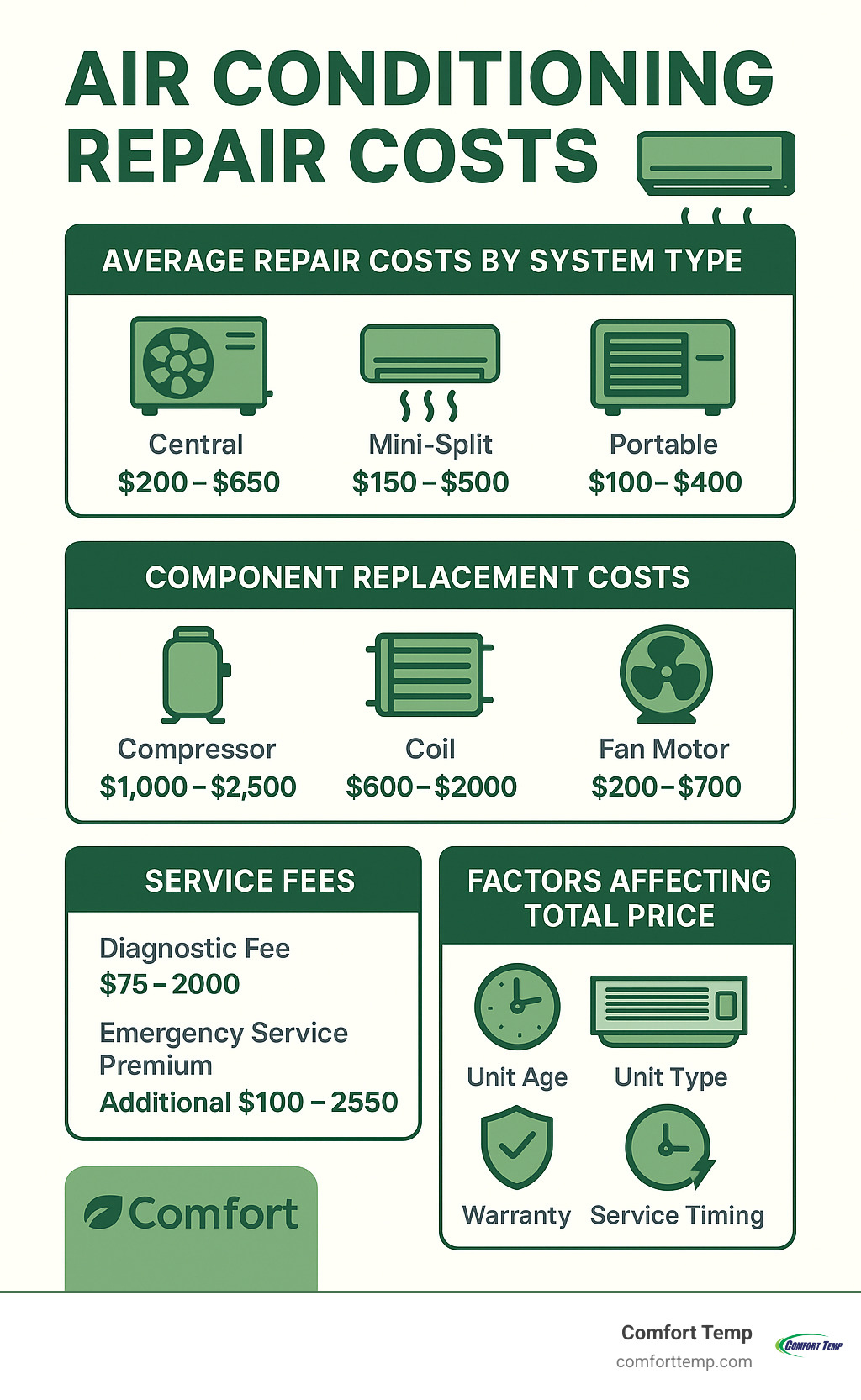
When a system fails, the cost of repair is dictated by the price of specialized parts and the labor-intensive nature of the work. In 2026, labor rates for licensed HVAC technicians typically range from $100 to $200 per hour, depending on the region and the complexity of the diagnostic tools required.
Minor vs. Major Repairs
Repairs are generally categorized by the time and materials required to resolve the issue.
Minor Repairs ($150 - $400):
- Capacitor Replacement: One of the most common failure points. Capacitors provide the initial "jolt" to start motors.
- Contactor Replacement: The switch that allows power to flow to the compressor.
- Thermostat Replacement: Upgrading to a basic Wi-Fi model or replacing a faulty sensor.
Medium Repairs ($400 - $1,000):
- Fan Motor Replacement: Whether it is the outdoor condenser fan or the indoor blower motor, these mechanical parts are subject to significant wear.
- Refrigerant Leak Detection and Repair: Locating a leak using electronic "sniffers" or dye tests, followed by sealing the leak and recharging the system.
- Circuit Board Replacement: Modern units rely on integrated control boards that can be damaged by power surges.
Major Repairs ($1,000 - $3,000+):
- Compressor Replacement: The "heart" of the AC. If the compressor fails outside of the warranty period, replacement costs often rival the price of a new outdoor unit.
- Evaporator Coil Replacement: Often necessary when coils develop multiple leaks due to corrosion. This requires "breaking into" the sealed refrigerant system, which is labor-intensive.
The Impact of the Refrigerant Transition in 2026
The HVAC industry is currently operating under the mandates of the EPA’s AIM Act, which has phased down the production of older refrigerants like R-410A. By 2026, the market has shifted toward A2L refrigerants, which have a much lower Global Warming Potential (GWP).
For homeowners with older systems, this means the cost of "topping off" a unit with R-410A has increased significantly due to dwindling supply. When a major leak occurs in an older system, technicians in 2026 will frequently recommend a full system replacement rather than an expensive repair involving high-priced, legacy refrigerants. New systems using R-454B or R-32 are more energy-efficient but require specialized tools and training for service, which has contributed to a slight rise in baseline service fees.
Air Conditioning Replacement Options and Costs
If a system is more than 12-15 years old or requires a repair exceeding 50% of its value, replacement is usually the most financially sound option. In 2026, there are three primary system configurations available.
1. Central Air Conditioning (Split Systems)
This remains the standard for homes with existing ductwork. A central system consists of an outdoor condenser and an indoor evaporator coil/air handler.
- Cost Range: $5,500 - $11,000.
- Pros: Uniform cooling, hidden infrastructure.
- Cons: High installation cost if ductwork needs repair.
2. Ductless Mini-Split Systems
Ideal for homes without ducts or for cooling specific zones. These systems use an outdoor unit connected to one or more indoor "heads" mounted on walls.
- Cost Range: $3,000 - $6,000 for a single zone; $8,000 - $18,000 for multi-zone.
- Pros: Highly efficient, independent temperature control for different rooms.
- Cons: Visible indoor units, higher upfront cost for whole-home coverage.
3. Air Source Heat Pumps
In 2026, heat pumps have become the preferred choice due to federal tax credits and their ability to provide both cooling and heating.
- Cost Range: $6,000 - $13,000 (before rebates).
- Pros: High efficiency, replaces both the furnace and the AC, environmentally friendly.
- Cons: Higher initial investment than a standard AC.
Factors That Influence Service and Installation Pricing
Several variables can shift an estimate from the lower end to the higher end of the spectrum.
System Capacity (Tonnage)
The size of the unit is measured in "tons" (the amount of heat it can remove in one hour). A 2-ton unit for a small home is significantly cheaper than a 5-ton unit for a large estate. Oversizing or undersizing a unit can lead to premature failure and high energy bills.
SEER2 Ratings
Efficiency is measured by the Seasonal Energy Efficiency Ratio 2 (SEER2). As of 2026, the minimum standards have stabilized, but high-efficiency units (20+ SEER2) cost considerably more upfront. However, these units can reduce monthly energy consumption by 20% to 40% compared to base-model units.
Accessibility and Logistics
If a technician needs to crawl into a tight attic space, climb onto a steep roof, or navigate a narrow crawlspace, labor costs will increase. Similarly, if a replacement requires new refrigerant lines (Line Sets) or electrical upgrades to meet 2026 building codes, the final invoice will reflect these additions.
2026 AC Service Cost Comparison Table
| Service Category | Typical Cost Range (2026) | Frequency / Notes |
|---|---|---|
| Basic Maintenance Tune-Up | $100 – $250 | Recommended annually |
| Diagnostic/Service Call Fee | $85 – $180 | Often waived if repair is performed |
| Refrigerant Recharge (R-410A) | $150 – $400 per lb | Prices rising due to phase-out |
| Refrigerant Recharge (A2L) | $60 – $150 per lb | Standard for new 2025/2026 units |
| Blower Motor Replacement | $500 – $1,200 | Cost varies by motor speed type |
| Compressor Replacement | $1,800 – $3,500 | Includes labor and refrigerant |
| Full System Replacement | $5,500 – $13,000 | Includes indoor/outdoor units |
| Smart Thermostat Install | $250 – $600 | Includes device and wiring |
Frequently Asked Questions
How often should I service my AC in 2026?
It is recommended to have your system professionally serviced at least once a year, preferably in the spring before the peak cooling season. Regular maintenance can extend the life of your system by 5 to 8 years and ensures your manufacturer’s warranty remains valid, as many manufacturers now require proof of professional maintenance for claim approval.
Are there tax credits available for new AC units in 2026?
Yes, under the Energy Efficient Home Improvement Credit (25C), homeowners can often claim a percentage of the cost for high-efficiency cooling equipment and heat pumps. In 2026, these credits remain a significant factor in lowering the effective cost of system upgrades, sometimes providing up to $2,000 in annual tax relief for qualified heat pump installations.
Why is my AC repair more expensive than it was five years ago?
The increase in cost is driven by three main factors: the transition to more expensive, environmentally friendly refrigerants, the rising cost of high-tech semiconductors used in modern control boards, and an industry-wide shortage of skilled HVAC technicians, which has driven up labor rates. Additionally, logistics and raw material costs (copper and aluminum) remain higher than historical averages.
Can I perform AC service myself?
While homeowners can and should perform basic tasks like changing air filters every 30-90 days and keeping the outdoor unit clear of debris, technical service must be left to professionals. Handling refrigerants requires Section 608 Certification from the EPA, and modern high-voltage systems pose significant risks of electrical shock or fire if handled incorrectly.
Is it better to repair or replace an 11-year-old unit?
In 2026, if an 11-year-old unit uses R-410A refrigerant and requires a major repair (like a compressor or evaporator coil), replacement is almost always the better option. The cost of the repair, combined with the rising cost of R-410A and the lower efficiency of the older unit, makes the "payback period" for a new, high-efficiency system using A2L refrigerant relatively short.
Practical Recommendations
To manage air conditioning costs effectively in 2026, follow these actionable steps:
- Schedule Early: Book your annual maintenance in March or April. Many companies offer "early bird" discounts and have more flexible scheduling before the summer heat waves begin.
- Verify Contractor Credentials: Ensure your technician is NATE (North American Technician Excellence) certified and holds the necessary EPA certifications for the new A2L refrigerants.
- Check for Rebates: Before committing to a replacement, visit the ENERGY STAR Rebate Finder to identify local utility rebates and federal tax incentives.
- Invest in Air Quality: When servicing your system, consider adding or upgrading air filtration. Options like HEPA filters or UV-C light purifiers are easier and cheaper to install during a standard service visit than as a standalone appointment.
- Monitor Energy Bills: Use your utility provider's app to track spikes in energy usage. An unexplained 20% increase in your cooling bill is often the first sign that your AC requires professional service.