The Airbus A380 provides a unique passenger experience characterized by its double-deck configuration, offering nearly 50% more floor space than a Boeing 747-8. These insights reveal how advanced acoustic engineering, sophisticated environmental control systems, and innovative material science create a cabin environment that remains the industry benchmark for long-haul comfort in 2026.
Even as the aviation industry shifts toward ultra-efficient twin-engine jets, the Airbus A380—often referred to as the "Superjumbo"—remains a crown jewel of the skies. For passengers and enthusiasts in 2026, the aircraft represents more than just size; it is a masterclass in how interior volume can be leveraged to solve the physiological and psychological challenges of ultra-long-haul travel.
The complexity of the A380’s interior goes far beyond its dual-aisle, two-story layout. It involves a symphony of hidden technologies, from air filtration systems that refresh every three minutes to structural dampening that makes it one of the quietest cabins ever built. Understanding these seven insights provides a deeper appreciation for the engineering required to keep over 500 people comfortable at 40,000 feet.
1. The Structural Reality of the Full-Length Double Deck
The most defining characteristic of the A380 is its full-length double deck. Unlike the Boeing 747, which features a shortened upper deck "bubble," the A380’s upper deck extends from the nose to the tail. This design choice was not merely about increasing seat count; it was a fundamental shift in aeronautical weight distribution and interior volume management.
Inside the cabin, this creates two distinct environments. The main deck (lower) is the widest in the sky, measuring approximately 6.5 meters (21.3 feet) across. This width allows for a 10-abreast economy configuration that feels significantly less cramped than on smaller widebody aircraft. The upper deck, while slightly narrower at 5.8 meters (19 feet), offers a more intimate feel and is typically reserved for premium cabins.
The engineering challenge of this "house on wings" lies in the floor beams. To support the weight of hundreds of passengers, galleys, and lavatories on the upper level without adding excessive weight to the airframe, Airbus utilized aluminum-lithium alloys and carbon fiber reinforced plastic (CFRP). These materials provide the necessary stiffness to prevent the floor from flexing during turbulence, which is essential for the integrity of the rigid monuments (walls and galleys) installed throughout the cabin.
2. Acoustic Engineering and the "Silent Giant" Phenomenon
One of the first things passengers notice inside the A380 is the absence of the "white noise" roar typical of jet travel. The A380 is widely regarded as having the quietest cabin in the sky. This was a deliberate design goal, achieved through a combination of engine placement, fuselage thickness, and specialized insulation.
The aircraft’s massive Rolls-Royce Trent 900 or Engine Alliance GP7200 engines are mounted far out on the wings, which are themselves enormous, acting as natural sound buffers. However, the true insight lies within the fuselage walls. Airbus engineers used advanced acoustic lining and "skin dampening" materials that absorb low-frequency vibrations before they reach the passenger's ears.
Furthermore, the A380's sheer volume works in its favor. A larger interior volume naturally dissipates sound waves more effectively than a narrow tube. In 2026, airlines continue to market the A380 specifically for night flights, as the lower decibel levels (roughly 60-65 dB in the cabin) are more conducive to sleep than the 70+ dB found in older generation long-haul aircraft.
3. Advanced Environmental Control Systems (ECS)
Maintaining air quality on a plane carrying 500 to 800 people is a massive logistical feat. The A380’s Environmental Control System (ECS) is split into several "zones," allowing the flight crew to fine-tune temperatures in different parts of the plane. This prevents the common problem where the front of the cabin is freezing while the back is too warm.
Beyond temperature, the A380 manages air pressure and humidity with high precision. The aircraft is pressurized to a lower cabin altitude than many older aluminum jets—typically around 7,000 feet—which helps reduce the symptoms of jet lag and fatigue.
The air inside the A380 is refreshed every three minutes. It uses a sophisticated HEPA (High-Efficiency Particulate Air) filtration system that removes 99.97% of particles, including bacteria and viruses. What many do not realize is that the air is not just "recycled"; it is a 50/50 mix of fresh outside air and filtered air, ensuring that oxygen levels remain optimal and odors are neutralized. The humidity levels are also slightly higher than industry averages of the early 2000s, which helps prevent the dehydration of skin and eyes during 14-hour flights.
4. The Utilization of "Dead Space" for Luxury Amenities
The A380’s massive interior volume created pockets of "dead space" that engineers and designers turned into the aircraft's most famous features. Because of the curvature of the fuselage on the upper deck, there are areas where standard seating cannot be placed effectively.
Airlines like Emirates and Qatar Airways utilized these areas to install on-board lounges and bars. These are not merely aesthetic additions; they are complex engineering installations. A bar on an aircraft must be plumbed for water, have drainage for ice, and be structurally reinforced to ensure it doesn't move during a hard landing.
Perhaps the most famous use of this space is the "Shower Spa" on Emirates' A380s. Each shower unit is a self-contained module that requires its own dedicated water heating system and grey-water management. This was only possible because of the A380’s high payload capacity, allowing it to carry the extra weight of the water (approximately 500kg or 1,100 lbs dedicated just to the showers) without significantly compromising range.
5. Circadian Rhythm Lighting Systems
While LED mood lighting is now common on many aircraft, the A380 was a pioneer in using light to influence the human circadian rhythm. The interior is equipped with over 5,000 light-emitting diodes capable of producing millions of color combinations.
The insight here is the "science of the transition." In 2026, cabin crews use pre-programmed lighting sequences to mimic natural daylight cycles. For a flight departing London at night and arriving in Singapore the next afternoon, the lighting system will slowly transition through deep ambers (simulating sunset) to encourage melatonin production, and then shift into cool blues and bright whites (simulating sunrise) several hours before landing.
This synchronization of the internal body clock with the destination time zone is a critical component of the A380 "wellness" experience. It reduces the physical shock of crossing multiple time zones, making the Superjumbo a preferred choice for business travelers who need to be productive immediately upon arrival.
6. Hidden Logistics: Crew Rest and Galley Elevators
To keep the A380 functioning, there is a "hidden" world inside the aircraft that passengers rarely see. Because the plane is so large, moving catering carts and crew members between decks requires specialized infrastructure.
Most A380s are equipped with electric lifts (dumbwaiters) that transport food and beverage carts between the lower and upper galleys. This allows the airline to prepare meals in the massive lower-deck galley and serve them efficiently on the upper deck.
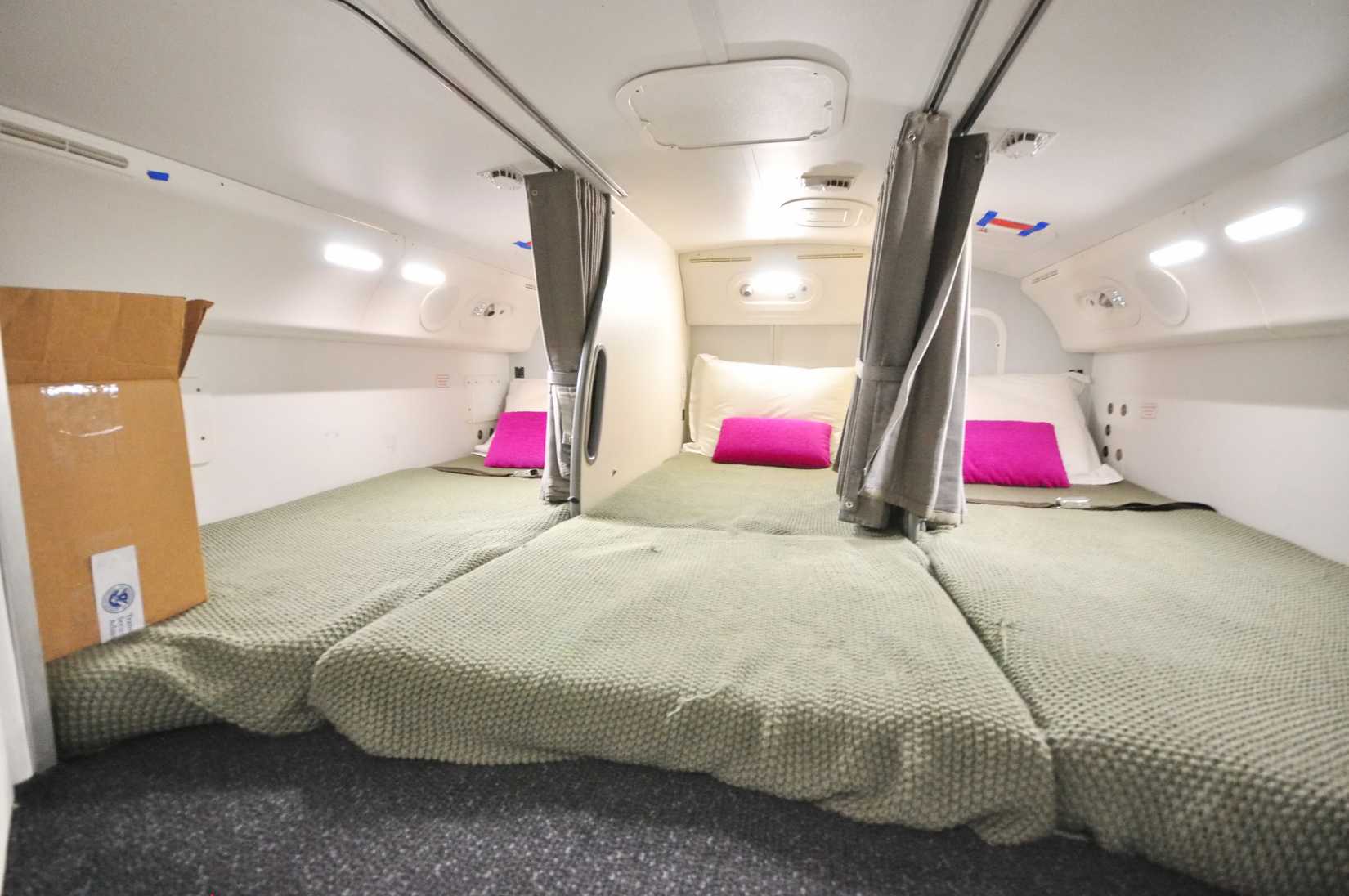
Furthermore, the A380 features two primary crew rest areas. One is typically located behind the cockpit for the pilots, and a much larger "Mobile Crew Rest" (MCR) is often situated in the cargo hold area or at the rear of the main deck. These areas contain bunks and changing rooms for the 18 to 24 crew members required for a full flight. These hidden compartments are soundproofed and temperature-controlled to ensure that the staff can get "quality sleep," which is a safety requirement for ultra-long-haul operations.
7. GLARE: The Invisible Material Science
While the "inside" of the A380 usually refers to the cabin, the engineering of the fuselage skin itself directly impacts the interior experience. The A380 was the first commercial aircraft to make extensive use of GLARE (Glass Laminate Aluminium Reinforced Epoxy).
GLARE is a composite material made of alternating layers of aluminum and glass fiber. From a passenger perspective, this material is a breakthrough for two reasons:
- Safety: It is incredibly fire-resistant and has superior fatigue properties, meaning it can withstand the constant pressurization cycles of the massive fuselage over decades.
- Comfort: Because GLARE is stronger and more damage-tolerant than traditional aluminum, engineers could design larger cabin windows.
While the A380’s windows may appear smaller than those on the Boeing 787 Dreamliner, the thickness of the fuselage (often over 12 inches including insulation) creates a "porthole" effect. The use of GLARE allowed for this thickness without making the aircraft too heavy to take off, effectively creating a "cocoon" for the passengers inside.
Comparing A380 Cabin Configurations (2026 Status)
The way airlines utilize the internal space of the A380 varies significantly. As of 2026, the following table illustrates how major carriers have optimized the "7 insights" for their specific business models.
| Airline | Total Seats (Avg) | Unique Interior Insight | Deck Distribution |
|---|---|---|---|
| Emirates | 484 - 615 | Onboard Lounge & Shower Spas | Mix of 2-class and 4-class |
| Singapore Airlines | 471 | Double Bed Suites in First Class | Upper Deck (Premium) / Main (Economy) |
| Qatar Airways | 517 | Open-plan Upper Deck Lounge | Premium Upper / Economy Main |
| Lufthansa | 509 | Humidification systems in First Class | Mostly 4-class layout |
| British Airways | 469 | Traditional "Club World" layout | Mixed decks for all classes |
How to Maximize Your Experience Inside the A380
If you are booking a flight on an A380 in 2026, there are practical steps you can take to leverage these engineering insights for a better journey.
- Choose the Upper Deck for Quiet: Even if you are flying Economy, some airlines (like British Airways or Qantas) have small economy sections at the rear of the upper deck. Because it is further from the engines and has fewer passengers, it is significantly quieter.
- Utilize the Storage Bins: On the upper deck, the curvature of the plane creates large storage bins between the window seat and the wall. This is extra space not found on the main deck.
- Acoustic Sweet Spot: The quietest seats are generally located in the front of the main deck or the front of the upper deck, as they are "ahead" of the engine noise.
- Hydration and Light: Pay attention to the mood lighting. If the cabin turns blue, try to stay awake; if it turns amber, try to sleep. The ECS system will be working to keep you hydrated, but you should still supplement with water due to the high altitude.
Frequently Asked Questions
Why is the A380 so much quieter than other planes?
The A380's quietness is due to its advanced engine technology (larger fans spinning more slowly), extensive use of sound-dampening insulation in the fuselage, and the sheer volume of the cabin, which prevents sound waves from bouncing as harshly as they do in smaller aircraft.
Can you walk between the decks during the flight?
Generally, yes, though access to the stairs is usually managed by the crew. There is a grand staircase at the front and a spiral or straight staircase at the rear. However, passengers are typically expected to stay on their ticketed deck unless using a shared amenity like the lounge.
Is the air on the A380 "stale" because there are so many people?
No. The A380 uses an advanced HEPA filtration system and high-capacity air compressors that refresh the entire cabin volume every three minutes. The air quality is often cleaner than that in most office buildings or hospitals.
Why did Airbus stop making the A380 if the interior is so good?
Production ended in 2021 (though many remain in service through 2026 and beyond) primarily because of fuel economics. While the interior is unmatched for comfort, the four engines consume more fuel than modern twin-engine jets like the A350 or Boeing 777X. The A380 requires high passenger loads on every flight to be profitable.
Do all A380s have showers and bars?
No. These are "monuments" chosen by specific airlines. Emirates is the most famous for having both showers and bars. Other airlines may use that space for additional seating, storage, or different types of social areas.
The Future of the A380 Interior
As we look at the aviation landscape in 2026, the A380 remains a specialized tool. While it is no longer the "standard" for new aircraft orders, it remains the "standard" for passenger comfort. Airlines that have retained their A380 fleets have largely moved toward retrofitting them with "Premium Economy" cabins, recognizing that the aircraft's internal volume is its greatest asset.
The insights gained from the A380—specifically in lighting, acoustics, and composite materials—have been integrated into newer planes like the Airbus A350 and the A321XLR. However, the sheer scale of the Superjumbo’s interior is something that unlikely to be replicated in the near future. For the traveler, the A380 remains the ultimate way to cross oceans, proving that engineering for the human experience is just as important as engineering for aerodynamic efficiency.