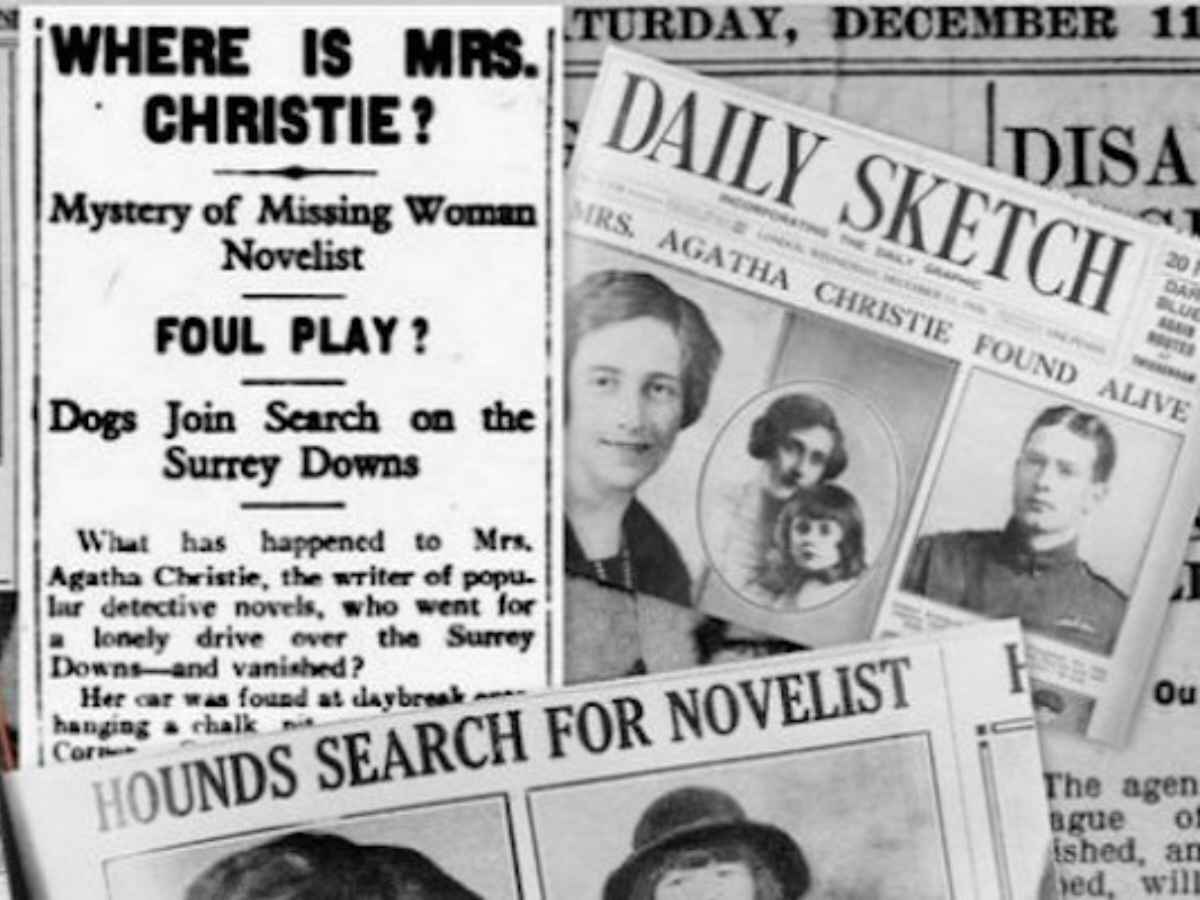
On December 3, 1926, the world-renowned mystery writer Agatha Christie vanished from her home in Sunningdale, Berkshire, sparking one of the most intense and widely publicized manhunts in British history. For eleven days, her whereabouts remained a total mystery, leading to public speculation, a massive police operation, and profound questions about the mental state of a woman who had mastered the art of the literary disappearance.
The Night of the Disappearance
The timeline of the event began on the evening of December 3, 1926. Following a heated argument with her husband, Colonel Archibald Christie—who had recently confessed to his affair with Nancy Neele—Agatha Christie left her home in her Morris Cowley motorcar. She did not return that evening, nor did she make contact with her staff or her young daughter.
The following morning, her car was discovered abandoned near the "Silent Pool" in Newlands Corner, Surrey. The vehicle was found perched on a steep incline, containing her fur coat and an expired driver’s license. The initial discovery caused immediate alarm. Given the location—notorious in local folklore for a double drowning—and the proximity to a deep pond, authorities initially feared the worst: suicide or foul play.
The Search Effort and Public Sensation
The disappearance of the "Queen of Crime" became an immediate sensation. It was the first time in history that a massive, coordinated search effort utilized aviation to assist in finding a missing person. Over 1,000 police officers and thousands of volunteers combed the countryside. Prominent authors, including Sir Arthur Conan Doyle, became involved in the search, with Doyle reportedly taking one of Christie’s gloves to a medium in hopes of receiving a psychic revelation.
The public's appetite for the story was insatiable. Newspapers carried daily updates, and the press turned the mystery into a national obsession. This was a watershed moment in the relationship between public figures and the media, demonstrating the power of the press to turn a private tragedy into a high-stakes, real-time national spectacle.
The Discovery at the Swan Hydropathic Hotel
On December 14, 1926, the search concluded in a manner that defied the dramatic expectations of the press and the public. Agatha Christie was discovered at the Swan Hydropathic Hotel (now the Old Swan Hotel) in Harrogate, Yorkshire. She had been staying there under the name "Teresa Neele"—the same surname as her husband’s mistress.
The staff at the hotel had recognized her from newspaper photographs and alerted the authorities. When Archibald Christie arrived to retrieve his wife, he reported that she did not appear to recognize him immediately. Her physical appearance had changed, and her demeanor was described as detached. She showed no memory of how she arrived at the hotel or why she had chosen that specific location.
Medical and Psychological Interpretations
The central question that persists to this day is why Agatha Christie remained missing for eleven days and what truly happened during that interim. Over the decades, various theories have emerged, ranging from the psychological to the performative.
The Fugue State Theory
The most prominent clinical explanation is that Christie suffered from a "dissociative fugue." In medical terms, a fugue state is a rare psychiatric condition characterized by sudden, unexpected travel away from home, an inability to recall one's past, and confusion about personal identity. Proponents of this theory suggest that the immense emotional trauma of her husband’s infidelity, combined with the recent death of her mother, triggered a complete psychological breakdown.
The "Publicity Stunt" Theory
During the 1920s and in the decades that followed, many critics and members of the public argued that the disappearance was an elaborate publicity stunt orchestrated by Christie to shame her husband or boost the sales of her novels. While this theory garnered significant traction, there is little empirical evidence to support it. Christie never spoke of the incident as a fabrication, and those who knew her described her as being deeply distressed by the ordeal.
The Revenge Theory
Some biographers have suggested that the use of the name "Teresa Neele" was a deliberate act of psychological warfare against her husband. By adopting the name of the woman for whom she was being abandoned, Christie may have been attempting to enact a form of subconscious revenge. However, this relies heavily on interpretations of her internal state, which remains largely inaccessible.
Comparing Theories of the Disappearance
| Theory | Premise | Primary Evidence |
|---|---|---|
| Dissociative Fugue | A psychological break due to trauma. | Her reported lack of recognition of her husband and memory loss. |
| Publicity Stunt | A calculated move to ruin her husband's reputation. | The high profile of her work and the timing of her books. |
| Revenge/Symbolic Act | An attempt to confront her husband’s mistress. | The adoption of the surname "Neele" at the hotel. |
| Suicidal Intent | An aborted attempt to end her life. | The abandoned car at a location linked to local legends of suicide. |
The Aftermath and Impact on Her Life
The aftermath of the 1926 event was profound. Agatha Christie and Archibald Christie were divorced in 1928. Christie rarely discussed the event in subsequent years, and it was conspicuously absent from her official autobiography. This silence has fueled ongoing speculation and academic interest in the author's private life.
Professionally, the incident did not derail her career; if anything, it solidified her status as a household name. However, the emotional toll was evident to those in her inner circle. Christie eventually moved on, marrying archaeologist Max Mallowan in 1930, a relationship that provided her with the stability and travel opportunities that defined the later, highly productive chapters of her career.
Evaluating the Evidence: A Professional Perspective
As we examine this event nearly a century later, it is vital to distinguish between reported facts and biographical interpretation. We have confirmed records of the car being found, the police search, and the staff at the Swan Hydropathic Hotel identifying her. These are objective events. The "why" remains subjective.
For researchers and fans of Christie’s work, the 1926 disappearance serves as a reminder that even the most meticulous planners of fictional mysteries are subject to the complexities of human psychology. It highlights the gap between public perception—which demanded a coherent "mystery story" resolution—and the messy, non-linear reality of mental health crises in the early 20th century.
Frequently Asked Questions
Did Agatha Christie ever write about her disappearance?
No. She maintained a strict silence regarding the events of those 11 days throughout her life. In her autobiography, she skips over the years of her life that included the divorce and the disappearance entirely.
Was the disappearance a police matter?
Yes. It was treated as a major missing persons case. The search was expensive and involved significant police resources, which led to some public criticism once she was found, as many felt the author had wasted taxpayer money.
How did the media react to the discovery?
The media reaction was polarized. While some outlets treated it as a tragic medical event, others were skeptical, labeling it a cynical attempt to gain attention or punish her husband. The press coverage was relentless and often invasive.
Is the "Silent Pool" in Surrey relevant to the case?
The Silent Pool is a lake in Surrey associated with legends of drowning. Its proximity to where her car was found suggested to the police in 1926 that she might have committed suicide, which heavily influenced the initial search strategy.
Can a "fugue state" be verified after 100 years?
Medical experts suggest that while a dissociative fugue is consistent with the behaviors described (identity loss, travel, lack of memory), it is impossible to medically diagnose someone posthumously with total certainty. It remains the most widely accepted clinical explanation for her behavior.
Moving Forward: Respecting the Mystery
The 11 days Agatha Christie spent missing remain a defining moment in the history of English literature and public celebrity. While it is natural to want a definitive solution—a "missing chapter" that explains the disappearance—the truth is likely rooted in a private, painful experience that the author chose to keep to herself. For those researching this event, the most respectful approach is to balance the documented facts of the search with an acknowledgement of the inherent limitations of interpreting the private life of a historical figure.
When exploring this topic, rely on established biographies and contemporary accounts rather than later dramatizations, which often prioritize narrative structure over historical reality. Understanding the context of the 1926 social environment—where divorce was stigmatized and female agency was often constrained—is key to grasping why the disappearance unfolded as it did.