While people often use the names interchangeably, Delhi and New Delhi are not the same. Delhi, officially known as the National Capital Territory (NCT), is a massive metropolitan area and union territory. New Delhi is a specific city and administrative district within the NCT that serves as the official capital of India.
To the casual observer or international traveler, the distinction might seem like a mere technicality. However, the difference between Delhi and New Delhi encompasses history, geography, governance, and urban planning. Understanding this distinction is essential for anyone navigating the legal, political, or logistical landscape of India’s most significant urban hub. As of 2026, the expansion of the National Capital Region (NCR) has further complicated these definitions, making it more important than ever to clarify where one boundary ends and another begins.
The Historical Genesis of Two Entities
The confusion between Delhi and New Delhi is rooted in the early 20th century. To understand why they are different, one must look at the transition of power during the British Raj. For centuries, the area known as Delhi was the seat of various empires, most notably the Mughals, who resided in what is now called Old Delhi (originally Shahjahanabad).
In 1911, during the Delhi Durbar, King George V announced that the capital of British India would shift from Calcutta (now Kolkata) to Delhi. The British sought to build a new, modern city that reflected the grandeur of the Empire while remaining distinct from the crowded, labyrinthine streets of the existing Mughal city. This "eighth city" of Delhi was designed by architects Edwin Lutyens and Herbert Baker.
This new administrative center was officially named New Delhi in 1927 and inaugurated in 1931. While the older parts of the region continued to exist as "Delhi," this new planned area became the seat of the government. Consequently, New Delhi was built as a city within the larger geographic region of Delhi.
Administrative and Governance Framework
One of the most significant differences lies in how these areas are governed. In 2026, the administrative landscape of the region is a multi-layered system that distinguishes the capital city from the union territory at large.
The National Capital Territory (NCT) of Delhi
Delhi is a Union Territory with a special status that allows it to have its own Legislative Assembly and Chief Minister. It covers an area of approximately 1,484 square kilometers. The NCT is divided into 11 administrative districts, one of which is the New Delhi district. The governance of the NCT involves a complex power-sharing agreement between the Government of Delhi and the Central Government of India, represented by the Lieutenant Governor.
The New Delhi Municipal Council (NDMC)
New Delhi is governed by a specific body known as the New Delhi Municipal Council (NDMC). Unlike the Municipal Corporation of Delhi (MCD), which handles the majority of the NCT’s residential and commercial zones, the NDMC area is relatively small (about 42.7 square kilometers). This zone includes the "Lutyens’ Bungalow Zone," major government buildings, embassies, and central business districts like Connaught Place. Because it houses the President, Prime Minister, and Parliament, the NDMC area receives a different level of security, funding, and maintenance compared to the rest of Delhi.
Geographical and Architectural Contrasts
If you were to travel from the heart of Old Delhi to the center of New Delhi, the visual transition would be jarring. This physical difference is the most obvious way to distinguish the two entities.
Architecture of Delhi (Old Delhi)
Old Delhi is characterized by narrow alleys, high-density housing, and historical monuments dating back to the 17th century. The architecture is predominantly Islamic and Mughal, featuring red sandstone, intricate marble work, and crowded bazaars like Chandni Chowk. It is a place where history is lived in the present, but it lacks the rigid grid-based planning seen in the newer parts of the territory.
Architecture of New Delhi
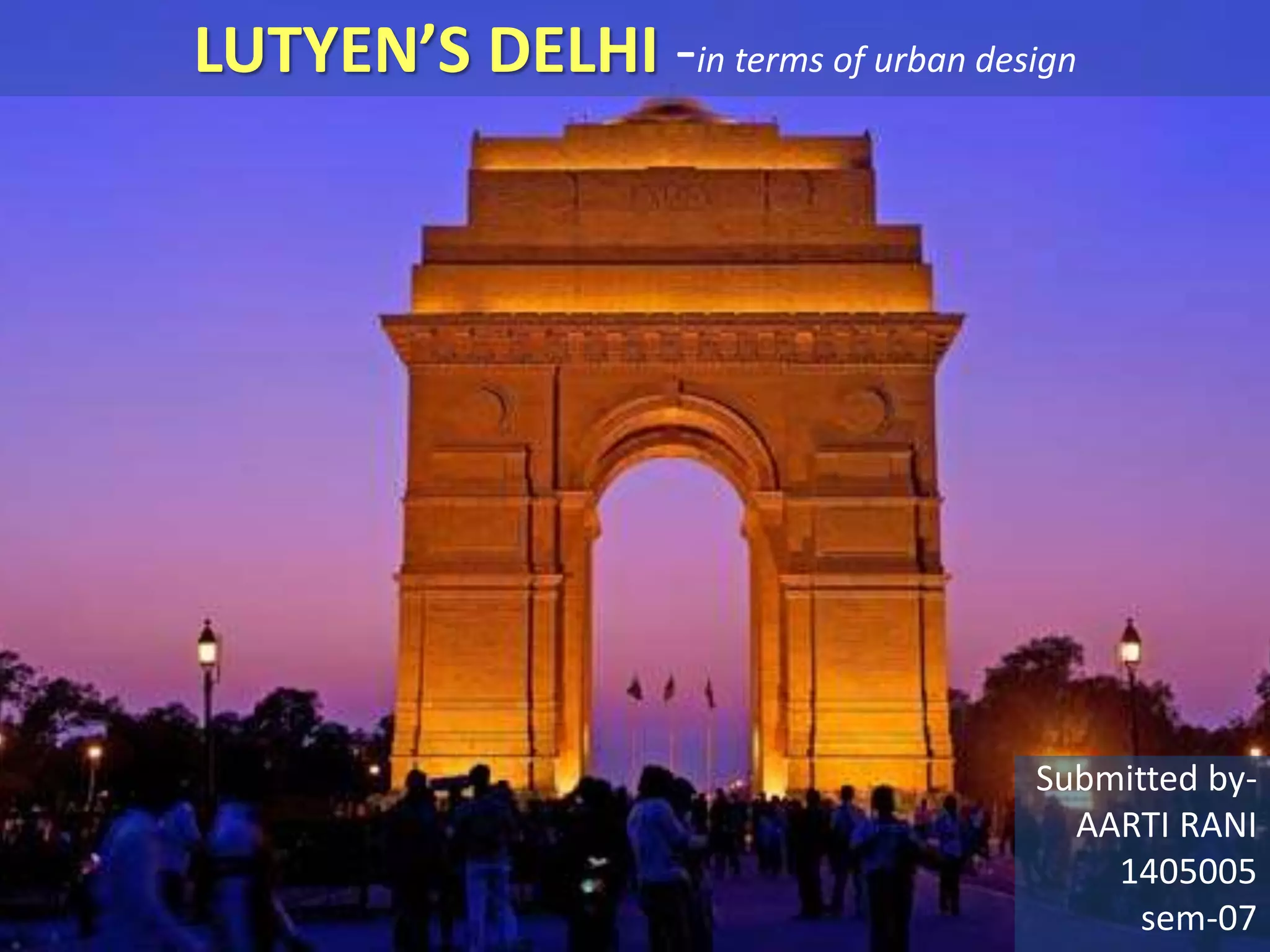
New Delhi was designed with a "Garden City" philosophy. It features wide, tree-lined boulevards, expansive circular roundabouts, and massive green spaces like Lodhi Gardens and the Central Secretariat. The architecture here is "Neo-Classical," blending Western styles with Indian motifs (such as the Chhatri). Iconic structures like Rashtrapati Bhavan (the President's House) and India Gate define the New Delhi skyline.
Comparing Delhi and New Delhi
To better visualize the differences, the following table breaks down the key characteristics of both entities as they stand in 2026.
| Feature | Delhi (NCT) | New Delhi |
|---|---|---|
| Status | Union Territory (NCT) | Capital City / Administrative District |
| Area | ~1,484 sq km | ~42.7 sq km |
| Primary Governing Body | Government of NCT of Delhi / MCD | New Delhi Municipal Council (NDMC) |
| Historical Origin | Multiple ancient & medieval empires | British Raj (20th Century) |
| Key Landmarks | Red Fort, Qutub Minar, Jama Masjid | Parliament House, India Gate, Rashtrapati Bhavan |
| Urban Layout | Organic, high-density, varying styles | Planned, grid-based, low-density |
| Population Density | Extremely high across many zones | Lower (high concentration of officials) |
The Role of the National Capital Region (NCR)
In modern discourse, a third term often enters the conversation: the National Capital Region (NCR). This is not a political entity in the same sense as the NCT, but an urban planning concept. The NCR includes the entire NCT of Delhi plus several surrounding districts from the neighboring states of Haryana, Uttar Pradesh, and Rajasthan.
Cities like Gurugram (Gurgaon), Noida, Faridabad, and Ghaziabad are part of the NCR. When people say they are "going to Delhi" for business, they are often actually heading to the corporate hubs of Gurugram or Noida. However, neither of these is in Delhi (the NCT), and they are certainly not in New Delhi. This highlights the importance of using precise terminology, especially for legal and logistical purposes.
Practical Implications for Residents and Visitors
Knowing the difference between Delhi and New Delhi is more than an academic exercise; it has practical consequences for daily life and travel.
Postal Addresses and Logistics
When sending mail or booking a courier, the distinction matters. While "New Delhi" is often used as a catch-all for the region, a specific PIN code (Postal Index Number) will determine whether a package goes to a government office in the NDMC area or a residential colony in South Delhi or West Delhi. In 2026, logistics providers rely heavily on these granular district classifications to navigate the city's complex traffic and zoning laws.
Transportation Hubs
The naming of transport hubs can be a major source of confusion for tourists.
- New Delhi Railway Station (NDLS): Located between Ajmeri Gate and Paharganj, this is the primary hub for high-speed trains like the Shatabdi and Rajdhani Express.
- Old Delhi Railway Station (DLI): Located in the heart of the historic city, serving different routes.
- Indira Gandhi International Airport (DEL): While the airport is the gateway to the capital, it is located in the South West Delhi district, not within the NDMC New Delhi boundary.
Legal and Judicial Jurisdiction
The High Court of Delhi has jurisdiction over the entire National Capital Territory. However, the Supreme Court of India is physically located within the New Delhi district. For businesses, the distinction is vital when determining which local municipal laws (NDMC vs. MCD) apply to building permits, waste management, and commercial taxation.
Common Misconceptions Resolved
A frequent mistake is the assumption that New Delhi is just "the modern part" of Delhi. This is inaccurate because many parts of Delhi (NCT) that are not in New Delhi are highly modern. Areas like Saket, Vasant Kunj, and Dwarka feature contemporary infrastructure, luxury malls, and modern apartments, yet they fall under the jurisdiction of the MCD, not the NDMC.
Another misconception is that New Delhi was the only capital India ever had in this region. In reality, the area has served as a capital for various dynasties for over a thousand years. New Delhi is simply the most recent iteration, built specifically to serve as the seat of modern democratic governance.
Frequently Asked Questions
Is New Delhi inside Delhi?
Yes, New Delhi is an administrative district located within the larger National Capital Territory (NCT) of Delhi. It represents a small portion of the total land area of the NCT but holds the highest political significance as the seat of the Indian government.
Why is New Delhi called the capital of India instead of just Delhi?
New Delhi is designated as the capital because it was specifically designed and built by the British to serve as the administrative center. The Parliament, Supreme Court, and all major central government ministries are located within the New Delhi municipal boundaries. While "Delhi" is the name of the broader territory, "New Delhi" is the specific legal seat of power.
Do I need a different visa or permit for New Delhi vs. Delhi?
No. There is no internal border or permit system between Delhi and New Delhi. They are part of the same Union Territory for the purposes of immigration and national law. Movement between the two is seamless, often marked only by a change in the width of the roads and the style of the streetlights.
Can I live in New Delhi?
While much of New Delhi is occupied by government bungalows and embassies, there are residential areas within the NDMC limits, such as parts of Chanakyapuri and various "colonies" nearby. However, these are among the most expensive real estate markets in the world. Most people who work in New Delhi actually live in other districts of the NCT or in NCR cities like Noida and Gurugram.
Is the Delhi Metro different in New Delhi?
The Delhi Metro Rail Corporation (DMRC) operates across the entire NCT and extends into the NCR. It connects Old Delhi, New Delhi, and the surrounding suburbs through a single unified network. There is no separate "New Delhi Metro"; it is one system serving the entire metropolitan expanse.
Are the laws different in New Delhi?
The fundamental criminal and civil laws of India apply equally to both. However, municipal bylaws regarding property taxes, sanitation, and commercial licensing differ because New Delhi is managed by the NDMC, while most of the rest of the territory is managed by the MCD.
Final Recommendation
For those planning a visit or conducting business in the region, it is best to refer to the broader region as Delhi when speaking generally about the culture, weather, or population. However, use the term New Delhi specifically when referring to official government functions, the capital’s administrative role, or when navigating to central landmarks like India Gate and the Parliament House.
If you are a traveler, always check your specific destination's district or PIN code. Mistaking a hotel in "Old Delhi" for one in "New Delhi" can result in a very different experience regarding noise levels, accessibility, and surroundings. Understanding this geographic nuance ensures better planning and a clearer appreciation of India’s multifaceted capital.