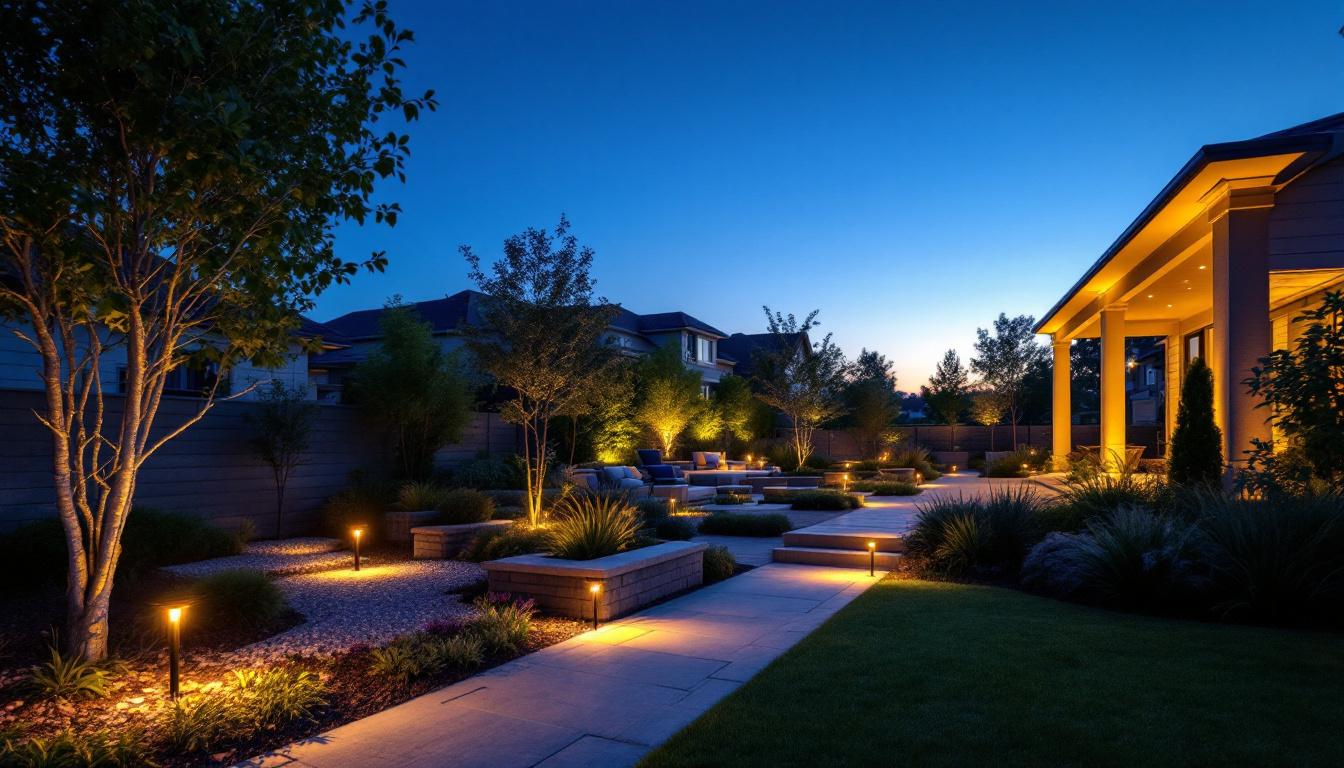
Accent lighting outdoor solar for gardens provides a wireless, energy-efficient way to highlight architectural features, prize plantings, and pathways. By utilizing integrated photovoltaic cells and high-capacity batteries, these fixtures transform stored sunlight into atmospheric evening illumination, enhancing property value and safety without the need for complex electrical trenching or increased utility costs.
Understanding the Role of Solar Accent Lighting in Modern Landscapes
As we move through 2026, the integration of solar technology into residential landscaping has transitioned from a niche hobby to a standard practice for homeowners. Accent lighting differs from task or security lighting in its primary intent: it is designed to create visual interest rather than provide high-intensity floodlighting. In a garden setting, accent lighting draws the eye to specific focal points—such as a mature Japanese maple, a stone water feature, or the texture of a brick retaining wall—creating depth and a sense of "outdoor rooms" that extend the home's living space after dark.
The primary appeal of solar-powered units lies in their autonomy. Traditional low-voltage lighting systems require a transformer, specialized outdoor cabling, and a dedicated power outlet. Solar accent lights for gardens bypass these requirements, allowing for placement in remote corners of a property where running wire would be cost-prohibitive. Furthermore, the 2026 generation of solar fixtures utilizes high-efficiency monocrystalline panels and advanced LED drivers, ensuring that even on overcast days, the fixtures can gather enough energy to provide consistent illumination throughout the evening.
Technical Specifications and Component Standards
When selecting accent lighting outdoor solar for gardens, understanding the internal components is vital for ensuring longevity and performance. Unlike the disposable plastic units of a decade ago, modern high-quality solar lights are engineered to withstand environmental stressors while maintaining light quality.
Solar Panel Efficiency
In 2026, the industry standard has shifted toward high-output monocrystalline silicon panels. These panels offer an efficiency rating of approximately 20% to 24%, compared to the 12% to 15% seen in older polycrystalline models. This efficiency is crucial for accent lighting because these fixtures often need to power higher-lumen LEDs to effectively highlight large garden features.
Battery Technology and Energy Storage
The transition to Lithium Iron Phosphate (LiFePO4) batteries is now complete across premium solar lighting tiers. LiFePO4 batteries are preferred over traditional Nickel-Metal Hydride (NiMH) or standard Lithium-ion because they offer significantly more charge cycles—often lasting 5 to 7 years—and are more stable in high-temperature environments. When evaluating a fixture, look for a battery capacity (measured in milliamp-hours or mAh) that is rated for at least 1.5 times the expected nightly power draw to account for partial charging on cloudy days.
Ingress Protection (IP) Ratings
For garden environments, where fixtures are exposed to irrigation, rain, and soil moisture, the IP rating is a non-negotiable metric.
- IP65: Rated to withstand low-pressure water jets and is dust-tight. Suitable for most garden accent lights.
- IP67: Can be submerged in water up to 1 meter for 30 minutes. This is necessary for "well lights" or ground-recessed units that may sit in puddles during heavy rain.
Designing with Light: Techniques for Garden Accenting
Successful accent lighting is about the interplay between light and shadow. Over-lighting a garden can lead to a "washed-out" look, whereas strategic placement creates a professional, multi-dimensional aesthetic.
Uplighting for Structural Grandeur
Uplighting is the most common form of accent lighting. By placing a solar spotlight at the base of a tree or architectural column and aiming it upward, you emphasize the height and texture of the object. For tall trees, a narrow-beam spotlight (15 to 30 degrees) is effective, while for wide shrubs or walls, a broader flood-style accent light (60 to 90 degrees) works better to distribute the glow.
Silhouetting and Shadowing
Silhouetting involves placing a solar light behind an object, directed toward a wall or fence. This creates a dark outline of the plant or sculpture against a lit backdrop. Conversely, shadowing involves placing the light in front of a textured object and aiming it toward a vertical surface to project the object's shadow. This is particularly effective with plants that have delicate leaf structures, like ferns or ornamental grasses.
Grazing for Texture
If your garden features stone walls, timber siding, or rugged masonry, grazing is a powerful technique. Place the solar fixture very close to the surface (usually within 6 to 12 inches) and aim it parallel to the wall. This heightens the highlights and deepens the shadows of the material's texture, providing a dramatic, high-end appearance.
Comparing Solar Accent Light Types for Garden Use
The following table summarizes the most common solar fixtures used for garden accenting in 2026, focusing on their typical performance and best applications.
| Fixture Type | Typical Lumen Output | Ideal Application | Light Spread |
|---|---|---|---|
| Solar Spotlights | 100 - 400 Lumens | Trees, statues, flags | Narrow to Medium |
| Well/In-Ground Lights | 50 - 150 Lumens | Pathways, low walls, shrubs | Wide/Diffuse |
| Wash Lights | 150 - 300 Lumens | Large hedges, broad walls | Very Wide |
| Hanging Lanterns | 10 - 50 Lumens | Pergolas, tree branches | Ambient/Omnidirectional |
| Solar Rocks | 20 - 80 Lumens | Naturalistic flower beds | Diffuse |
Installation and Placement Optimization
To maximize the effectiveness of accent lighting outdoor solar for gardens, placement must consider both the aesthetic goal and the technical requirement for sunlight.
- Sunlight Exposure: Solar panels require direct UV exposure to charge the internal batteries fully. In the northern hemisphere, south-facing panels are ideal. Even a few hours of shade from a nearby tree can reduce the nightly run-time by 30% or more. Many 2026 models feature "remote panels," where the light is in the shade but the panel is connected via a 10-foot wire to a sunny spot.
- Color Temperature (Kelvin): For garden accenting, the color temperature of the LED is critical. Warm white (2700K to 3000K) is generally preferred because it enhances the natural greens and browns of the landscape. Cool white (5000K+) can appear harsh and clinical in a garden, often making foliage look gray or blue.
- Beam Adjustment: Most professional-grade solar spotlights feature adjustable heads. After installation, perform a "night aim" where you adjust the angle of the beam to ensure the light hits the desired focal point without causing glare for viewers on the patio or looking out from windows.
Maintenance and Troubleshooting
While solar lights are low-maintenance, they are not "no-maintenance." To preserve the system's performance, a few routine tasks are necessary.
Cleaning the Photovoltaic Surface
Dust, pollen, and hard water spots from sprinklers can build up on the solar panel's surface, acting like a filter that blocks sunlight. Every three months, wipe the panels with a damp, soft cloth. Avoid using harsh chemicals or abrasive pads, which can scratch the protective coating and permanently reduce efficiency.
Winter Management
In 2026, many solar lights include "winter modes" or "power-saving modes" that reduce the lumen output to extend the battery life during shorter days. If your region experiences heavy snow, ensure the panels are cleared promptly. If the temperature drops below -4°F (-20°C) for extended periods, some manufacturers recommend bringing the units indoors, as extreme cold can degrade the battery chemistry, though LiFePO4 units are generally more resilient than older types.
Troubleshooting Dim or Non-Functional Lights
If a light fails to turn on, first check the sensor. Most solar lights use the solar panel itself as a light sensor; if there is a nearby streetlamp or bright porch light, the fixture may "think" it is still daytime. If the light is dim, it usually indicates a battery that is reaching the end of its life cycle or a panel that is not receiving sufficient direct sunlight.
Cost Considerations and Long-Term Value
In 2026, the price of high-quality solar accent lighting has stabilized. While entry-level "stake lights" can be found for $10–$15, professional-grade solar spotlights for garden accenting typically range from $45 to $120 per fixture.
The value proposition of these higher-end units is found in their durability. A $60 fixture with a replaceable LiFePO4 battery and an aluminum housing will likely outlast five $10 plastic units. Furthermore, because there is no electricity cost and no professional installation required (which can cost $2,000–$5,000 for a hardwired system), the "break-even" point for solar accent lighting is often immediate upon installation.
Frequently Asked Questions
Can solar accent lights work in the shade?
Solar lights can operate in partial shade, but their performance will be significantly diminished. If a panel is in the shade for most of the day, the light may only stay on for 1-2 hours at night. For shaded garden areas, use "split-circuit" solar lights where the panel is located up to 15 feet away from the light fixture in a sunny location.
How long do the LEDs and batteries actually last?
In 2026, the high-intensity LEDs used in garden accent lighting are typically rated for 50,000 hours of use, which equates to over 11 years if used for 12 hours every night. The batteries are the most common point of failure; a high-quality LiFePO4 battery should last between 2,000 and 3,000 charge cycles, or roughly 5 to 8 years.
Is solar accent lighting bright enough to illuminate a large tree?
Yes, modern solar spotlights can produce up to 400-600 lumens, which is equivalent to a 40W-50W incandescent bulb. This is more than sufficient to illuminate a tree up to 25 feet tall. For exceptionally large canopy trees, using two or three fixtures from different angles is recommended to provide full coverage.
Do I need to turn the lights off during the day?
No. Solar accent lights are designed with built-in sensors (often called dusk-to-dawn sensors) that automatically detect the drop in light levels. They will charge during the day and activate automatically at night. Most fixtures also include a manual "off" switch if you wish to store them or prevent them from turning on during a specific event.
Are these lights safe for pets and wildlife?
Solar lighting is generally safer for gardens than high-voltage lighting because there are no wires for pets to chew on and no risk of electrical shock in wet soil. To minimize the impact on local wildlife and nocturnal insects, choose fixtures with a warm color temperature (under 3000K) and use "shielded" fixtures that direct light downward or specifically at the target object to reduce light pollution.
Final Recommendation for Homeowners
For the best results with accent lighting outdoor solar for gardens, avoid purchasing bulk "all-in-one" kits from big-box retailers. Instead, invest in individual, high-lumen spotlights with adjustable panels and metal housings. Focus your initial efforts on three key focal points—typically a significant tree, a water feature, and an architectural corner—to create a balanced "triangle" of light. This approach provides the most professional look and allows you to expand your lighting design as your garden matures and your needs evolve.