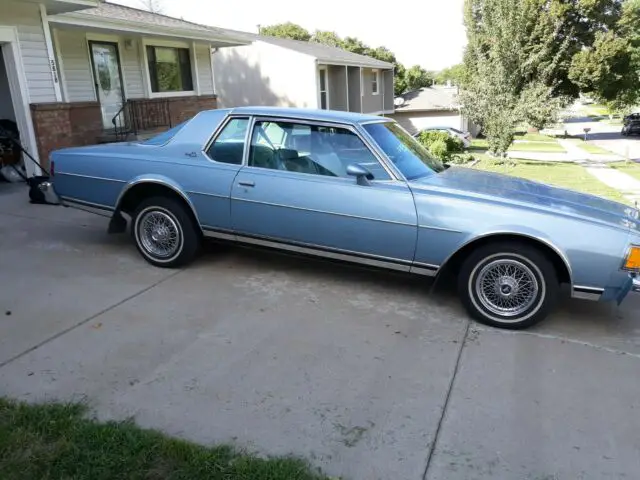
The 1978 Chevrolet Caprice Classic 2-Door represents a pivotal shift in automotive design, marking the transition from the oversized, fuel-thirsty land yachts of the early 1970s to a more efficient, downsized architecture. This model year solidified the success of the B-body platform’s redesign, balancing improved structural efficiency with the traditional comfort and luxury expectations of the Chevrolet flagship, effectively defining the domestic personal luxury segment for the late 1970s.
The Context of the 1977-1979 Downsizing Program
To understand the 1978 Caprice Classic 2-door, one must first recognize the industry-wide mandate for change. Following the 1973 oil crisis and the subsequent implementation of Corporate Average Fuel Economy (CAFE) standards, General Motors faced an urgent need to reduce the weight and physical footprint of its full-size vehicles.
In 1977, Chevrolet unveiled the completely redesigned B-body platform. While the exterior dimensions shrunk significantly—the 1977/1978 models were shorter, narrower, and lighter than their 1976 predecessors—GM engineers prioritized interior packaging. By utilizing more upright seating positions and efficient glass-to-body ratios, the 1978 Caprice Classic 2-door managed to offer more headroom, legroom, and trunk space than the larger cars it replaced. This engineering paradox became a hallmark of the late 70s GM strategy, proving that fuel economy did not have to come at the expense of passenger comfort.
Technical Evolution and Platform Architecture
The 1978 Caprice Classic 2-door utilized a perimeter frame chassis, but it was drastically modernized. The suspension geometry was revised to provide a more controlled ride compared to the "floaty" feeling of early 70s Chevrolets. The 2-door coupe variant was particularly distinct, featuring a formal roofline that distinguished it from the sportier, more tapered designs of the era.
Key technical specifications for the 1978 model year included:
- Chassis: Full perimeter frame with rubber-isolated body mounts to minimize vibration and road noise.
- Suspension: Front coil springs with unequal-length A-arms; rear four-link system with coil springs and a solid rear axle.
- Engine Options: The lineup began with the 250 cubic-inch (4.1L) inline-six, followed by the 305 cubic-inch (5.0L) V8, and the top-tier 350 cubic-inch (5.7L) V8.
- Transmission: Primarily the Turbo-Hydramatic 350, known for its reliability and smooth shifting characteristics in period applications.
The shift toward the 305 V8 became a defining trait of the 1978 model. It offered a middle ground between the fuel-sipping efficiency required by regulators and the torque required by American drivers accustomed to the "big block" experience.
Distinguishing the 1978 Model Year
While the 1977 redesign was the most radical, the 1978 model year served as the refinement phase. In 1978, Chevrolet made subtle aesthetic updates to the grill and tail lamp configurations to distinguish the car from the inaugural 1977 launch models.
The 2-door coupe, specifically, was marketed toward a buyer seeking personal luxury. With the "Classic" designation, the interior featured higher-grade upholstery, wood-grain accents on the dashboard, and enhanced sound-deadening materials. This was not a sports car; it was a testament to "boulevard cruising." The refinement in the 1978 build quality—specifically regarding door seals and window alignment—helped rectify some of the initial assembly-line hiccups that occurred during the massive tooling changeover of the 1977 model year.
Performance and Market Position
Comparing the 1978 Caprice Classic 2-door to its contemporaries provides clarity on its market success. The car competed against the Ford LTD II and the Chrysler Cordoba. While the Mopar offerings often leaned into "luxury styling," the Chevrolet offered a pragmatic balance of parts availability, lower maintenance costs, and a more user-friendly driving experience.
| Feature | 1978 Caprice Classic (2-Door) | Typical Competitor (1978) |
|---|---|---|
| Curb Weight | ~3,500 lbs | ~3,800–4,100 lbs |
| Primary V8 | 305 CID (5.0L) | 360/400 CID (5.9/6.6L) |
| Fuel Economy | Improved (Approx. 16-19 MPG) | Lower (Approx. 12-15 MPG) |
| Maintenance | High part compatibility | Often proprietary/limited |
The primary appeal was its "right-sized" nature. Drivers felt they were piloting a substantial, safe vehicle, yet they could maneuver it into a standard parking space without the stress of the previous generation's 225-inch length.
Ownership, Maintenance, and Preservation
In 2026, the 1978 Caprice Classic 2-door has transitioned from a used car to a classic enthusiast vehicle. Because the B-body platform was produced in high volumes, the primary advantage for owners today is the availability of replacement components. Most mechanical parts, including suspension bushings, brake calipers, and engine internals, are interchangeable with a vast array of GM vehicles from the late 70s through the 80s.
Critical Maintenance Considerations:
- Rust Remediation: The rocker panels and the rear quarter panels behind the wheel wells are the most common corrosion points. In any inspection, these areas should be prioritized.
- Vacuum Systems: The 1978 model relied heavily on vacuum-operated systems for heating and climate control (HVAC) doors. Over four decades, these vacuum lines often become brittle or develop leaks, leading to malfunctioning cabin airflow.
- Transmission Seals: The Turbo-Hydramatic 350 is robust, but the output shaft and pan seals often require replacement due to age-related hardening of rubber components.
- Electrical Grounding: Like many domestic cars of the era, the factory ground straps can corrode. This often manifests as flickering instrument panel lights or intermittent starting issues.
Cultural Significance
The 1978 Caprice Classic 2-door remains an iconic piece of American industrial history. It represents the moment the American automotive industry stopped fighting physics and began adapting to it. The car proved that "downsizing" did not have to result in "downgrading." It remains a popular canvas for both factory-correct restoration enthusiasts and the "Donk" or "Lowrider" car culture communities, who prize the car for its iconic body lines and the ease of modifying its robust chassis.
Frequently Asked Questions
Why is the 1978 Caprice Classic 2-door considered more "refined" than the 1977 model? The 1978 model benefited from a full year of customer feedback and assembly-line adjustments. Minor tweaks to the exterior trim, improved weatherstripping, and better quality control in the paint shop made the 1978 version a more "sorted" vehicle compared to the 1977 launch year.
What is the most sought-after engine configuration for a 1978 2-door? Most collectors prefer the 350 cubic-inch (5.7L) V8 option. While the 305 was sufficient, the 350 provides the classic "Small Block Chevy" torque and exhaust note that many enthusiasts associate with the era, while still retaining excellent parts availability.
Are parts still readily available for the 1978 Caprice in 2026? Yes, due to the high volume of production and the sharing of the B-body platform with the Impala, Oldsmobile, and Buick lines, mechanical parts are plentiful. Trim and interior upholstery are the only categories where "New Old Stock" (NOS) parts have become scarce, often requiring custom fabrication or restoration.
What is the primary difference between the 2-door Coupe and the 4-door Sedan? Beyond the obvious two-door configuration, the 2-door coupe featured a unique "formal" roofline designed to mimic the appearance of luxury touring cars. This roofline was less aerodynamic than the sedan's but provided a more distinct, sophisticated aesthetic favored by buyers at the time.
Is the 1978 Caprice suitable for a daily driver in 2026? While the mechanical reliability is high, it lacks modern safety features like airbags, side-impact protection, or modern crumple zones. For short weekend drives or car shows, it is highly capable, but prospective owners should factor in the lack of modern passive safety equipment before considering frequent use in heavy, modern traffic.
Final Recommendation for Owners and Enthusiasts
If you are currently looking to acquire or restore a 1978 Caprice Classic 2-door, focus your search on a rust-free shell. Because the engine and transmission are essentially "bulletproof" and easy to repair, the true value of the vehicle lies in the integrity of the bodywork and the completeness of the interior trim. Prioritize the replacement of all rubber seals and cooling system components immediately upon acquisition; after forty-eight years, these parts are the most likely to cause a mechanical failure. Maintaining this vehicle is an act of preserving a specific, transformative era of the American automobile—a time when efficiency was forced upon the industry, and the results were surprisingly elegant.