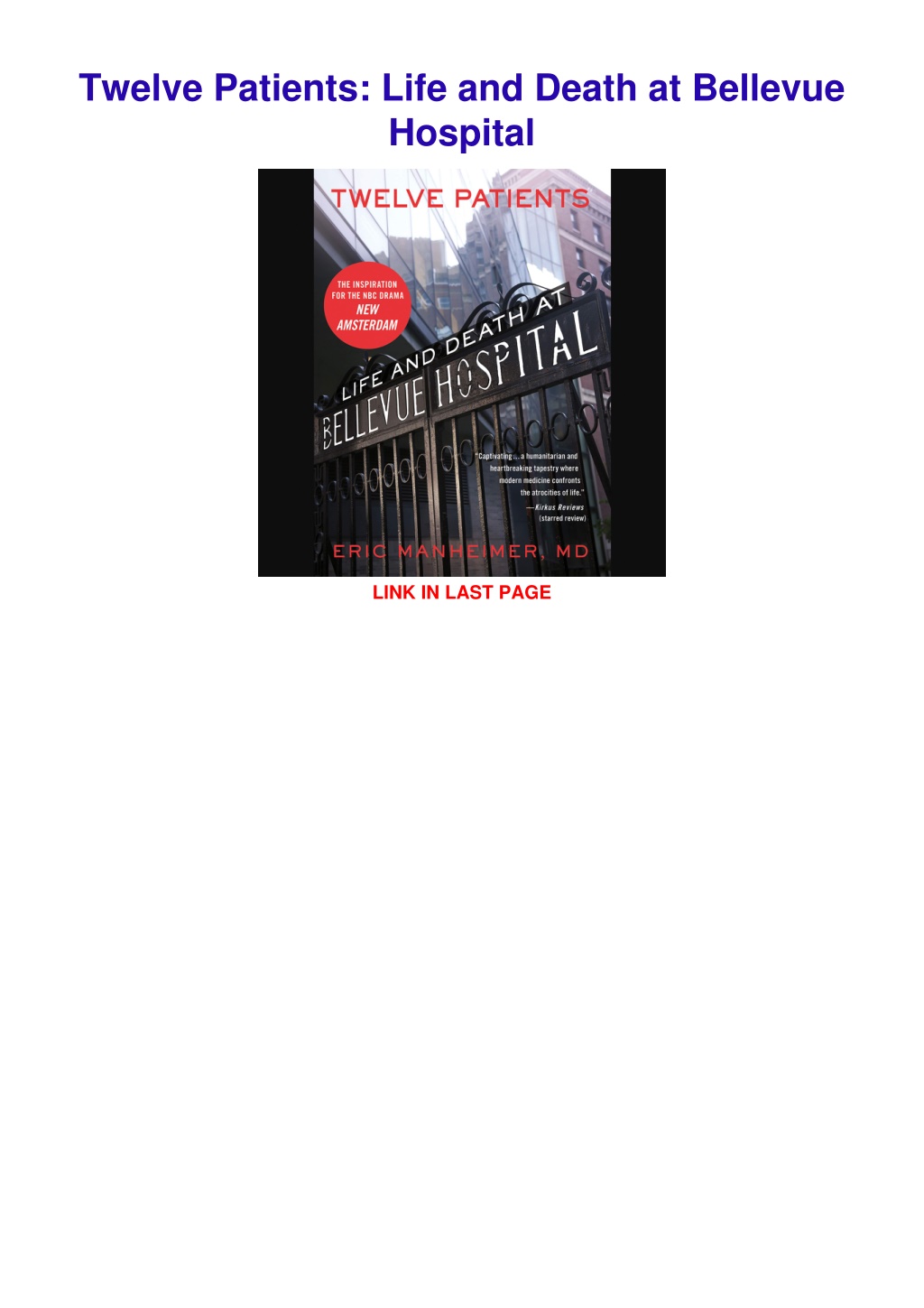
"12 Patients: Life and Death at Bellevue Hospital" by Dr. Eric Manheimer is a foundational literary and clinical text offering a harrowing, deeply human look inside the daily operations of America's oldest continuously operating public hospital. Serving as a reference overview for medical ethics, public health administration, and narrative medicine, the book chronicles twelve distinct patient profiles that embody the broader structural crises, triumphs, and failures of the urban healthcare system in New York City. By examining the interplay between severe illness, socio-economic marginalization, and institutional limitations, the text provides healthcare professionals, students, and general readers alike with a panoramic view of safety-net medicine.
Context, Authorship, and Institutional Scope of Bellevue Hospital
Bellevue Hospital, established in 1736 in New York City, occupies a unique position in the history of American medicine. Long before it became famous for treating heads of state, diplomats, and celebrities, it served as an almshouse infirmary. Over the centuries, Bellevue evolved into a premier teaching hospital and the ultimate safety-net institution for New York City's most vulnerable populations—including the uninsured, undocumented immigrants, incarcerated individuals, and the severely mentally ill.
Dr. Eric Manheimer served as the medical director of Bellevue Hospital for over a dozen years. In that role, he was responsible for overseeing patient care across vastly different departments, ranging from the emergency department and the correctional ward to the oncology unit and psychiatric services. "12 Patients" draws directly from Manheimer’s extensive journals, capturing the institutional friction between bureaucratic mandates, financial constraints, and the moral imperative to heal.
Understanding the operational framework of Bellevue is essential for analyzing the book. Public hospitals operate under a legal and ethical mandate to treat any patient who walks through their doors, regardless of their ability to pay, legal status, or insurance coverage. This open-door policy creates a high-volume, high-acuity environment where medical practitioners frequently encounter diseases of poverty, substance use disorders, and untreated mental illness. The book serves as a clinical and sociological reference document because it exposes the downstream consequences of a fractured social safety net, illustrating how societal failures inevitably land on the exam tables of emergency rooms.
Structural Anatomy of the Book: The Twelve Patient Profiles
The core structure of "12 Patients" relies on twelve narrative case studies. Rather than presenting abstract policy debates, Dr. Manheimer grounds systemic critiques in individual human experiences. Each patient profile highlights a different facet of public healthcare delivery, medical ethics, and institutional vulnerability.
1. The Undocumented Immigrant
This profile examines the extreme barriers faced by undocumented patients navigating the American healthcare system. Without access to preventative care or long-term insurance subsidies, these individuals often delay seeking treatment until a condition becomes life-threatening. The text details the ethical dilemmas physicians face when treating advanced pathologies that could have been managed cheaply in an outpatient setting, contrasted against the massive hospital costs incurred during emergency interventions.
2. The Prisoner
Healthcare behind bars intersects with public hospital care in complex ways. This profile explores the tension between security protocols and medical ethics. Physicians must balance the duty of care with the presence of armed guards, shackle requirements, and correctional hierarchies, all while treating incarcerated patients who frequently suffer from chronic neglect and untreated infectious diseases.
3. The Uninsured Artist
Representing the precarious nature of the American gig economy and creative class, this case study highlights the sudden descent into medical bankruptcy and administrative labyrinth. It demonstrates how a single catastrophic diagnosis can strip away financial stability, forcing patients to rely entirely on charity care and social work interventions to navigate their treatment paths.
4. The Severe Mental Illness Patient
As the de facto psychiatric facility for the region, Bellevue deals extensively with the deinstitutionalization fallout. This profile details the "revolving door" phenomenon, where patients with severe psychiatric disorders cycle through emergency stabilization, temporary housing, and street homelessness due to a lack of robust community-level support structures.
5. The Substance Use Disorder Patient
Chronic addiction is a constant presence in the public hospital ecosystem. This chapter explores the physiological toll of severe substance dependence alongside the medical complications of endocarditis, abscesses, and overdose. Dr. Manheimer examines the limitations of acute medical intervention in the absence of comprehensive rehabilitation and harm-reduction infrastructure.
6. The Elderly Geriatric Patient
Social isolation and elder neglect manifest starkly in urban emergency rooms. This profile addresses the challenges of disposition planning—discharging elderly patients who lack family support or safe housing environments, turning hospitals into long-term holding facilities while social workers search for scarce nursing home placements.
7. The Developmentally Disabled Adult
Navigating complex medical needs alongside cognitive impairments requires multidisciplinary advocacy. This case illustrates the vulnerabilities of adults aging out of state care systems and the difficulties clinicians face in securing ongoing support and legal guardianship.
8. The Chronic Pain Sufferer
Examining the delicate balance between palliative care, pain management, and the risks of iatrogenic addiction, this profile highlights the difficulties of treating chronic pain in marginalized populations who lack consistent primary care physicians to monitor their medication regimens.
9. The Homeless Shelter Resident
Living in New York City's municipal shelter system exposes individuals to severe environmental hazards, infectious outbreaks, and physical violence. This chapter connects urban housing policy directly to public health outcomes, showing how environmental instability undermines medical recovery.
10. The Foreign Diplomat
Providing a sharp institutional contrast, this profile explores the dual nature of Bellevue—a facility that simultaneously serves destitute street patients and international dignitaries requiring specialized care. It exposes the internal resource allocation debates within a public institution balancing public service mandates with high-paying private international contracts.
11. The Traumatic Injury Victim
Focusing on the high-acuity surgical and emergency response units, this case details the frantic, coordinated efforts of trauma teams dealing with urban violence, vehicular accidents, and industrial injuries, emphasizing the split-second decisions required in acute resuscitation.
12. The Terminally Ill Patient
Palliative care and the ethics of end-of-life decision-making form the basis of this final profile. It explores how a public hospital manages mortality when patients lack advance directives, family proxies, or the financial means to access hospice care outside of institutional walls.
Key Themes and Analytical Reference Points
"12 Patients" transcends standard medical memoir writing by engaging directly with systemic policy issues. Scholars, medical students, and healthcare administrators frequently reference the text to examine several core themes:
- The Safety-Net Burden: The book quantifies and personalizes the reality that public hospitals absorb the financial and operational shocks of a broken healthcare market. When private hospital systems close unprofitable departments or turn away uninsured patients, Bellevue absorbs the surplus demand.
- Medical Ethics at the Bedside: Clinicians in resource-constrained environments face daily triage decisions that go beyond medical severity. They must weigh social determinants of health, housing availability, and legal status against clinical guidelines.
- The Intersection of Bureaucracy and Empathy: Dr. Manheimer highlights the emotional burnout experienced by healthcare providers who must navigate rigid hospital administration policies while trying to maintain humanistic connections with suffering patients.
| Patient Category | Primary Clinical Challenge | Institutional Barrier | Systemic Context |
|---|---|---|---|
| Undocumented Immigrant | Advanced pathology, delayed presentation | Lack of insurance, deportation fears | Safety-net emergency access limitations |
| Incarcerated Individual | Infectious disease, trauma, chronic illness | Security protocols, correctional oversight | Prison-to-hospital pipeline deficiencies |
| Severe Mental Illness | Acute psychosis, non-compliance | Deinstitutionalization, lack of step-down care | Community mental health funding gaps |
| Homeless Shelter Resident | Environmental exposure, trauma, malnutrition | Housing instability, lack of post-discharge home | Municipal shelter system health hazards |
Comparative Overview: Public vs. Private Healthcare Delivery
To fully grasp the reference value of "12 Patients," it is helpful to contrast the operating realities of Bellevue Hospital with private, profit-driven healthcare institutions. Private hospitals optimize their service lines around insured populations and lucrative specialties such as orthopedics and cardiology. Conversely, public institutions maintain round-the-clock emergency departments, burn units, psychiatric wards, and prison wards regardless of profitability.
- Urban Population
- Private Insured Market
- Specialized Private Hospitals (Profitable Care)
- Uninsured / Underinsured / Marginalized
- Bellevue Hospital (Safety-Net Care)
- Private Insured Market
This structural division creates severe funding imbalances. Public hospitals rely heavily on municipal tax subsidies, state disproportionate share hospital (DSH) funds, and federal grants. When these funding streams fluctuate, patient care quality, staffing ratios, and infrastructure maintenance face immediate threats. Dr. Manheimer’s accounts illustrate how administrative budget cuts directly translate to depleted medication supplies, overworked nursing staff, and extended wait times in emergency corridors.
Practical Guidance and Lessons for Modern Healthcare Professionals
For contemporary medical practitioners, hospital administrators, and public health advocates, "12 Patients" offers actionable insights into systemic resilience and patient advocacy.
- Integrate Social Determinants into Treatment Plans: Clinical interventions frequently fail if a patient is discharged back into homelessness, food insecurity, or an abusive environment. Effective care requires active collaboration with social work teams prior to discharge disposition.
- Recognize and Mitigate Institutional Burnout: High-volume public health environments breed compassion fatigue. Establishing institutional support structures, debriefing sessions, and psychological resources for clinical staff is vital for maintaining workforce retention and care quality.
- Advocate for Structural Reform: Individual clinical excellence is insufficient to overcome systemic failures. Healthcare providers must engage in health policy advocacy to address root causes such as affordable housing shortages, mental health funding deficits, and pharmaceutical pricing transparency.
Frequently Asked Questions
What is the main premise of "12 Patients: Life and Death at Bellevue Hospital"?
The book uses twelve distinct patient profiles from Dr. Eric Manheimer's tenure as medical director to illustrate the daily realities, systemic challenges, and ethical dilemmas of running America's oldest public safety-net hospital.
Is Bellevue Hospital a real institution?
Yes. Bellevue Hospital, located in New York City, is the oldest continuously operating public hospital in the United States, founded in 1736. It has a historic legacy of pioneering medical treatments and serving marginalized populations.
Who is the author of the book?
The book was written by Dr. Eric Manheimer, who served as the medical director of Bellevue Hospital for over a dozen years, drawing on his extensive personal journals and clinical experience.
How does the book relate to public health policy?
The text serves as a reference overview for understanding the social determinants of health, demonstrating how economic inequality, housing instability, immigration status, and criminal justice policies directly impact emergency room utilization and clinical outcomes.
Does the book focus solely on medical procedures?
No. While clinical details are present, the primary focus is on the sociological, economic, and ethical dimensions of patient care, exploring the human stories behind complex institutional bureaucracies.
Conclusion and Next Actions
"12 Patients: Life and Death at Bellevue Hospital" remains an essential reference text for anyone seeking to understand the intersection of medicine, poverty, and institutional administration in the United States. By examining the lives of twelve diverse individuals, readers gain a clear perspective on the strengths and severe vulnerabilities of the public health safety net. To deepen your understanding of these topics, review contemporary public health policy reports on safety-net hospital funding, explore literature on narrative medicine, or examine municipal healthcare budget allocations in major urban centers.