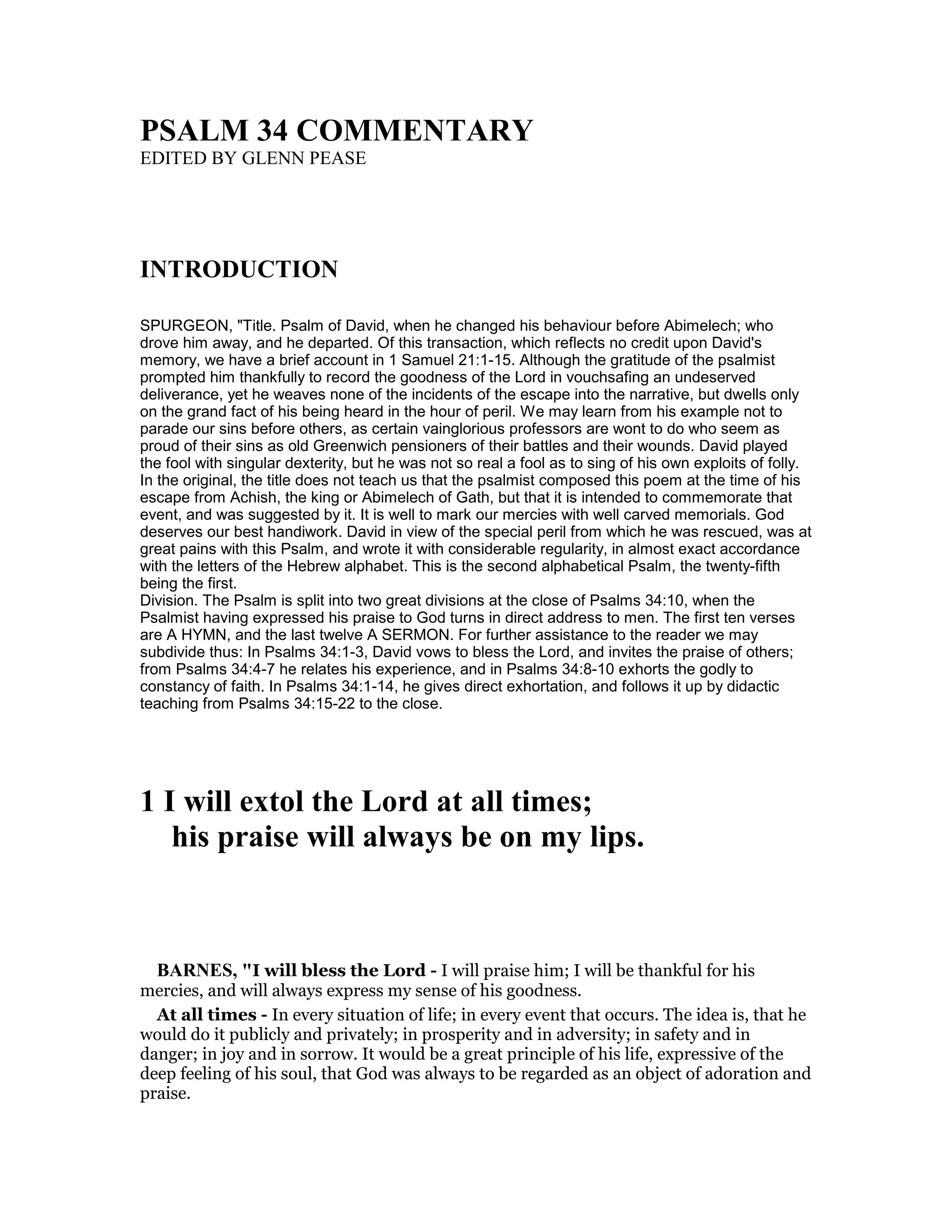
Psalm 34 stands as one of the most comforting, practical, and structurally deliberate wisdom poems in the Hebrew Psalter, offering an enduring explanation of how faith sustains individuals through deep suffering. Attributed historically to King David during a harrowing period of his life when he feigned madness before King Abimelech to escape execution, the psalm transitions from a personal testimony of deliverance into a universal tutorial on fearing God, guarding one's speech, and pursuing peace. Examining this text requires a close look at its historical backdrop, its sophisticated literary design, its theological themes, and its practical application for modern readers seeking stability in turbulent times.
Historical Context and Authorship: The Escape from Gath
To understand Psalm 34 properly, one must examine the historical superscription embedded in verse 1: "A Psalm of David, when he pretended madness before Abimelech, who drove him away, and he departed." This narrative coordinates directly with the events recorded in 1 Samuel 21:10–15. Fleeing from the murderous jealousy of King Saul, David escapes to Gath—the very hometown of Goliath, whom David had previously slain. Recognizing the mortal danger of being identified as a foreign champion in enemy territory, David resorts to feigning insanity, letting saliva run down his beard and scratching at the gates. Abimelech (also referred to as Achish in Samuel) dismisses him as a madman, sparing his life.
This biographical setting provides the psychological and spiritual lens through which the entire psalm must be read. David was not writing from a palace of comfort or security; he composed these lines fresh from a narrow escape, deeply aware of his own vulnerability. Yet, rather than boasting of his own cleverness in fooling the Philistine king, David attributes his preservation entirely to divine intervention. The psalm bridges the gap between acute crisis and profound gratitude, proving that genuine trust in God does not exempt a person from terrifying circumstances, but rather provides a safe passage through them.
Literary Structure: An Acrostic Poem of Praise
From a structural standpoint, Psalm 34 is an alphabetic acrostic, a literary device where each successive verse (or paired verses in some Hebrew configurations) begins with the subsequent letter of the Hebrew alphabet (Aleph through Tav). While some letters are slightly transposed or omitted in standard critical texts, the overarching intent is clear and deliberate: completeness.
Writing an acrostic poem was a traditional Hebrew method of expressing praise from A to Z, signifying a comprehensive, whole-hearted offering to God. This structured form also served as a pedagogical and mnemonic tool, making the text easier for worshippers to memorize, recite, and pass down through generations.
The psalm divides naturally into two distinct movements:
- Verses 1–10 (Personal Testimony and General Invitation): David declares his personal commitment to constant praise, testifies that God answered his prayer in a time of fear, and invites others to taste and see the goodness of the Lord.
- Verses 11–22 (Wisdom Instruction and Ethical Exhortation): David shifts tone to act as a teacher or father figure, instructing his listeners on how to live righteously, control their tongues, and trust that God remains intimately close to the brokenhearted.
Verse-by-Verse Thematic Breakdown
The Resolution to Praise (Verses 1–3)
"I will bless the Lord at all times; His praise shall continually be in my mouth." (Verse 1)
David initiates the psalm with a resolute act of the will. Praising God when circumstances are favorable is natural, but blessing the Lord "at all times"—especially when hiding in enemy territory or facing institutional opposition—requires a conscious spiritual discipline. Praise is framed not merely as an emotional reaction to good news, but as a continuous state of orientation toward the Creator.
He continues in verse 2: "My soul shall make its boast in the Lord; the humble shall hear of it and be glad." David deliberately strips away self-reliance. He does not boast in his military prowess, his royal anointing, or his survival tactics; he boasts solely in God's character. This humility acts as a beacon for others who are suffering, creating a community of shared encouragement.
Deliverance from Fear (Verses 4–7)
"I sought the Lord, and He heard me, and delivered me from all my fears." (Verse 4)
This verse captures the emotional core of the psalm. Notice that God delivered David not only from his physical adversaries in Gath, but specifically from "all my fears." Internal dread often paralyses human beings long before external threats materialize. By bringing his terror directly to God, David experiences a profound internal recalibration: "They looked to Him and were radiant, and their faces were not ashamed" (Verse 5).
Verse 6 introduces a universal application: "This poor man cried out, and the Lord heard him, and saved him out of all his troubles." The designation "poor man" (Hebrew ani) denotes one who is afflicted, needy, and entirely lacking human resources. It is precisely this posture of absolute dependency that unlocks divine intervention. Verse 7 reinforces this protection with military imagery: "The angel of the Lord encamps all around those who fear Him, and delivers them." The metaphor of a divine encampment suggests a permanent, active military defense surrounding the vulnerable believer.
Tasting the Goodness of God (Verses 8–10)
"Oh, taste and see that the Lord is good; blessed is the man who trusts in Him!" (Verse 8)
One of the most famous invitations in the Old Testament, this verse uses sensory language to describe spiritual reality. Knowing about God intellectually differs fundamentally from experiencing His goodness firsthand. To "taste" is to personally verify, consume, and internalize God's character.
Verses 9 and 10 build on this trust by addressing material and physical anxieties: "Oh, fear the Lord, you His saints! There is no want to those who fear Him. The young lions lack and suffer hunger; but those who seek the Lord shall not lack any good thing." While strong, aggressive, self-sufficient hunters (young lions) occasionally face starvation, those who humble themselves before God find their fundamental needs sustained.
The Conditions of Righteous Living (Verses 11–14)
"Come, you children, listen to me; I will teach you the fear of the Lord." (Verse 11)
David shifts from a worship leader to a wisdom teacher, adopting the authoritative yet tender voice of a father or elder instructing the community. He introduces a critical moral question in verses 12 and 13: "Who is the man who desires life, and loves many days, that he may see good? Keep your tongue from evil, and your lips from speaking deceit."
Here, the pursuit of a meaningful, long, and blessed life is directly tied to ethical speech. The human tongue is portrayed as a primary instrument of relational destruction or peace. To fear God is not an abstract, mystical emotion; it manifests concretely in daily behavior: "Depart from evil and do good; seek peace and pursue it" (Verse 14). Peace is not described as a passive state that arrives automatically, but as a fugitive that must be actively pursued.
| Psalm 34 Instruction | Practical Application | Corresponding Ethical Principle |
|---|---|---|
| Keep your tongue from evil | Refrain from gossip, slander, and malicious rumors. | Integrity in communication |
| Keep your lips from deceit | Speak absolute truth; avoid manipulation and dishonesty. | Transparency and trust |
| Depart from evil | Actively distance yourself from corrupt practices and harmful environments. | Moral separation |
| Do good | Perform acts of mercy, charity, and justice toward neighbors. | Active benevolence |
| Seek peace and pursue it | Actively work to resolve conflicts and restore harmony in relationships. | Reconciliation |
The Eyes of the Lord and the Brokenhearted (Verses 15–22)
The final section of the psalm provides deep theological reassurance regarding divine justice and human suffering.
"The eyes of the Lord are on the righteous, and His ears are open to their cry. The face of the Lord is against those who do evil, to cut off the memory of them from the earth." (Verses 15–16)
This contrast establishes a moral universe governed by a watchful God. While evildoers may seem prosperous temporarily, their legacy is ultimately erased. Conversely, God's attention is magnetically drawn toward those who suffer:
"The Lord is near to those who have a broken heart, and saves such as have a contrite spirit." (Verse 18)
A broken heart—often caused by grief, betrayal, failure, or oppression—is frequently viewed in human culture as a sign of weakness or failure. Yet Scripture presents it as the ideal qualification for divine intimacy. God does not stand distant from human pain; He draws remarkably close to those whose self-sufficiency has been shattered.
Verse 19 introduces a vital realism regarding human hardship: "Many are the afflictions of the righteous, but the Lord delivers him out of them all." The biblical text explicitly rejects the prosperity gospel notion that righteousness guarantees an easy life free from trouble. Afflictions are many and varied; the promise is not the absence of trials, but comprehensive deliverance ("out of them all").
The psalm concludes with a striking prophetic note in verse 20: "He guards all his bones; not one of them is broken." While physically applied to David's preservation in battle and hardship, the New Testament writers view this verse as a direct prophecy fulfilled in Jesus Christ during His crucifixion, where His legs were left unbroken (John 19:36). Verse 22 provides the final theological bracket: "The Lord redeems the soul of His servants, and none of those who trust in Him shall be condemned."
Comparative Analysis: Psalm 34 in Context
To fully appreciate Psalm 34, it helps to compare its theological motifs with other major wisdom and lament psalms within the Hebrew collection.
| Feature / Theme | Psalm 34 | Psalm 23 | Psalm 91 |
|---|---|---|---|
| Primary Author | David | David | Traditionally attributed to Moses |
| Historical Setting | Escape from Gath / Feigned madness | Wilderness / Royal life | General sanctuary / Crisis |
| Main Metaphor | The Teacher and the Refugee | The Shepherd and the Sheep | The Fortress and the Wings |
| View of Suffering | "Many are the afflictions..." | "Though I walk through the valley..." | "You will not fear the terror by night..." |
| Core Invitation | "Taste and see that the Lord is good" | "He restores my soul" | "He shall cover you with His feathers" |
While Psalm 23 uses pastoral imagery to convey internal peace and Psalm 91 emphasizes divine fortress protection during military or plague crises, Psalm 34 functions primarily as an ethical and experiential training manual. It pairs the raw reality of human failure and fear with the concrete disciplines of truthful speech, active peace-seeking, and steadfast trust in God's nearness to the broken.
Common Misinterpretations and Theological Pitfalls
When studying Psalm 34, modern readers occasionally fall into interpretive traps that distort the text's original message:
- The Formulaic Guarantee Fallacy: Some readers interpret verse 19 ("The Lord delivers him out of them all") as an absolute guarantee that every faithful believer will escape physical death, illness, or financial ruin in this lifetime. Historical reality and biblical context refute this; many righteous figures in Scripture and history (including prophets and apostles) suffered martyrdom. The ultimate "deliverance" encompasses eternal redemption and spiritual preservation, which transcends temporary earthly tragedy.
- Behavioral Legalism: The ethical instructions in verses 12–14 can be misconstrued as a merit-based system where human speech and moral perfection earn God's protection. However, the psalm consistently emphasizes grace and dependency—beginning with the "poor man" who cries out (verse 6) and the "contrite spirit" (verse 18). Good behavior is the fruit of a transformed heart anchored in trust, not the wage that purchases divine favor.
- Ignoring the Historical Anchor: Separating the psalm from David's desperate flight to Gath reduces the text to generic motivational poetry. Recognizing that these words were forged in an atmosphere of genuine terror and humiliation heightens their power, proving that profound praise can coexist with acute personal danger.
Practical Steps for Applying Psalm 34 Today
For contemporary readers, Psalm 34 provides a clear framework for navigating personal crisis, anxiety, and interpersonal conflict. Implementing its principles involves several deliberate steps:
- Inventory and Surrender Anxieties: Identify specific fears—whether financial, relational, or professional—and deliberately bring them before God, mirroring David's prayer in verse 4.
- Guard the Tongue Daily: Practice intentional self-control in communication. Before speaking or posting on digital platforms, screen words against the standard of verse 13: eliminate deceit, gossip, and malice.
- Cultivate Active Peace: Do not wait for harmony to happen organically. Take the initiative to resolve ongoing conflicts in family, work, or community settings, fulfilling the mandate to "pursue it" (verse 14).
- Embrace Vulnerability in Suffering: When experiencing a broken heart or a season of profound grief, resist the urge to isolate or project artificial strength. Accept God's nearness, recognizing that a contrite spirit is the primary meeting place for divine comfort.
Frequently Asked Questions
What is the main message of Psalm 34?
The main message of Psalm 34 is that God hears the cries of the afflicted, delivers those who trust in Him from their fears, and draws intimately close to the brokenhearted. It combines personal testimony with practical wisdom, urging believers to praise God continually, speak truthfully, and pursue peace.
Why is Psalm 34 written as an acrostic?
Psalm 34 is structured as an alphabetic acrostic—where each verse begins with successive letters of the Hebrew alphabet—to express comprehensive, whole-hearted praise from start to finish. This literary format also served as a memory aid for communal worship and transmission.
Who wrote Psalm 34 and what is its background?
The psalm was written by King David based on the historical account in 1 Samuel 21:10–15. David composed it after fleeing from King Saul, seeking refuge in the Philistine city of Gath, and feigning madness before King Abimelech to escape execution.
How does Psalm 34 apply to modern anxiety and fear?
Verse 4 explicitly states that David was delivered from "all my fears." The psalm teaches individuals to move past internal dread by turning directly to God in prayer, trading self-reliance for humility, and resting in the assurance of divine protection.
What does "taste and see that the Lord is good" mean in verse 8?
This phrase invites believers to move beyond abstract theological knowledge into a direct, personal experience of God's sustaining grace. Just as tasting food provides undeniable proof of its flavor, experiencing God's faithfulness during trials verifies His goodness firsthand.
Conclusion and Next Actions
Psalm 34 remains an essential anchor for anyone navigating seasons of uncertainty, fear, or profound personal failure. By grounding its theology in the real-life desperation of David's escape in Gath, the text bridges the gap between human weakness and divine strength. To integrate this wisdom into daily life, begin by reading through the psalm aloud each morning this week, pausing specifically at verse 4 to surrender personal anxieties to God, and practicing the ethical discipline of verse 13 by intentionally guarding your speech in every interaction.