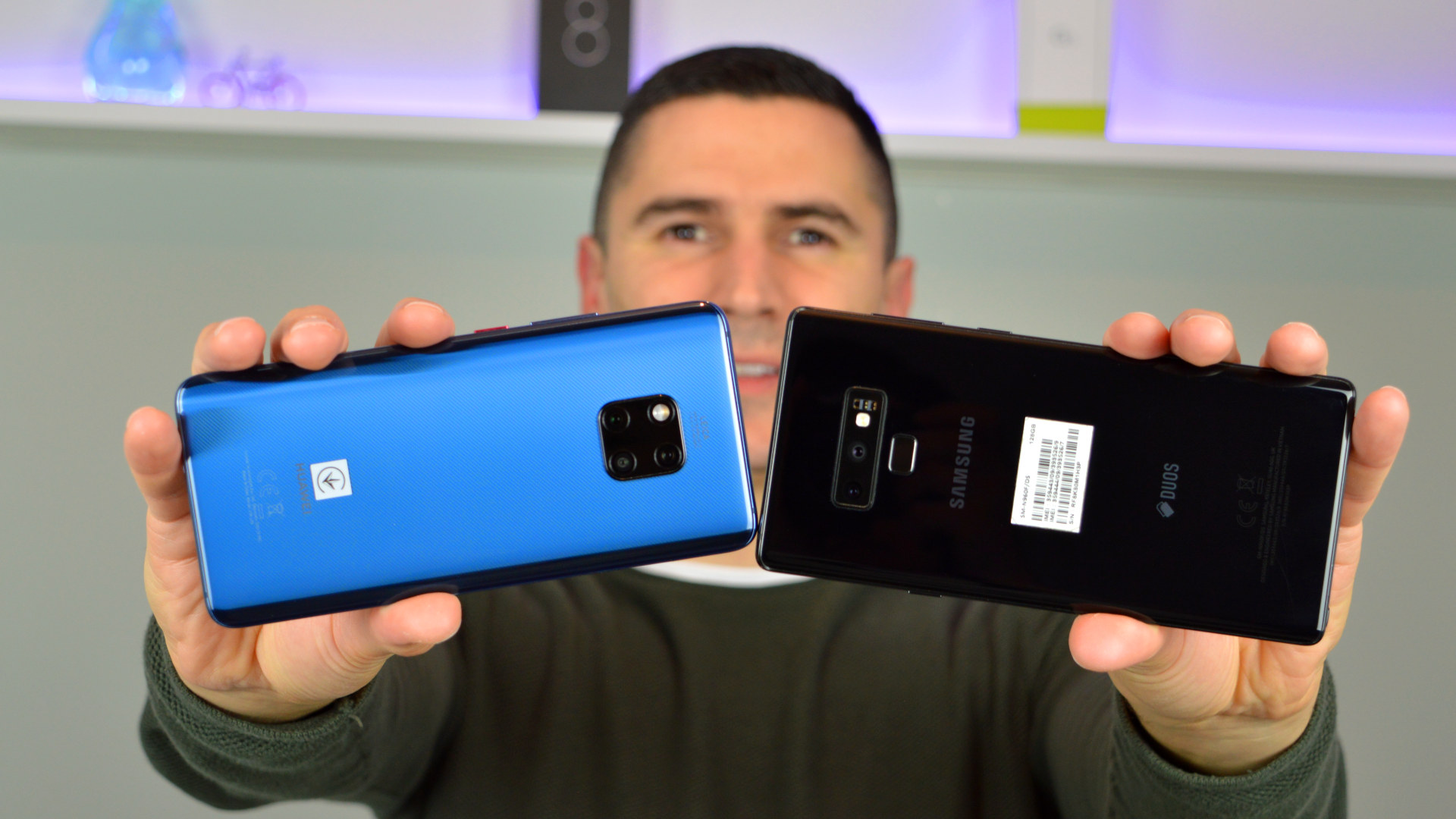
In the landscape of 2026, the Huawei Mate 20 Pro and the Samsung Galaxy S10 represent a pivotal era in smartphone evolution. Choosing between them involves weighing Huawei's superior battery technology and 3D face unlock against Samsung’s refined software experience and superior display quality. Both devices remain significant benchmarks for mobile photography and hardware engineering.
To understand the comparison between the Huawei Mate 20 Pro and the Samsung Galaxy S10, one must look back at the years 2018 and 2019, when these devices dominated the premium market. These phones were the last of their kind before the industry shifted toward high-refresh-rate screens and 5G ubiquity. Today, as these devices have reached their legacy status, the differences in their design philosophies, internal hardware, and long-term software viability provide a fascinating look at how these two giants competed for dominance.
Design and Build Quality: Aesthetics vs. Ergonomics
The Huawei Mate 20 Pro and Samsung Galaxy S10 share a common design language characterized by "glass sandwiches" held together by aluminum frames, but their executions differ significantly. The Mate 20 Pro, released in late 2018, opted for a more aggressive, industrial aesthetic. It featured a distinct "matrix" camera layout—a square housing for its three lenses and flash—which became an iconic design element for the brand. Its most notable design feature, however, was the wide notch at the top of the display, necessitated by the inclusion of a complex 3D depth-sensing hardware suite for facial recognition.
In contrast, the Samsung Galaxy S10, launched in early 2019, focused on the "Infinity-O" display. Samsung avoided the notch by utilizing a laser-cut hole-punch for the front camera. This gave the S10 a higher screen-to-body ratio and a more modern, "all-screen" feel compared to the Mate 20 Pro. The S10 is also noticeably lighter and slimmer, making it the preferred choice for those who value one-handed usability.
Both phones feature curved glass on the front and back. While this creates a premium feel and makes the devices feel thinner than they actually are, it also increases the susceptibility to accidental touches and makes screen repairs significantly more expensive. In terms of durability, both carry an IP68 rating, meaning they are resistant to dust and can withstand immersion in water up to 1.5 meters for 30 minutes.
Display Technology: The Battle of AMOLEDs
Samsung has long been the king of mobile displays, and the Galaxy S10 was the first to introduce the "Dynamic AMOLED" panel. This screen was the first in a smartphone to support HDR10+, offering incredible peak brightness and color accuracy that, even by 2026 standards, remains respectable for media consumption. The S10 features a 6.1-inch panel with a resolution of 1440 x 3040 pixels (QHD+), resulting in a very high pixel density of approximately 550 ppi.
The Huawei Mate 20 Pro features a slightly larger 6.39-inch OLED display, also boasting a QHD+ resolution (1440 x 3120). While Huawei's panel—sourced primarily from BOE and LG—was excellent, it generally lagged slightly behind Samsung in terms of outdoor visibility and the vibrancy of the "Natural" color profile. However, the Mate 20 Pro offered a more immersive experience for users who didn't mind the notch, as the screen was slightly taller and better suited for document viewing and split-screen multitasking.
One critical difference lies in the biometrics integrated into these displays. The Samsung Galaxy S10 utilized an ultrasonic fingerprint sensor, which uses sound waves to map the ridges of the finger. This tech works even if your finger is wet or oily. The Mate 20 Pro used an optical fingerprint sensor, which essentially takes a high-speed photo of your print. While the Mate 20 Pro’s sensor was first-generation and somewhat slower than modern standards, it was compensated for by the 3D Face Unlock, which was much faster and more secure than Samsung’s 2D camera-based face recognition.
Hardware Performance and Processing Power
When comparing these two, we look at the Kirin 980 (Huawei) against the Snapdragon 855 or Exynos 9820 (Samsung). In the North American market, the S10 shipped with the Snapdragon 855, while the rest of the world generally received the Exynos 9820.
- Huawei Mate 20 Pro (Kirin 980): This was the first 7nm chipset in the Android world. It featured a dual-NPU (Neural Processing Unit) designed specifically for AI tasks, such as scene recognition in the camera and system-level power management.
- Samsung Galaxy S10 (Snapdragon 855): Also a 7nm chip, the Snapdragon version of the S10 generally outperformed the Kirin 980 in raw GPU performance, making it the slightly better device for high-end mobile gaming in their prime.
In 2026, the performance gap has narrowed because both are now relegated to light tasks, web browsing, and social media. The Kirin 980’s efficiency actually helps the Mate 20 Pro feel quite snappy today, particularly because Huawei’s EMUI/HarmonyOS was heavily optimized for aging hardware. The S10, while powerful, often struggled with thermal throttling under heavy load, a common trait of the Exynos variants.
Both devices typically started with 6GB or 8GB of RAM. For the Mate 20 Pro, storage expansion was limited to Huawei’s proprietary NM (Nano Memory) cards, which were more expensive and harder to find. The Galaxy S10, however, supported standard microSD cards, providing a much cheaper and more accessible path for expanding storage up to 512GB.
Camera Systems: Leica Optics vs. Samsung Versatility
The camera comparison is where these two truly diverge. Huawei collaborated with Leica to tune the Mate 20 Pro, resulting in a triple-camera setup that was years ahead of its time.
Huawei Mate 20 Pro Camera Array:
- 40 MP Wide (Main) sensor with f/1.8 aperture.
- 20 MP Ultra-wide sensor with f/2.2.
- 8 MP Telephoto sensor with 3x optical zoom.
- Notable Feature: The Mate 20 Pro pioneered the "Super Macro" mode, allowing users to focus on objects just 2.5cm away.
Samsung Galaxy S10 Camera Array:
- 12 MP Wide (Main) with a dual-aperture (f/1.5 and f/2.4).
- 16 MP Ultra-wide with f/2.2.
- 12 MP Telephoto with 2x optical zoom.
- Notable Feature: The dual-aperture allowed the S10 to physically change how much light entered the sensor, which was beneficial for daytime sharpness and nighttime brightness.
The Mate 20 Pro was the clear winner in terms of Night Mode and Zoom. Huawei’s RYYB-adjacent processing (though this specific model used a traditional RGGB sensor) allowed for incredible low-light performance that surpassed the S10's more noisy night shots. The 3x optical zoom on the Huawei also provided significantly more reach than Samsung’s 2x.
However, the Samsung S10 was widely considered the superior device for video recording. It offered better stabilization, more natural skin tones, and the ability to record in HDR10+. Samsung’s selfie camera was also generally preferred for its autofocus capabilities, whereas the Mate 20 Pro’s front camera was fixed-focus.
Battery Life and Charging Speeds
This is perhaps the most lopsided category in the comparison. The Huawei Mate 20 Pro featured a massive 4200mAh battery, coupled with 40W SuperCharge technology. In its heyday, the Mate 20 Pro could charge from 0% to 70% in about 30 minutes—a feat the S10 couldn't even dream of.
The Samsung Galaxy S10 was equipped with a much smaller 3400mAh battery and supported only 15W fast charging. Because the S10 had a high-resolution display and a relatively inefficient modem, its battery life was often the subject of criticism. Most users struggled to get through a full day of heavy use without a midday top-up.
Interestingly, the Mate 20 Pro was the first smartphone to introduce reverse wireless charging, allowing you to charge other Qi-enabled devices (like a friend's phone or wireless earbuds) by placing them on the back of the phone. Samsung followed suit with the S10, calling their version "Wireless PowerShare."
Technical Specifications Comparison
The following table summarizes the core hardware specifications for both devices to provide a clear technical overview.
| Feature | Huawei Mate 20 Pro | Samsung Galaxy S10 |
|---|---|---|
| Release Date | October 2018 | February 2019 |
| Display | 6.39" OLED (1440 x 3120) | 6.1" Dynamic AMOLED (1440 x 3040) |
| Processor | Kirin 980 (7nm) | Snapdragon 855 / Exynos 9820 (7nm/8nm) |
| RAM | 6GB / 8GB | 8GB |
| Storage | 128GB / 256GB (NM Card) | 128GB / 512GB (microSD) |
| Main Camera | 40MP (W) + 20MP (UW) + 8MP (3x Tele) | 12MP (W) + 16MP (UW) + 12MP (2x Tele) |
| Front Camera | 24MP + 3D Depth Sensor | 10MP (Dual Pixel AF) |
| Battery | 4200 mAh | 3400 mAh |
| Charging | 40W Wired, 15W Wireless | 15W Wired, 15W Wireless |
| Biometrics | 3D Face Unlock, Optical Fingerprint | Ultrasonic Fingerprint |
| Headphone Jack | No | Yes (3.5mm) |
| Weight | 189g | 157g |
Software, Google Services, and Long-Term Viability
In 2026, the software situation is the most critical factor for anyone still using these devices.
The Samsung Galaxy S10 benefited from Samsung's improved update policy. It launched with Android 9 and was updated through Android 12. While it no longer receives official security patches from Samsung, its compatibility with the Google Play Store and all Google Mobile Services (GMS) remains seamless. This makes it a more "plug-and-play" device for the average user.
The Huawei Mate 20 Pro exists in a unique historical bubble. It was the last flagship from Huawei to be released with full Google Mobile Services support globally before the U.S. trade ban took full effect on newer models. This means the Mate 20 Pro does have the Google Play Store, Gmail, and YouTube natively. However, its software journey ended mostly with EMUI 12. In some regions, users transitioned to HarmonyOS, which breathed new life into the hardware with better animations and interconnectedness with other Huawei products, but it lacks the official Android version updates that Samsung provided.
For a user in 2026, the S10 is generally safer for banking and sensitive apps due to its slightly later security support, though both are technically "at risk" as they are several years past their last official patches.
Connectivity and the Missing Jack
A significant win for the Samsung Galaxy S10 is the inclusion of the 3.5mm headphone jack. In 2019, Samsung was one of the few manufacturers still holding onto the port. For audiophiles or those who prefer wired connections without dongles, the S10 remains a nostalgic favorite.
The Mate 20 Pro, on the other hand, requires a USB-C to 3.5mm adapter. However, Huawei countered this by offering much more robust infrared (IR) blaster capabilities. The Mate 20 Pro can function as a universal remote for TVs, air conditioners, and other appliances, a feature that Samsung removed from its flagships years prior.
Common Questions and Considerations
Does the Huawei Mate 20 Pro have Google apps?
Yes, the Huawei Mate 20 Pro was released before the major restrictions were placed on Huawei by the United States. It natively supports the Google Play Store, Google Maps, and all other Google Mobile Services. Unlike the Mate 30 or P40 series, you do not need to "sideload" these services on a Mate 20 Pro.
Which phone has a better battery in the long run?
The Huawei Mate 20 Pro has a significantly better battery life. Not only is the physical capacity larger (4200mAh vs 3400mAh), but the Kirin 980 processor is more conservative with power. Furthermore, the 40W charging is vastly superior to Samsung’s 15W, meaning you spend much less time tethered to a wall.
Can the Galaxy S10 handle modern apps in 2026?
The Snapdragon 855 and 8GB of RAM in the Galaxy S10 are still capable of running most standard applications smoothly. However, modern high-fidelity games or intensive video editing apps will likely cause the device to heat up and drain the battery very quickly. For daily tasks like WhatsApp, Instagram, and web browsing, it remains functional.
Is the fingerprint sensor on the S10 better than the Mate 20 Pro?
The S10's ultrasonic sensor is technically more advanced and generally more reliable in various conditions (like wet fingers). However, many users found the first-generation ultrasonic sensor to be a bit "fussy" regarding screen protector compatibility. The Mate 20 Pro's 3D Face Unlock is arguably the more convenient biometric overall, as it works instantly upon lifting the phone.
Why is the Mate 20 Pro's camera still highly regarded?
The Mate 20 Pro was one of the first phones to master the combination of a large main sensor, a dedicated ultra-wide, and a capable telephoto lens. Its "Night Mode" was revolutionary, using long-exposure stacking to pull detail out of near-total darkness, a feature that took Samsung and Apple another year or two to fully match in quality.
Final Verdict and Recommendations
Choosing between these two legendary devices in 2026 depends entirely on your specific priorities.
Choose the Samsung Galaxy S10 if:
- You want a compact, light device that is easy to use with one hand.
- You require a 3.5mm headphone jack for high-quality wired audio.
- You prefer a cleaner, hole-punch display without a notch.
- You value the peace of mind that comes with standard microSD expansion.
Choose the Huawei Mate 20 Pro if:
- Battery life and fast charging are your primary concerns.
- You want a superior camera experience, specifically for night photography and zoom.
- You prefer the security and convenience of 3D Face Unlock.
- You need an IR blaster to control household electronics.
While both phones are now past their prime, they remain a testament to a time of fierce innovation. If you are looking to purchase one as a secondary "beater" phone or a collector's item, the Huawei Mate 20 Pro offers the more "flagship" feel due to its advanced biometrics and superior charging. However, the Samsung Galaxy S10 is the more practical daily driver for most people, thanks to its superior ergonomics and the presence of the headphone jack.