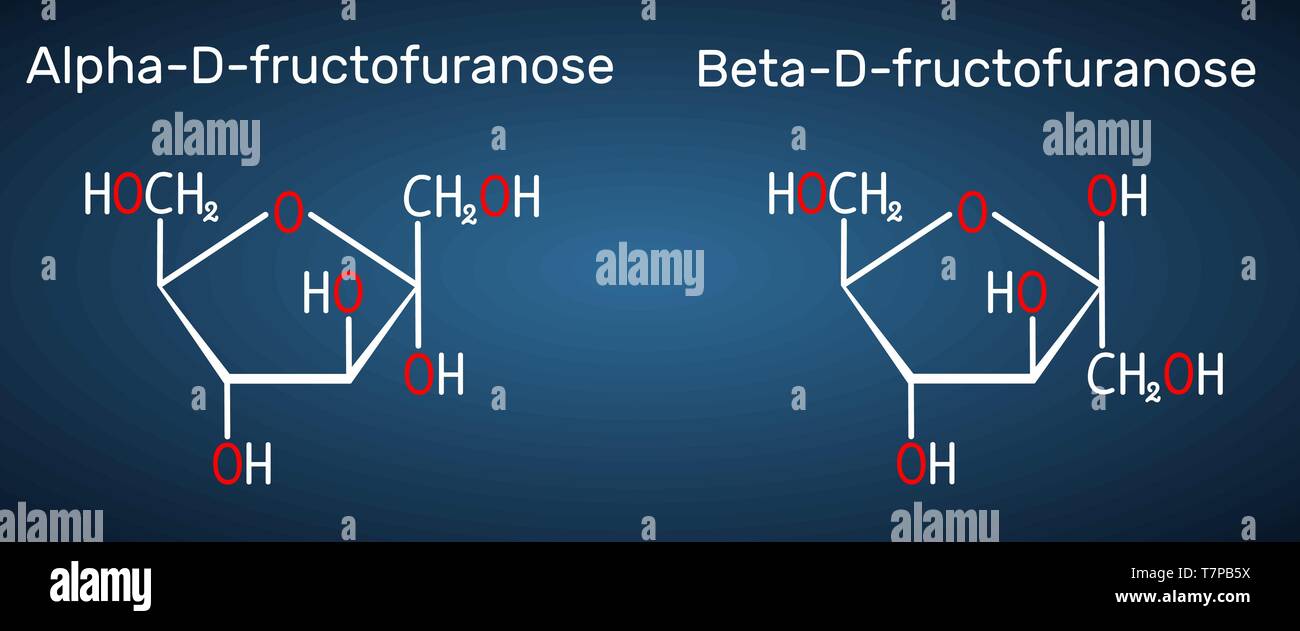
Alpha D-fructose is a specific stereoisomeric form of the simple sugar fructose, existing primarily as a cyclic hemiacetal in aqueous solutions. While fructose is commonly recognized as a hexose monosaccharide found in fruits and honey, its chemical behavior is dictated by its ability to interconvert between linear and cyclic forms, including the alpha-anomer, which plays a critical role in glycosidic bonding and metabolic stability.
The Chemical Identity of Fructose
Fructose, a member of the ketose family of sugars, possesses the molecular formula C6H12O6. Unlike glucose, which is an aldose containing an aldehyde group, fructose contains a ketone group at the second carbon position. This structural distinction is the foundation of its chemistry. In solid form, fructose exists as a crystalline structure, but when dissolved in water—the environment relevant to biological systems—it undergoes mutarotation.
Mutarotation is the spontaneous conversion between different cyclic forms of a sugar. When fructose dissolves, the open-chain structure undergoes an intramolecular reaction where the hydroxyl group on the fifth carbon (C5) reacts with the ketone group at the second carbon (C2). This cyclization results in a five-membered ring structure known as a furanose, which is the most common form of fructose in aqueous solution.
Defining Alpha and Beta Anomers
The cyclization process at the second carbon creates a new chiral center, known as the anomeric carbon. Because the hydroxyl group at this position can be oriented in two distinct directions relative to the ring, two anomers are formed: alpha (α) and beta (β).
- Alpha D-Fructose: In this configuration, the hydroxyl group (-OH) attached to the anomeric carbon (C2) points in the opposite direction of the CH2OH group attached to the C5 position in a Haworth projection.
- Beta D-Fructose: Conversely, in the beta-anomer, the hydroxyl group at the anomeric carbon points in the same direction as the CH2OH group.
In any given aqueous solution at equilibrium, fructose exists as a complex mixture of these anomers. At room temperature, beta-D-fructopyranose is the most dominant form in its crystalline state, but in solution, the mixture typically consists of roughly 70% beta-D-fructopyranose, 22% beta-D-fructofuranose, 6% alpha-D-fructofuranose, and trace amounts of other forms. The alpha-D-fructofuranose form, while a minority component, is functionally vital because it is the form required for the formation of sucrose and other complex oligosaccharides.
The Role of Furanose vs. Pyranose Rings
Fructose is unique among common dietary monosaccharides because it can form both furanose (five-membered) and pyranose (six-membered) rings. The stability of these rings depends heavily on the solvent and temperature.
The furanose form is chemically more reactive in the context of biological enzyme binding. Enzymes that process fructose, such as hexokinase or fructokinase, must account for these fluctuating populations of anomers. Because the interconversion (mutarotation) is relatively rapid, the body generally maintains a sufficient supply of the required anomeric form to facilitate metabolic pathways, despite the alpha-anomer’s low concentration at equilibrium.
Comparison of Monosaccharide Structures
To understand why alpha-D-fructose behaves the way it does, it is helpful to compare it to other common sugars like glucose and galactose.
| Property | Alpha-D-Fructose | Alpha-D-Glucose |
|---|---|---|
| Functional Group | Ketone (at C2) | Aldehyde (at C1) |
| Common Ring Type | Furanose (5-membered) | Pyranose (6-membered) |
| Anomeric Carbon | C2 | C1 |
| Dietary Context | Fruit, Honey, High-Fructose Corn Syrup | Starch, Sucrose, Blood Sugar |
| Biological Role | Energy source, glycolysis intermediate | Primary fuel, cellular respiration |
Metabolic Processing and Biochemistry
The biochemistry of alpha-D-fructose is primarily governed by the liver. Unlike glucose, which is processed throughout the body via insulin-dependent mechanisms, fructose bypasses the rate-limiting step of glycolysis (the phosphofructokinase reaction). This allows fructose to be metabolized rapidly, which can lead to specific metabolic consequences if consumed in high quantities.
When fructose enters a cell, it is phosphorylated by fructokinase to form fructose-1-phosphate. This enzyme does not differentiate between the alpha and beta anomers at the rate-limiting stage because the mutarotation process occurs faster than the enzyme processing rate. Once converted into fructose-1-phosphate, it is split into dihydroxyacetone phosphate and glyceraldehyde, both of which feed directly into the later stages of the glycolytic pathway.
Analytical and Laboratory Detection
In a laboratory setting, identifying the presence and proportion of alpha-D-fructose requires specialized instrumentation, such as Nuclear Magnetic Resonance (NMR) spectroscopy. Because the different anomers possess slightly different chemical environments for their hydrogen and carbon atoms, NMR can distinguish between the alpha and beta forms by measuring the specific chemical shifts.
Researchers studying sugar chemistry often monitor mutarotation by observing the change in optical rotation over time. By using a polarimeter—a device that measures the angle of rotation of polarized light passing through a sugar solution—scientists can track how a sample reaches equilibrium. Since alpha-D-fructose and beta-D-fructose rotate light differently, the change in rotation confirms the conversion process.
Common Misconceptions
A frequent error in understanding fructose is the belief that "fructose" refers to a single, static molecular shape. In reality, the "fructose" listed on nutrition labels is a dynamic, equilibrium-based mixture. Another common misunderstanding is that fructose and glucose are identical in their physiological effects. Because alpha-D-fructose exists largely as a furanose and is processed via a unique hepatic pathway, it impacts insulin secretion differently than glucose, which has contributed to extensive research regarding its role in metabolic health.
Frequently Asked Questions
Does alpha-D-fructose exist as a solid? While fructose can be crystallized, the solid form is usually dominated by beta-D-fructopyranose. Alpha-D-fructose is primarily a transient structural state that exists in high concentrations only when in an aqueous solution or when locked into a glycosidic bond, such as in sucrose.
Why is the alpha-anomer important? The alpha-anomer is essential for the structure of disaccharides and polysaccharides. In the plant world, the linkage between glucose and fructose to form sucrose specifically utilizes the alpha configuration of the glucose and the beta configuration of the fructose, making the exact anomeric state critical for structural biological functions.
How does mutarotation affect sugar sweetness? Temperature affects the equilibrium of fructose anomers. As temperature increases, the proportion of the sweeter, beta-pyranose form typically decreases, which is why fruit juices or beverages sweetened with high-fructose corn syrup may taste less sweet when served at high temperatures compared to when chilled.
Is alpha-D-fructose the same as high-fructose corn syrup? No. High-fructose corn syrup is a commercial liquid mixture of glucose and fructose. Within that mixture, the fructose component naturally exists in its equilibrium state, fluctuating between its alpha and beta anomeric forms as it would in any natural fruit source.
Can the body specifically utilize the alpha-anomer? The body does not distinguish between anomers for basic energy metabolism because of the rapid interconversion rates in biological fluids. The enzymes involved in the fructolytic pathway process the total pool of available fructose molecules regardless of their current anomeric orientation.
Next Steps for Further Study
For those interested in the deeper structural chemistry of sugars, exploring the Haworth projection model is the most effective next step. By drawing the five-membered ring of fructose, one can manually map the position of the hydroxyl groups to better visualize why the alpha configuration is distinct from the beta configuration. If you are conducting research, prioritize utilizing NMR data for accurate quantification of anomeric ratios, as basic titration methods are insufficient for distinguishing between structural isomers.