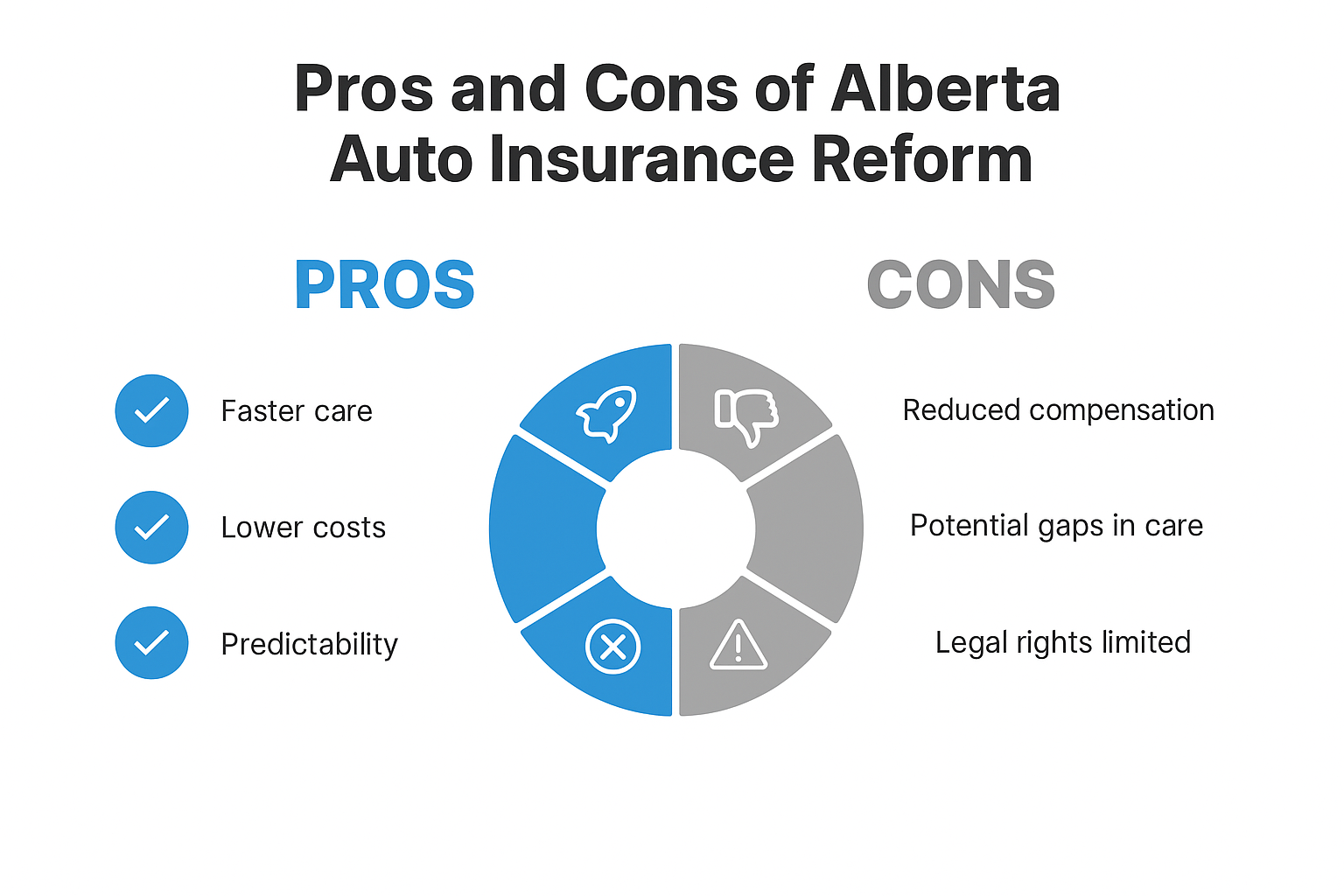
As of 2026, Alberta has transitioned toward a care-focused insurance model designed to stabilize premiums by prioritizing immediate medical benefits over protracted legal battles. This reform limits the ability to sue for minor injuries while significantly increasing the mandatory medical and rehabilitation benefits available to all drivers, regardless of fault, to ensure faster recovery and lower administrative costs.
For years, Alberta drivers faced some of the highest automobile insurance premiums in Canada. The road to the 2026 insurance landscape was paved with systemic challenges, including rising litigation costs, high inflation on vehicle repairs, and an increasing frequency of injury claims. To address these pressures, the provincial government moved away from the traditional "tort-based" system—where the at-fault party is sued for damages—toward a hybrid care-focused model that emphasizes "no-fault" medical benefits while preserving limited legal recourse for serious injuries.
Understanding these reforms is essential for every Albertan vehicle owner. The changes affect everything from how you file a claim after a collision to how your annual premiums are calculated and what legal rights you retain in the event of a catastrophic accident.
The Drivers of Change: Why Reform Was Necessary
The transition to the current 2026 framework began in earnest during the early 2020s. At that time, the Alberta insurance market was described by many industry analysts as "volatile." Despite a 3.7% rate cap introduced for "good drivers" in late 2023, the underlying costs of the system continued to climb. According to the Automobile Insurance Rate Board (AIRB), legal fees and non-economic damages (pain and suffering) for minor injuries were consuming an outsized portion of every premium dollar.
By 2024, reports commissioned by the provincial government suggested that Albertans were paying significantly more than neighbors in provinces with care-focused or public systems. The primary culprit was identified as the high cost of the adversarial legal process. When a driver is injured, a large percentage of the settlement often went to legal fees rather than the victim’s actual medical recovery. The 2026 reform was specifically engineered to redirect those funds back to the policyholder in the form of enhanced benefits and stabilized rates.
Core Pillars of the 2026 Care-Focused Model
The 2026 Alberta auto insurance system is built on several fundamental shifts in policy. These changes are designed to balance the need for affordable coverage with the necessity of comprehensive care for accident victims.
1. Expanded Accident Benefits
The most significant change is the expansion of Section B (Accident Benefits). In the old system, medical and rehabilitation limits were often insufficient for complex recoveries, forcing many drivers to sue to cover their long-term costs. In 2026, the mandatory medical benefit limit has been significantly increased. This ensures that regardless of who caused the accident, the injured parties have immediate access to physiotherapy, chiropractic care, psychological counseling, and occupational therapy.
2. The Litigation Threshold
To keep premiums down, the government introduced a higher threshold for lawsuits involving non-economic loss (pain and suffering). While Albertans can still sue for economic losses (like loss of income) and for "serious and permanent" impairments, lawsuits for "minor injuries" as defined by updated regulations have been largely replaced by predefined care pathways. This shift is intended to remove the incentive for lengthy legal battles over injuries that can be resolved through standard medical protocols.
3. Direct Compensation for Property Damage (DCPD) Evolution
The DCPD system, which was introduced in Alberta in 2022, remains a cornerstone of the 2026 model. Under DCPD, your own insurance company pays for repairs to your vehicle when you are not at fault. This speeds up the repair process and reduces the need for inter-company subrogation, which historically added administrative overhead to the system.
Comparison: Old Tort System vs. 2026 Care-Focused System
To visualize the impact of these reforms, the following table compares the key components of the Alberta auto insurance system before the major 2025-2026 legislative shifts and the current state.
| Feature | Pre-2024 Tort-Heavy System | 2026 Care-Focused System |
|---|---|---|
| Primary Recovery Route | Litigation against at-fault driver | Direct "no-fault" care benefits |
| Medical Benefit Limits | Often capped at $50,000 | Enhanced limits (varies by care path) |
| Right to Sue | Broad rights for most injuries | Limited to serious/permanent impairment |
| Minor Injury Definition | Based on the 2004 MIR framework | Updated, clinical-outcome-based definition |
| Premium Stability | High volatility; frequent double-digit requests | Moderated by reduced legal overhead |
| Claim Speed | Slow (often years for settlement) | Immediate (care starts within days) |
| Legal Fees | High (often 30% or more of settlement) | Minimal for standard care claims |
Impact on Premiums and the "Good Driver" Protection
One of the most debated aspects of the 2026 reform is its effect on the wallet. The government’s primary goal was to flatten the "premium curve." By 2026, the data indicates that while premiums have not necessarily plummeted for everyone, the aggressive year-over-year increases seen in the early 2020s have largely subsided.
The "Good Driver" definition has been refined to ensure that those with clean records are not subsidizing high-risk drivers. Under the current rules, a "Good Driver" typically refers to someone who has not had an at-fault accident or a significant number of moving violations within a rolling six-year period. These individuals benefit from protected rate tiers and are insulated from the higher costs associated with the broader risk pool.
However, vehicle repair costs remain a challenge. In 2026, cars are more technologically advanced than ever, with sensors and cameras integrated into bumpers and windshields. Even with insurance reform, the physical cost of "fixing the metal" continues to exert upward pressure on the collision and comprehensive portions of a policy.
Navigating the Claims Process in 2026
If you are involved in a collision under the new reform guidelines, the process is markedly different from the "sue-first" mentality of a decade ago. The focus is now on the "Diagnostic and Treatment Protocols."
- Immediate Notification: You must report the accident to your insurer as soon as possible. Under the care-focused model, the insurer is required to initiate a care assessment within a strict timeframe.
- Accessing Care: For most common injuries (whiplash, strains, sprains), you no longer need to wait for a "settlement" to get treatment. You are directed to a pre-approved list of healthcare providers who bill the insurer directly.
- The Serious Impairment Assessment: If your injuries do not resolve within the standard care window, or if they meet the criteria for "serious and permanent impairment," your file is moved to a different stream. It is at this stage that the possibility of a lawsuit for non-economic damages may be explored.
- Income Replacement: The 2026 reforms also improved the weekly indemnity for those unable to work. This provides a more robust safety net while you recover, reducing the financial desperation that often drove people to settle claims prematurely in the past.
The Role of the Insurance Bureau of Canada (IBC) and Advocacy
The Insurance Bureau of Canada (IBC) has been a vocal participant in the reform process. From the industry perspective, the 2026 model represents a compromise. Insurers argued that without moving to a full no-fault system (similar to British Columbia or Manitoba), costs would never truly be controlled.
On the other side, the Alberta Civil Liberties Association and various legal groups expressed concerns that the 2026 reforms stripped Albertans of their "access to justice." The current care-focused model is the middle ground—retaining private competition (unlike BC's government-run ICBC) while adopting the cost-saving measures of a no-fault system.
Common Pitfalls and Misunderstandings
Despite the government's efforts to simplify the system, several misconceptions persist among Alberta drivers regarding the 2026 reforms:
- "I can't sue anyone anymore." This is false. While the bar is higher, you can still sue for damages if your injuries are life-altering or if you have significant economic losses that exceed your policy limits.
- "My rates will automatically go down." Reform was designed for stability, not necessarily a 50% reduction. Factors like your location, the type of vehicle you drive, and your driving history still play a massive role in your individual premium.
- "No-fault means it doesn't matter who caused the crash." This only applies to how your medical benefits and vehicle repairs (under DCPD) are handled. At-fault determinations still matter for your driving record and future premium calculations.
Frequently Asked Questions
Does Alberta have a public auto insurance system now?
No. Unlike British Columbia, Saskatchewan, or Manitoba, Alberta has maintained a private, competitive market. The 2026 reforms changed the rules of how private insurers operate and what they must pay out, but you still shop for coverage through private brokers and companies. The government continues to regulate rates through the AIRB.
What happens if I am injured by an uninsured or hit-and-run driver?
The 2026 reforms include provisions for the Motor Vehicle Accident Claims Program (MVACP). You are still protected. If you are injured by an unidentified or uninsured driver, the care-focused benefits still apply, and the MVACP acts as the insurer of last resort to provide the necessary medical and rehabilitation funding.
How is a "serious impairment" defined under the 2026 rules?
A serious impairment is generally defined as a physical or cognitive function that results in a substantial inability to perform the essential tasks of your employment, education, or normal daily living activities, and is expected to be permanent. This definition is more clinical and stringent than the older "minor injury" cap criteria.
Can I opt-out of the care-focused model and keep a full tort policy?
In the current 2026 regulatory environment, the care-focused model is the standard mandatory framework for all basic auto insurance policies in Alberta. While you can purchase higher limits for third-party liability or additional endorsements, the fundamental structure of how injury claims are processed is standardized across the province to ensure system-wide cost control.
How does this affect motorcycle or commercial insurance?
While the primary focus of the 2026 reform was private passenger vehicles, the care-focused benefits extend to all classes of licensed vehicles. However, commercial operators may face different premium structures based on their fleet risk profiles, though they still benefit from the reduced litigation overhead in the general system.
What should I do if my insurance company denies my care?
The 2026 reforms introduced an enhanced Dispute Resolution Process (DRP). If there is a disagreement between your healthcare provider and the insurer regarding the necessity of a treatment, an independent medical examiner (IME) can be engaged to provide a binding assessment, bypassing the need for a lawsuit to settle simple medical disputes.
Practical Recommendation for Alberta Drivers
In light of the 2026 reforms, the best course of action for Albertans is to review their Section B limits and Umbrella coverage. While the basic care-focused benefits have increased, they are designed to cover standard recoveries. If you have a high income or unique medical needs, you may want to consider purchasing "Excess Medical" endorsements.
Additionally, because the "Good Driver" status is so critical for rate protection in 2026, investing in winter tires and telematics (UBI - Usage Based Insurance) programs can provide further discounts and protect your standing within the preferred risk pool. Always consult with a licensed broker to ensure that your specific needs—such as replacement cost for new vehicles or increased liability for out-of-province travel—are fully met under the current legislative framework.