When an employee is injured while working across state lines or when an out-of-state employer operates within Alabama, calculating workers' compensation benefits becomes a complex exercise involving extraterritorial jurisdiction, average weekly wage computations, and statutory compliance. Understanding how out-of-state wages are treated under Alabama law ensures that injured workers receive proper compensation and employers avoid costly compliance errors.
Introduction to Alabama Workers’ Compensation and Out-of-State Wages
The Alabama Workers' Compensation Act establishes the framework by which injured employees receive medical care and wage replacement benefits. When employment crosses state boundaries, questions immediately arise regarding which state's laws apply and how earnings generated outside of Alabama factor into calculating the Average Weekly Wage (AWW). Under Alabama Code Title 25, Chapter 5, the determination of benefits relies heavily on the contract of hire, the location where the injury occurred, and the regular course of the employer's business within the state.
For employees injured while temporarily working outside Alabama, or for out-of-state workers injured while performing duties within Alabama, establishing jurisdiction is the first critical step. Once Alabama jurisdiction is established, the administrative law judges and insurance adjusters must determine how out-of-state wages paid to the employee are factored into the AWW formula. This calculation directly dictates the weekly temporary total disability (TTD) or permanent partial disability (PPD) benefits the injured worker will receive.
Legal, financial, and insurance matters of this nature require careful review of employment contracts, payroll records, and specific statutory provisions. Employers and employees navigating cross-state workers' compensation claims should consult with qualified legal professionals or the Alabama Department of Labor to ensure adherence to current state regulations.
Jurisdictional Principles: When Does Alabama Law Apply?
Before addressing how wages are calculated, one must determine whether Alabama workers' compensation law has jurisdiction over an injury that involves out-of-state elements. Jurisdiction generally depends on where the contract of hire was made, where the employer's principal place of business is located, and where the injury occurred.
The Contract of Hire and Injury Location
Under Alabama jurisprudence, if an employee is hired within the state of Alabama, the Alabama Workers' Compensation Act typically covers injuries sustained by that employee, even if the injury occurs entirely outside of Alabama. This extraterritorial provision protects local workers who travel for their employment. Conversely, if an employee is hired in another state by an out-of-state employer but is injured while performing work temporarily inside Alabama, Alabama jurisdiction may also apply, provided the employment relationship has a sufficient nexus to the state.
The "Temporary" vs. "Permanent" Out-of-State Distinction
In determining jurisdiction and wage calculations, administrative bodies look closely at the duration of the out-of-state assignment:
- Temporary Assignments: If an Alabama-hired employee is sent out of state for a short, transitory project, Alabama courts almost universally maintain jurisdiction, and the wages earned during that temporary assignment remain tied to the Alabama employment record.
- Permanent or Long-Term Transfers: If an employee is permanently transferred to an out-of-state facility and enters into a new employment arrangement or remains out of state indefinitely, subsequent injuries may fall under the exclusive jurisdiction of the destination state's workers' compensation laws.
Calculating the Average Weekly Wage (AWW) with Out-of-State Earnings
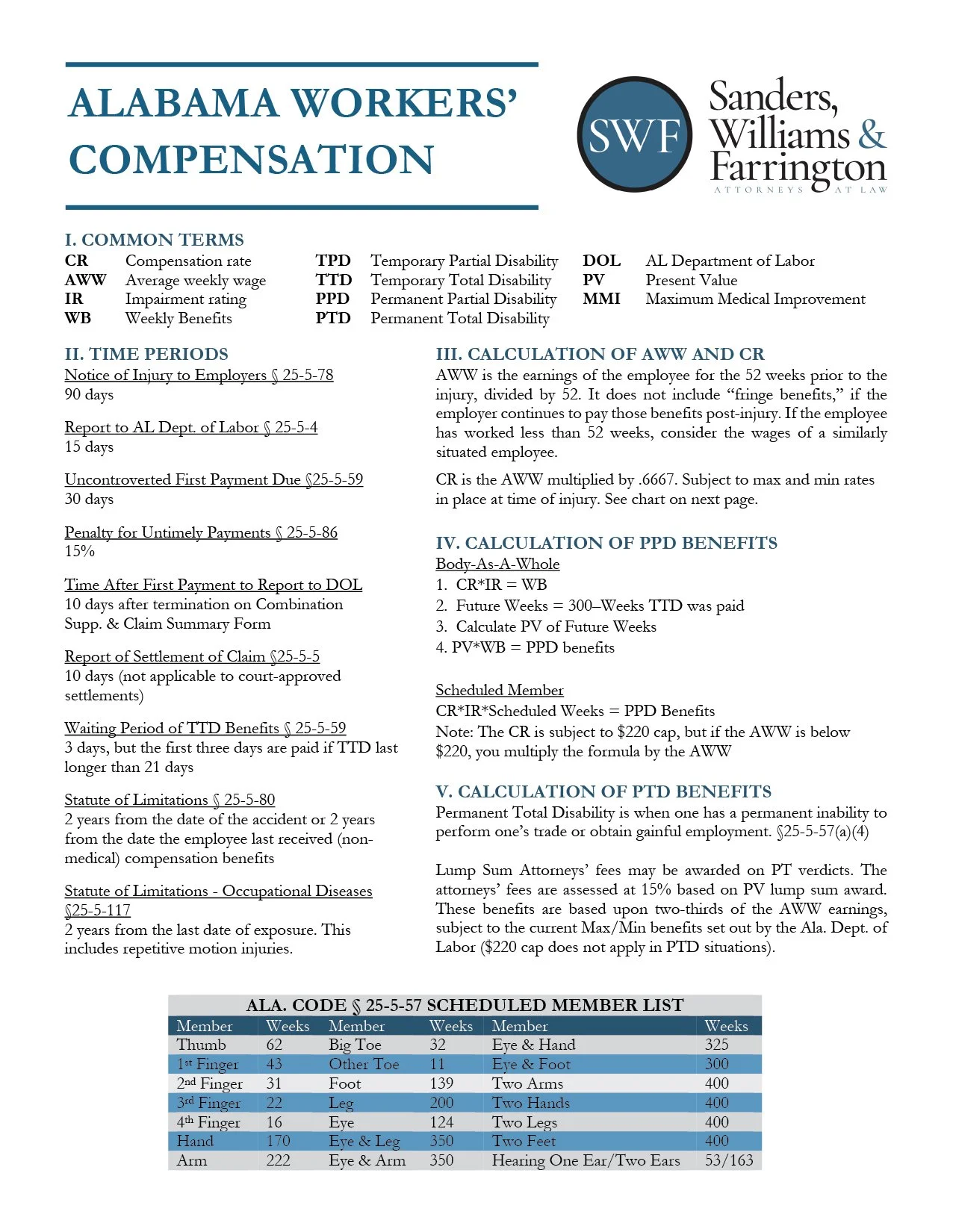
The core financial metric in any workers' compensation claim is the Average Weekly Wage. In Alabama, the AWW is generally calculated based on the earnings of the injured employee during the 52 weeks immediately preceding the date of the accident. When a portion of those earnings consists of out-of-state wages paid by the same employer—or in some instances, concurrent employment—specific rules govern what can and cannot be included.
Standard 52-Week Lookback Period
For employees with steady earnings, the employer or insurance carrier examines the gross wages earned over the prior 52 weeks. If the employee worked in multiple states for the same employer during that window, all gross earnings—including per diems, bonuses, and hourly or salaried wages earned out of state—are typically aggregated into the total earnings pool, provided they were reported as taxable income under the direct control of the employer.
| Wage Component | Inclusion Status | Legal / Operational Rationale |
|---|---|---|
| Base Hourly/Salaried Wages | Included | Represents direct compensation for labor under the contract of hire. |
| Out-of-State Per Diem Allowances | Excluded (Usually) | Generally considered reimbursement for actual expenses (lodging, meals) rather than wages, unless structured to artificially inflate earnings. |
| Bonuses and Commissions | Included (Pro-rata) | Factored into total annual earnings if regularly earned and tied to employment performance. |
| Overtime Premium Pay | Included | Calculated at the straight-time rate or gross amount depending on statutory interpretation and historical earnings patterns. |
Handling Irregular Schedules and Short-Term Employment
When an employee has worked for the employer for less than 52 weeks prior to the injury—a common scenario for traveling construction crews, pipeline workers, and specialized technicians—Alabama law provides alternative methods for calculating the AWW.
- The wages of a similarly situated employee in the same grade and employment can be used as a benchmark.
- If no such employee exists, the total wages earned by the injured worker during the period of actual employment are divided by the number of weeks worked, provided that period reflects a fair and reasonable approximation of the employee's earning capacity.
Employer Obligations and Interstate Insurance Coverage
Employers based outside of Alabama who send workers into the state, as well as Alabama employers sending workers across state lines, must navigate complex insurance requirements to ensure compliance and avoid severe financial penalties.
Extraterritorial Reciprocity and Workers' Compensation Policies
Most standard workers' compensation insurance policies include "Other States Insurance" endorsements (often referred to as Part Three of the standard policy). This endorsement provides coverage if an employer's operations expand into a state not explicitly listed on the policy declarations page, subject to statutory notification requirements and limits.
- Alabama Compliance: If an out-of-state employer brings workers into Alabama, they must ensure their policy complies with Alabama statutory mandates. Alabama does not have a broad, universal reciprocal agreement with every state that automatically exempts out-of-state employers from securing local coverage, particularly if the work performed in Alabama exceeds temporary thresholds (such as 30 to 90 days, depending on specific industry rules).
- Proof of Coverage: The Alabama Department of Labor strictly enforces workers' compensation coverage requirements. Failure to maintain appropriate coverage while employing workers within the state can result in stop-work orders, civil penalties, and personal liability for corporate officers.
Reporting Out-of-State Payroll for Premium Audits
Insurance carriers conduct annual payroll audits to determine the final premium owed by the employer. When out-of-state wages are paid to employees whose primary base of operations is Alabama, or vice versa, proper classification codes must be applied:
- Payroll must be allocated to the correct state classification code based on where the work was actually performed, unless the employee's duties are strictly transitory or incidental.
- Misclassifying out-of-state payroll or failing to report wages paid during interstate travel can lead to premium adjustments, retroactive assessments, or disputes during claims adjudication.
Common Disputes and Legal Challenges Involving Out-of-State Wages
Cross-state workers' compensation claims frequently generate legal disputes between injured workers and insurance carriers. Recognizing these friction points allows stakeholders to prepare accurate documentation and mitigate protracted litigation.
Dual Jurisdiction and Forum Shopping
Occasionally, an injury sustained during interstate travel creates concurrent jurisdiction under the laws of both Alabama and the state where the injury occurred. Employees may seek benefits in the jurisdiction that offers higher weekly compensation rates or more favorable medical provisions.
- Alabama courts evaluate whether a prior claim has been filed in another state. While the Full Faith and Credit Clause of the U.S. Constitution prevents a claimant from recovering duplicate permanent disability benefits for the same injury across multiple states, an injured worker may sometimes pursue temporary benefits or medical care where most advantageous until an election of remedies is made.
Calculating Wages for Multi-State Independent Contractors vs. Employees
A frequent point of contention is whether a traveling worker is classified as a W-2 employee or a 1099 independent contractor. Out-of-state companies utilizing independent contractors often fail to secure workers' compensation coverage, assuming contractual waivers protect them. However, Alabama courts apply a strict "right of control" test. If an out-of-state company exerts significant control over the worker's schedule, methods, and tools—regardless of whether the worker was paid via out-of-state accounts—Alabama authorities may reclassify the worker as an employee, triggering retroactive workers' compensation liabilities and severe penalties for uninsured status.
Frequently Asked Questions
Are out-of-state wages included when calculating my Alabama workers' compensation benefits?
Yes, if those wages were earned under a contract of hire connected to Alabama or as part of continuous employment with an employer operating within the state during the 52-week lookback period. All gross earnings reported under the employer's direct supervision are factored into the Average Weekly Wage calculation.
What happens if I am an Alabama resident injured while working temporarily in another state?
You are generally protected by the Alabama Workers' Compensation Act if your employment contract was made in Alabama or if your out-of-state work was merely temporary and incidental to your primary Alabama-based employment. You may file your claim through the Alabama system, provided the employer is subject to the state's jurisdiction.
Can an insurance company exclude per diem payments made during out-of-state travel from my wage calculation?
Yes. Standard per diem payments intended strictly to reimburse an employee for out-of-pocket lodging, travel, and meal expenses incurred while traveling out of state are generally excluded from AWW calculations, as they represent expense reimbursements rather than direct remuneration for labor.
What should an out-of-state employer do if they have employees working in Alabama temporarily?
The employer must verify that their existing workers' compensation policy includes an "Other States Insurance" endorsement or specifically lists Alabama. They must also ensure that their payroll records accurately track hours and wages earned within Alabama for premium audit and compliance purposes.
How far back do insurance adjusters look when auditing out-of-state wages for a claim?
Insurance adjusters typically examine the 52-week period immediately preceding the date of the workplace injury. If the employee has worked for the company for less than 52 weeks, alternative statutory calculation methods using shorter timeframes or similar employee benchmarks are applied.
Conclusion and Next Actions
Navigating workers' compensation claims involving out-of-state wages paid in Alabama requires meticulous attention to jurisdictional rules, payroll documentation, and statutory wage calculation formulas. Injured workers should maintain detailed records of all pay stubs, interstate travel schedules, and employment contracts. Employers must review their insurance policies for proper multi-state endorsements and ensure accurate payroll allocation to prevent compliance penalties. For specific disputes regarding benefit calculations or jurisdictional authority, consulting with an experienced Alabama workers' compensation attorney or contacting the Alabama Department of Labor is the recommended course of action.