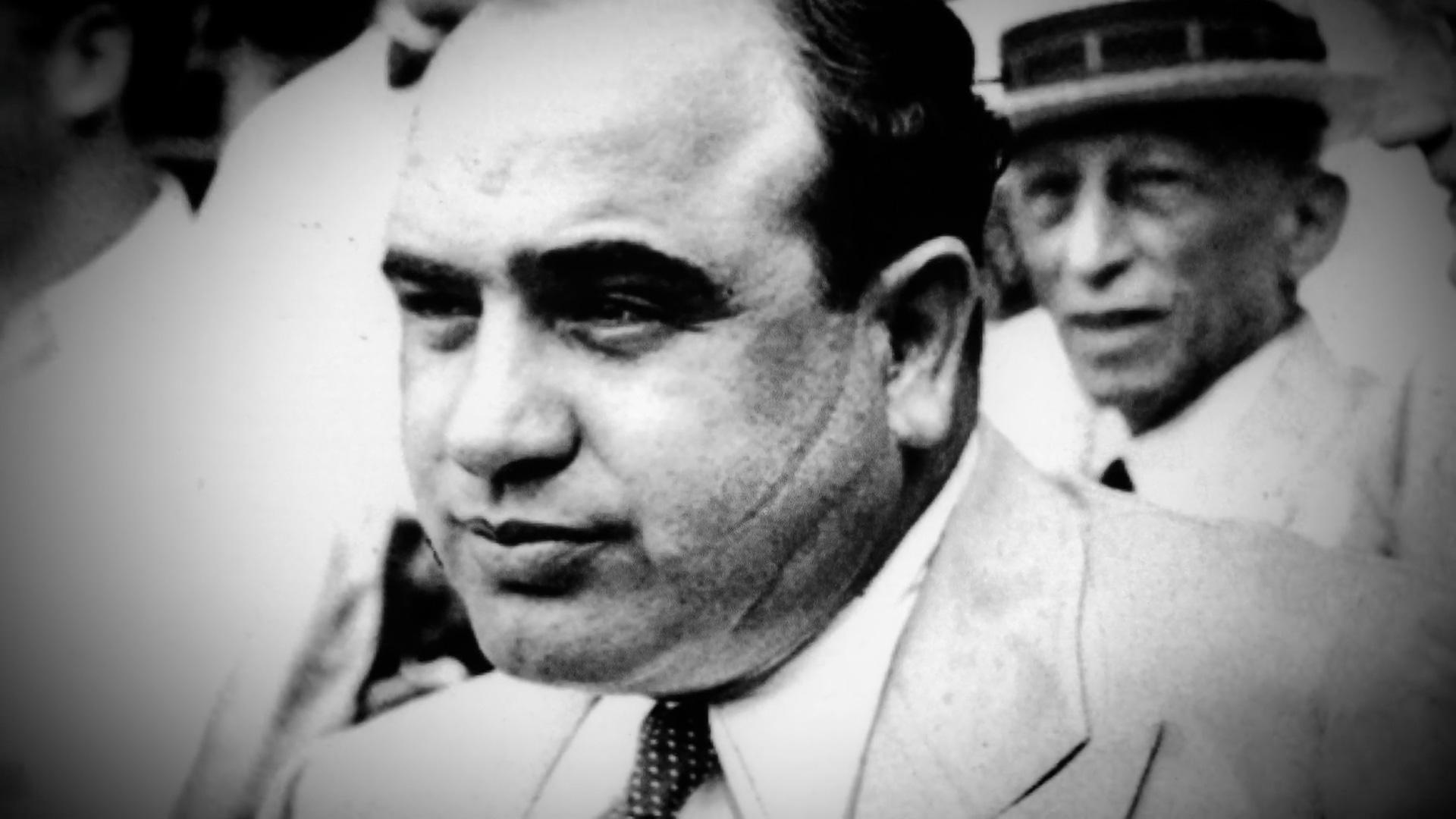
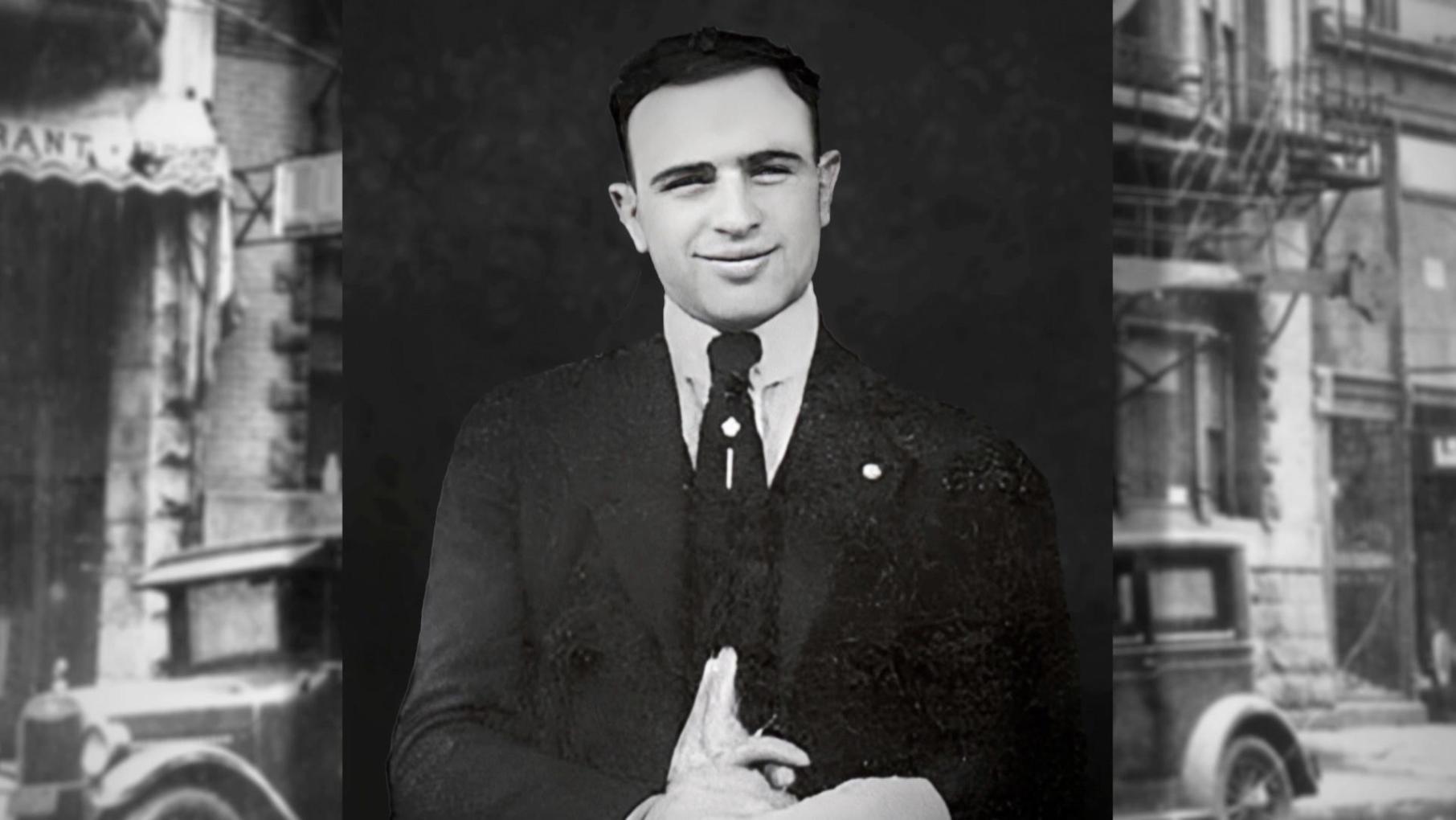
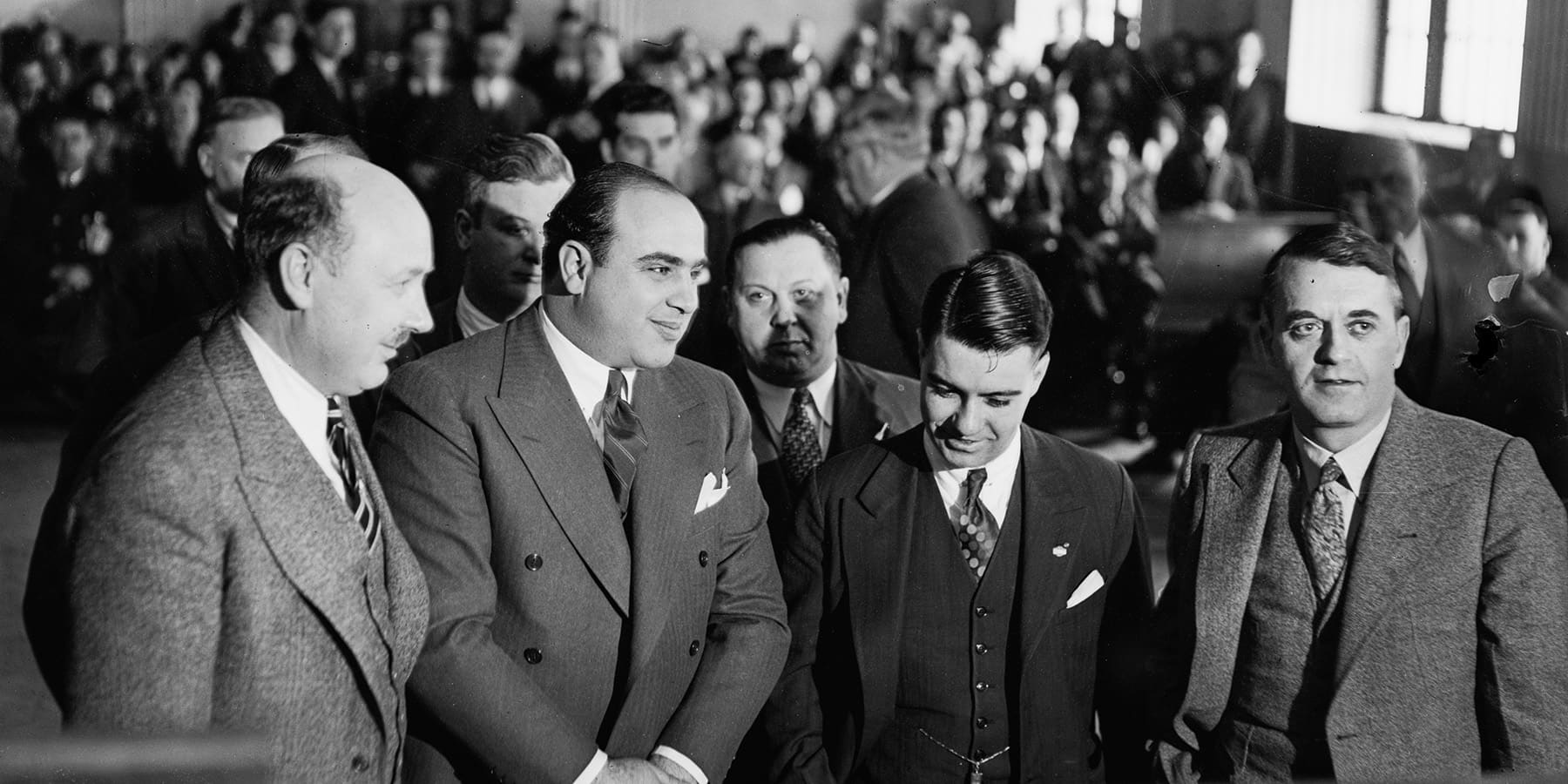
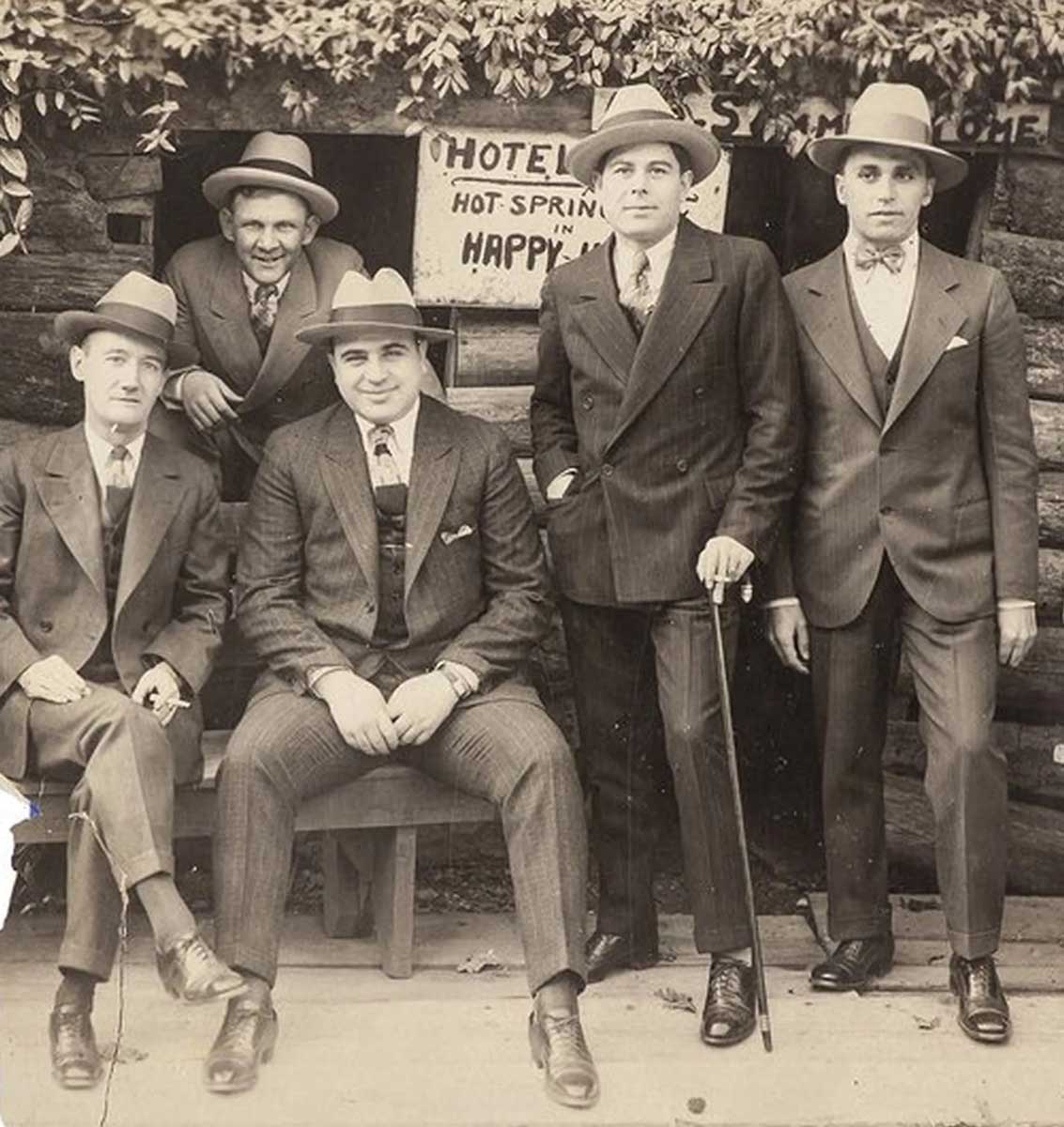
At its peak in the late 1920s, Alphonse "Al" Capone’s criminal syndicate—the Chicago Outfit—functioned as one of the most lucrative corporate enterprises in American history. Generating an estimated $100 million in annual gross revenue through bootlegging, gambling, protection rackets, and vice, Capone structured his empire using modern corporate principles, vertical integration, and cash-based money laundering before federal tax evasion charges dismantled his operation.
The Rise of the Chicago Outfit as a Corporate Enterprise
The business model of organized crime in Chicago underwent a radical transformation during the Prohibition era (1920–1933). Before the passage of the Eighteenth Amendment and the Volstead Act, local gang activity was fragmented, regional, and primarily focused on localized extortion, petty theft, and street-level vice.
When bootlegging made illegal alcohol a massive consumer market, crime bosses Johnny Torrio and his protégé, Al Capone, recognized that street gang tactics could not scale to meet consumer demand. Torrio had systematically consolidated South Side operations under an organized framework focused on efficiency, cartel formation, and territorial agreements.
- Torrio-Capone Executive Leadership
- Operations: Frank Nitti (Breweries & Distilleries)
- Financials: Jake Guzik (Accounting & Casinos)
- Enforcement: Jack McGurn (Protection & Territory)
When Torrio retired to Italy in 1925 after surviving an assassination attempt by rival North Side Mob gunmen, the 26-year-old Capone assumed full executive control of the Chicago Outfit. Capone approached organized crime not merely as a criminal enterprise, but as a corporate syndicate. He established centralized management, appointed specialized department heads, maintained territorial monopolies through physical force and bribery, and reinvested profits into supply chain expansion.
Capone famously defended his operations by framing them as a public service operating under basic principles of supply and demand:
"I am just a businessman, giving the people what they want... All I do is supply a demand that is pretty popular."
By treating the illegal alcohol trade as a standard retail sector, Capone constructed an enterprise that rivaled major American corporations of the era in revenue, employee payroll, and logistical complexity.
Primary Revenue Streams of Capone's Empire
The Chicago Outfit's revenue stream was diversified, though bootlegging served as its primary financial engine. Estimates compiled by federal investigators, including agents from the U.S. Department of the Treasury, indicated that Capone’s syndicate brought in over $100 million annually at its peak (equivalent to roughly $1.5 billion to $1.8 billion in 2026 inflation-adjusted dollars).
| Category | Estimated Annual Revenue |
|---|---|
| Bootlegging & Alcohol Distribution | ~$60M (60%) |
| Gambling, Casinos & Dog Tracks | ~$25M (25%) |
| Racketeering & Extortion | ~$10M (10%) |
| Brothels & Vice Operations | ~$5M (5%) |
Bootlegging and Breweries
Bootlegging constituted approximately 60% of the Outfit’s total revenues, generating roughly $60 million per year. Capone controlled an extensive, vertically integrated supply chain that encompassed:
- Importation: Smuggling real Canadian whiskey across the Great Lakes and importing rum via transatlantic maritime routes ("Rum Row").
- Domestic Production: Operating large-scale illegal breweries and industrial spirit distilleries throughout Chicago and rural Illinois.
- Distribution: Managing fleets of armored delivery trucks and secure warehouses.
- Retail Outlets: Owning or controlling thousands of speakeasies, nightclubs, and roadhouses throughout Cook County and northern Indiana.
To maintain market share, Capone forced independent saloon owners to purchase alcohol exclusively from Outfit-controlled distributors. Venue operators who resisted faced bombings, physical destruction of their establishments, or murder.
Illegal Gambling and Dog Tracks
Gambling served as the Outfit’s second most lucrative business line, producing an estimated $25 million annually. Under the financial management of Jake "Greasy Thumb" Guzik, the syndicate operated:
- Underground casinos in Cicero and Chicago featuring roulette, craps, and high-stakes poker.
- Wire services that transmitted real-time horse racing results to off-track betting parlors across the Midwest.
- Dog tracks and wire-betting networks that operated without government regulation.
Gambling venues yielded high profit margins because overhead costs were low, transactions were entirely cash-based, and customer losses were guaranteed through standard house odds or rigged gaming equipment.
Protection Rackets and Extortion
Extortion generated an estimated $10 million annually. The Outfit targeted local trade unions, dry cleaners, restaurants, bakeries, and transport firms.
Business owners paid weekly "protection" fees to ensure their facilities were not sabotaged, vandalized, or set on fire. Concurrently, Capone infiltrated labor unions, allowing the Outfit to embezzle union pension funds, extort business executives with the threat of strikes, and manipulate municipal construction contracts.
Brothels and Vice Operations
While vice was the foundation of the early Chicago crime syndicates under Jim Colosimo, Capone gradually downgraded brothels in favor of more profitable bootlegging and gambling activities. Nevertheless, brothels, call-girl networks, and suburban roadhouses still contributed an estimated $5 million annually, operating primarily in areas where local police marshals were on the Outfit’s payroll.
Corporate Hierarchy and Operational Strategy
Capone's organization was structured along corporate lines to maintain operational security, insulate top executives from street-level crimes, and maximize efficiency.
- Al Capone (General Manager)
- Frank Nitti (Operations Chief)
- Brewery Management
- Distribution
- Jake Guzik (Financial & Legal Chief)
- Cash Accounting
- Bribes/Payroll
- Frank Nitti (Operations Chief)
Executive Management and Key Lieutenants
Capone operated as the General Manager or Chief Executive Officer, delegating day-to-day operations to trusted division leads:
- Frank Nitti ("The Enforcer"): Directed physical operations, logistics, brewery maintenance, and enforcer squads. Nitti ensured that production quotas were met and that territorial boundaries were maintained.
- Jake "Greasy Thumb" Guzik: Served as Chief Financial Officer and political manager. Guzik handled double-entry accounting ledgers, managed cash collections, and coordinated political corruption payments.
- Frank Capone and Ralph Capone: Al's brothers managed suburban territories and bottling plants, ensuring family control over high-yield assets.
- Machine Gun Jack McGurn: Managed protection details and tactical elimination of rival gang threats, serving as the head of the syndicate's security wing.
Territorial Control and Systemic Corruption
A key component of Capone's business model was systemic corruption. The Outfit allocated an estimated 20% to 30% of its gross profits toward bribing public officials, including local police officers, municipal judges, ward committeemen, prosecutors, and federal Prohibition agents.
By relocating his operational headquarters from Chicago proper to the suburb of Cicero in 1924, Capone effectively bought the entire suburban municipal government, installing compliant city officials through voter intimidation and public corruption. This gave the Outfit safe havens for breweries, gambling houses, and administrative headquarters at the Hawthorne Hotel.
Front Companies and the Evolution of Money Laundering
Because Capone’s revenue streams derived from criminal acts, the resulting currency consisted of millions of dollars in unrecorded, small-denomination bills. Integrating this illicit cash into the legitimate economy posed a severe operational challenge.
- Illicit Cash Income (Bootlegging/Gambling)
- Cash-Intensive Fronts (Laundries, Bakeries, Meadowmoor Dairies)
- Mixed Bank Deposits (Legitimate Corporate Taxable Revenues)
Cash-Intensive Service Businesses
To conceal the origins of his cash flow, Capone acquired control of cash-intensive service businesses across Chicago. The syndicate bought dry cleaners, sanitary laundries, bakeries, car washes, and cigar stores.
These entities possessed high transaction volumes with low material supply costs, making it difficult for auditors to verify actual customer traffic. The Outfit co-mingled illicit cash from speakeasies with legitimate daily cash receipts from these service businesses, depositing the combined funds into standard bank accounts as legitimate corporate income.
Historical myth often attributes the origin of the term "money laundering" to Capone's acquisition of commercial laundromats. While the phrase itself did not appear in legal terminology until the 1970s, the operational practice of using cash-based service businesses to cleanse illicit funds was pioneered during this period.
Meadowmoor Dairies and the Milk Industry Experiment
As Prohibition faced growing opposition in the early 1930s, Capone sought to transition his capital into legal consumer monopolies. One of his notable legal ventures was the acquisition of Meadowmoor Dairies in 1931.
Capone observed that the fresh milk market operated with high profit margins, consistent daily demand, and fragmented distribution—similar to the alcohol industry. The Outfit applied its traditional business tactics to the dairy sector:
- Undercutting Competitors: Meadowmoor purchased milk from non-union dairy farmers at lower rates and sold it below prevailing market prices.
- Distribution Control: The Outfit used intimidation to force independent grocery stores to carry Meadowmoor milk products.
- Consumer Safety Innovation: Capone successfully lobbied the Chicago City Council to pass milk safety legislation requiring explicit expiration dates ("sell-by" dates) stamped on milk bottles. While framed as a public health initiative, the requirement benefited Meadowmoor because Capone held patents on the specific date-stamping machinery used in local bottling plants.
Financial Breakdown of Capone's Enterprise
The operational and financial mechanics of Capone’s major business units are summarized below based on data compiled from historical trial exhibits and U.S. Treasury Department intelligence reports.
| Business Division | Primary Revenue Source | Operating Model | Estimated Annual Gross Revenue (c. 1929) | Primary Cost Drivers |
|---|---|---|---|---|
| Bootlegging & Distilling | Wholesale alcohol sales, speakeasies | Vertical integration: production, smuggling, retail venue ownership | $60,000,000 | Raw corn/sugar supplies, import transport, driver payroll, protective payoffs |
| Gambling Operations | Off-track horse racing wire services, casino gaming | Controlled wire services, proprietary gaming houses, dog tracks | $25,000,000 | Gaming equipment, property leases, wire lease fees, payout reserves |
| Protection & Extortion | Trade union embezzlement, business owner fees | Direct extortion, forced trade association memberships | $10,000,000 | Enforcer payroll, legal defense funds, political payoffs |
| Vice & Brothels | Underground brothels, roadhouses | Direct ownership of real estate operated by proxy managers | $5,000,000 | Property leases, local police protection fees |
| Legitimate Fronts | Sanitary cleaning, bakeries, Meadowmoor Dairies | Cash co-mingling, undercutting retail prices | $2,000,000–$5,000,000 | Processing machinery, commercial fleet leases, raw milk purchasing |
The Financial Downfall: Tax Evasion and the Treasury Investigation
Despite his extensive physical control over Chicago, Capone’s financial reliance on unrecorded cash created a severe vulnerability under federal law.
- Undeclared Cash Profits
- Supreme Court Precedent: United States v. Sullivan (1927) (Illicit Income is Taxable)
- IRS Special Intelligence Unit (Elmer Irey & Frank Wilson)
- Discovery of Mattingly Ledger & Financial Evidence
- 1931 Indictment & Conviction (11-Year Federal Sentence)
United States v. Sullivan and Taxable Illicit Income
Before 1927, many organized crime figures assumed that income derived from illegal activities was exempt from federal income taxes, arguing that reporting illegal income violated Fifth Amendment protections against self-incrimination.
That legal defense ended with the landmark Supreme Court decision in United States v. Sullivan, 274 U.S. 259 (1927). The Court ruled that income derived from illegal businesses (specifically bootlegging) is subject to federal income tax, establishing that criminals must file tax returns regardless of the source of their revenue.
The IRS Investigation: Elmer Irey and Frank Wilson
Following the 1929 St. Valentine's Day Massacre, President Herbert Hoover ordered federal law enforcement agencies to focus resources on Capone. While Prohibition agent Eliot Ness led a small unit ("The Untouchables") that targeted breweries and trucks to disrupt Capone's supply chain, the primary financial strategy was managed by the Internal Revenue Service Special Intelligence Unit, led by Chief Elmer L. Irey and Special Agent Frank J. Wilson.
| Unit | Strategy |
|---|---|
| Prohibition Bureau (Eliot Ness) | Disrupt Physical Supply Chains (Breweries, Armored Trucks) |
| IRS Special Intelligence Unit (Frank Wilson) | Reconstruct Cash Ledgers & Prove Net Worth Expansion |
Wilson and his team realized that Capone owned no real estate, bank accounts, or corporate shares under his own name. He conducted all personal and business transactions in physical cash, paid for luxury suites at the Metropole and Congress hotels with currency, and used straw buyers for his Miami estate.
To establish tax evasion, Wilson's team spent years auditing thousands of financial records, bank deposits, canceled checks, and seized ledgers across Illinois and Florida.
The Mattingly Ledger and the 1931 Conviction
The turning point in the investigation occurred with the discovery of a ledger seized during a 1926 raid on a Capone gambling hall, the Hawthorne Smoke Shop. The document—known as the "Mattingly Ledger"—detailed daily profit allocations, overhead costs, and payout distributions directly to Capone under aliases such as "Al" and "A."
When Capone's tax attorney, Lawrence P. Mattingly, attempted to negotiate with the IRS in 1930, he sent a letter admitting that Capone had income from criminal enterprises, estimating his net income at $26,000 to $100,000 per year between 1924 and 1929. The federal prosecution team later introduced the Mattingly Letter into evidence to establish Capone’s awareness of his income tax obligations.
In June 1931, a federal grand jury indicted Capone on 22 counts of federal income tax evasion covering tax years 1924 through 1929, representing an estimated tax liability of over $215,000 (plus interest and penalties).
In October 1931, Capone was convicted on five counts of tax evasion and willful failure to file tax returns. Judge James H. Wilkerson sentenced him to 11 years in federal prison, fined him $50,000, and ordered him to pay $215,000 in back taxes plus court costs. Capone served his sentence in Atlanta Federal Penitentiary and Alcatraz before his release in 1939 due to deteriorating health from neurosyphilis.
Modern Legacy: How Capone's Enterprise Shaped Financial Crime Law
The investigation and conviction of Al Capone established the template for modern white-collar crime investigations, financial intelligence gathering, and anti-money laundering regulations.
Capone Financial Prosecution (1931)
Creation of Net Worth Method of Proof
Bank Secrecy Act (BSA) of 1970 (Cash Transaction Reports > $10k)
Racketeer Influenced & Corrupt Organizations (RICO) Act (1970)
The Net Worth Method of Accounting: The tax prosecution of Capone validated the "net worth method" of proving financial crime. Under this framework, prosecutors do not need to prove the exact origin of every dollar; instead, they prove that an individual's net asset growth and expenditures far exceed their reported legal income.
The Bank Secrecy Act (BSA) of 1970: To prevent criminals from operating exclusively in cash or using cash-intensive business fronts, the U.S. Congress passed the Bank Secrecy Act, establishing mandatory reporting for currency transactions exceeding $10,000 (Currency Transaction Reports) and requiring financial institutions to report suspicious activity.
The RICO Act (1970): The difficulty of prosecuting executive leaders who used lieutenants to execute crimes led to the passage of the Racketeer Influenced and Corrupt Organizations (RICO) Act (18 U.S.C. §§ 1961–1968). RICO allowed federal prosecutors to target leaders of a criminal enterprise for orders they issued, even if subordinates committed the physical acts.
Frequently Asked Questions
What was Al Capone's estimated net worth at his peak?
At the peak of his power in 1929, Al Capone's syndicate generated approximately $100 million in gross annual revenue. Capone's personal net worth was estimated between $30 million and $40 million at the time (equivalent to roughly $500 million to $650 million in 2026 inflation-adjusted value). Because his assets were held in cash, straw names, and front businesses, exact personal accounting remains an estimate based on federal tax records.
How did Al Capone launder his illegal money?
Capone laundered cash by buying cash-intensive businesses such as dry cleaners, sanitary laundries, bakeries, car washes, and restaurants. The syndicate co-mingled illicit cash from bootlegging and gambling with the daily legal cash receipts of these businesses. The combined cash was then deposited into standard commercial bank accounts as legitimate business revenue.
Why was Al Capone convicted of tax evasion instead of murder or bootlegging?
Federal prosecutors faced significant challenges obtaining convictions for violent crimes or Prohibition violations because Capone routinely bribed local law enforcement, intimidated witnesses, and operated through intermediaries. The IRS Special Intelligence Unit circumvented local corruption by focusing on federal tax laws, utilizing the 1927 Supreme Court ruling (United States v. Sullivan) to prove that Capone had unreported taxable income regardless of its legality.
Did Al Capone actually own Meadowmoor Dairies?
Yes. Capone acquired control of Meadowmoor Dairies in 1931 as part of a strategy to diversify into legal consumer industries as Prohibition approached repeal. Under Outfit control, Meadowmoor undercut local milk prices and successfully lobbied the Chicago City Council to mandate expiration dates on milk bottles, a market segment where Capone controlled key patents for date-stamping machinery.
Who managed the financial accounting for Capone's empire?
Jake "Greasy Thumb" Guzik served as the Chief Financial Officer and business administrator for the Chicago Outfit. Guzik managed cash collections, double-entry financial ledgers, casino payouts, and political corruption payments. Unlike many gang members, Guzik did not engage in physical violence, focusing instead on financial logistics and legal defense strategy.
Final Summary: Lessons from the Capone Business Model
Al Capone’s enterprise demonstrated how organized crime could adopt corporate organizational strategies—including vertical integration, market segmentation, and portfolio diversification. However, the reliance on cash-based front operations and unrecorded revenue exposed his empire to financial tracing by federal authorities.
Ultimately, the failure to account for federal tax obligations under United States v. Sullivan proved that financial records and accounting evidence can dismantle criminal operations when traditional law enforcement methods fail. Modern anti-money laundering (AML) protocols, federal tax enforcement, and enterprise-focused statutes like RICO trace their lineage directly to the tools developed to dismantle Capone's empire.