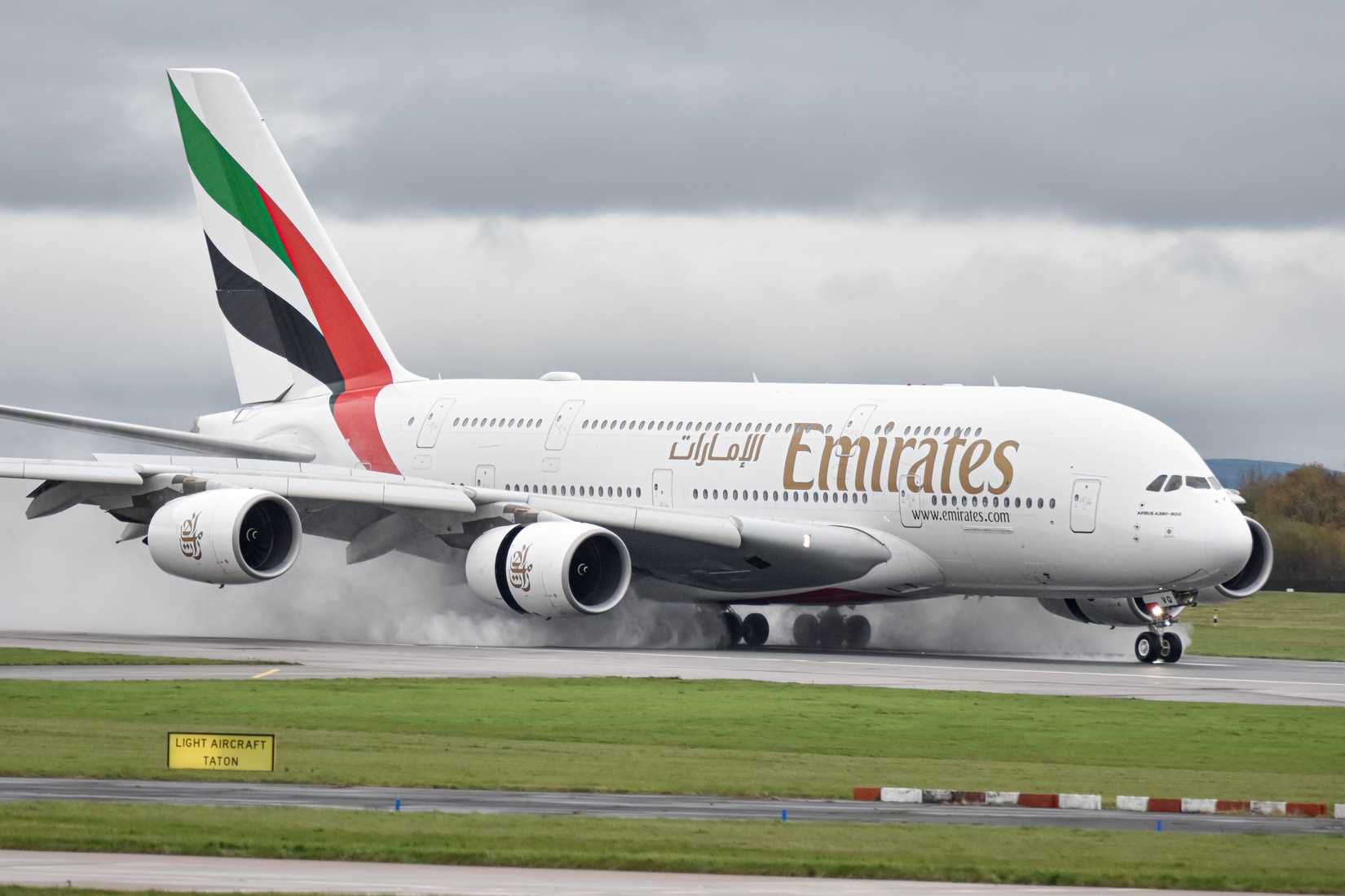
The Airbus A380-800 features a maximum fuel capacity of approximately 320,000 liters (specifically 323,546 liters or 85,472 US gallons). This massive volume is stored across 11 structural tanks within the wings and horizontal stabilizer, allowing the aircraft to achieve a maximum range of 8,000 nautical miles (14,800 kilometers) while carrying over 500 passengers.
The Airbus A380 remains a marvel of modern engineering, standing as the largest passenger aircraft ever built. While its double-deck configuration and quiet cabin often capture the public's imagination, the true feat of engineering lies hidden within its wings and fuselage: the fuel system. To keep 560 tonnes of metal, passengers, and cargo in the air for 15 hours at a time, the A380 requires a fuel storage and management system of unprecedented scale. As of 2026, even as the industry moves toward twin-engine efficiency, the A380’s 323,546-liter capacity remains the benchmark for long-haul capability.
The Architecture of a 320,000-Liter Storage System
To store over 320,000 liters of Jet A-1 fuel, Airbus engineers had to utilize nearly every available cubic meter of "dead space" within the aircraft's primary structures. The fuel is not stored in separate "drums" or bottles but is contained directly within the sealed structures of the wings and the tail. These are known as integral tanks.
The fuel system is divided into 11 distinct tanks:
- Inner Tanks: Two massive tanks located closest to the fuselage in the thickest part of the wing.
- Mid Tanks: Located in the center section of each wing.
- Outer Tanks: Positioned toward the wingtips.
- Feed Tanks: These smaller tanks (four in total) are dedicated to supplying fuel directly to each of the four engines (Engine 1 through 4).
- Trim Tank: Located in the horizontal stabilizer (the "small wings" at the back of the plane).
The wing tanks alone hold the vast majority of the fuel, but the trim tank is perhaps the most technically significant. By moving fuel to the rear of the aircraft during flight, the onboard computers can shift the center of gravity. This reduces the amount of downward force the tail needs to generate to keep the nose up, thereby reducing "trim drag" and increasing fuel efficiency over long distances.
Weight, Density, and the Physics of Takeoff
When discussing 320,000 liters of fuel, it is essential to translate volume into weight. Fuel density varies based on temperature, but a standard average for Jet A-1 is roughly 0.8 kilograms per liter. This means that a fully fueled A380 is carrying approximately 256,000 kilograms (256 metric tons) of fuel alone.
To put this in perspective, the fuel weight by itself is greater than the total maximum takeoff weight of a Boeing 787-8 Dreamliner. This creates a massive challenge for the aircraft's structural integrity. When the A380 is on the ground, the weight of the fuel in the wings actually helps counteract the upward bending moment that would occur if the wings were empty. Conversely, in flight, the weight of the fuel helps "tamp down" the wings, providing a smoother ride for passengers by dampening the effects of turbulence.
As of 2026, the Maximum Takeoff Weight (MTOW) of the A380-800 remains 575 tonnes. If the aircraft takes off with a full fuel load, the weight of the fuel accounts for nearly 45% of the total mass of the airplane. This necessitates the use of 22 wheels on the landing gear to distribute that weight across the runway surface.
The Intricacies of Fuel Management and Center of Gravity
Managing 320,000 liters of liquid is not as simple as drawing from a single source. Because the fuel is spread across a massive surface area (the A380 wing span is nearly 80 meters), the movement of that fuel can significantly affect the aircraft’s stability.
The A380 uses an automated Fuel Management System (FMS) that constantly monitors the quantity in each tank. As the engines consume fuel, the system automatically transfers liquid between tanks to ensure the aircraft remains balanced.
- Engine Feed: Fuel is first drawn from the feed tanks. These are kept full by the inner and mid tanks through a series of transfer pumps.
- Wing Loading: Fuel is typically consumed from the inner tanks first to keep the weight toward the wingtips as long as possible, which reduces structural stress on the wing root during the early stages of flight.
- Trim Transfers: During cruise, the system may move fuel from the wing tanks to the trim tank in the tail. As the flight progresses and the total weight decreases, the fuel is moved back forward to ensure the aircraft remains stable for the approach and landing.
This "liquid ballast" system is critical. Without it, the A380 would be significantly less efficient and harder for the fly-by-wire system to stabilize.
Refueling Logistics: Filling the Giant
Filling a 320,000-liter tank is a logistical feat that requires specialized airport infrastructure. A standard fuel truck used for smaller regional jets would be woefully inadequate. Instead, major international hubs use a "hydrant system" where fuel is pumped directly from underground pipes at high pressure.
The A380 features four refueling points located on the underside of the wings. When all four points are connected to the hydrant system, the aircraft can be refueled at a rate of approximately 5,000 liters per minute. Even at this incredible speed, a completely empty-to-full refueling operation would take over an hour.
In 2026, airline turnaround times are more critical than ever. Ground crews rarely fill the tanks to the absolute maximum unless the aircraft is performing an ultra-long-haul flight, such as Dubai to Los Angeles or Singapore to New York. Typically, they carry "mission fuel"—the amount needed for the trip, plus legally required reserves (for holding patterns or diversion to an alternate airport). Carrying unnecessary fuel is "carrying fuel to burn fuel," as the extra weight increases the burn rate.
Comparison of Fuel Capacities in Large Aircraft
To understand the scale of the A380’s capacity, it is helpful to compare it to other iconic long-haul aircraft. The following table highlights the differences in fuel capacity and maximum takeoff weight.
| Aircraft Model | Max Fuel Capacity (Liters) | Max Takeoff Weight (MTOW) | Typical Range (nmi) |
|---|---|---|---|
| Airbus A380-800 | 323,546 | 575,000 kg | 8,000 |
| Boeing 747-8i | 238,610 | 447,700 kg | 7,730 |
| Airbus A350-1000 | 158,791 | 316,000 kg | 8,700 |
| Boeing 777-9 (777X) | 197,977 | 351,534 kg | 7,285 |
| Boeing 787-9 | 126,206 | 254,011 kg | 7,530 |
The data confirms that the A380 carries nearly 100,000 liters more fuel than its closest historical rival, the Boeing 747-8. However, modern twin-engine jets like the A350-1000 carry roughly half the fuel but achieve similar or even greater ranges. This highlights the massive fuel burn of the A380’s four engines compared to the ultra-efficient high-bypass turbofans found on 2026-era twinjets.
Fuel Efficiency and the Role of Sustainable Aviation Fuel (SAF)
As of 2026, the conversation around the A380's fuel capacity has shifted toward sustainability. While 320,000 liters of traditional Jet A-1 kerosene is the standard, the aviation industry is under immense pressure to decarbonize.
The Airbus A380 has been a primary testbed for Sustainable Aviation Fuel (SAF). SAF is chemically identical to traditional jet fuel but is derived from renewable sources like used cooking oils or municipal waste. In recent years, Airbus has successfully tested the A380 with 100% SAF in one of its four engines.
The challenge for the A380 in 2026 is the sheer volume required. A single full-tank departure of an A380 using a 50/50 SAF blend would require 160,000 liters of biofuel. This is more than the total fuel capacity of many smaller long-haul aircraft, making the A380 a difficult aircraft to "green" until SAF production reaches much higher industrial scales.
Operational Limitations of the Massive Fuel Load
While the 320,000-liter capacity allows for incredible range, it also introduces operational constraints:
- Runway Length: At MTOW (full fuel), the A380 requires a significantly longer runway for takeoff to reach the necessary lift speed. Only "Code F" airports with reinforced runways and specific lengths can accommodate a fully loaded A380.
- Second Segment Climb: After takeoff, the aircraft must be able to maintain a specific climb gradient even if one engine fails. The massive weight of the fuel makes this a critical calculation for pilots, especially at "hot and high" airports (high altitude and high temperature), where air is less dense.
- Fuel Dumping: If an A380 needs to return to the airport shortly after takeoff due to an emergency, it is often too heavy to land safely without damaging the landing gear. The aircraft is equipped with a fuel jettison system that can spray thousands of liters of fuel per minute from nozzles on the wings, reducing the weight to the Maximum Landing Weight (MLW).
Frequently Asked Questions
How much does it cost to fill an A380?
The cost varies wildly based on global oil prices and airport fees. At an average price of $0.70 to $0.90 per liter (standard in 2026 for bulk commercial contracts), a full tank of 323,546 liters can cost between $226,000 and $291,000 USD. Airlines often use fuel hedging—buying fuel in advance at fixed prices—to mitigate these massive fluctuations.
Does the A380 use more fuel than two smaller planes?
From a per-passenger perspective, the A380 is remarkably efficient when full. If configured with 500+ seats and flown at high capacity, its fuel burn per passenger kilometer is competitive with many smaller aircraft. However, if the A380 is only half-full, its four engines and the weight of its massive structure make it significantly less efficient than two smaller, twin-engine aircraft like the A321LR or Boeing 787.
Where exactly is the fuel stored?
The fuel is stored in "integral tanks," meaning the actual structure of the wing is the tank. The space between the front and rear spars of the wing is sealed with specialized aerospace sealants to prevent leaks. There are no rubber bladders; the metal skin of the wing is the outer wall of the fuel tank.
What happens if the fuel freezes?
At high altitudes, temperatures can drop to -60°C. Jet A-1 has a freezing point of -47°C. To prevent the 320,000 liters of fuel from turning into a gel-like state, the A380 uses heat exchangers. These systems use hot engine oil to warm the fuel before it reaches the engines, which simultaneously cools the oil and ensures the fuel remains liquid and pumpable.
Why does the tail have a fuel tank?
The "trim tank" in the horizontal stabilizer is used to manage the aircraft's center of gravity (CG). By moving several thousand liters of fuel to the tail, the aircraft's nose naturally wants to pitch up. This reduces the need for the elevators to create "downward" lift, which in turn reduces drag and saves about 1-2% in total fuel burn over the course of a long flight.
Final Recommendations for Enthusiasts and Professionals
The 320,000-liter fuel capacity of the Airbus A380 is more than just a statistic; it is a testament to the scale of 21st-century global connectivity. For those studying aviation or working in the industry in 2026, understanding this system provides several key takeaways:
- System Integration: Observe how the fuel system is integrated into the flight control and weight-and-balance systems. It is not just storage; it is a dynamic tool for flight stability.
- Sustainability Focus: Follow the progress of SAF implementation. The A380’s massive tanks represent the biggest hurdle—and the biggest opportunity—for proving that long-haul aviation can eventually become carbon-neutral.
- Operational Awareness: Recognize that the A380's greatest strength (its range and capacity) is also its economic vulnerability. The high cost of filling these tanks means the aircraft is only profitable on high-density routes with high load factors.
For travelers, knowing that there are over 250 tonnes of fuel beneath your feet during a transoceanic flight may be daunting, but it is the very reason why the A380 can offer such a smooth, stable, and remarkably quiet experience across the globe.