In 2026, the primary exceptions to the Form 8621 (often referred to in error as Form 9621) filing requirement for foreign life insurance include the de minimis value exception for aggregate holdings under $25,000, the pension plan exception under specific tax treaties, and the term insurance exception for policies without a cash-investment component.
Understanding the Landscape of Foreign Life Insurance Reporting
For U.S. citizens, residents, and green card holders, owning a foreign life insurance policy is rarely as simple as paying premiums and designating beneficiaries. Under the current 2026 regulatory framework, the Internal Revenue Service (IRS) often views foreign life insurance policies—specifically those with a "cash value" or investment component—as more than just insurance. These products are frequently classified as Passive Foreign Investment Companies (PFICs).
The reporting for PFICs is handled via Form 8621 (Information Return by a Shareholder of a Passive Foreign Investment Company or Qualified Electing Fund). It is important to address a common point of confusion: many taxpayers and some older documentation may mistakenly refer to "Form 9621" in the context of foreign insurance and asset reporting. However, within the Internal Revenue Code (IRC) and current 2026 compliance standards, the mandatory filing for the investment elements of foreign life insurance is almost exclusively Form 8621.
Filing this form is notoriously complex, requiring detailed calculations of "excess distributions" and deferred tax interest charges. However, the IRS provides specific relief for those who meet certain criteria. Identifying whether you qualify for an exception is critical to avoiding the high cost of specialized tax preparation and the severe penalties associated with international information return non-compliance.
Exception 1: The De Minimis Value Threshold
The most common exception utilized by taxpayers in 2026 is the de minimis exception, which is grounded in the aggregate value of a taxpayer's PFIC holdings. The IRS recognizes that the administrative burden of filing Form 8621 is disproportionate for individuals with relatively small investments.
The $25,000 and $50,000 Rules
According to Treasury Regulations under Section 1298(f), a U.S. person is generally not required to file Form 8621 for a taxable year if:
- Individual Filers: The aggregate value of all PFIC stock owned by the shareholder at the end of the shareholder's taxable year is $25,000 or less.
- Joint Filers: For those filing a joint return, the aggregate threshold increases to $50,000 or less.
It is vital to understand that this threshold applies to the total value of all PFICs owned by the taxpayer. If you own a foreign life insurance policy with a cash value of $15,000 but also hold $15,000 in a foreign mutual fund (also a PFIC), your total aggregate value is $30,000. In this scenario, an individual filer would lose the de minimis exception and must file Form 8621 for both assets.
The "No Distribution" Condition
This exception is not absolute. Even if your policy value is under the threshold, you must still file if you received an "excess distribution" during the year or if you are making a specific election, such as a Qualified Electing Fund (QEF) or Mark-to-Market (MTM) election. If the foreign life insurance policy is simply sitting and accumulating value without any withdrawals or loans taken against it, and the value stays below the limit, the exception holds.
Exception 2: Tax Treaty Overrides and Pension Characterization
The second major exception applies when a foreign life insurance policy is held within a structure that a bilateral tax treaty recognizes as a qualified retirement or pension plan. In 2026, the U.S. maintains several treaties that significantly alter how foreign accounts are reported.
Treaty Protection for Retirement Savings
In many jurisdictions, life insurance is used as a primary vehicle for retirement savings. For example, under the U.S.-U.K. Tax Treaty or the U.S.-Canada Tax Treaty, certain "pension funds" are granted specialized status. If the foreign life insurance policy meets the treaty definition of a pension fund, the taxpayer may be exempt from PFIC reporting under the "Section 1298(f) Treaty Exception."
This exception exists because the treaty intended to defer taxation on retirement growth until distribution. Applying the PFIC rules—which often result in annual taxation or complex interest charges—would contradict the purpose of the treaty.
Qualification Requirements
To claim this exception, the taxpayer must:
- Verify that the specific foreign policy is recognized under the "Pensions" article of the relevant treaty.
- Ensure that the policy is operated exclusively to provide retirement benefits.
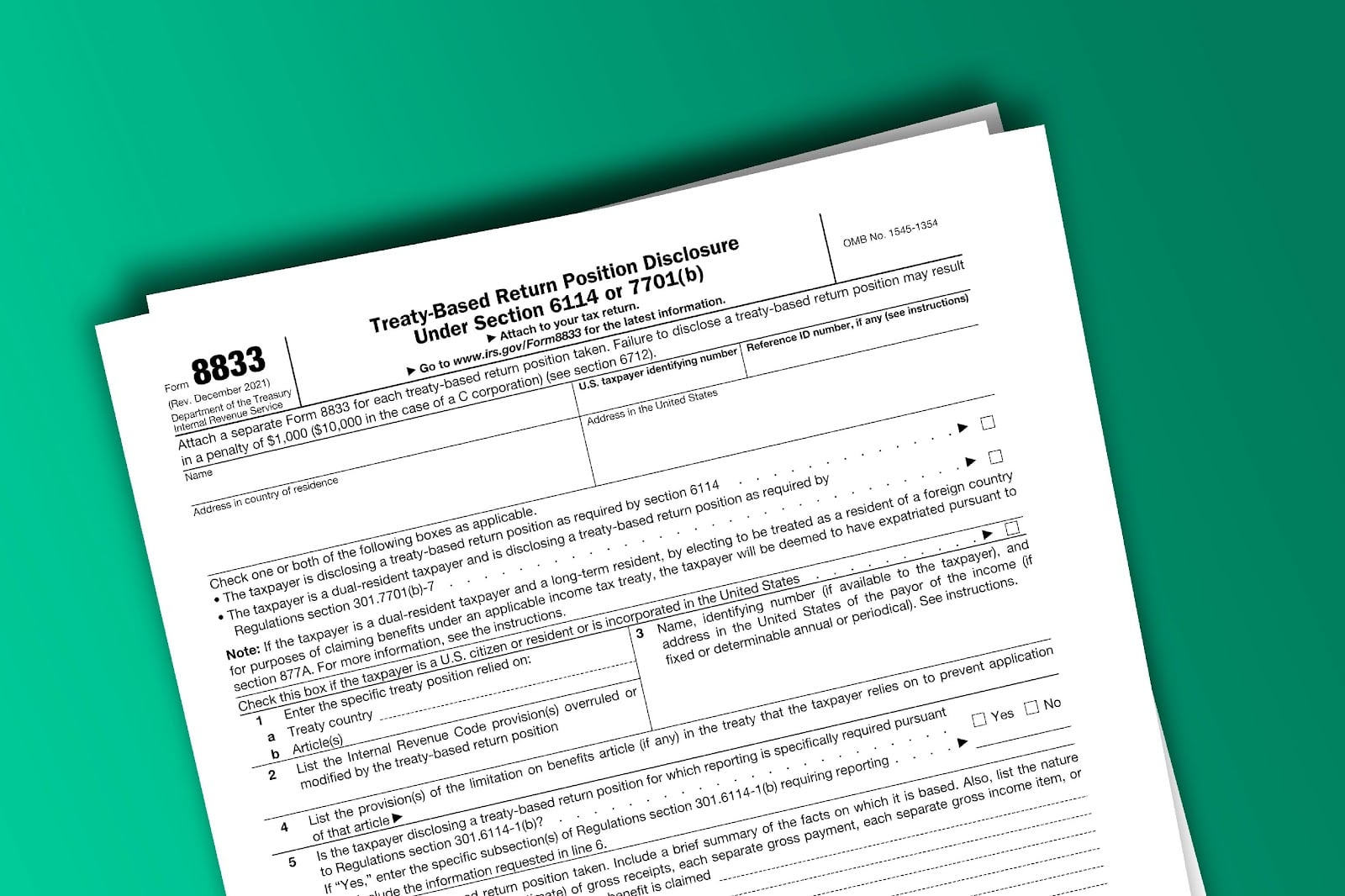
- Disclose the treaty-based position on Form 8833 (Treaty-Based Return Position Disclosure Under Section 6114 or 7701(b)) if the value of the omitted filing is significant.
This is a technical area of law. For instance, the French Assurance Vie is a common point of contention. While it is a "life insurance" contract, it is frequently used as a general investment account and often does not qualify for the pension treaty exception, unlike a U.K. SIPP or a Canadian RRSP.
Exception 3: Pure Protection (Term Insurance) Contracts
The third exception is based on the technical definition of what constitutes a PFIC. A foreign life insurance policy is only subject to Form 8621 if it is considered a "passive investment."
The Absence of "Cash Value"
Form 8621 is required for "stock" in a foreign corporation that meets the income or asset test for a PFIC. A Term Life Insurance policy, which provides a death benefit but has no cash surrender value or investment sub-accounts, does not constitute an investment in a PFIC.
Because there is no "equity" or "value" to the policyholder other than the contingent death benefit, there is no "passive income" being generated for the policyholder. Consequently, "pure protection" policies are exempt from Form 8621 filing because they fail the fundamental definition of a PFIC.
Commercial and Business Insurance Exceptions
Similarly, if a foreign life insurance policy is held by a foreign corporation for legitimate business purposes (such as key-person insurance) and that corporation is an active operating business (not a PFIC itself), the U.S. shareholder of that corporation generally does not need to file a separate Form 8621 for the insurance policy. The reporting would instead be consolidated within Form 5471 (Information Return of U.S. Persons With Respect To Certain Foreign Corporations).
Comparison of Reporting Requirements for Foreign Life Insurance (2026)
The following table compares the different filing requirements that may apply to foreign life insurance and where exceptions are most likely to be found.
| Form Type | Purpose | Filing Threshold | Common Exception |
|---|---|---|---|
| Form 8621 | PFIC Investment Reporting | $25k (Single) / $50k (Joint) | De Minimis value or Treaty-protected pension |
| Form 8938 | FATCA Asset Reporting | $50k - $400k (varies by residency) | Assets reported on other forms (e.g., 8621) |
| FinCEN 114 (FBAR) | Foreign Bank Account Reporting | $10,000 aggregate | Term insurance (no cash value) |
| Form 720 | Federal Excise Tax (FET) | $0 (applies to all premiums) | Policies from countries with FET treaty waivers |
Secondary Reporting Obligations: Form 8938 and FBAR
Even if you meet one of the three exceptions for Form 8621, you are not necessarily finished with your 2026 tax obligations. Foreign life insurance with a cash value is still considered a Specified Foreign Financial Asset.
Form 8938 (FATCA)
Under the Foreign Account Tax Compliance Act (FATCA), you must file Form 8938 if the total value of your foreign assets exceeds certain thresholds. For a single person living in the U.S., this threshold is $50,000 on the last day of the year or $75,000 at any time during the year. If you are exempt from Form 8621 because your policy is worth $20,000, but you have $40,000 in a foreign bank account, you must still report the insurance policy on Form 8938 because your total assets exceed $50,000.
FinCEN Form 114 (FBAR)
The FBAR is a separate filing from your tax return, submitted to the Financial Crimes Enforcement Network. If the aggregate value of all your foreign financial accounts—including the cash value of life insurance—exceeds $10,000 at any time during the calendar year, you must file an FBAR. There is no de minimis exception for FBARs that mirrors the PFIC $25,000 rule; if you have $11,000 in a foreign policy, you must report it to FinCEN even if you are exempt from filing Form 8621 with the IRS.
Common Mistakes and Compliance Risks in 2026
As of 2026, the IRS has increased its use of automated data matching between foreign financial institutions and individual tax returns. Common errors can lead to "quiet disclosures" or "willful blindness" penalties.
- Confusing Form Numbers: As noted, searching for "Form 9621" will not yield official IRS instructions. Taxpayers must ensure they are using Form 8621 for PFIC matters and Form 720 for the 1% excise tax on premiums.
- Missing the Excise Tax: Many people focus so heavily on the PFIC rules that they forget the Federal Excise Tax (FET). Under IRC Section 4371, a 1% tax is due on premiums paid for foreign life insurance policies. Unless the policy is from a country like the U.K., Germany, or Canada, which have FET waivers in their tax treaties, you must file Form 720 quarterly.
- Inaccurate Valuation: The "cash value" used for the $25,000 exception must be the maximum value possible during the year, often including any accrued interest or dividends, not just the premiums paid.
- Failure to Aggregate: Forgetting to add the value of foreign mutual funds or "wrapper" investments held within the insurance policy to the total PFIC count.
FAQ
1. What happens if I should have filed Form 8621 but didn't?
In 2026, the penalties for failing to file Form 8621 are unique. Unlike other forms that have a flat $10,000 penalty, the primary "penalty" for Form 8621 is that the statute of limitations on your entire tax return remains open indefinitely. This means the IRS can audit your entire return five or ten years later if the Form 8621 was missing.
2. Can I use the de minimis exception if my policy is in a "Tax Haven"?
Yes. The $25,000/$50,000 de minimis exception is based on the value of the asset, not the jurisdiction of the insurance provider. However, policies from non-treaty jurisdictions are more likely to be scrutinized for excise tax (Form 720) compliance.
3. Does a foreign "Endowment Policy" count as life insurance for these exceptions?
Usually, yes. For U.S. tax purposes, if the contract meets the definition of life insurance under IRC Section 7702, it is treated as insurance. If it fails Section 7702 (common for many foreign high-cash-value policies), it is treated as a complex investment, making the PFIC/Form 8621 filing even more likely to be required without the benefit of the insurance-specific tax advantages.
4. Is the $25,000 exception based on the death benefit or the cash value?
It is based strictly on the cash surrender value. The death benefit (the amount paid upon your passing) is not used to calculate the filing threshold for PFIC reporting.
5. If my policy is term insurance, do I still need to file an FBAR?
No. If the policy has no cash value (pure term insurance), it is not considered a "financial account" for FBAR (FinCEN 114) purposes. However, if the policy has even a small amount of returnable premium or "cash-back" features, it might cross into the reporting zone.
Practical Recommendation
If you own a foreign life insurance policy in 2026, your first step should be to request an annual valuation statement from your insurance provider that specifically breaks down the cash surrender value in U.S. Dollars (using the IRS-approved year-end exchange rates).
If the value is below $25,000 and you have no other foreign investments, you may safely omit Form 8621 under the de minimis exception. However, if the value exceeds this amount, you should consult with a tax professional to determine if a treaty-based exception applies. Given the complexity of the PFIC "Excess Distribution" regime, qualifying for an exception can save you thousands of dollars in annual compliance costs and potential interest charges. Always ensure that even if you are exempt from Form 8621, you remain compliant with FBAR and Form 8938 requirements, which have lower thresholds and different sets of rules.