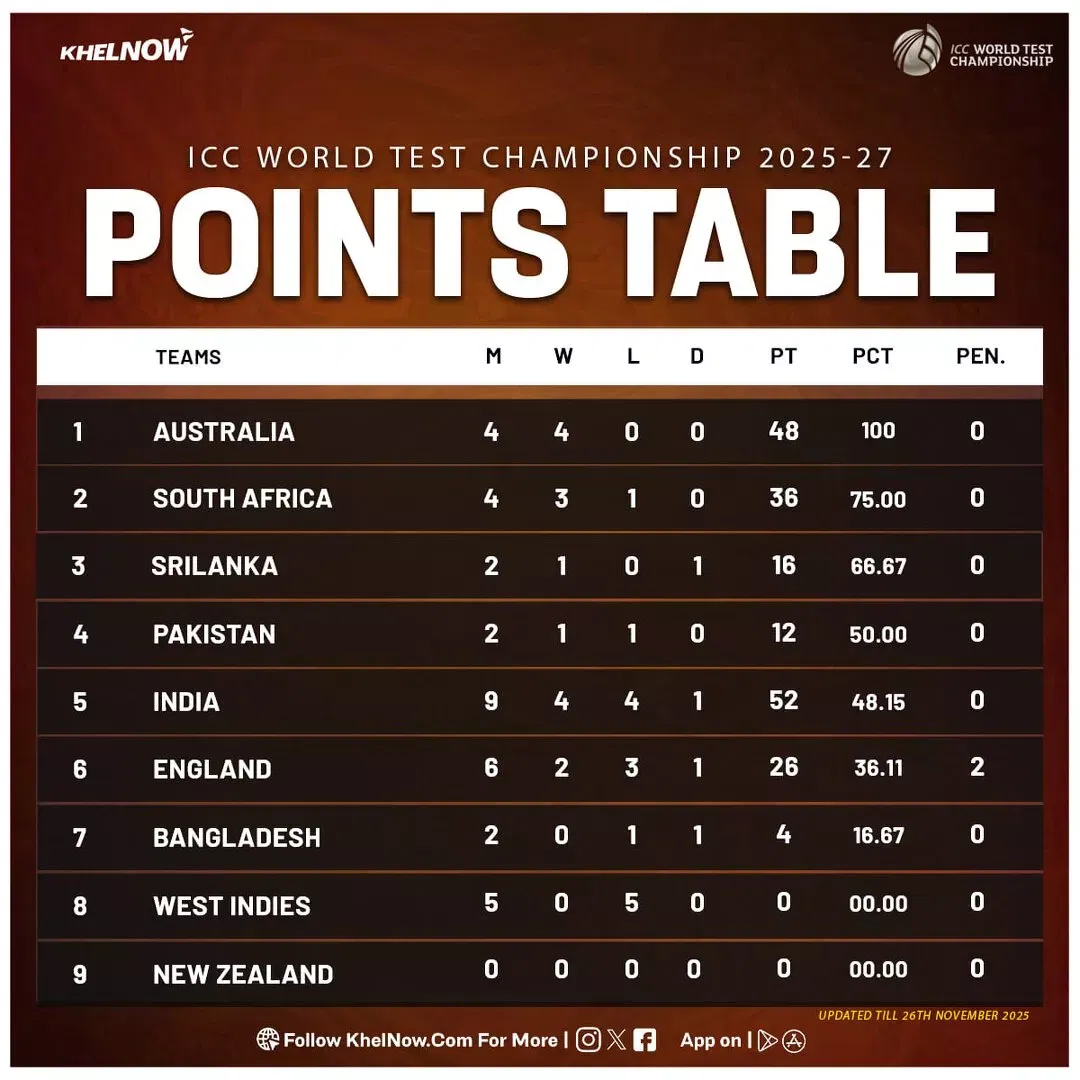
The 2025–27 World Test Championship (WTC) is the fourth edition of the International Cricket Council's (ICC) premier Test competition. Featuring nine teams playing 27 series across two years, the cycle culminates in a grand final in June 2027 to determine the world champion of the five-day format.
The World Test Championship was designed to bring context to bilateral Test cricket, ensuring that every match—regardless of the historical rivalry—contributes to a larger global narrative. As we progress through 2026, the competition for the top two spots on the leaderboard has intensified, with teams navigating complex points systems, over-rate penalties, and varying pitch conditions across the globe. This cycle follows the 2023–25 edition, continuing the tradition of a league-based structure followed by a one-off final.
Understanding the Structure of the 2025–27 WTC Cycle
The 2025–27 cycle maintains the foundational structure established in previous editions. Nine teams compete in the league stage: Australia, India, England, South Africa, New Zealand, Pakistan, Sri Lanka, West Indies, and Bangladesh. Each team is scheduled to play six Test series—three at home and three away.
The duration of these series varies, ranging from two-match series to five-match encounters. This discrepancy is a result of bilateral agreements between cricket boards, but the WTC points system is standardized to ensure fairness. Regardless of whether a series consists of two or five matches, the percentage of points (PCT) is the primary metric used to determine the standings. This ensures that a team playing fewer matches is not unfairly penalized compared to a team with a more crowded schedule, provided they maintain a high win ratio.
The Points System and Qualification Criteria
The mechanics of the 2025–27 WTC leaderboard are centered on the points awarded per match. Each individual Test match offers a total of 12 points for a victory. In the event of a draw, both teams receive 4 points, while a tie results in 6 points for each side.
While the raw points are visible on the table, the Percentage of Points (PCT) is the only figure that determines the final ranking. This is calculated by dividing the points earned by the total points available from the matches played. This system is crucial because the total number of matches played by each team is not uniform. For example, England frequently plays five-match series, whereas teams like South Africa or Sri Lanka often play two-match series.
Points Breakdown Table
| Match Result | Points Awarded | Percentage of Points (PCT) |
|---|---|---|
| Win | 12 | 100% |
| Tie | 6 | 50% |
| Draw | 4 | 33.33% |
| Loss | 0 | 0% |
The Impact of Penalty Points
One of the most significant factors in the 2025–27 cycle has been the strict enforcement of over-rate penalties. For every over a team fails to bowl within the allotted time, one competition point is deducted from their total. In a tight race where the difference between second and third place can be a fraction of a percentage, these penalties have proven to be "season-killers" for several nations. Captains in 2026 have been under immense pressure to utilize spinners more frequently or speed up transitions between overs to avoid these costly deductions.
Participating Teams and Their Path to the 2027 Final
As we navigate the 2026 season, each of the nine participating nations faces a unique set of challenges based on their home and away assignments.
The Powerhouses: India and Australia
India and Australia have traditionally dominated the WTC format. For India, the 2025–27 cycle involves critical away tours where they must secure wins in challenging conditions to maintain their PCT. Australia, usually formidable at home, relies on its pace battery to sweep home series while looking for opportunistic wins in the subcontinent.
The "Bazball" Factor: England
England's approach to Test cricket continues to influence the 2025–27 cycle. Their aggressive style often results in fewer draws, which is beneficial for the PCT system as wins are worth triple the points of a draw. However, the high-risk nature of their play means they are also susceptible to rapid losses, making their standing one of the most volatile in the current table.
The Dark Horses: South Africa and New Zealand
South Africa and New Zealand often play fewer Tests but remain highly competitive due to their strong home records. In 2026, South Africa’s pace-friendly tracks have become a fortress, while New Zealand continues to rely on their disciplined seam bowling and technical batting. For these teams, the path to the final usually requires near-perfect home records and at least one away series win.
The Subcontinent Challengers: Pakistan, Sri Lanka, and Bangladesh
These teams rely heavily on spin-friendly home conditions to climb the rankings. Pakistan’s ability to secure points on the road has been a point of focus in 2026, while Bangladesh and Sri Lanka have shown they can upset higher-ranked teams in their own backyards.
Strategic Challenges for Teams in 2026
By mid-2026, teams are forced to balance player workloads with the necessity of fielding their best XI for WTC points. Unlike bilateral cricket of the past, teams can no longer afford to "experiment" in Test matches without risking their qualification for the 2027 final.
- Squad Rotation vs. Consistency: With the increase in T20 leagues, multi-format players are facing burnout. Boards must decide whether to rest star bowlers for minor series, knowing that a single loss could derail a two-year WTC campaign.
- Pitch Preparation: Home teams are increasingly tailoring pitches to suit their strengths to maximize the 12 points available per match. This has led to shorter, more intense matches where results are almost guaranteed.
- Technological Integration: The use of data analytics in 2026 has reached new heights. Teams are now using advanced ball-tracking data to predict seam movement and spin degrees specifically to prepare for WTC opponents.
The Road to Lord's 2027
While the ICC has experimented with different venues, the 2027 World Test Championship Final is slated to be held at Lord’s Cricket Ground in London. This venue remains the symbolic home of cricket, and the 2027 final is expected to be a massive commercial and sporting event.
To qualify, a team typically needs a PCT of over 60%, though this threshold can fluctuate depending on how many draws occur throughout the cycle. In 2026, the "points cut-off" is becoming clearer as the bottom half of the table falls away, leaving four or five teams in a genuine race for the top two spots.
Key Fixtures to Watch in the Remainder of the Cycle
The 2026 calendar is packed with "six-pointer" series that will decide the finalists. Major rivalries, such as the Ashes or the Border-Gavaskar Trophy (when falling within the cycle), carry immense weight. However, even smaller series, such as West Indies vs. Bangladesh, serve as vital opportunities for mid-table teams to play the role of "spoiler," potentially knocking a frontrunner out of contention.
Comparing WTC Cycles (2019–2027)
| Cycle | Winner | Runner-up | Key Feature |
|---|---|---|---|
| 2019–21 | New Zealand | India | Inaugural edition; Final affected by rain. |
| 2021–23 | Australia | India | Dominance of pace bowling in the final. |
| 2023–25 | Confirmed in 2025 | Confirmed in 2025 | Rise of aggressive batting styles. |
| 2025–27 | TBD (June 2027) | TBD (June 2027) | Strict over-rate enforcement. |
Common Pitfalls and Tactical Errors
As we analyze the performances in 2026, several recurring mistakes have cost teams valuable PCT:
- Conservative Captaincy in Draws: Some teams have batted too long, settling for a draw rather than risking a loss for a win. Under the 12-point win system, a draw is a poor return (only 4 points), making "safe" play statistically detrimental over a long cycle.
- Neglecting the Tail: Teams that have failed to develop lower-order batting have struggled to recover in low-scoring matches, which are common in the 2025–27 cycle due to result-oriented pitches.
- Over-reliance on Home Advantage: While winning at home is easier, the top two spots almost always require at least two away match victories. Teams that fail to adapt their techniques to overseas conditions find themselves stuck in the middle of the table.
FAQ: 2025–27 World Test Championship
What happens if the 2027 WTC Final ends in a draw or tie?
According to ICC regulations, if the final ends in a draw or a tie, the two competing teams will be declared joint champions. A "Reserve Day" is usually allocated to make up for time lost due to rain or bad light, but it cannot be used to start a new innings if a result hasn't been reached within the standard playing time.
How are the nine teams for the WTC selected?
The nine teams are the top-ranked Test nations in the ICC rankings at the start of the cycle. This means that newer Test nations like Ireland, Afghanistan, and Zimbabwe do not currently participate in the main WTC league, although they continue to play bilateral Test cricket.
Can a team be disqualified from the 2025–27 cycle?
Teams are not "disqualified" in the traditional sense, but they can be heavily penalized. Persistent slow over-rates or failing to fulfill fixture obligations can lead to point deductions that effectively remove a team from contention for the final.
Does the 2025–27 cycle include Day/Night Tests?
Yes, Day/Night (Pink Ball) Tests are included in the cycle if both participating boards agree to the format. Pink ball matches often produce results more quickly, making them strategic choices for teams looking to avoid draws.
Is there a prize pool for the 2025–27 WTC?
Yes, the ICC allocates a significant prize pool for the WTC. In previous cycles, the total purse was approximately $3.8 million, with the winners receiving $1.6 million and the runners-up $800,000. The remaining funds are distributed among the other seven teams based on their final standings.
Final Recommendations for Following the Cycle
To stay informed during the remainder of the 2025–27 cycle, fans and analysts should focus on the PCT column rather than total points. As we move into late 2026 and early 2027, the "magic number" for qualification will become the primary focus of every selection meeting.
For those tracking the progress, pay close attention to away series involving the top four teams. Winning away from home remains the hardest task in Test cricket and is the definitive hallmark of a championship side. As the road to Lord's narrows, every session of play counts toward the ultimate goal of being crowned the world's best Test team.