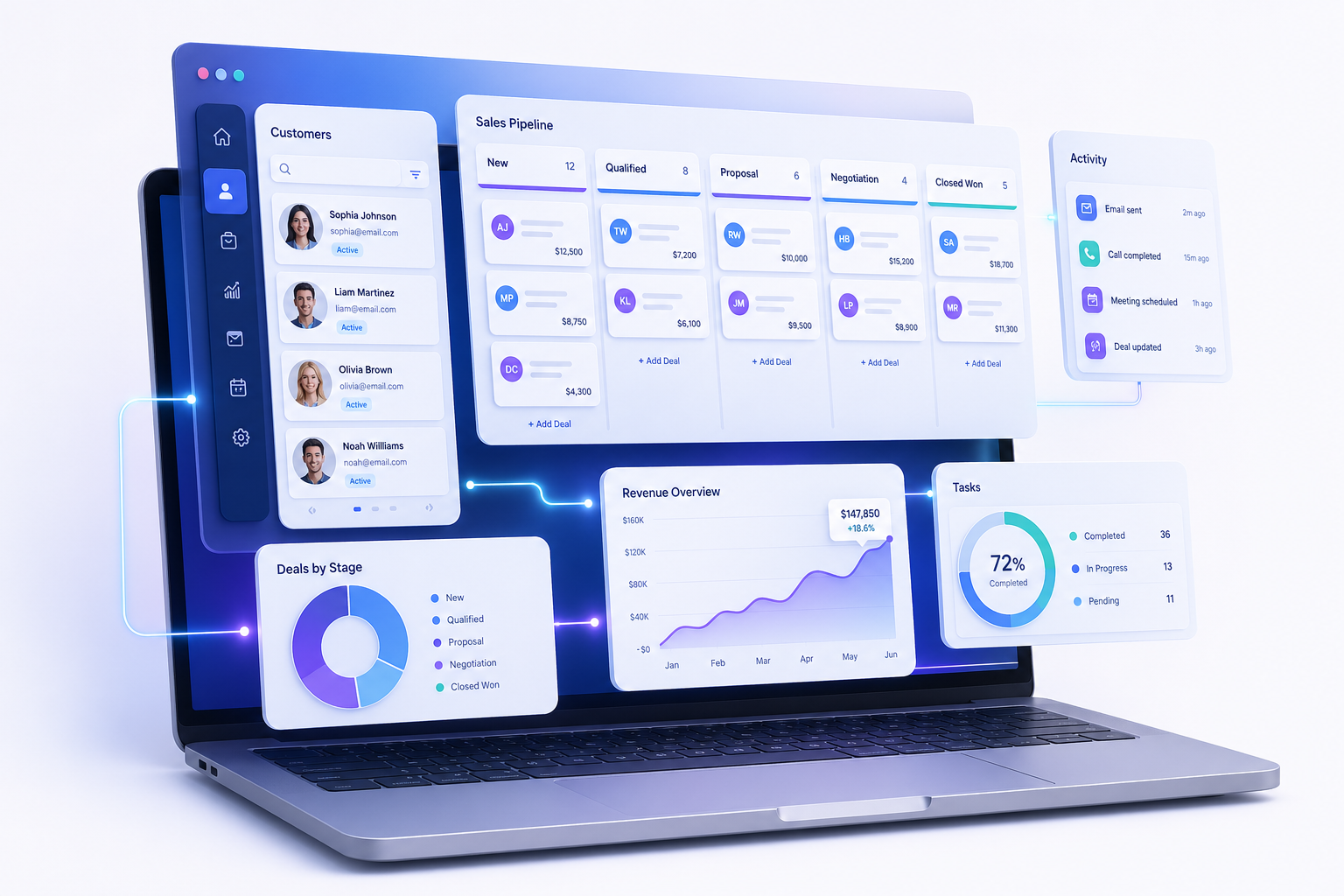
Small businesses evaluating customer relationship management (CRM) tools require software that balances essential pipeline tracking and contact management with affordable pricing structures. Selecting the right platform involves comparing per-user monthly costs, storage limits, automation capabilities, and ease of implementation to ensure the chosen tool supports operational growth without straining tight budgets.
Selecting an affordable customer relationship management platform requires balancing upfront financial limits with long-term operational needs. For small business owners and solo entrepreneurs, investing in overly complex enterprise software drains resources, while excessively basic free tools often lack the scaling capacity required for growing sales pipelines. The search for the 2021 best low cost CRM software for small business centers on platforms that deliver core sales tracking, contact management, and basic automation without hidden fees or complex implementation overhead.
Evaluating these platforms requires looking past marketing claims to examine actual feature limitations, tiered pricing structures, and user interface complexity. This guide explores the top low-cost CRM options available, analyzes their core strengths and limitations, and provides a structured framework for choosing the right solution for your specific business workflow.
Core Requirements for Small Business CRM Software
Before examining specific software options, it is essential to define what makes a CRM genuinely suitable for a small business. Budget constraints mean every dollar spent must directly contribute to revenue generation or administrative efficiency.
Essential Features vs. Enterprise Bloat
Small businesses rarely utilize the advanced predictive analytics, multi-tier territory management, or custom enterprise integrations found in high-end platforms. Instead, a cost-effective CRM must master the fundamentals:
- Contact Management: Centralized databases storing customer communications, purchase histories, and custom attributes.
- Pipeline and Deal Tracking: Visual Kanban boards or list views that track prospects through various stages of the sales funnel.
- Activity Logging: Automated or manual tracking of emails, phone calls, meetings, and scheduled tasks.
- Email Integration: Seamless synchronization with providers like Google Workspace or Microsoft 365 to log correspondence automatically.
Pricing Models and Hidden Costs
Affordability goes beyond the headline monthly subscription fee. When analyzing low-cost CRM tools, buyers must evaluate:
- Per-User vs. Flat-Fee Structures: Some platforms charge per user per month, which can become expensive as teams expand. Others offer flat-tier pricing for a set number of users.
- Contact Tier Limits: Many budget CRMs restrict the total number of contacts or stored records, charging significant overage fees if the database grows past the threshold.
- Add-On Costs: Essential features like advanced email automation, reporting dashboards, or customer support phone lines are sometimes locked behind expensive tier upgrades.
Top Low-Cost CRM Options for Small Businesses
Several platforms stand out for delivering robust functionality at an accessible price point. Each caters to slightly different operational styles, ranging from marketing-heavy workflows to pure pipeline tracking.
HubSpot CRM
HubSpot remains a dominant force in the small business sector, largely due to its robust free tier and scalable paid plans.
- Overview: HubSpot offers a comprehensive ecosystem that combines contact management, ticketing, email marketing, and live chat.
- Pricing Structure: Features a permanently free tier with foundational CRM tools. Paid tiers (Starter and Professional) introduce advanced automation, custom reporting, and increased limits, scaling up as the business grows.
- Pros: Highly intuitive user interface, extensive third-party app marketplace, and seamless inbound marketing integration.
- Cons: Costs can escalate rapidly when moving from the Starter tier to Professional plans, and data storage limits on lower tiers require careful management.
Freshsales (Freshworks CRM)
Freshsales is designed for sales teams that require built-in telephony, email tracking, and AI-driven lead scoring without paying enterprise-level prices.
- Overview: A sales-focused CRM providing visual deal pipelines, built-in phone and email, and contact lifecycle tracking.
- Pricing Structure: Offers a competitive free tier alongside low-cost paid editions (Growth and Pro) billed per user.
- Pros: Built-in phone and email capabilities reduce the need for expensive third-party integrations; clean, modern interface.
- Cons: Advanced customization and workflow automation require moving past the entry-level paid tiers.
Zoho CRM
Zoho CRM is widely recognized for offering extensive feature depth and customization options at a fraction of the cost of legacy enterprise competitors.
- Overview: Part of the broader Zoho ecosystem, this CRM provides comprehensive sales force automation, process management, and analytics.
- Pricing Structure: Includes a free edition for up to three users and highly affordable Standard and Professional tiers.
- Pros: Exceptional value for money, deep customization capabilities, and tight integration with other Zoho productivity applications.
- Cons: The learning curve can be steep due to the sheer volume of settings and configuration options, making initial setup time-consuming for non-technical users.
Pipedrive
Built by salespeople for salespeople, Pipedrive focuses entirely on pipeline management and keeping sales teams focused on closing deals.
- Overview: A visual, activity-based CRM designed to move deals through defined stages with minimal administrative friction.
- Pricing Structure: Subscription-based tiers (Essential, Advanced, Professional) billed per user monthly, with no free tier available (though a trial is offered).
- Pros: Outstanding visual pipeline interface, strong emphasis on activity-based selling, and straightforward onboarding.
- Cons: Lacks native customer support ticketing or advanced marketing automation tools, requiring integrations for broader business operations.
Comparative Feature Matrix
To help determine which platform aligns with your operational requirements, review the comparison table below detailing structure, primary focus, and suitability for small business segments.
| CRM Platform | Primary Focus | Free Tier Available | Entry-Level Paid Cost | Best Suited For |
|---|---|---|---|---|
| HubSpot CRM | Inbound Marketing & Sales | Yes | Low to Moderate | Businesses seeking an all-in-one marketing and sales ecosystem |
| Freshsales | Sales Pipelines & Telephony | Yes | Low | Teams needing built-in phone and email communication |
| Zoho CRM | Customization & Scalability | Yes | Very Low | Cost-conscious teams requiring deep feature sets and custom workflows |
| Pipedrive | Visual Deal Tracking | No (Trial Only) | Low | Pure sales teams focused on pipeline progression and activity tracking |
Implementation Challenges and Common Pitfalls
Adopting a new CRM software frequently encounters internal resistance or technical hurdles. Recognizing these pitfalls helps ensure a smooth rollout.
Low User Adoption Rates
The most common cause of CRM failure is not software deficiency, but employee non-adoption. If sales representatives view data entry as an administrative burden rather than a sales aid, databases quickly become outdated. Mitigate this risk by:
- Involving end-users in the software selection process.
- Choosing tools with automated email logging and calendar syncing to minimize manual data entry.
- Keeping initial pipeline stages simple before introducing complex automation rules.
Ignoring Data Migration Prerequisites
Moving from spreadsheets or a legacy database to a new CRM requires rigorous data hygiene. Importing duplicate, outdated, or incorrectly formatted contacts into a new platform immediately compromises reporting accuracy. Cleanse datasets thoroughly—removing inactive leads and standardizing name, phone, and address fields—before executing any data migration.
Step-by-Step Selection and Setup Process
Following a structured methodology prevents analysis paralysis and ensures the chosen CRM directly supports business objectives.
- Audit Current Workflows: Document how leads enter your business, how they move through your sales pipeline, and where communication breakdowns currently occur.
- Establish Budget Limits: Calculate the maximum per-month expenditure your business can sustain over a 12-month period, factoring in potential team growth.
- Test Free Trials: Narrow the selection to two platforms and test them with real-world data and actual team members for at least one week.
- Execute Pilot Migration: Import a small subset of contacts (e.g., 50 records) to test field mapping, email synchronization, and pipeline stages.
- Launch and Train: Conduct mandatory training sessions focused on daily workflow habits rather than exhaustive software feature tours.
Frequently Asked Questions
Are free CRM tiers truly viable for running a small business?
Yes, for micro-businesses and startups with straightforward sales pipelines, free tiers from providers like HubSpot or Zoho offer adequate contact storage and task management. However, as your team grows or you require advanced automation, reporting, and higher contact limits, upgrading to a paid tier becomes necessary.
How many users should I account for when calculating CRM costs?
Calculate costs based on your active daily users who require write access to customer records. Many platforms also offer read-only or occasional-use permissions at lower rates, though most standard pricing models require a per-user monthly subscription for full sales functionality.
Can low-cost CRMs integrate with my existing email and accounting tools?
Most reputable budget CRMs offer native integrations or Zapier compatibility with major email providers (Gmail, Outlook) and common accounting software (QuickBooks, Xero). Always verify specific integration availability on the vendor's pricing page before committing to a subscription.
What is the difference between a sales CRM and a marketing CRM?
A sales CRM focuses on managing active deals, tracking phone calls and emails, and moving prospects through a sales pipeline. A marketing CRM emphasizes mass email campaigns, lead capture forms, social media tracking, and website visitor analytics. Many modern platforms combine both functions into tiered suites.
How long does it typically take to implement a new small business CRM?
For simple pipeline CRMs, basic setup and team onboarding can take anywhere from a few days to two weeks. More complex platforms with custom fields, automated workflows, and extensive historical data migrations typically require three to six weeks of phased implementation.
Conclusion and Next Action
Finding the right low-cost CRM software requires balancing immediate budget constraints against future scaling requirements. Begin by mapping your essential sales workflows and auditing your existing contact data. Shortlist two platforms that fit your financial parameters, utilize their free trials or entry-level tiers, and test them with real team workflows before committing to an annual contract.