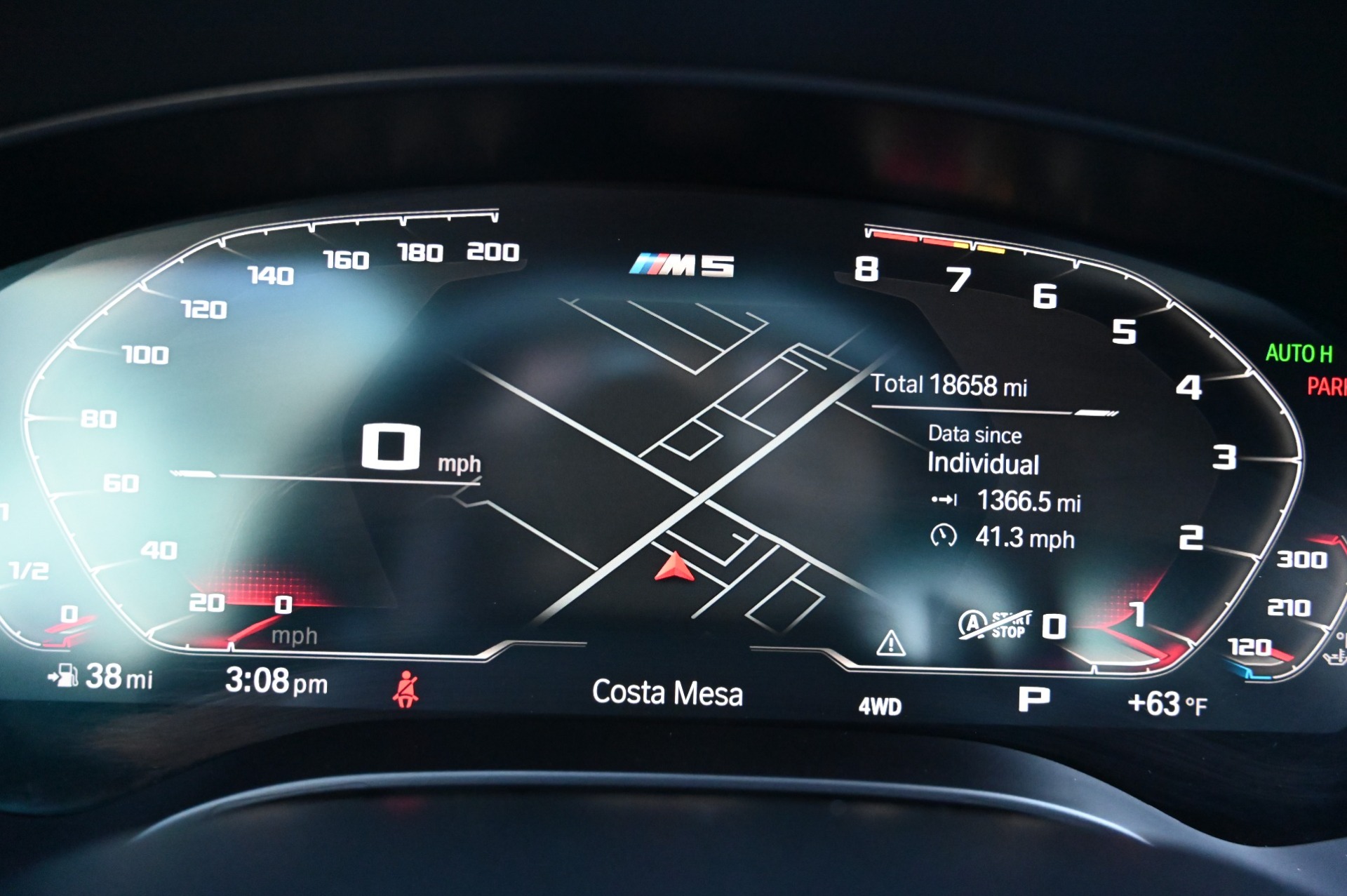
The 2020 BMW M5 F90 accelerates from 0 to 60 mph in approximately 3.1 to 3.2 seconds under real-world testing conditions, while factory specifications officially rate the standard model at 3.2 seconds and the M5 Competition variant at 3.1 seconds. This blistering performance is achieved through a combination of a high-output 4.4-liter twin-turbo V8 engine, an advanced M xDrive all-wheel-drive system, and a lightning-fast 8-speed automatic transmission.
Evaluating high-performance luxury sedans requires looking past marketing claims to understand the engineering, environmental variables, and driving modes that dictate real-world acceleration. The sixth-generation BMW M5, internally designated as the F90, fundamentally shifted how heavy executive sedans handle power delivery. By introducing an all-wheel-drive platform to a lineage historically defined by rear-wheel drive, BMW transformed the M5 from a twitchy autobahn cruiser into an all-weather supercar slayer.
Understanding the 2020 BMW M5 F90 0-60 mph time requires examining the powertrain architecture, the role of traction technology, environmental factors during testing, and how this vehicle compares to its elite tier of competitors.
Powertrain Architecture and Technical Specifications
At the heart of the 2020 BMW M5 F90 lies the S63 engine, a 4.4-liter twin-turbocharged V8 equipped with high-precision direct injection and BMW's Valvetronic variable valve timing. In the standard 2020 M5, this powerplant generates 600 horsepower between 5,600 and 6,700 rpm, alongside 553 lb-ft of torque available from a remarkably low 1,800 rpm up to 5,600 rpm.
For buyers who opted for the M5 Competition package, output increased to 617 horsepower while maintaining the same broad torque band. This power is routed through an 8-speed M Steptronic automatic transmission with Drivelogic, which replaces the dual-clutch transmission found in previous generations. While purists initially mourned the loss of the dual-clutch unit, the torque-converter automatic proved vastly superior in handling the immense torque loads off the line, enabling more consistent launch control sequences without overheating the clutch packs.
The engine's reverse-flow design places the turbochargers inside the "V" of the cylinder banks, shortening intake and exhaust paths. This layout virtually eliminates turbo lag, allowing maximum boost pressure to hit almost instantly when the driver stomps on the accelerator pedal. Consequently, the car begins moving with urgency the exact moment the transmission engages.
The Role of M xDrive in Launch Performance
Historically, high-horsepower rear-wheel-drive sedans struggled to achieve quick 0-60 mph times on standard asphalt because rear tire slip limited acceleration. The F90 generation solved this physics problem by introducing the M xDrive all-wheel-drive system.
Unlike traditional front-biased all-wheel-drive systems, M xDrive is rear-biased by design, ensuring the car retains its characteristic driving dynamics. It utilizes a central transfer case with an electronically controlled multi-plate clutch to distribute torque variably between the front and rear axles within milliseconds.
When executing a launch control sequence, the system locks the clutch packs to maximize traction across all four contact patches. This eliminates wheelspin, allowing the engine's full 553 lb-ft of torque to translate directly into forward motion. Once the vehicle gains momentum and higher gears are engaged, the system can decouple the front axle entirely, reverting to pure rear-wheel drive in 2WD mode for track driving and drifting. However, achieving the benchmark 3.1 to 3.2-second 0-60 mph time strictly requires utilizing the M xDrive system in 4WD Sport or 4WD mode.
| Model Variant | Horsepower | Torque (lb-ft) | Official 0-60 mph Time | Tested 0-60 mph Time |
|---|---|---|---|---|
| 2020 BMW M5 (Base) | 600 hp | 553 lb-ft | 3.2 seconds | 3.1 seconds |
| 2020 BMW M5 Competition | 617 hp | 553 lb-ft | 3.1 seconds | 2.8 to 3.0 seconds |
| 2020 BMW M5 CS (Later release) | 627 hp | 553 lb-ft | 2.9 seconds | 2.6 to 2.7 seconds |
How Launch Control Works on the F90 M5
Achieving published acceleration figures relies heavily on executing the factory launch control procedure correctly. Automakers test vehicles under optimal conditions using electronic launch systems designed to manage engine speed and wheel slip automatically.
To execute launch control in a 2020 BMW M5 F90, the driver must follow a specific sequence:
- Ensure the engine and transmission operating temperatures are within normal ranges.
- Select the most aggressive settings for the engine (Sport Plus), transmission (Drivelogic level 3, the fastest shifting mode), and stability control (DSC off or M Dynamic Mode).
- Engage the M xDrive system in 4WD or 4WD Sport.
- Press firmly on the brake pedal with the left foot.
- Floor the accelerator pedal past the kick-down switch until "Flag" symbol or "Launch Control Active" appears in the instrument cluster.
- Adjust the engine speed using the cruise control rocker switch if fine-tuning is required, though the computer typically sets it around 2,500 rpm.
- Release the brake pedal abruptly while keeping the accelerator pinned to the floor.
The car manages boost pressure and clutch engagement autonomously to minimize tire scrub while maximizing forward thrust.
Real-World Testing Variables
While BMW officially claims a 3.1-second 0-60 mph time for the Competition model, independent automotive testing publications have frequently recorded quicker times under ideal track conditions. Outlets like Car and Driver and MotorTrend have clocked the 2020 M5 Competition sprinting from 0 to 60 mph in as low as 2.8 to 3.0 seconds using 1-foot rollout.
Several environmental and mechanical factors influence these figures:
- Tire Compound and Temperature: The factory-equipped Pirelli P Zero or Michelin Pilot Sport 4S tires must be warm to provide maximum mechanical grip. Cold rubber significantly increases wheel slip.
- Density Altitude: Track elevation, ambient temperature, and barometric pressure dictate atmospheric oxygen levels. Sea-level tracks in cool weather yield denser air, increasing turbo efficiency and engine output.
- Fuel Quality: High-performance engines require high-octane fuel (91 to 93 AKI in the United States) to prevent pre-ignition and allow the engine control unit to maintain maximum ignition timing and boost pressure.
- Surface Preparation: Drag strips with treated, rubber-laden surfaces provide superior traction compared to standard public asphalt.
Comparison Against Competitors
The executive super-sedan segment represents the pinnacle of engineering compromise, balancing luxury accommodations with supercar-rivaling performance. The 2020 BMW M5 F90 competes directly against established heavyweights in this category.
| Vehicle | Engine | Horsepower | 0-60 mph Time (Tested) |
|---|---|---|---|
| 2020 BMW M5 Competition | 4.4L Twin-Turbo V8 | 617 hp | 2.8 - 3.1 seconds |
| 2020 Mercedes-AMG E 63 S | 4.0L Twin-Turbo V8 | 603 hp | 3.0 - 3.3 seconds |
| 2020 Audi RS 7 Sportback | 4.0L Twin-Turbo V8 | 591 hp | 3.3 - 3.5 seconds |
| 2020 Porsche Panamera Turbo | 4.0L Twin-Turbo V8 | 550 hp | 3.2 - 3.4 seconds |
When stacked against its primary rival, the Mercedes-AMG E 63 S, the M5 F90 frequently matches or edges out its competitor in straight-line acceleration tests, despite weighing over 4,200 pounds. This competitive advantage stems from how efficiently the ZF 8-speed automatic transmission handles gear changes compared to AMG's multi-clutch wet-pack setup, as well as superior power delivery in the mid-to-high RPM range.
Common Mistakes and Misconceptions
Drivers attempting to replicate manufacturer acceleration figures often encounter pitfalls that skew their results.
A common misconception is that turning off Dynamic Stability Control (DSC) entirely yields the fastest time. In reality, completely disabling stability control on a high-torque all-wheel-drive car often results in excessive wheelspin or electronic intervention cutting power if the tires break traction on unprepared surfaces. Utilizing M Dynamic Mode (MDM) or leaving stability control fully engaged during a factory launch control sequence ensures optimal power management.
Another frequent error involves neglecting component heat soak. Repeatedly running launch control sequences back-to-back causes intake air temperatures to spike and transmission fluid to overheat, prompting the engine computer to pull timing and reduce power output to protect mechanical components. Allowing the vehicle adequate cool-down time between runs is essential for consistent performance.
Frequently Asked Questions
Does the 2020 BMW M5 F90 require a specific fuel octane rating to achieve its fastest 0-60 time?
Yes. To achieve advertised horsepower and acceleration figures, the vehicle requires premium fuel with an octane rating of 91 AKI (US standard) or 98 RON (European standard) minimum. Using lower-octane fuel forces the engine control unit to retard ignition timing to prevent engine knock, resulting in reduced power output and slower acceleration times.
Can the 2020 BMW M5 F90 launch control be used repeatedly without damaging the car?
While the car is engineered with robust cooling and heavy-duty transmission components, consecutive back-to-back launches will induce thermal stress. The transmission and differentials feature electronic protection modes that may temporarily disable launch control if fluid temperatures exceed safe operational limits. Allowing normal driving intervals between runs prevents premature component wear.
What is the difference in 0-60 acceleration between the base M5 and the M5 Competition?
The factory-rated difference is minimal, with the base M5 claiming 3.2 seconds and the Competition claiming 3.1 seconds. In real-world testing, skilled drivers frequently record nearly identical times between the two variants due to identical torque outputs (553 lb-ft), though the Competition model pulls slightly harder at higher RPMs due to its 17-horsepower advantage.
How does the 1-foot rollout affect published 0-60 mph testing numbers?
Automotive testing publications typically subtract the time it takes for the vehicle to travel the first 12 inches of movement from the total elapsed time. This standard industry practice simulates a drag strip timing tree setup. Without rollout, real-world 0-60 times measured by GPS devices are generally about 0.2 to 0.3 seconds slower than published magazine figures.
Is the 2020 BMW M5 F90 faster than the older F10 M5?
Substantially. The older F10 M5 (produced from 2011 to 2016) was rear-wheel drive and produced 560 horsepower (or 575 with the Competition package). It required approximately 3.7 to 4.0 seconds to reach 60 mph because of traction limitations off the line. The F90's addition of M xDrive all-wheel drive shaved nearly a full second off the car's standing-start acceleration capability.
Practical Recommendation
For owners or prospective buyers looking to experience the true acceleration capability of a 2020 BMW M5 F90, ensure the vehicle is fitted with high-performance summer tires with adequate tread depth, verify that ambient temperatures are favorable, and find a closed track or strip rather than attempting hard launches on public highways. Maintaining proper tire pressures—typically matching the factory door-jamb recommendations for high-speed driving—ensures maximum contact patch integrity and repeatable performance.