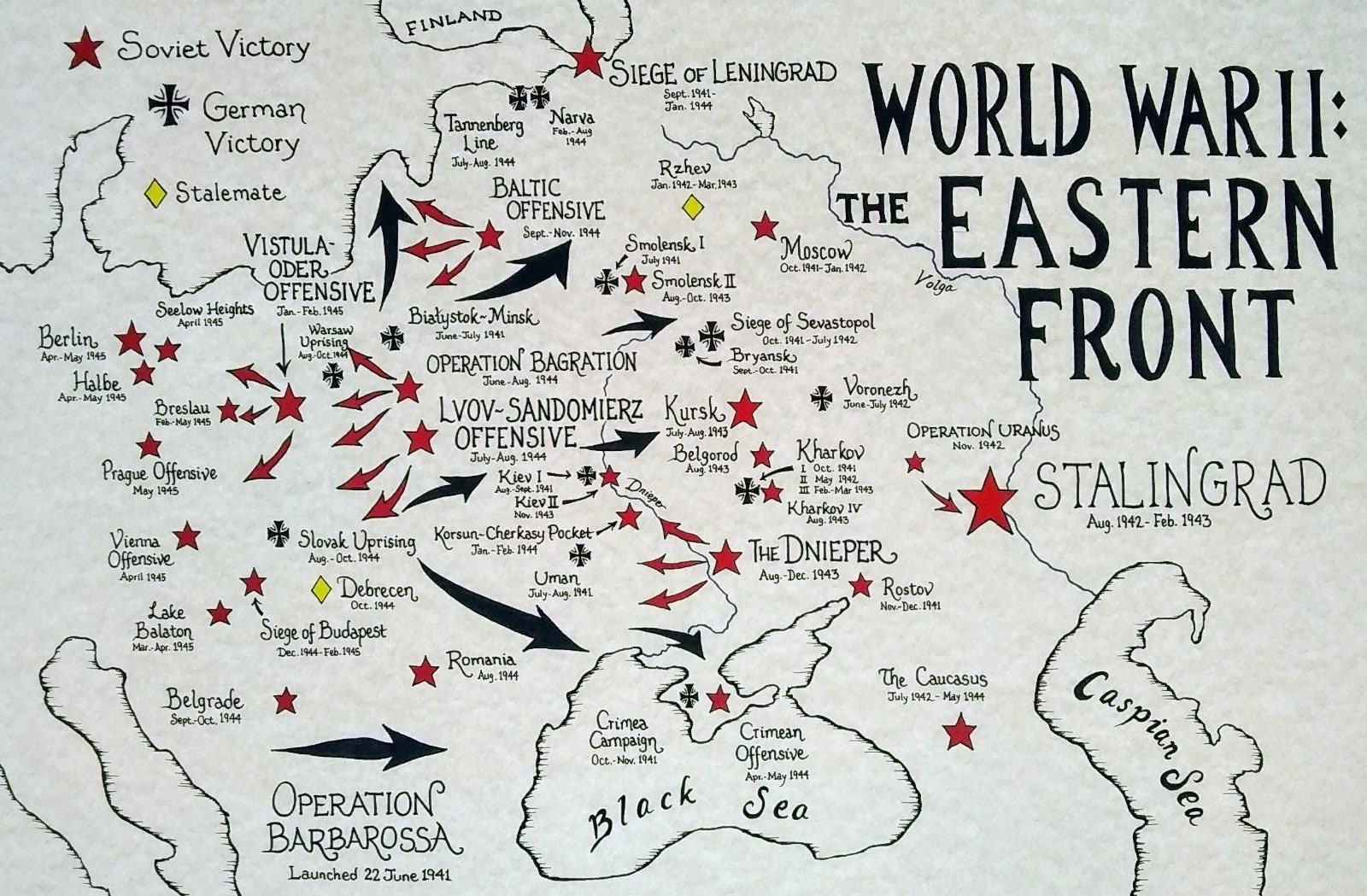
The Eastern Front of World War II, spanning from June 1941 to May 1945, was the largest and deadliest theater of conflict in human history. It pitted Nazi Germany and its Axis allies against the Soviet Union, culminating in the destruction of the Third Reich and the shifting of global power dynamics for the remainder of the twentieth century.
Strategic Prelude and the Launch of Operation Barbarossa (June 1941)
The theater of war in Eastern Europe shifted dramatically on June 22, 1941, when Nazi Germany launched Operation Barbarossa, shattering the Molotov-Ribbentrop Pact of 1939. Adolf Hitler’s primary objective was the swift destruction of the Soviet Union, the acquisition of Lebensraum (living space) for German settlers, and the exploitation of rich grain supplies in Ukraine and oil fields in the Caucasus.
The invasion involved more than three million Axis personnel deployed across three primary army groups:
- Army Group North: Tasked with capturing Leningrad and linking up with Finnish forces.
- Army Group Centre: Directed toward Moscow via the Belarusian land bridge.
- Army Group South: Assigned to conquer Ukraine, the Donbass industrial region, and the southern approaches.
Caught unprepared despite extensive intelligence warnings, the Red Army suffered catastrophic losses in the opening weeks. Entire armies were encircled in massive pockets near Minsk, Smolensk, and Kiev. Hundreds of thousands of Soviet soldiers were captured, and vast quantities of equipment were destroyed. However, despite rapid territorial advances, German planners underestimated the sheer depth of Soviet mobilization capacity, logistical strain, and the vast scale of the road network infrastructure deficits.
The Pivot to Moscow and the Winter Counteroffensive (Late 1941)
By autumn 1941, the German advance slowed as logistical lines stretched to their breaking point. Muddy autumn conditions (rasputitsa) severely hampered motorized transport, followed rapidly by the onset of an exceptionally harsh Russian winter.
Despite these obstacles, the German Wehrmacht launched Operation Typhoon in October 1941, a renewed push to capture Moscow before the end of the year. By early December, vanguard German units reached the outskirts of the Soviet capital, catching glimpses of the Kremlin spires through binoculars.
The Red Army, reinforced by elite Siberian divisions redeployed from the Far East, launched a massive counteroffensive on December 5, 1941. Operating in temperatures plunging below minus thirty degrees Celsius, Soviet forces pushed the exhausted and freezing German forces back by 150 to 300 kilometers. Operation Barbarossa failed to achieve its strategic goals, proving that the war would be a protracted conflict of attrition.
The Southern Campaign and the Battle of Stalingrad (1942–1943)
With the failure to take Moscow, Axis strategy shifted in the summer of 1942 toward the economic jugular of the Soviet Union: the oil fields of the Caucasus and the industrial hub of Stalingrad on the Volga River. Operation Blau aimed to cut off Soviet fuel supplies and starve the Red Army of resources.
The resulting Battle of Stalingrad (August 1942 to February 1943) became the psychological and strategic turning point of the entire war. Urban combat reduced the city to rubble, turning every factory, street, and apartment building into a fortified stronghold.
| Phase / Operation | Date Range | Primary Objective | Strategic Outcome |
|---|---|---|---|
| Operation Blau | Summer 1942 | Capture Caucasus oil and secure the Volga | Initial rapid advance followed by overextension |
| Battle of Stalingrad | August 1942 – February 1943 | Capture and hold Stalingrad | Decisive Soviet encirclement and surrender of the German 6th Army |
| Operation Uranus | November 1942 | Encircle Axis forces in Stalingrad | Successful isolation of 300,000 Axis troops |
| Battle of Kursk | July – August 1943 | Eliminate the Kursk salient via pincer attack | Soviet defensive victory and end of German strategic offensive capability |
The culmination of the battle occurred when Soviet forces launched Operation Uranus, encircling the German 6th Army under General Friedrich Paulus. Efforts by Erich von Manstein to relieve the trapped garrison failed, and on February 2, 1943, the remaining German forces surrendered. This marked the first time an entire German field army was destroyed.
The Clash of Armor: Kursk and the Strategic Initiative (July–August 1943)
Seeking to regain the initiative after the catastrophe at Stalingrad, the German High Command planned Operation Citadel in the summer of 1943. This offensive targeted the Kursk salient, a massive bulge in the front line held by Soviet forces.
Anticipating the attack through extensive intelligence networks, the Red Army constructed deep, multi-layered defensive belts consisting of minefields, anti-tank strongpoints, and entrenched artillery. The ensuing Battle of Kursk featured the largest armored engagement in history, most notably at the village of Prokhorovka on July 12, 1943.
While tactical losses were heavy on both sides, the Red Army absorbed the armored blow and immediately launched counter-offensives (Operation Kutuzov and Operation Polkovodets Rumyantsev). Following Kursk, the strategic initiative passed permanently to the Soviet Union. The Wehrmacht could no longer mount large-scale strategic offensives on the Eastern Front.
The Great Soviet Offensives and Operation Bagration (1944)
Throughout 1944, the Red Army unleashed a series of devastating offensives designed to clear Soviet territory and drive Axis forces back toward Central Europe. The most significant of these was Operation Bagration, launched on June 22, 1944—exactly three years after the initial German invasion.
Coordinated to coincide with the Western Allies' Normandy landings, Operation Bagration shattered German Army Group Centre in Belarus. Utilizing the doctrine of Deep Battle, Soviet forces bypassed strongpoints, advanced rapidly through heavily forested terrain, and trapped entire German armies. The Wehrmacht lost more territory and personnel in this single campaign than it had during the entire Stalingrad disaster.
Concurrently, Soviet forces cleared Ukraine, liberated Leningrad after a brutal 872-day blockade, and forced Romania and Bulgaria to switch sides after successful invasions of the Balkans.
The Drive to Berlin and the Final Collapse (1945)
By January 1945, the Eastern Front moved onto German soil. The Vistula-Oder Offensive saw Soviet armies sweep across Poland and advance to the Oder River, just 70 kilometers from Berlin. Millions of German civilians fled westward to escape the advancing Red Army, fearing retribution for the horrific war crimes committed by Nazi occupiers in the Soviet Union.
The final act of the war in Europe began in mid-April 1945. Marshal Georgy Zhukov and Marshal Ivan Konev led the assault on the Berlin garrison. Surrounded, low on ammunition, and with Soviet artillery pounding the Reich Chancellery, Adolf Hitler committed suicide on April 30, 1945.
The unconditional surrender of German forces was signed in Karlshorst, Berlin, on May 8, 1945 (often marked as May 9 in Moscow due to time zones), formally ending the European war and bringing closure to the Eastern Front timeline.
Frequently Asked Questions
Why was the Eastern Front considered the decisive theater of World War II?
The Eastern Front involved the vast majority of land combat casualties and military resources utilized by Nazi Germany. Approximately 75 to 80 percent of German military casualties occurred fighting the Red Army, making the destruction of German land power on the Eastern Front the primary driver of the Third Reich's collapse.
What was Operation Barbarossa and when did it begin?
Operation Barbarossa was the code name for the Axis invasion of the Soviet Union, which began on June 22, 1941. It was the largest military operation in history by troop numbers and geographic scope.
How did the Russian winter impact the German military?
The German military entered Russia equipped primarily for a rapid summer and autumn campaign, lacking winter clothing, engine anti-freeze, and lubricants designed for sub-zero temperatures. This caused widespread frostbite, mechanical failures across motorized fleets, and severe tactical limitations during the winter counteroffensives of 1941–1942.
What was the significance of the Battle of Stalingrad?
Stalingrad marked the turning point of the war in Europe. The destruction of the German 6th Army shattered the myth of Wehrmacht invincibility and permanently stripped Germany of the strategic initiative in the East.
How did the Eastern Front finally end in 1945?
The front ended with the Soviet capture of Berlin in April and May 1945, followed by the unconditional surrender of German armed forces on May 8, 1945, concluding four years of relentless warfare across Eastern Europe.