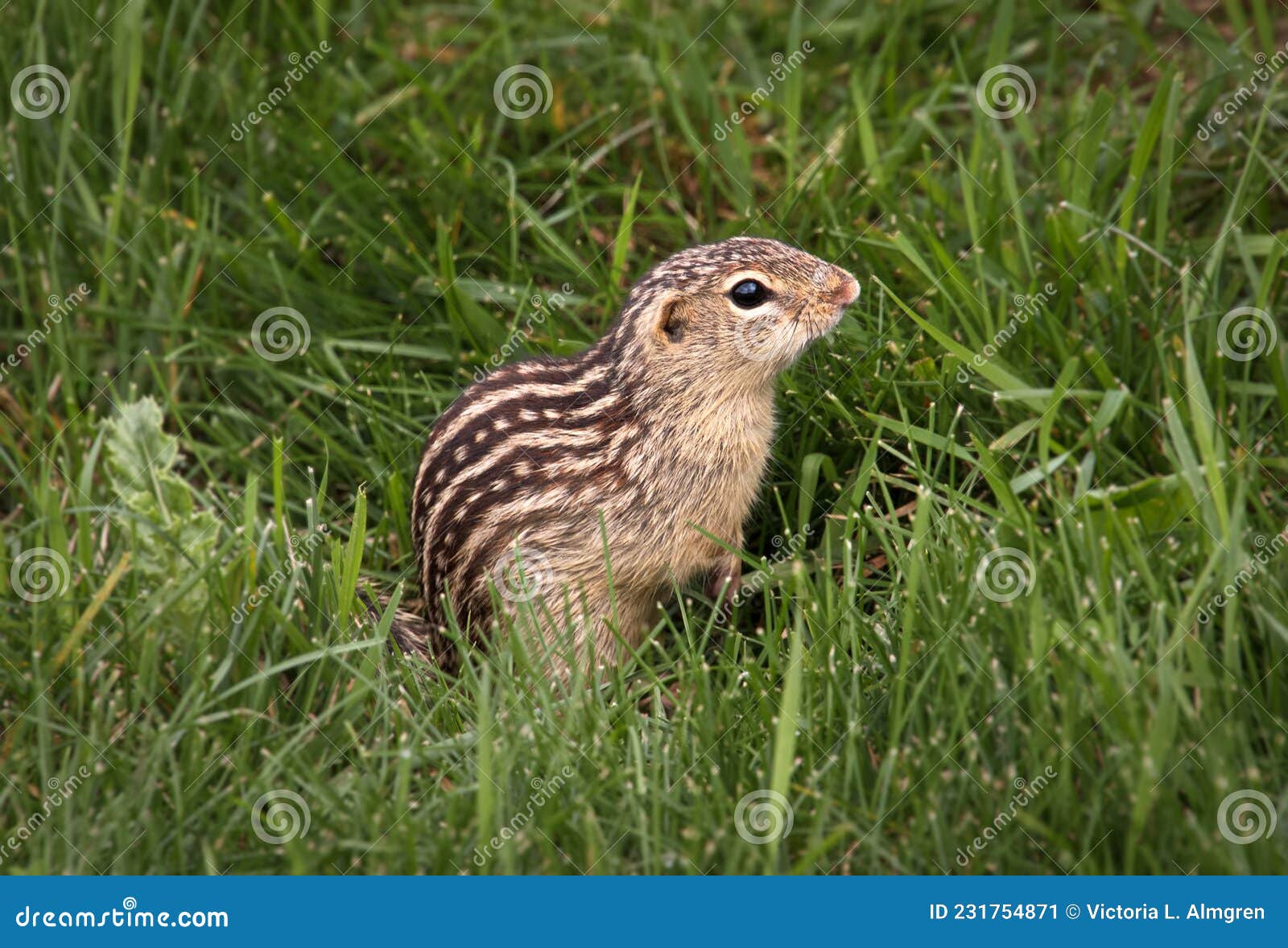
The thirteen-lined ground squirrel (Ictidomys tridecemlineatus) is a distinct North American rodent easily identified by its pattern of thirteen alternating dark and light longitudinal stripes. Primarily inhabiting the grasslands and prairies of the central United States, this diurnal mammal is known for its complex burrowing systems and deep winter hibernation.
Taxonomy and Evolutionary Background
The thirteen-lined ground squirrel belongs to the family Sciuridae, which includes tree squirrels, flying squirrels, marmots, and prairie dogs. For many years, it was classified under the genus Spermophilus. however, molecular phylogenetic studies led to a reclassification in the early 21st century, placing it in the genus Ictidomys. This genus is specifically characterized by ground-dwelling squirrels that have adapted to the open environments of North America.
Evolutionarily, these squirrels have developed specialized physiological traits to survive the extreme temperature fluctuations of the Great Plains. As of 2026, genomic sequencing of the thirteen-lined ground squirrel has provided significant insights into the mammalian "hibernation blueprint," showing how certain genes are upregulated to protect the heart and brain during periods of extreme metabolic depression. This makes them a vital model organism in biomedical research, particularly concerning ischemia and organ preservation.
Distinctive Physical Characteristics
The most striking feature of Ictidomys tridecemlineatus is its coat. The dorsal side features approximately thirteen stripes that run from the neck to the base of the tail. These are not simple lines; typically, seven of the stripes are a dark brownish-black, often containing rows of small, light-colored spots, while the remaining six stripes are a lighter tan or buff color. This pattern provides exceptional camouflage against the variegated shadows and light of short-grass prairies.
Size and Dimensions
Adult thirteen-lined ground squirrels are relatively small compared to their cousins, the prairie dogs. An average adult measures between 170 and 300 millimeters (roughly 7 to 12 inches) in total length. The tail accounts for a significant portion of this, usually measuring 60 to 110 millimeters.
In terms of weight, these animals exhibit dramatic seasonal fluctuations. In early spring, following emergence from hibernation, an adult may weigh as little as 110 grams (4 ounces). By late autumn, as they prepare for the winter by accumulating massive adipose (fat) stores, their weight can double or even triple, reaching up to 270 grams (over 9 ounces).
Sensory Features
They possess large, dark eyes positioned high on the sides of the head, providing a wide field of vision to detect aerial and terrestrial predators. Their ears are small and sit low on the head, an adaptation that reduces drag and prevents debris from entering while moving through narrow subterranean tunnels. Their foreclaws are particularly robust, curved, and sharp—perfectly designed for excavating the compacted soils of the American Midwest.
Distribution and Habitat Preferences
The range of the thirteen-lined ground squirrel is extensive, stretching from central Canada (Alberta, Saskatchewan, and Manitoba) down through the central United States to the Gulf Coast of Texas. They are most prevalent in the Great Plains and the Great Lakes regions, including states like Nebraska, Kansas, Iowa, Minnesota, and Illinois.
Preferred Ecosystems
Historically, these squirrels were restricted to the short-grass and tall-grass prairies. However, they have proven remarkably adaptable to human-altered landscapes. In 2026, they are frequently found in:
- Golf Courses and Cemeteries: The frequently mowed, short turf provides the visibility they need to spot predators.
- Residential Lawns and Parks: Open areas with well-drained soil are ideal for burrowing.
- Roadside Shoulders: The disturbed soil and available forage make these attractive corridors for movement.
- Agricultural Margins: They often inhabit the edges of corn and soybean fields, though they generally avoid the dense interior of tall crops where visibility is limited.
Behavior and Activity Patterns
The thirteen-lined ground squirrel is strictly diurnal, meaning it is active during the day. Their daily schedule is heavily influenced by temperature; they are most active on warm, sunny days and often remain in their burrows during overcast, rainy, or excessively windy weather.
Social Structure
Unlike the highly social black-tailed prairie dog, the thirteen-lined ground squirrel is a more solitary creature. While they may live in "colonies" due to the suitability of a specific patch of land, they do not share burrows or exhibit complex social hierarchies. Each adult typically maintains its own burrow system. When multiple squirrels are seen together, it is usually a mother with her "pups" or a temporary pairing during the brief spring mating season.
Burrowing Architecture
Their burrows are surprisingly complex. A single squirrel may maintain two types of tunnels:
- Escape Burrows: Short, shallow, and scattered throughout their foraging range to provide immediate cover from hawks or foxes.
- Permanent Burrows: These are deeper and more intricate, often reaching depths of 15 to 20 feet and featuring multiple "rooms." These rooms include a nesting chamber lined with dry grass, a separate caching area for food, and a deeper hibernation chamber located below the frost line to ensure the animal does not freeze during the winter.
Diet and Nutrition
Thirteen-lined ground squirrels are omnivorous, a trait that contributes to their survival in varying environments. Their diet shifts significantly based on the season and the availability of resources.
- Vegetation: In the early spring, they consume tender green shoots, grasses, and the seeds of various weeds. They are known to occasionally damage vegetable gardens by eating lettuce, peas, and various sprouts.
- Insects: During the summer months, insects can make up over 50% of their diet. They are voracious predators of grasshoppers, crickets, caterpillars, and beetles. This predatory behavior actually provides a service to farmers by reducing the population of crop-destroying insects.
- Animal Protein: While less common, they are opportunistic and will consume bird eggs, small chicks, or even carrion. They have been observed capturing and eating smaller mice or shrews.
- Seeds and Grains: As autumn approaches, they focus heavily on high-energy seeds and grains to build up the fat reserves necessary for hibernation.
The Remarkable Hibernation Cycle
One of the most fascinating aspects of thirteen-lined ground squirrel biology is their profound state of hibernation. As a "true hibernator," the squirrel undergoes physiological changes that would be fatal to most other mammals.
Physiological Changes
During the peak of hibernation (typically October through March), the squirrel’s metabolic rate drops to about 2% to 5% of its normal active rate.
- Body Temperature: Their internal temperature can drop from a normal 98°F (37°C) to just a few degrees above freezing.
- Heart Rate: A heart rate that is normally 200–300 beats per minute during activity can plummet to as low as 3–10 beats per minute.
- Respiration: Breathing becomes sporadic, with long periods of apnea (breath-holding) followed by a few shallow breaths.
Interbout Arousals
Hibernation is not a continuous state of sleep. Throughout the winter, the squirrel undergoes "interbout arousals." Every few weeks, the animal's body temperature rises back to normal for several hours. During this time, they do not usually eat or drink; instead, scientists believe these periods allow the animal to perform "cellular maintenance," such as restoring immune function or processing metabolic waste.
Reproduction and Life Cycle
Mating occurs shortly after the squirrels emerge from hibernation in the spring, typically in April or May. The males are the first to emerge, establishing territories and searching for females.
- Gestation: The gestation period is approximately 28 days.
- Litter Size: A single litter is produced each year, usually consisting of 7 to 10 pups, though litters as large as 13 have been recorded.
- Development: At birth, the pups are blind, hairless, and weigh only about 3 to 4 grams. Their characteristic stripes begin to appear at about 12 days of age. Their eyes open at roughly 25 to 30 days, at which point they begin to venture out of the burrow to forage on solid food.
- Dispersal: By six weeks of age, the young are fully weaned and begin to disperse to find or dig their own burrows. They reach sexual maturity the following spring.
Comparison of Common Ground-Dwelling Rodents
It is common for property owners to confuse the thirteen-lined ground squirrel with other similar species. The following table highlights the key differences.
| Feature | Thirteen-Lined Ground Squirrel | Franklin’s Ground Squirrel | Eastern Chipmunk | Richardson’s Ground Squirrel |
|---|---|---|---|---|
| Scientific Name | Ictidomys tridecemlineatus | Poliocitellus franklinii | Tamias striatus | Urocitellus richardsonii |
| Markings | 13 stripes (7 dark, 6 light) with spots | Solid brownish-gray, speckled | 5 dark stripes, white eye stripe | Plain sandy/gray, no stripes |
| Habitat | Short grass, open fields | Tall grass, bushy edges | Forests, gardens with cover | Open prairies, pastures |
| Sociality | Solitary/Semi-colonial | Generally solitary | Highly territorial | Highly colonial |
| Average Weight | 110g - 270g | 300g - 500g | 70g - 120g | 200g - 450g |
| Tail Appearance | Thin, moderately bushy | Long and quite bushy | Flattened, furry | Short, slightly bushy |
Human Interaction and Management
While many people find thirteen-lined ground squirrels charming, they can become a nuisance in specific settings. Their burrowing can damage golf course greens, undermine the foundations of small outbuildings, and create trip hazards in athletic fields or pastures.
Non-Lethal Management
- Habitat Modification: Since these squirrels prefer short grass for visibility, allowing grass to grow taller (over 6 inches) can encourage them to move elsewhere. However, this is rarely practical for lawns or golf courses.
- Exclusion: For small garden plots, hardware cloth (1/4 inch mesh) can be buried 12 inches deep with an L-shaped footer to prevent them from burrowing into the area.
- Repellents: Some commercial repellents containing capsaicin or castor oil may provide temporary relief, but their effectiveness is often limited and requires frequent reapplication after rain.
Control Methods
If populations become excessive and cause significant economic damage, control measures may be necessary.
- Trapping: Live traps (such as the Havahart model) can be used, but many states have strict regulations regarding the relocation of wildlife due to disease concerns and the low survival rate of relocated animals. Check with local wildlife agencies first.
- Rodenticides: In agricultural settings, certain baits are labeled for ground squirrel control. These should be used with extreme caution to avoid "non-target" poisoning of pets or birds of prey that might consume a poisoned squirrel.
- Professional Services: In 2026, many integrated pest management (IPM) professionals offer specialized ground squirrel mitigation that focuses on burrow destruction and long-term site exclusion.
Ecological Importance
Despite their potential as pests, thirteen-lined ground squirrels play a vital role in the grassland ecosystem. They serve as a primary food source for a variety of predators, including red-tailed hawks, American kestrels, foxes, coyotes, and various snake species like the bullsnake. Furthermore, their burrowing activity helps aerate the soil and incorporates organic matter into lower soil layers, which can improve soil health over time.
For more detailed information on local regulations or scientific research, visit the following authoritative sources:
Frequently Asked Questions
How long do thirteen-lined ground squirrels live?
In the wild, their lifespan is relatively short, usually averaging 2 to 3 years. Predation and the rigors of hibernation are the primary causes of mortality. In captive settings with controlled environments, they have been known to live up to 7 or 8 years.
Do thirteen-lined ground squirrels carry diseases?
Like all wild rodents, they can carry parasites such as fleas and ticks, which may transmit diseases like tularemia or bubonic plague, though the latter is rare in this specific species compared to prairie dogs. They are not significant carriers of rabies. Always use gloves and exercise caution if handling a sick or dead animal.
What is the difference between a chipmunk and a thirteen-lined ground squirrel?
The most obvious difference is the facial markings; chipmunks have distinct white and dark stripes running through their eyes and across their faces, whereas thirteen-lined ground squirrels have plain, unstriped faces. Additionally, chipmunks spend more time in wooded areas and climb trees, while thirteen-lined ground squirrels stay strictly on the ground in open areas.
Can I keep one as a pet?
In most U.S. states and Canadian provinces, it is illegal to keep native wildlife as pets without specialized permits. Furthermore, their complex social and biological needs—including the physiological requirement for hibernation—make them very difficult to care for in a domestic setting.
Why do they stand up straight on their hind legs?
This behavior is known as "picket-pinning." By standing upright and remaining perfectly still, the squirrel increases its vantage point to scan for predators. Their striped coat makes them look like a dead stick or a piece of wood from a distance, further aiding their concealment.
Practical Recommendation for Property Owners
If you discover thirteen-lined ground squirrels on your property, first assess the level of damage. If they are merely living in a back corner of the yard, they are likely providing a service by eating pest insects. However, if they are encroaching on structures or high-traffic areas, the most effective 2026 strategy is a combination of exclusionary fencing for gardens and filling in abandoned burrows with heavy gravel to discourage re-colonization.