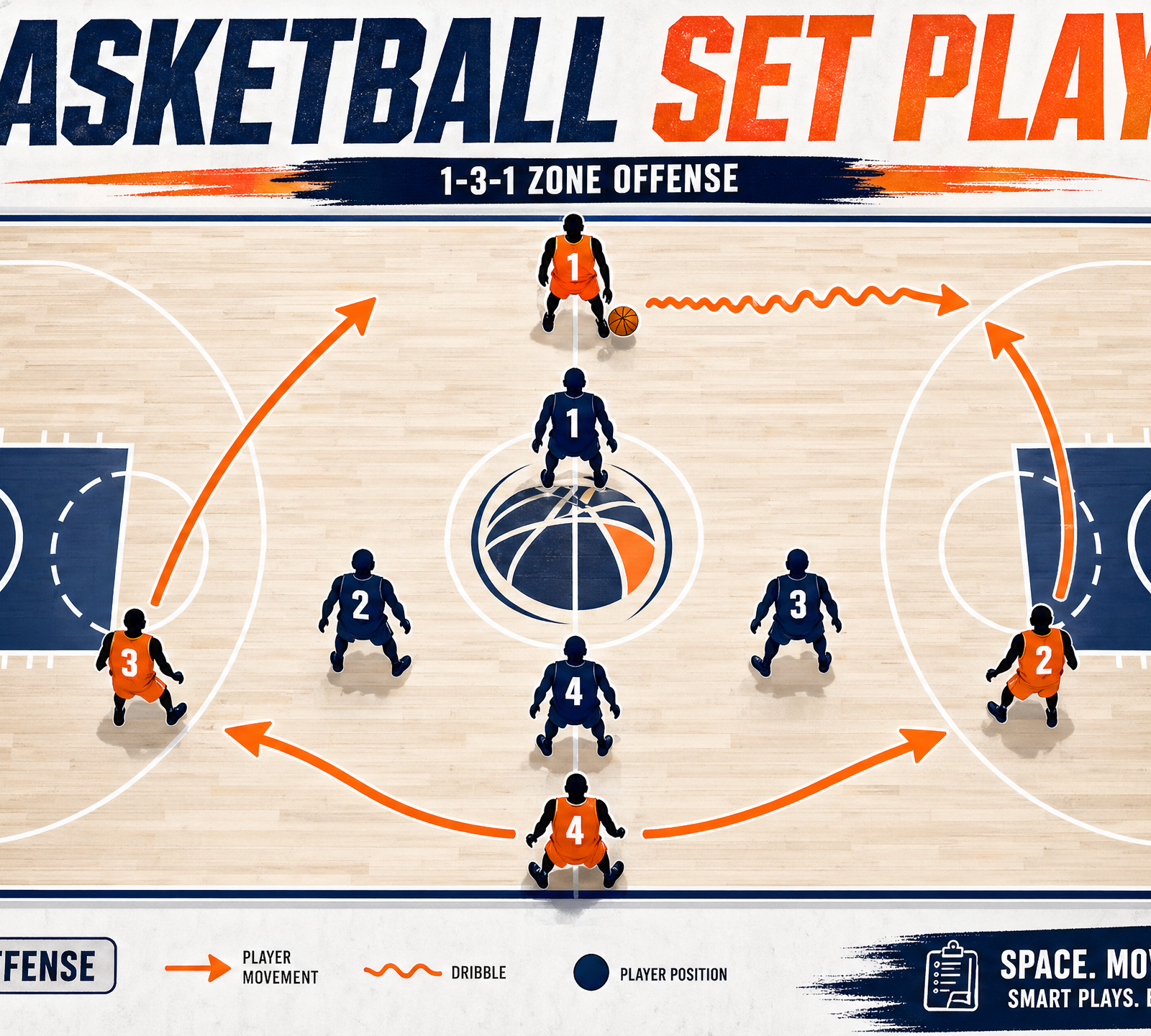
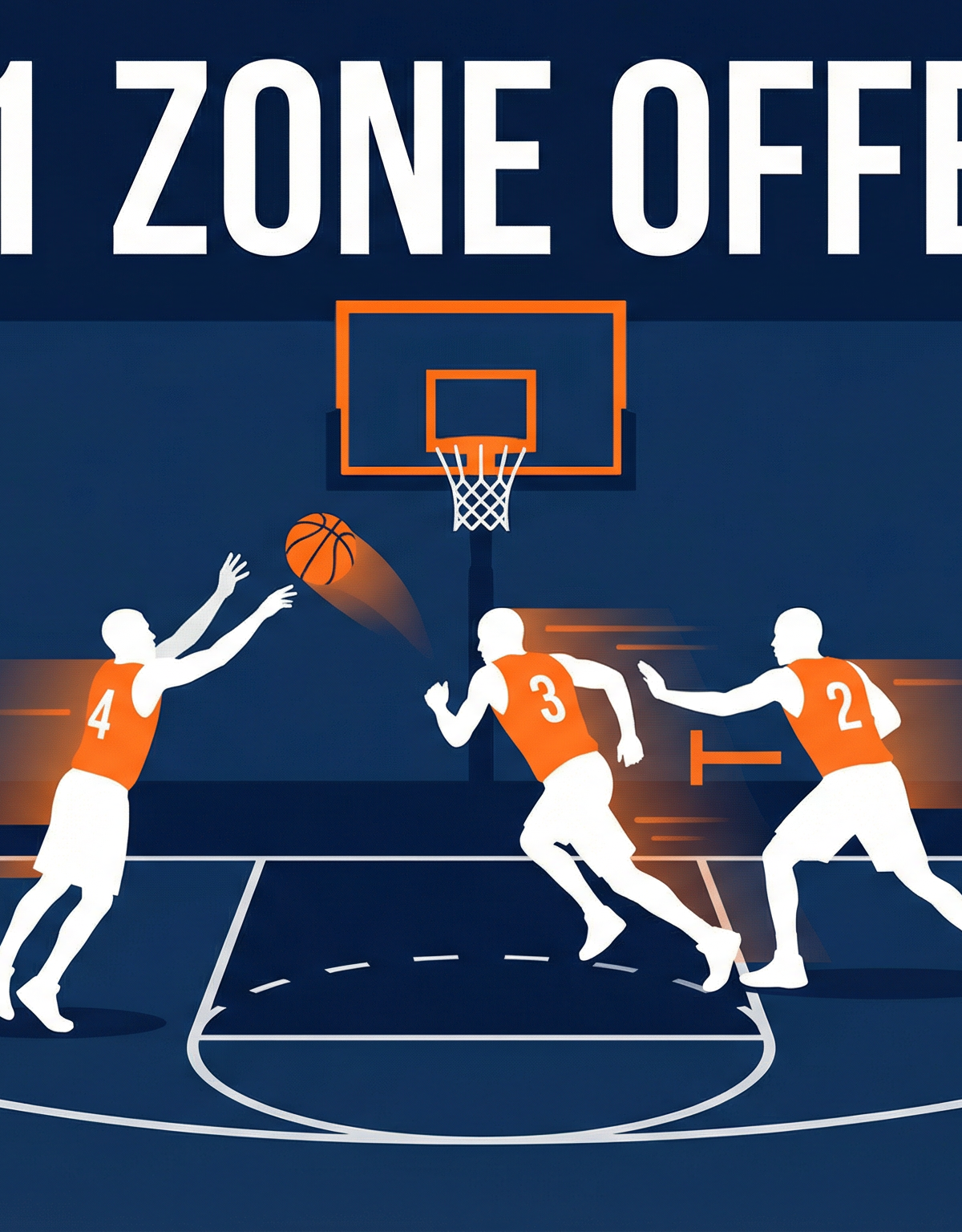
The 1-4 high offense is a basketball strategic alignment where the point guard initiates play while the remaining four players position themselves along the free-throw line extended. This formation creates significant spacing in the paint, isolates defenders, and allows for versatile entries such as high-post feeds, wing ball screens, and UCLA cuts.
Understanding the Geometry of the 1-4 High Alignment
The 1-4 high offense, often referred to as the "High Stack" or "Flat" set, is defined by its unique spatial configuration. In this set, the point guard (1) brings the ball up the middle of the floor. The other four players are aligned horizontally across the court, roughly level with the free-throw line. The two "bigs" (typically the 4 and 5) occupy the elbows—the corners of the free-throw line—while the two wings (the 2 and 3) stand at the free-throw line extended, near the sidelines.
This alignment is intentionally "top-heavy." By pulling all five offensive players above the free-throw line, the entire baseline and "paint" area (the restricted area under the basket) are left completely vacant. In the context of 2026 basketball coaching, this is a premium strategic choice. Modern defenses rely heavily on "help-side" principles where defenders sag off their players to protect the rim. The 1-4 high neutralizes this by forcing those help defenders to stay high, leaving the basket unprotected against quick cuts or drives.
From a technical standpoint, the 1-4 high is not a "motion" offense in its purest form, but rather a starting formation from which dozens of specific plays can be run. It serves as a "box of tools" for a coach. Because the personnel can be swapped—for example, putting a shooting "4" on the wing or a versatile "3" at the elbow—it becomes an incredibly difficult set for opposing defenses to scout and contain.
Strategic Advantages of the 1-4 High Set
The primary reason coaches implement the 1-4 high offense is its inherent versatility. Whether a team possesses dominant post players or lightning-fast guards, the set can be tailored to highlight those specific strengths.
Emptying the Paint
By positioning all players high, the offense creates a "clean" look at the basket. If a guard beats their defender off the dribble from the top of the key, there is no primary rim protector standing in the way because that defender has been pulled up to the elbow to guard the 4 or 5. This forces the defense to make a difficult choice: allow a layup or rotate from the wing, which inevitably leaves a three-point shooter wide open.
Facilitating the High Post Entry
The 1-4 high is perhaps the best formation for utilizing a "Point Forward" or a passing center. When the ball is passed to a player at the elbow, they become the hub of the offense. From this "Pinch Post" position, the player can facilitate hand-offs, look for backdoor cutters, or simply turn and face the basket for a mid-range jumper. This alignment is a staple in systems that prioritize basketball IQ and passing over raw athleticism.
Versatility Against Different Defenses
While primarily used against man-to-man coverage, the 1-4 high can be adjusted to attack 2-3 or 3-2 zone defenses. By placing players in the "gaps" of the zone—specifically at the high post and the short corners—the offense can force the zone to collapse and then kick the ball out to the perimeter for high-percentage shots.
Personnel Roles and Responsibilities
For the 1-4 high to function effectively in 2026, players must understand their specific roles within the geometry of the set. While positions are often fluid, the traditional breakdown is as follows:
- The Point Guard (1): The initiator. Their job is to read the defense as they cross half-court. If the wings are being denied, the 1 must be prepared to dribble-entry or pass to the elbow. Communication is vital here, as the 1 usually signals which "entry" the team will execute.
- The Wings (2 and 3): These players are the primary floor spacers. In a 1-4 high, they must be threats to shoot from the outside. Their most important movement is the "V-cut" or "Backdoor cut." If their defender overplays the passing lane to the wing, the 2 or 3 must immediately sprint to the empty basket.
- The Posts/Bigs (4 and 5): Positioned at the elbows, these players act as both screeners and facilitators. They must be comfortable handling the ball at the free-throw line and making quick, accurate passes to cutters. In modern iterations, at least one of these players is usually a "stretch" big who can also pop out for a three-pointer after setting a screen.
Core Entry Plays and Tactical Sequences
The effectiveness of the 1-4 high lies in its "entries." An entry is the initial sequence of passes and cuts that triggers the rest of the play. Here are the most common technical sequences used by elite programs:
The UCLA Cut Entry
This is a classic basketball movement that remains a foundation of the 1-4 high in 2026. The 1 passes the ball to a wing (say, the 2). Immediately after the pass, the 1 uses a screen set by the post player at the near elbow (the 4) and cuts hard toward the basket. If the 1 is open, the 2 passes for a layup. If not, the 1 continues through to the opposite corner, and the 4 "pops" or rolls, creating a secondary scoring opportunity.
The High Post Rub (Scissors)
In this sequence, the 1 passes the ball directly to one of the posts at the elbow (the 5). This pass triggers a "scissors" action where the 1 and the wing on the same side (the 3) both cut past the post player. The 5 can hand the ball off to either player or use them as decoys to create a 1-on-1 situation in the mid-post. This is particularly effective if the post player has a size advantage over their defender.
The Double Ball Screen (Horns Variation)
The 1-4 high can quickly transition into a "Horns" set. The two post players at the elbows move slightly toward the center to set a double screen for the 1. The 1 can choose which side to drive toward. As the 1 drives, one post player rolls to the basket while the other "pops" to the three-point line. This creates a "triple threat" scenario where the defense must account for the drive, the roll, and the outside shot simultaneously.
Troubleshooting Defensive Counters
As teams become more familiar with 1-4 high patterns, they will employ specific defensive tactics to disrupt the flow. Coaches must be prepared with the following counters:
- Countering Wing Denial: If the defense is "denying" the initial pass to the wings, the 1 should not force the pass. Instead, the 1 should dribble toward the wing player. This "Dribble-At" signal tells the wing to immediately backdoor cut to the basket, while the post player on that side flashes to the top of the key to receive the ball.
- Countering High Post Sagging: If defenders are "sagging" off the elbow players to clog the paint, the posts must become shooters. In 2026, the "mid-range" is often ignored by defenses focusing on the rim and the arc. A post player who can consistently hit a 15-foot jumper will force the defense to stay home, re-opening the driving lanes for the guards.
- Handling Ball Pressure on the 1: If the opposing PG is putting intense pressure on the ball, the 1-4 high should use a "Step-Up" screen. One of the elbow players moves up above the three-point line to provide a release valve, allowing the 1 to escape the pressure and reset the offense.
Comparison of 1-4 High Entry Options
The following table compares the most common entry strategies within the 1-4 high system, detailing their primary goals and the best defensive scenarios for their use.
| Entry Strategy | Primary Action | Target Scorer | Best Against |
|---|---|---|---|
| UCLA Cut | Vertical screen for the PG | Point Guard or Post | Man-to-man (Aggressive) |
| High Post Entry | Scissors cut / Hand-off | Cutting Wings | Pressure defenses |
| Wing Ball Screen | Side pick and roll | PG or Rolling Big | Slower post defenders |
| Dribble Clear | Dribble-at with backdoor | Wing or Shooter | Overplaying / Denial defense |
| Double Elbow | Horns-style dual screen | Point Guard | Balanced man-to-man |
Implementing the 1-4 High: Training and Drills
To master this offense, a team must focus on more than just the "plays." They must master the "reads." Training should emphasize the following three areas:
- The "Read" Drill: Set up 5-on-5. The coach dictates how the defense will play (e.g., "Deny the wings" or "Sag the posts"). The offense must identify the defensive look and choose the correct entry (UCLA, Backdoor, or Elbow feed) without a called play.
- Passing from the Elbow: Since the 4 and 5 are the hubs of the 1-4 high, they need specific skill development. Drills should focus on high-post passing against a defender, practicing the timing of hand-offs and "pinch post" bounce passes to cutters.
- The 3-on-0 Continuity: Players start in the 1-4 high formation (using only three players: a guard, a wing, and a post). They cycle through entries—pass to wing, UCLA cut, reset, pass to post, scissors cut—to build the muscle memory required for the rapid-fire movements the offense demands.
Common Mistakes to Avoid
Even seasoned coaches can struggle with the 1-4 high if they fall into these common traps.
First, standing still is the death of the 1-4 high. Because the formation is so spread out, if players aren't actively cutting or screening, the defense has an easy time staying in their lanes. There must be constant "secondary action." If the primary entry fails, players should immediately transition into a flare screen or a secondary ball screen.
Second, poor spacing often occurs when the wings "drift" toward the corners too early. The wings must stay at the free-throw line extended until the play dictates a move. If they drop to the corners prematurely, they bring their defenders with them, clogging the very baseline the offense is trying to keep open.
Finally, ignoring the "Post-Up" can be a mistake. While the 1-4 high is a perimeter-oriented starting set, the posts are often guarded by smaller players in modern "switch-heavy" defenses. If a switch occurs during a screen, the post player should immediately dive to the block to exploit the mismatch.
Frequently Asked Questions
Is the 1-4 high offense suitable for youth basketball?
Yes, it is highly recommended for youth levels because it teaches fundamental spacing and the importance of the "threat" of the high post. It moves away from "clumped" basketball where everyone chases the ball, and it encourages players to look for backdoor cuts, which is a vital skill for developing basketball IQ.
How does the 1-4 high differ from the 1-4 low?
The 1-4 low (or "Box") positions the four non-guards along the baseline or at the low blocks. While the 1-4 low is better for immediate post-up opportunities and baseline screens, it clogs the paint. The 1-4 high is the inverse; it sacrifices immediate post position for maximum driving lanes and high-post playmaking.
Can you run the 1-4 high against a 2-3 zone?
Absolutely. To adapt it, one of the elbow players usually drops to the "short corner" (the area between the lane and the sideline on the baseline) while the other stays at the high post. This creates a diagonal passing lane that is notoriously difficult for a 2-3 zone to cover, as it forces the middle defender of the zone to choose between the high and low man.
What is the best "secondary" offense to run if the 1-4 high entry fails?
Most modern coaches transition into a "4-Out 1-In" motion or a "Euro-Ball Screen" continuity. Once the initial 1-4 high cuts are made, the players naturally end up in spots that transition easily into a spread pick-and-roll or a circular motion offense.
Does the 1-4 high require a dominant center?
No. In fact, it is often preferred by teams that lack a traditional "back-to-the-basket" center. It allows more mobile, athletic "bigs" to play at the elbow where they can use their speed to beat defenders or their passing to find teammates, rather than being forced to bang in the low post.
Practical Recommendation
For coaches looking to implement the 1-4 high offense in 2026, the best next step is to begin with the UCLA Cut as your primary entry. It is the most intuitive movement for players to learn and immediately demonstrates the value of the high post screen. Once your players understand how to read the defender's position on that initial cut, you can layer in the "Scissors" and "Horns" variations. Consistently emphasize that the "paint is a vacuum"—if a player sees it is empty, they should be looking to fill it with a purposeful cut or a strong drive. For further technical diagrams and coaching clinics, resources like the FIBA Coaching Library or NCAA Champion Magazine's coaching archives provide excellent historical and modern context for these sets.