As of 2026, India's life insurance sector comprises 27 registered companies regulated by the Insurance Regulatory and Development Authority of India (IRDAI). This landscape includes the state-owned Life Insurance Corporation of India (LIC) and 26 private-sector insurers, many of which are joint ventures between prominent Indian financial institutions and global insurance leaders.
The Regulatory Framework of Life Insurance in India
The life insurance industry in India is governed strictly by the Insurance Regulatory and Development Authority of India (IRDAI). Established under the IRDAI Act of 1999, this statutory body is tasked with protecting the interests of policyholders while regulating, promoting, and ensuring the orderly growth of the insurance industry.
In 2026, the regulatory environment is defined by the "Insurance for All by 2047" initiative. IRDAI has introduced several reforms to increase insurance penetration, including the Bima Sugam platform—a digital marketplace that acts as a one-stop shop for buying policies, servicing, and claim settlements. All companies listed below are mandatory participants in this ecosystem, ensuring transparency and ease of access for the Indian public.
The IRDAI maintains a "solvency margin" requirement, ensuring that every insurer holds sufficient capital to pay out claims even in extreme economic scenarios. As a consumer, verifying that a company is on the official IRDAI list is the first step toward financial security.
The Public Sector Giant: Life Insurance Corporation of India (LIC)
The Life Insurance Corporation of India remains the sole public sector insurer and the largest player in the market. Established in 1956 through the Life Insurance Corporation Act, LIC held a monopoly until the sector opened to private players in 2000.
Even in 2026, LIC commands a significant portion of the market share, particularly in rural and semi-urban areas. Following its landmark IPO in 2022, LIC has modernized its operations, balancing its traditional agency-led model with digital-first initiatives. Its "Sovereign Guarantee" on the sum assured and bonus—unique to LIC—continues to make it a preferred choice for conservative investors. LIC offers a massive portfolio ranging from simple term plans like Anmol Jeevan to complex participating endowment plans and pension schemes.
Comprehensive List of Private Life Insurance Companies
The private sector has introduced significant competition, leading to product innovation and improved customer service. Most private insurers are joint ventures where an Indian entity partners with a foreign insurance firm (which can hold up to 74% equity as per current FDI norms).
1. HDFC Life Insurance Company Limited
HDFC Life is one of the most profitable private insurers, known for its diverse product suite. Following its successful integration of Exide Life, HDFC Life has expanded its reach significantly into South India. It specializes in high-margin protection products and innovative ULIPs (Unit Linked Insurance Plans).
2. ICICI Prudential Life Insurance Company Limited
A joint venture between ICICI Bank and Prudential plc, this company was the first private insurer to be listed on the Indian stock exchanges. It is recognized for its strong digital platform and a robust claim settlement process.
3. SBI Life Insurance Company Limited
Leveraging the massive reach of the State Bank of India, SBI Life consistently ranks as the largest private life insurer by New Business Premium (NBP). Its strength lies in its bancassurance model, selling policies through thousands of SBI branches nationwide.
4. Bajaj Allianz Life Insurance Company Limited
A partnership between Bajaj Finserv and Allianz SE, this company is a leader in the "Value-Packed" segment, offering flexible ULIPs and comprehensive term plans with various riders like critical illness and accidental death benefits.
5. Max Life Insurance Company Limited
Max Life is often cited for having one of the highest Claim Settlement Ratios in the industry. It focuses heavily on the "Protection First" philosophy, encouraging long-term term insurance coverage.
6. Tata AIA Life Insurance Company Limited
Combining the trust of the Tata Group with the global expertise of AIA Group, this insurer has made significant strides in 2026 by focusing on personalized wellness programs integrated into their life insurance products.
7. Aditya Birla Sun Life Insurance Company Limited
Formerly known as Birla Sun Life, this company is a joint venture between the Aditya Birla Group and Sun Life Financial Inc. of Canada. They are well-regarded for their wealth management-cum-insurance products.
8. Kotak Mahindra Life Insurance Company Limited
A 100% subsidiary of Kotak Mahindra Bank (after buying out Old Mutual), this company provides a wide range of savings and protection products, primarily targeted at the affluent and middle-class urban segments.
9. PNB MetLife India Insurance Company Limited
This insurer brings together the distribution power of Punjab National Bank and the global expertise of MetLife. It has a strong presence in Northern and Eastern India.
10. Canara HSBC Life Insurance Company Limited
A bank-led insurer owned by Canara Bank and HSBC. It relies almost exclusively on the customer base of its parent banks, offering seamless integration with banking apps for policy management.
11. Reliance Nippon Life Insurance Company Limited
A joint venture between Reliance Capital and Nippon Life of Japan. Despite the restructuring of its parent Indian entity, the insurance arm remains a significant player with a focus on traditional endowment and child plans.
12. Aviva Life Insurance Company India Limited
A partnership between the Dabur Group and Aviva plc. They are known for their focus on child education plans and retirement solutions.
13. Sahara India Life Insurance Company Limited
While Sahara India Life was the first wholly Indian-owned private life insurance company, it has faced various regulatory interventions by IRDAI over the years regarding its management. In 2026, prospective buyers should check the latest IRDAI circulars regarding their operational status.
14. Shriram Life Insurance Company Limited
Part of the Shriram Group, which has a massive presence in truck financing and retail lending, this company focuses on the "common man," providing affordable insurance in smaller towns and rural pockets.
15. Bharti AXA Life Insurance Company Limited
This company has undergone various structural changes, including a significant merger process with ICICI Prudential Life in previous years, though the brand remains recognizable in specific market segments.
16. Future Generali India Life Insurance Company Limited
A joint venture between the Future Group and Generali Group. They offer a simplified range of products aimed at retail consumers and corporate groups.
17. Ageas Federal Life Insurance Company Limited
Formerly IDBI Federal Life Insurance, this company is now primarily backed by Ageas and Federal Bank. It focuses on digital sales and bancassurance.
18. Aegon Life Insurance Company Limited
Recently acquired by Bandhan Financial Services, Aegon Life has transitioned into a digital-only insurer. In 2026, it is a pioneer in using AI for underwriting and providing instant policy issuance.
19. Pramarica Life Insurance Limited
A joint venture between DHFL Investments and Prudential International Insurance Holdings. It provides a niche set of products focusing on financial security for families.
20. Star Union Dai-ichi Life Insurance Company Limited
A unique tripartite venture between Bank of India, Union Bank of India, and Dai-ichi Life of Japan. It has a vast reach through the two Indian public sector banks.
21. IndiaFirst Life Insurance Company Limited
Promoted by Bank of Baroda and Union Bank of India, this company has quickly grown by leveraging the "Jan Dhan" accounts and other government-backed schemes.
22. Edelweiss Life Insurance Company Limited
Known for its innovative product designs, especially in the income-replacement and wealth-accumulation categories.
23. Go Digit Life Insurance Limited
One of the newest entrants, Go Digit Life brings the "InsureTech" revolution to the life segment. In 2026, they are known for ultra-simplified documentation and transparent, modular policy structures.
24. Acko Life Insurance Limited
Following its success in the general insurance space, Acko’s life insurance arm focuses on direct-to-consumer digital sales, eliminating intermediaries to provide lower premiums.
Summary Table: Life Insurance Providers in India (2026)
| Company Name | Sector | Key Strengths |
|---|---|---|
| LIC of India | Public | Sovereign Guarantee, Rural Reach |
| SBI Life | Private | Bancassurance, Market Capitalization |
| HDFC Life | Private | Product Innovation, Digital Maturity |
| ICICI Pru Life | Private | Online Term Plans, ULIP Performance |
| Max Life | Private | Claim Settlement Reliability |
| Tata AIA | Private | Rider Options, Wellness Integration |
| Bajaj Allianz | Private | Flexible Investment Options |
| Kotak Life | Private | Wealth Management Focus |
| Aditya Birla Sun Life | Private | Comprehensive Savings Plans |
| Go Digit Life | Private | Tech-driven, Simplified UX |
Critical Metrics for Evaluating Insurance Companies
When choosing from the list above, looking at the brand name is insufficient. In 2026, the IRDAI mandates the publication of several key performance indicators (KPIs) that every buyer should analyze.
1. Claim Settlement Ratio (CSR)
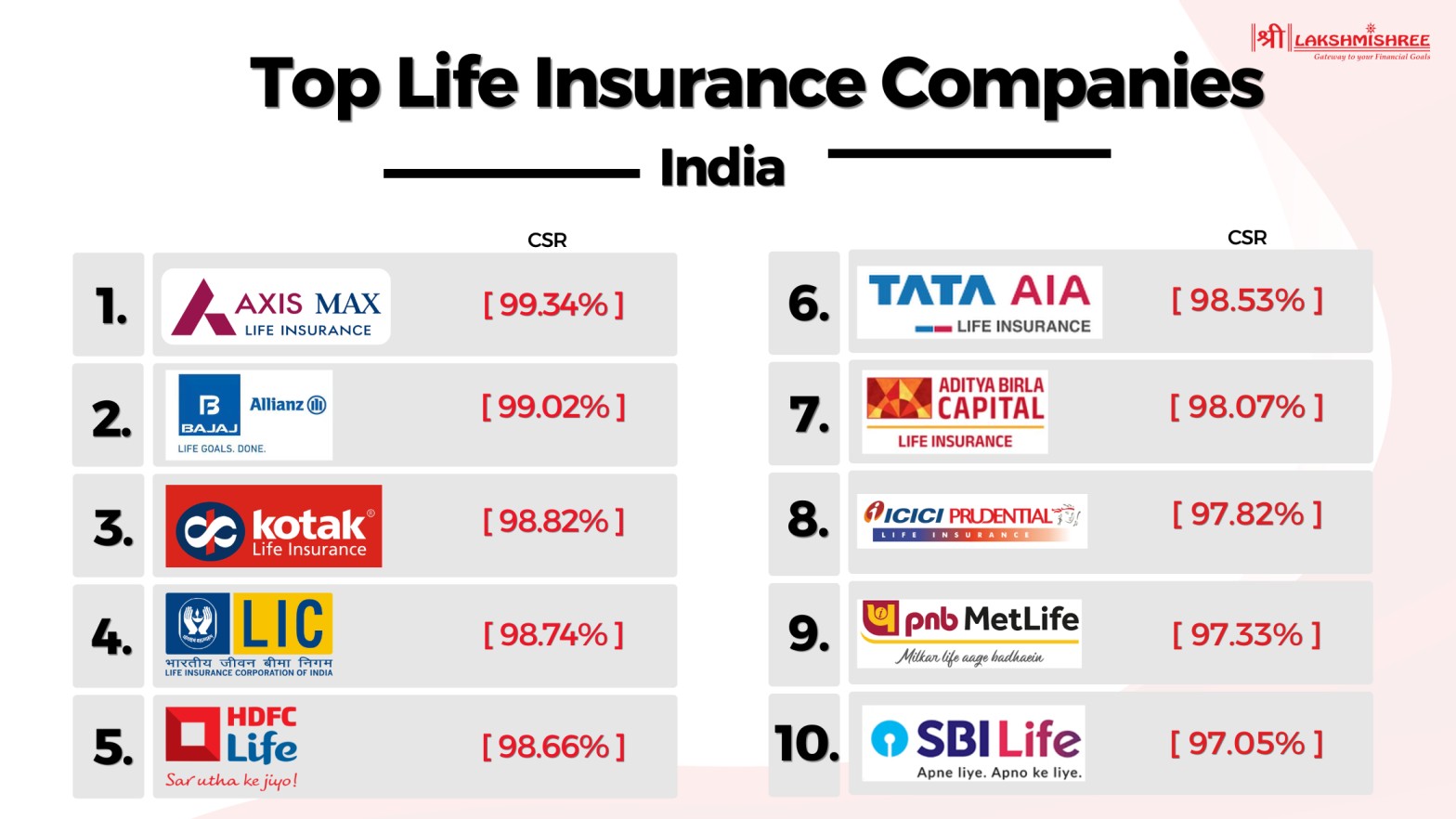
The CSR indicates the percentage of claims the company paid out against the total claims received during a financial year. For example, a CSR of 99% means the company settled 99 out of every 100 death claims. In the 2026 market, most top-tier insurers maintain a CSR above 97%. However, it is vital to check the CSR specifically for the "Life" segment rather than the general company group.
2. Solvency Ratio
This is a measure of an insurance company's financial health and its ability to meet long-term claims. The IRDAI requires a minimum solvency ratio of 1.50 (150%). A higher ratio (e.g., 2.0 or above) suggests that the company has a significant capital buffer to handle catastrophic events or economic downturns.
3. Persistency Ratio
The persistency ratio measures how many policyholders continue to pay their premiums year after year. A high 13th-month or 61st-month persistency ratio indicates customer satisfaction and the suitability of the products sold. If a company has a low persistency ratio, it may indicate "misselling" by agents.
4. Grievance Redressal Rate
This metric shows how efficiently a company resolves customer complaints. Under the Bima Sugam framework of 2026, these statistics are updated in real-time, allowing consumers to see which insurers are the most responsive to issues.
Understanding Product Categories in 2026
The companies listed above do not offer a single type of insurance. Instead, they provide a spectrum of products tailored to different life stages:
- Term Insurance: The purest form of life insurance. It pays a sum assured only in the event of the policyholder's death. In 2026, "Term with Return of Premium" (TROP) and "Increasing Cover" plans are highly popular.
- Unit Linked Insurance Plans (ULIPs): These offer a mix of insurance and investment. Part of the premium goes toward life cover, and the rest is invested in equity or debt funds.
- Endowment & Money Back Plans: Traditional plans that provide a lump sum after a specific period or at regular intervals. These are preferred for goal-based savings like a child's education.
- Annuity/Pension Plans: Designed to provide a steady stream of income post-retirement. With the aging population in 2026, these products have seen a surge in demand.
Steps to Verify an Insurance Company
Before purchasing a policy or sharing personal data, ensure the company is legitimate:
- Check the IRDAI Registration Number: Every licensed insurer has a specific registration number (e.g., LIC is 512, HDFC Life is 101).
- Visit the Bima Sugam Portal: Search for the company on the official government-backed digital marketplace.
- Avoid Unsolicited Offers: Be wary of callers claiming to be from the "IRDAI Verification Department" offering bonuses on existing policies. IRDAI does not sell insurance or declare bonuses.
- Confirm the URL: Ensure the website address matches the official company domain. Fraudulent "mirror" sites are a common risk in the digital age.
Frequently Asked Questions
Which insurance company has the highest claim settlement ratio in India?
While the rankings fluctuate annually based on IRDAI's yearly reports, companies like Max Life, HDFC Life, and ICICI Prudential consistently maintain some of the highest Claim Settlement Ratios, often exceeding 99%. However, LIC settles the highest volume of claims in absolute numbers due to its massive customer base.
Is it safe to buy life insurance from private companies?
Yes, it is entirely safe to buy from private companies registered with the IRDAI. The regulatory body maintains strict oversight, including solvency requirements and a mandatory "Policyholder Protection Committee" within every company. In the event of a private insurer facing financial distress, the IRDAI typically facilitates a merger with a stronger entity to protect policyholder interests.
What happens if an insurance company goes bankrupt?
In India, the IRDAI has robust mechanisms to prevent bankruptcy from affecting policyholders. Since insurers must maintain a 150% solvency margin, they usually have enough assets to cover liabilities. If a company fails, the regulator typically directs the transfer of the "Life Fund" and policy liabilities to another healthy insurance company, ensuring that your coverage remains intact.
How can I check the list of all active life insurance companies?
The most reliable way is to visit the official website of the Insurance Regulatory and Development Authority of India (IRDAI) under the "Insurers" section. Additionally, the Bima Sugam platform, operational in 2026, provides a live directory of all active and licensed insurers allowed to sell products in the country.
Can a foreign company sell life insurance in India directly?
No, a foreign company cannot sell life insurance directly in India. They must form a joint venture with an Indian company and obtain a license from the IRDAI. As of 2026, the Foreign Direct Investment (FDI) limit in the insurance sector stands at 74%, allowing significant foreign ownership while maintaining local regulatory compliance.
Practical Recommendation for 2026
When navigating the list of life insurance companies in India, do not settle for the first name you recognize. Use the Bima Sugam portal to compare at least three different companies based on their Solvency Ratio and Claim Settlement Ratio. For pure protection, prioritize a Term Plan from an insurer with a CSR above 98%. If you are looking for long-term wealth creation with insurance, evaluate the historical fund performance of ULIPs from private players like HDFC Life or SBI Life. Always read the "Exclusions" section of your policy document to understand exactly what is not covered before making your first premium payment.