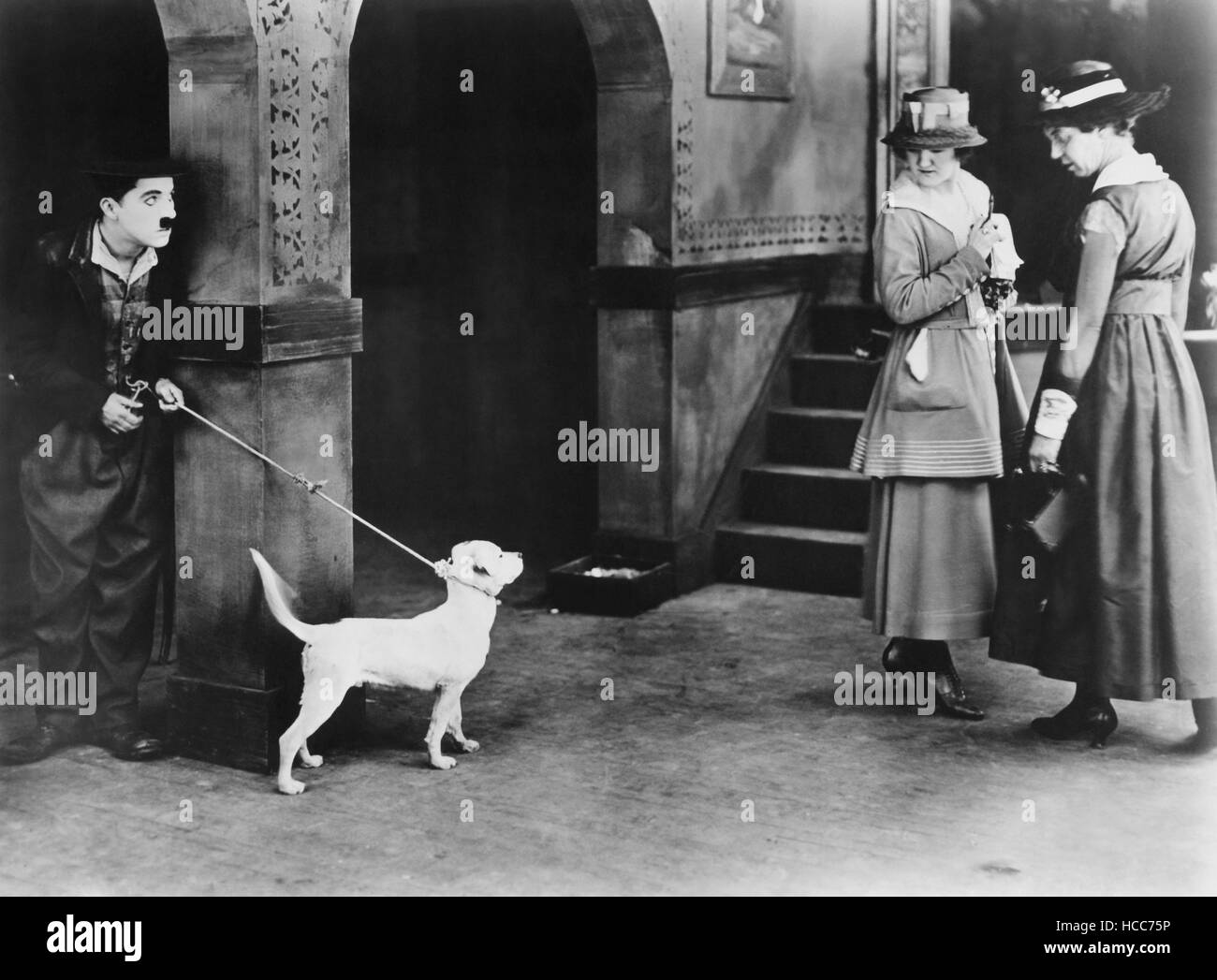
A Dog’s Life, released in 1918, is a landmark silent film written, produced, directed by, and starring Charlie Chaplin. It marks a pivotal moment in cinematic history as Chaplin’s first film for the First National Exhibitors’ Circuit, introducing a sophisticated blend of social commentary, pathos, and slapstick comedy that defined his mature work.
The Historical Context of A Dog’s Life
By 1917, Charlie Chaplin had become a global phenomenon. Having completed his contract with Mutual Film Corporation, where he produced some of his most famous shorts, he signed an unprecedented $1 million contract with the newly formed First National Exhibitors’ Circuit. This deal granted him total creative control and ownership of his films after a set period, a rarity for the era.
A Dog’s Life was the first product of this new independence. It was also the inaugural film shot at the newly constructed Chaplin Studios on La Brea Avenue in Hollywood. As of 2026, the film remains a cornerstone of silent film studies, representing the transition from the frantic "knockabout" comedy of Chaplin's early years to the structured, character-driven narratives of his later features.
The production took place against the backdrop of World War I. While Chaplin was criticized by some for not enlisting, he used his platform to boost morale and promote war bonds. A Dog’s Life served as a brief respite for a weary public, though it did not shy away from the harsh realities of poverty and unemployment that many faced during and after the Great War.
Plot Synopsis: The Parallel Destinies of Man and Dog
The narrative of A Dog’s Life is deceptively simple, focusing on the shared struggles of the Tramp (Chaplin) and a stray dog named Scraps. The film is structured in a way that suggests the lives of the poor and the lives of stray animals are virtually indistinguishable in the eyes of a rigid social hierarchy.
The Struggle for Survival
The film opens with the Tramp sleeping against a fence, trying to stay warm. The early sequences established Chaplin's mastery of physical comedy through a scene at an employment office. Here, the Tramp competes with other desperate men for a single job opening, with the frantic movement of the window shutter serving as a metaphor for the fleeting nature of opportunity.
Meeting Scraps
The turning point occurs when the Tramp rescues a small thoroughbred mongrel, Scraps, from a pack of larger dogs. This relationship is the heart of the film. Chaplin does not treat the dog as a mere prop; instead, Scraps is his mirror. When the Tramp tries to steal a sausage from a vendor, Scraps is right there with him. This "parallel survival" highlights the theme that in a world of scarcity, both man and beast must rely on their wits.
The Green Lantern and the Stolen Fortune
The Tramp meets a disillusioned singer (played by Edna Purviance) at a low-rent dance hall called The Green Lantern. Their shared misery creates an instant bond. The plot thickens when Scraps digs up a wallet stolen and buried by crooks. Through a series of brilliant comedic set pieces—including a famous scene where the Tramp uses his own arms to mimic the movements of a knocked-out crook behind a curtain—the Tramp recovers the money.
The film ends on a rare note of domestic bliss. The Tramp, the singer, and Scraps (along with a new litter of puppies) are shown living on a farm, having escaped the urban squalor that defined their previous existence.
The Artistic Evolution of the Tramp
A Dog’s Life represents a significant "humanization" of the Little Tramp character. In his earlier Keystone and Essanay shorts, the Tramp was often mischievous, sometimes even cruel. In this 1918 masterpiece, he becomes a more sympathetic figure—an "underdog" in every sense.
The film introduced a level of structural complexity previously unseen in short comedies. Chaplin began to use motifs and recurring themes to tie the narrative together. The comparison between the "dog-eat-dog" world of the streets and the literal struggle of Scraps against the pack was a sophisticated cinematic metaphor for the time.
Critics often point to A Dog’s Life as the spiritual precursor to The Kid (1921). The dynamic between Chaplin and the dog served as a prototype for the father-son relationship he would later explore with Jackie Coogan. Both films deal with the concept of an outsider taking a smaller, more vulnerable creature under his wing to navigate a hostile environment.
Technical Aspects and Production at Chaplin Studios
The move to his own studio allowed Chaplin the luxury of time. Unlike his previous films, which were often rushed to meet distributor deadlines, A Dog’s Life was the result of meticulous planning and multiple retakes.
- The Set Design: The "slum" sets were built with a heightened realism that contributed to the film's gritty feel. Chaplin wanted the audience to feel the cold and the dirt of the alleyways.
- Cinematography: Roland Totheroh, Chaplin's long-time cinematographer, used naturalistic lighting to enhance the atmosphere of the dance hall and the dark streets.
- Animal Training: The dog who played Scraps, a mutt named "Mut," was trained by Chaplin himself. The chemistry between them was not accidental; it was the result of weeks of bonding and rehearsal. Mut reportedly became a favorite on the studio lot, though he sadly passed away shortly after the film was completed.
Comparing A Dog's Life to Other Chaplin Classics
To understand the placement of A Dog's Life in Chaplin's filmography, it is helpful to compare it with his other works from the First National and United Artists eras.
| Feature | A Dog's Life (1918) | The Kid (1921) | The Gold Rush (1925) | City Lights (1931) |
|---|---|---|---|---|
| Duration | 33 Minutes (3 Reels) | 68 Minutes (6 Reels) | 95 Minutes | 87 Minutes |
| Primary Theme | Survival and Parallelism | Fatherhood and Poverty | Greed and Loneliness | Romantic Sacrifice |
| Co-star | Scraps (the dog) | Jackie Coogan | Georgia Hale | Virginia Cherrill |
| Social Focus | The Unemployment Line | The Orphanage System | The American Dream | The Great Depression |
| Ending | Happy/Domestic | Bittersweet/Hopeful | Triumphant/Wealthy | Emotional/Ambiguous |
The Symbolic Relationship Between Charlie and Scraps
The choice of a dog as a co-star was a stroke of genius that allowed Chaplin to comment on class without being overtly political. In 1918, society viewed stray dogs and the "unemployable" poor in much the same way: as nuisances to be cleared away.
The Tramp’s attempt to hide Scraps inside his baggy trousers to get into the dance hall is one of the film's most iconic moments. The dog's tail wagging through a hole in the pants becomes a comedic beat, but it also symbolizes the impossibility of hiding one's true nature or circumstances. No matter how much the Tramp tries to blend in or follow the rules, his "tail"—his poverty and his baggage—is always visible to the authorities.
Furthermore, Scraps acts as the Tramp's conscience and protector. It is Scraps who finds the money, and it is Scraps who alerts the Tramp to danger. This reversal of the traditional "master and pet" dynamic suggests that the marginalized must rely on one another to overcome systemic obstacles.
Critical Reception and Long-Term Legacy
Upon its release, A Dog’s Life was a massive commercial success. Critics praised its balance of humor and sentiment. The New York Times at the time noted that Chaplin had reached a new level of artistry, moving beyond the "pie-throwing" antics of his contemporaries.
In the decades following its release, the film has been preserved as a masterpiece of the silent era. In 1959, Chaplin re-released the film as part of The Chaplin Revue, which included Shoulder Arms and The Pilgrim. For this re-release, he composed a new musical score, which remains the standard accompaniment for modern viewings.
As of 2026, the film is frequently cited in lists of the greatest short films ever made. Its influence can be seen in the works of filmmakers ranging from Federico Fellini to modern animators at Pixar, who often cite Chaplin's ability to tell a story through pure visual movement without the need for dialogue.
How to Watch A Dog’s Life in 2026
For modern audiences, A Dog’s Life is more accessible than ever. Because the film was produced over a century ago, its copyright status has transitioned, though the Chaplin estate (Association Chaplin) still maintains control over specific restored versions and the 1959 score.
- Streaming Services: High-definition restorations are available on platforms specializing in classic cinema, such as The Criterion Channel and MUBI.
- Physical Media: The Criterion Collection offers a definitive Blu-ray version of The Chaplin Revue, which includes A Dog’s Life with extensive scholarly commentary.
- Public Archives: The British Film Institute (BFI) and the Library of Congress maintain high-quality prints of the film for researchers and historians.
When watching the film today, it is recommended to seek out the version with Chaplin’s own 1959 score, as the timing of the music was meticulously edited by Chaplin to match the rhythmic "dance" of his physical movements.
Common Mistakes When Analyzing the Film
When researching A Dog's Life by Chaplin, beginners often fall into a few traps:
- Confusing it with a feature film: While it is highly sophisticated, it is technically a "short" or "featurette" at three reels (approx. 33 minutes). It is not a full-length feature like Modern Times.
- Misidentifying the dog: Some mistakenly believe Scraps was a famous movie dog like Rin Tin Tin. In reality, Mut was a stray found specifically for the production and did not have a long film career.
- Ignoring the Social Subtext: Viewing the film as just a "funny dog movie" misses the biting critique of the post-WWI economic landscape and the treatment of the working class.
Final Recommendation: Why You Should Watch It
If you are new to silent cinema, A Dog’s Life is arguably the best entry point into Charlie Chaplin’s filmography. It is short enough to hold a modern attention span while containing all the elements that made Chaplin a genius: the impeccable timing, the deep empathy for the downtrodden, and the ability to find beauty in the most miserable circumstances.
Watching the film in 2026 allows us to appreciate how little the core of human (and canine) nature has changed. The struggle for a warm place to sleep, the search for a decent meal, and the desire for companionship remain universal themes that Chaplin captured perfectly over a hundred years ago.
FAQ
Is A Dog’s Life a silent film? Yes, A Dog’s Life is a silent film. Like all of Chaplin's work from this era, it relies on intertitles (text cards) to convey essential dialogue, though the majority of the story is told through pantomime, facial expressions, and physical action.
Who played the dog in A Dog’s Life? The dog, named Scraps in the film, was played by a rescue dog named Mut. Chaplin famously tested many dogs for the role, looking for one that possessed "human-like" expressions and could maintain a specific comedic rhythm.
What was the significance of the 1959 re-release? In 1959, Chaplin compiled A Dog’s Life into The Chaplin Revue. He edited the film slightly to adjust the frame rate for modern projectors and composed an original orchestral score. This version is considered the "authoritative" version favored by the director.
Where was A Dog’s Life filmed? The film was the first to be shot at the Charlie Chaplin Studios in Hollywood. Chaplin built this studio to ensure he had total control over every aspect of his productions, from set construction to the final edit.