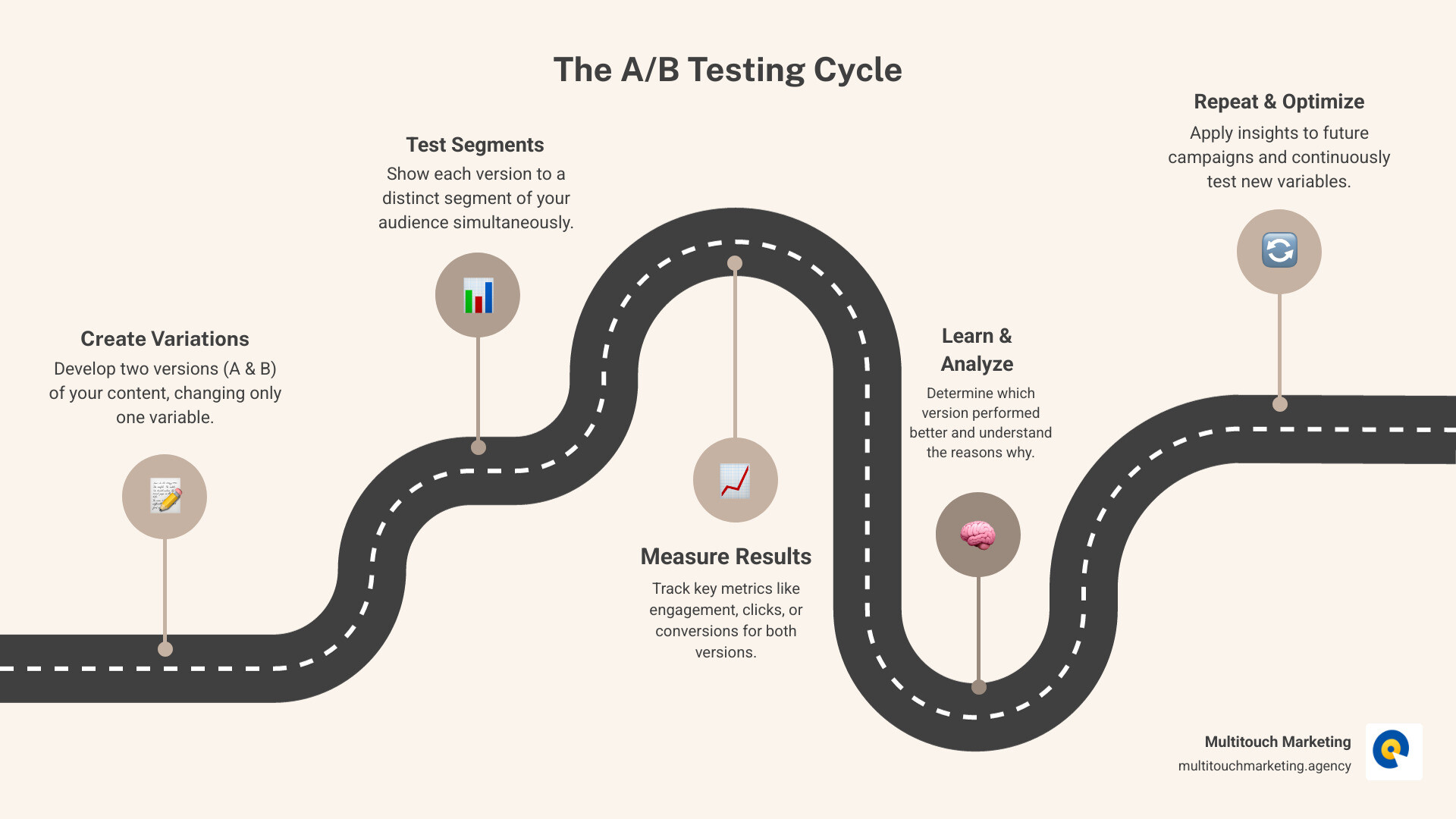
A/B testing on social media, often referred to as split testing, is a controlled experiment where two or more versions of a post or advertisement are shown to different segments of an audience to determine which performs better. By isolating a single variable—such as an image, headline, or call-to-action—marketers use comparative data to optimize engagement, click-through rates, and conversions based on empirical evidence rather than intuition.
In 2026, the social media landscape is defined by hyper-personalized algorithms and AI-driven content distribution. For brands to remain competitive, understanding the mechanics of A/B testing is no longer optional; it is the foundation of a high-ROI digital strategy. This guide explores the technical definitions, essential variables, and strategic considerations required to execute effective social media experiments.
Defining A/B Testing in the Social Media Context
At its core, A/B testing is a method of comparing two versions of a single variable, typically by testing a subject's response to variant A against variant B, and determining which of the two is more effective. In the specific realm of social media, this process involves creating two nearly identical pieces of content, changing only one specific element, and then deploying them to a randomized, non-overlapping audience.
The "Control" (Version A) usually represents the current standard or the original creative. The "Variation" (Version B) contains the modification. By monitoring how these versions perform against a specific Key Performance Indicator (KPI)—such as likes, shares, link clicks, or lead generation—social media managers can identify patterns in user behavior and preferences.
The Evolution of Split Testing
Historically, A/B testing was a manual process that required significant oversight to ensure that audience segments did not see both versions of the test (which would spoil the results). In 2026, major platforms like Meta, LinkedIn, and TikTok provide integrated, automated testing environments. These systems use sophisticated machine learning to handle audience randomization and statistical significance calculations in real-time, allowing brands to scale their experimentation efforts across multiple campaigns simultaneously.
Core Variables to Test on Social Media
To achieve a "clean" test result, it is critical to isolate one variable at a time. If a marketer changes both the image and the headline, they cannot be certain which change caused the difference in performance.
1. Visual Creative and Formatting
The visual element is often the first thing a user notices in a feed. Testing different types of media can yield the most significant performance swings.
- Static vs. Video: Comparing a high-quality product photo against a short-form video or "Lo-Fi" user-generated content (UGC).
- Color Palettes: Testing vibrant, high-contrast colors against more muted, brand-aligned aesthetics.
- Text Overlays: Evaluating whether text on the image increases clarity or creates visual clutter that drives users away.
2. Copywriting and Messaging
Words matter, but their effectiveness depends on tone, length, and placement.
- Headlines: Comparing "How to Save Money" with "5 Strategies for Wealth Growth."
- Post Length: Testing short, punchy captions (under 100 characters) against "long-form" storytelling captions.
- Tone of Voice: Evaluating a professional, authoritative tone against a casual, emoji-rich, or humorous approach.
3. Call-to-Action (CTA)
The CTA is the final nudge for a user to take a specific step. Small changes here can have a massive impact on conversion rates.
- Action Verbs: Comparing "Sign Up" with "Join the Community" or "Get Started."
- Button Placement: Testing where a CTA link appears within a caption or whether a native platform button (e.g., "Learn More") outperforms a simple text link.
4. Audience Targeting
Sometimes the content is perfect, but the audience is wrong. A/B testing can be applied to the "who" rather than the "what."
- Demographics: Testing a campaign against users aged 25–34 versus those aged 35–44.
- Interests: Comparing an audience interested in "Sustainability" with one interested in "Luxury Goods."
- Lookalike Audiences: Testing a 1% lookalike (most similar) against a 3% lookalike (broader) to see which provides better cost-per-acquisition (CPA).
Key Considerations for Statistical Validity
Conducting a test is easy; conducting a valid test is difficult. Without adhering to scientific principles, the results of an A/B test may lead a brand to make incorrect strategic decisions based on "noise" rather than real data.
Sample Size and Reach
For a test to be statistically significant, it must reach enough people. If Version A gets 2 clicks out of 10 views and Version B gets 1 click out of 10 views, the 100% difference is mathematically true but practically meaningless. A larger sample size reduces the margin of error. In 2026, most platforms recommend a minimum of several hundred "events" (clicks or conversions) per variant before a winner is declared.
Duration of the Experiment
Timing is a major variable in social media. User behavior changes based on the day of the week, holidays, and even the time of day. A test that runs for only 24 hours may be biased by a specific event or news cycle. Generally, a test should run for at least 7 to 14 days to account for a full weekly cycle of user behavior.
Significance Levels and P-Values
In technical SEO and data analysis, we look for a "Confidence Level"—usually 95%. This means there is only a 5% chance that the results occurred by random chance. Most modern social ad managers provide a "Chance to Beat Original" percentage. Marketers should wait for this number to exceed 95% before shifting their entire budget to the winning variant.
Step-by-Step Execution of a Social Media A/B Test
To implement a successful testing framework, follow these structured steps:
- Identify the Goal: Decide exactly what you want to improve. Is it the engagement rate on organic posts or the conversion rate on a lead-generation ad?
- Formulate a Hypothesis: State your assumption clearly. For example: "I believe that using a customer testimonial in the caption will result in a 10% higher click-through rate than the standard product description."
- Select the Platform and Tool: Use native tools like the Meta Ads Manager A/B Testing tool or third-party scheduling tools for organic testing.
- Create the Variants: Design Version A (the control) and Version B (the variation). Ensure all other settings—budget, schedule, and audience—remain identical.
- Run the Test: Launch the campaigns simultaneously. Avoid making any mid-test adjustments, as this will reset the data and invalidate the results.
- Analyze and Document: Once the test concludes, look at the primary metric. Document the winning variant and, more importantly, why it likely won. This creates a "playbook" for future creative development.
Comparative Analysis: Organic vs. Paid A/B Testing
While the principles remain the same, the execution differs significantly between organic posts and paid social advertisements.
| Feature | Organic A/B Testing | Paid (Ad) A/B Testing |
|---|---|---|
| Audience Overlap | High risk; followers may see both posts. | Low risk; platforms use "split" audiences. |
| Cost | Free (time-intensive). | Requires media spend budget. |
| Statistical Certainty | Lower; limited by organic reach. | Higher; can be forced through spend. |
| Best For | Testing tone and community engagement. | Testing ROI, ROAS, and conversion paths. |
| Data Accessibility | Limited to platform insights. | Deep, granular data and API exports. |
| Primary Limitation | Algorithm-dependent visibility. | Cost-per-click fluctuations. |
Common Pitfalls and How to Avoid Them
Even experienced marketers fall into traps that skew their data. Recognizing these pitfalls is essential for maintaining the integrity of your marketing intelligence.
Testing Too Many Variables
This is the most common error. If you change the headline, the image, and the target audience all at once, you are no longer performing an A/B test; you are performing a "multivariate test" without the necessary statistical volume to support it. Stick to one change per test to maintain clarity.
Ignoring the "Learning Phase"
Social media algorithms in 2026 require a "learning phase." During the first few days of a campaign, the platform's AI is experimenting with whom to show the ad. If you cut a test short because Version B looks like it's losing on day two, you might be killing a winning variant before it had the chance to optimize.
Lack of a Testing Repository
The value of A/B testing is cumulative. Many organizations perform a test, use the winner, and then forget the result. Maintaining a centralized repository of all past tests allows the entire team to understand what resonates with the audience over time, preventing redundant experiments.
The Role of AI in 2026 Social Media Testing
By 2026, Artificial Intelligence has transformed A/B testing from a reactive process to a predictive one. Generative AI tools can now automatically create dozens of variations of a headline or image based on historical performance data.
Furthermore, "Predictive Testing" models can now simulate how an audience might react to a piece of content before it is even published. While these simulations do not replace real-world testing, they allow marketers to weed out poor-performing variants early, ensuring that only the strongest candidates are put into a live A/B test. This significantly reduces the cost of experimentation and increases the speed of optimization.
Frequently Asked Questions
What is the difference between A/B testing and multivariate testing?
A/B testing compares two versions of a single variable (e.g., Headline A vs. Headline B). Multivariate testing (MVT) compares multiple variables simultaneously to see which combination performs best (e.g., Image A + Headline B vs. Image B + Headline A). Multivariate testing requires significantly more traffic and budget to reach statistical significance.
How long should I run a social media A/B test?
In most cases, a test should run for 7 to 14 days. This duration ensures that you capture behavior across all days of the week. Running a test for less than a week may lead to results that are skewed by the specific "mood" or activity level of the internet on a particular day (such as a weekend vs. a weekday).
Can I A/B test organic posts?
Yes, but it is more difficult than testing ads. To test organically, you can post Version A at a specific time one week and Version B at the same time the following week. However, because the external environment changes, this is less "scientific" than a paid split test where the audience is divided simultaneously. Some third-party tools allow for "dark posts" to help simulate organic A/B tests.
Should I always choose the version with the highest engagement?
Not necessarily. You must choose the version that performs best for your primary goal. If your goal is sales, but Version A has more likes while Version B has more purchases, Version B is the winner. Engagement is often a "vanity metric" that does not always correlate with business growth.
Is A/B testing still relevant with AI-optimized ads?
Absolutely. While AI (like Meta’s Advantage+ or Google’s Performance Max) does its own internal optimization, it still needs high-quality inputs to work with. A/B testing allows you to find the "winning" creative concepts that the AI can then scale across the platform more effectively.
Recommendation for Next Actions
To begin or refine your A/B testing journey in 2026, start by auditing your current social media performance to identify your "weakest link." If your impressions are high but your click-through rate is low, focus your first A/B tests on visual creative and headlines.
- Define a monthly testing budget: Allocate 10-15% of your total social media spend specifically for experimentation.
- Standardize your reporting: Create a simple spreadsheet or dashboard that tracks the hypothesis, the variants, the winner, and the percentage lift.
- Iterate, don't stop: Once you find a winner, make that your new "Control" and try to beat it with a new "Variation." Continuous improvement is the key to long-term social media success.