Attribute-Based Access Control (ABAC) in cloud-native and container security is an authorization model that grants or denies access requests based on combining evaluated attributes of subjects, resources, actions, and environmental conditions. Unlike rigid role-based access control, ABAC enables dynamic, real-time security policies tailored to highly fluid container environments, ephemeral workloads, and microservice architectures.
The Evolution of Access Control in Cloud-Native Infrastructure
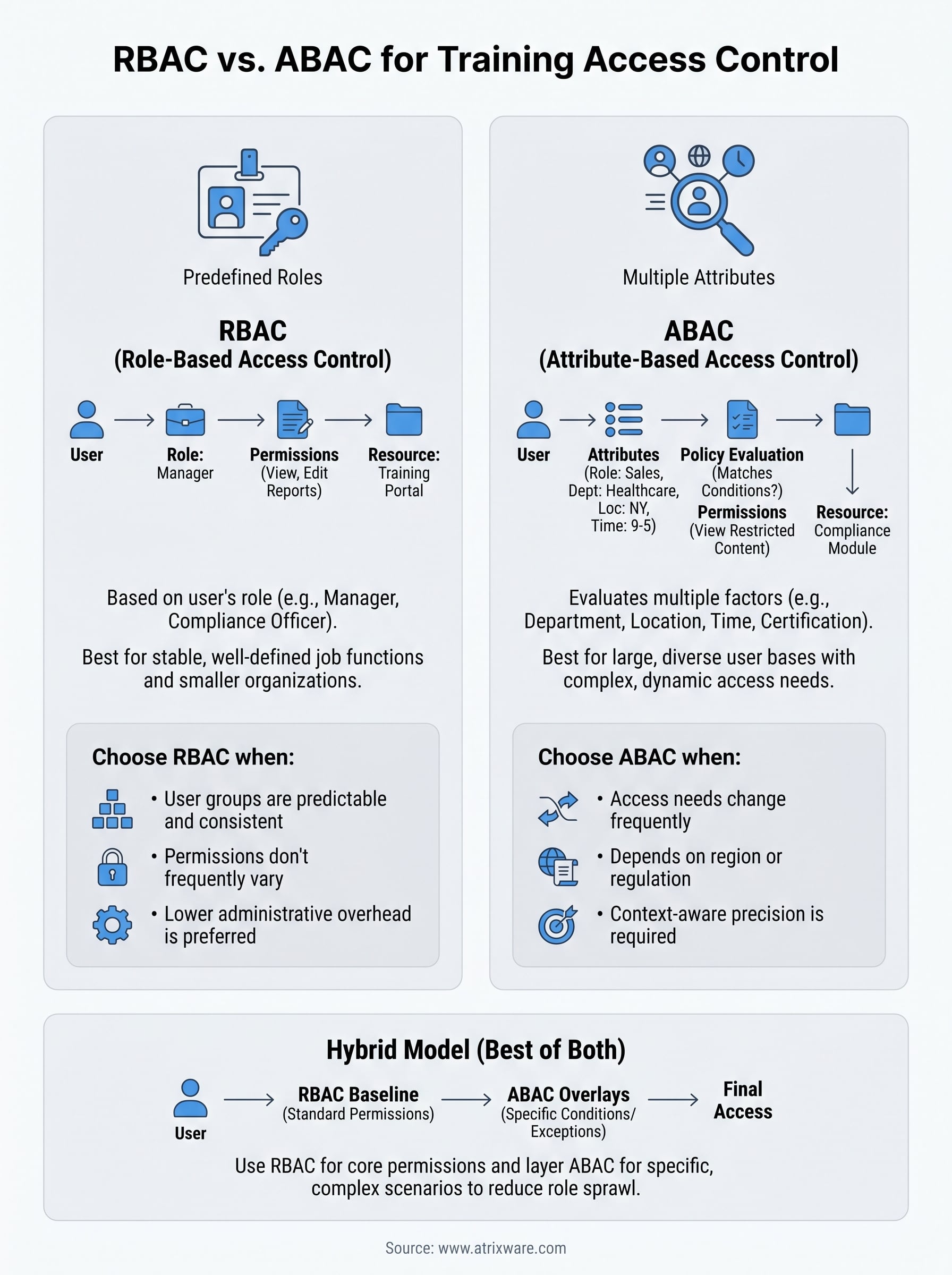
In early containerized and cloud-native environments, organizations relied primarily on Role-Based Access Control (RBAC). RBAC assigns permissions to defined roles (such as developer, cluster-admin, or auditor) and attaches those roles to users or service accounts. While RBAC provides a clean foundational security model for static infrastructure, it scales poorly in modern cloud-native systems. Containerized architectures involve thousands of ephemeral microservices, dynamic IP addresses, automated CI/CD deployment pipelines, and multi-tenant Kubernetes clusters.
As cluster density and deployment velocity increase, reliance on RBAC frequently leads to role explosion—a scenario where security teams must create hundreds of distinct roles to account for slight differences in access requirements across microservices, environments, and compliance zones. Managing these roles creates severe maintenance overhead, increases the risk of privilege creep, and complicates auditing effort.
To implement a true Zero Trust Architecture across cloud-native platforms, authorization decisions must evaluate context in real time. Rather than asking "What role does this service account hold?", a cloud-native authorization decision must evaluate:
- What identity issue claims are present?
- What runtime security posture does the calling pod exhibit?
- Is the request occurring within an approved maintenance window?
- Is the destination pod residing in a high-compliance namespace?
Attribute-Based Access Control (ABAC) answers these requirements by evaluating dynamic logic rules against arbitrary metadata tags and runtime telemetry.
Understanding ABAC Architecture in Containerized Environments
ABAC evaluates fine-grained rules composed of four primary attribute categories:
Subject Attributes: Metadata belonging to the entity requesting access. Examples include user identity claims, pod service account names, cryptographic SPIFFE IDs, pod labels, namespace tags, and security context (e.g., whether a pod is running as root).
Resource Attributes: Metadata belonging to the target entity being accessed. Examples include Kubernetes secret classifications, image repository tags, database labels, API endpoint sensitivity levels, and container runtime states.
Action Attributes: Properties describing the requested operation, such as HTTP verbs (
GET,POST,DELETE), Kubernetes API verbs (exec,patch,watch), or custom application operations.Environment/Contextual Attributes: External operational conditions present at the exact time of the request. Examples include origin IP subnet, TLS cipher suite, time of day, cluster geographical region, dynamic threat detection scores, and node security posture.
Requestor (Subject) + Action + Target (Resource)
Context / Environment
Policy Decision Point (PDP Engine) (Policy Definitions: Rego / Custom CRDs)
- PERMIT
- DENY
The Standard Reference Architecture (XACML Adaptation)
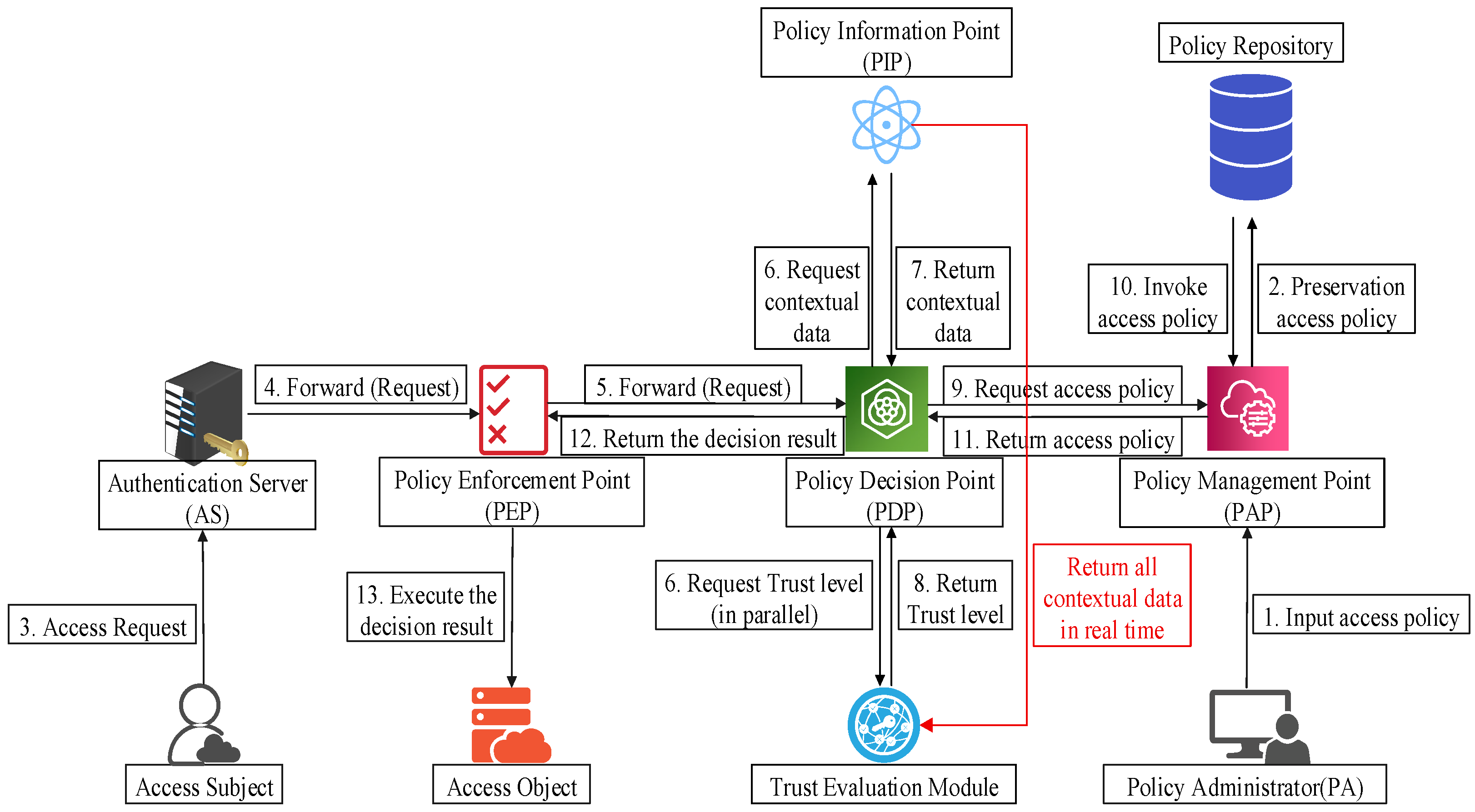
The National Institute of Standards and Technology (NIST) defines the foundational architecture for ABAC under Special Publication 800-162. In containerized and cloud-native ecosystems, this architecture translates directly into policy engine abstractions:
- Policy Enforcement Point (PEP): The component that intercepts access requests, extracts context, enforces decisions, and blocks unauthorized traffic. In cloud-native stacks, PEPs are implemented via API gateways, Kubernetes admission webhooks, service mesh sidecars (such as Envoy proxies), or eBPF kernel probes.
- Policy Decision Point (PDP): The engine that evaluates active security policies against submitted attributes to return an explicit
PermitorDenydecision. Popular cloud-native PDP implementations include the Open Policy Agent (OPA) and Kyverno. - Policy Information Point (PIP): The source of truth for attribute retrieval. PIPs pull metadata from external systems such as identity providers (IdPs), container registries, vulnerability scanners, runtime threat detection engines (like Falco), and Kubernetes cluster state APIs.
- Policy Administration Point (PAP): The interface and storage repository where security teams write, manage, version-control, and publish access policies. In modern infrastructure, the PAP is managed via GitOps workflows utilizing repositories and deployment pipelines.
ABAC vs. RBAC vs. ReBAC in Cloud Native
Understanding when to leverage ABAC alongside or instead of Role-Based Access Control (RBAC) and Relationship-Based Access Control (ReBAC) is critical when designing cloud-native security postures.
| Feature / Dimension | Role-Based Access Control (RBAC) | Attribute-Based Access Control (ABAC) | Relationship-Based Access Control (ReBAC) |
|---|---|---|---|
| Primary Basis of Authorization | Pre-assigned user/service roles | Contextual metadata (Subject, Resource, Action, Environment) | Direct or graph-based relationships between entities |
| Granularity Level | Coarse to medium | Extremely fine-grained | Fine-grained (object-level hierarchy) |
| Policy Flexibility | Static; requires updating role bindings when needs change | Dynamic; policies evaluate real-time conditions automatically | Dynamic; traverses relationship trees (e.g., owner, viewer, parent folder) |
| Complexity at Scale | High risk of role explosion in large environments | Policy management complexity requires structured testing | Requires specialized graph stores (e.g., Google Zanzibar implementations) |
| Native Kubernetes Support | Fully native (ClusterRole, RoleBinding) |
Legacy static file ABAC mode; modern ABAC requires webhooks/OPA | Requires external authz frameworks or custom CRDs |
| Performance Impact | Minimal (simple array/string lookup) | Low to moderate (requires attribute fetch and engine evaluation) | Moderate to high (graph traversal cost) |
| Primary Cloud-Native Use Case | Cluster-level administrator and developer scope isolation | Microservice-to-microservice dynamic authz and admission control | Application-layer multi-tenancy and resource sharing |
While standard Kubernetes API access relies primarily on RBAC for simple user-to-cluster authorization, ABAC dominates advanced workload-to-workload authorization, dynamic admission control, and runtime security enforcement.
Core Technical Mechanisms for ABAC in Containers
Implementing ABAC within a containerized stack requires linking runtime infrastructure components to policy decision engines.
1. Admission Control via Dynamic Webhooks
In Kubernetes, access control begins at the API server boundary. While native Kubernetes offers a legacy static ABAC authorizer file mode (which requires control plane restarts to modify policies and is generally discouraged in production), modern dynamic ABAC is achieved via Validating and Mutating Admission Webhooks.
When a user or automated pipeline submits a manifest (e.g., creating a Pod or Deployment), the Kubernetes API server invokes registered webhooks before persisting objects to etcd.
# Conceptual Open Policy Agent (OPA) Gatekeeper Constraint Template apiVersion: templates.gatekeeper.sh/v1 kind: ConstraintTemplate metadata: name: k8srequiredabaclabels spec: crd: spec: names: kind: K8sRequiredABACLabels targets: - target: admission.k8s.gatekeeper.sh rego: | package k8srequiredabaclabels violation[{"msg": msg}] { # Extract subject identity and target attributes provided_labels := input.review.object.metadata.labels user := input.review.userInfo.username namespace := input.review.object.metadata.namespace # Policy rule: Only CI/CD automation can deploy to production namespaces re_match("^system:serviceaccount:cicd-system:.*", user) == false startswith(namespace, "prod-") msg := sprintf("User '%v' is not authorized to deploy resources into production namespace '%v'", [user, namespace]) }
Dynamic webhooks allow policy engines to evaluate the attributes of the caller (input.review.userInfo), the target resource (input.review.object), and cluster metadata before approving workload execution.
2. Service Mesh Workload Authorization
Inside a container cluster, microservices communicate constantly over network interfaces. Traditional IP-based firewall rules fail because container IP addresses are dynamic and ephemeral.
Service meshes solve this by inserting a sidecar proxy (such as Envoy) next to every application container or using an eBPF node-level proxy. The service mesh extracts cryptographic identity tokens—such as SPIFFE/SPIRE SVID certificates or OpenID Connect (OIDC) JSON Web Tokens (JWTs)—and acts as a Policy Enforcement Point (PEP).
For example, Istio uses AuthorizationPolicy custom resources to execute ABAC logic at layer 7 (HTTP/gRPC):
apiVersion: security.istio.io/v1beta1 kind: AuthorizationPolicy metadata: name: payment-service-abac namespace: finance spec: selector: matchLabels: app: payment-processor action: ALLOW rules: - from: - source: # Subject Attribute: Verified SPIFFE Identity principals: ["cluster.local/ns/finance/sa/checkout-service-account"] to: - operation: # Action Attribute methods: ["POST"] paths: ["/v1/charge"] when: - key: request.auth.claims[environment] # Context Attribute extracted from JWT values: ["production"] - key: request.headers[x-compliance-level] # Resource Context Attribute values: ["pci-dss-strict"]
In this setup, the Envoy sidecar blocks requests unless the caller provides valid identity attributes, matching action attributes, and accurate environmental headers.
3. Cloud Provider Identity Federation (Workload Identities)
Securing containerized workloads that need access to cloud services (such as AWS S3, GCP BigQuery, or Azure Key Vault) requires bridging in-cluster attributes with cloud IAM frameworks.
Cloud providers implement this bridge through OIDC federated identity mechanisms:
- AWS: IAM Roles for Service Accounts (IRSA) and AWS EKS Pod Identity
- Google Cloud: GKE Workload Identity
- Azure: Azure AKS Workload ID
These frameworks map Kubernetes Service Account metadata (namespace, service account name, cluster ID) to cloud provider IAM roles. Rather than embedding long-lived cloud credentials inside container images, the cloud provider verifies signed tokens issued by the Kubernetes cluster API server.
- Container Pod (Requests Cloud Resource Access)
- Kubernetes API Token Exchange (OIDC) (Presents signed JWT containing Namespace & ServiceAccount attributes)
- Cloud Provider IAM (AWS/GCP/Azure) (Evaluates attribute policy conditions: e.g., Namespace == "prod")
- Temporary Cloud Credentials Issued
Access is granted dynamically based on the exact attributes of the running workload rather than static keys.
Step-by-Step Architecture for Implementing ABAC
Building a resilient ABAC framework across cloud-native platforms requires structured integration across multiple security layers.
- Context & Attribute Extraction
- SPIFFE/SPIRE IDs, OIDC JWTs, K8s Labels, Vulnerability Scores
- Centralized Policy Management (GitOps)
- Declarative Rego/Kyverno rules stored in Version Control
- Execution & Enforcement Gates
- Admission Control (Kubernetes API Webhooks)
- Traffic In-Flight Authorization (Service Mesh / Envoy / eBPF)
- Cloud IAM Access (Workload Identity Federation)
- Continuous Observability & Audit Logging
- Structured Decision Logs, Prometheus Metrics, Telemetry Auditing
Phase 1: Attribute Extraction and Telemetry Enrichment
Establish authoritative data pipelines to supply attributes to your policy decision engine:
- Establish identity providers (IdPs) for human users and issue SPIFFE/SPIRE identities for container workloads.
- Standardize workload tagging and labeling conventions (e.g.,
data-classification=restricted,owner=payments-team). - Integrate container vulnerability scanners (such as Trivy or Grype) and runtime threat platforms (such as Falco) to supply dynamic risk-score attributes.
Phase 2: Central Policy Store and Version Control
Define policies in declarative, readable languages using dedicated engines like OPA (Rego) or Kyverno. Store all policies in Git repositories managed through pull request reviews, automated linting, and continuous integration testing pipelines.
Phase 3: Layered Enforcement Integration
Deploy Policy Enforcement Points across three key boundaries:
- Control Plane / Management Layer: Deploy OPA Gatekeeper or Kyverno as validating admission controllers to enforce cluster state governance.
- Data Plane / In-Flight Traffic: Deploy service mesh proxies or eBPF programs to enforce layer-7 HTTP and gRPC network security rules.
- Infrastructure Boundary: Configure cloud provider OIDC federation to map container identities to cloud resources based on environment tags.
Phase 4: Continuous Audit and Monitoring
Set policy engines to emit structured JSON decision logs for every evaluated request. Route these decision logs to centralized SIEM platforms (e.g., OpenSearch, Datadog, Splunk) to establish audit trails required by frameworks such as SOC 2, ISO 27001, and PCI-DSS.
Operational Challenges and Best Practices
While ABAC offers fine-grained security for containerized systems, operating it at scale presents unique technical challenges.
Performance Latency and Engine Caching
Evaluating complex policy logic for thousands of HTTP requests per second can introduce microsecond or millisecond latency spikes to service-to-service communications.
- Mitigation: Execute policy evaluations locally using sidecar engines or embedded libraries rather than making centralized network calls to remote PDP instances. Cache static attribute lookups locally with defined time-to-live (TTL) limits. Ensure policy code avoids expensive nested loops and high-complexity regular expressions.
Attribute Freshness and Telemetry Drift
If a policy relies on dynamic attributes—such as container security scanning status or live threat scores—delay in updating attribute pipelines can lead to stale policy decisions. For instance, a vulnerable container might continue receiving traffic if the vulnerability scanner hasn't refreshed its metadata in the PIP.
- Mitigation: Implement event-driven attribute distribution architectures. Utilize webhooks or message queues to invalidate local attribute caches instantly when workload status changes.
Dry-Run and Audit-Only Modes
Deploying a flawed ABAC rule directly into production can accidentally block critical application traffic or crash container deployments.
- Mitigation: Leverage audit or "dry-run" modes available in modern policy engines. Kyverno and OPA Gatekeeper support
auditandwarnenforcement actions. This allows security teams to validate policies against real cluster traffic and log potential violations without blocking valid operations.
Frequently Asked Questions
How does ABAC differ from native Kubernetes RBAC?
Kubernetes native RBAC grants access based purely on binding a subject (User, Group, or ServiceAccount) to a static set of roles containing API groups and resource permissions. ABAC evaluates broader context, including pod labels, request timing, requestor IP subnets, dynamic risk scores, and external identity claims. Native RBAC operates at the cluster API layer, whereas ABAC extends authorization down into microservice network traffic, admission webhooks, and cloud IAM integrations.
Can ABAC and RBAC be used together in container clusters?
Yes. Modern cloud-native architectures frequently use a hybrid model. Native Kubernetes RBAC handles foundational access to standard API server objects (e.g., granting developers read access to deployment manifests in a staging namespace). ABAC is layered on top via admission controllers, service meshes, and cloud IAM federation to manage dynamic operational policy enforcement and fine-grained microservice communications.
What policy engines support ABAC in Kubernetes?
The standard open-source policy engines for ABAC in container environments are Open Policy Agent (OPA) with Gatekeeper, and Kyverno. Service meshes like Istio, Linkerd, and Envoy proxies also execute built-in ABAC authorization rules based on SPIFFE/SPIRE certificates and OIDC/JWT claims.
Does ABAC introduce latency to microservice calls?
If designed improperly, querying remote attribute databases on every service call can cause network latency. However, when deployed using optimized architecture—such as running OPA as a local sidecar or utilizing Envoy's native policy evaluation engines with local attribute caching—evaluation latency is typically sub-millisecond and negligible for modern applications.
How do ephemeral container lifecycles impact ABAC policies?
Because containers spin up and shut down rapidly, static permissions like hardcoded IP addresses or explicit pod names fail. ABAC handles ephemerality natively because it evaluates persistent metadata attributes—such as cryptographic identity (SPIFFE ID), workload labels, namespace tags, and deployment environment claims—rather than transient network identifiers.
Next Actions for Securing Cloud-Native Workloads
To implement or upgrade Attribute-Based Access Control in your containerized environments, consider taking the following technical steps:
- Audit Existing Access Controls: Evaluate your current Kubernetes RBAC roles and cloud provider bindings to identify privilege overlap, role explosion, or static secrets that can be replaced with identity federation.
- Standardize Workload Metadata: Establish clear labeling, tagging, and namespace conventions across all containerized workloads to create a reliable set of input attributes.
- Deploy a Policy Engine in Audit Mode: Install Open Policy Agent Gatekeeper or Kyverno on your development and staging clusters. Draft initial governance policies (e.g., enforcing image registry origins or restricting privilege escalation) using dry-run/audit modes to measure impact without breaking workloads.
- Implement Service Mesh Authorization: Integrate cryptographic service identities using SPIFFE/SPIRE or service mesh sidecars to move microservice communications from IP-based controls to layer-7 attribute authorization.