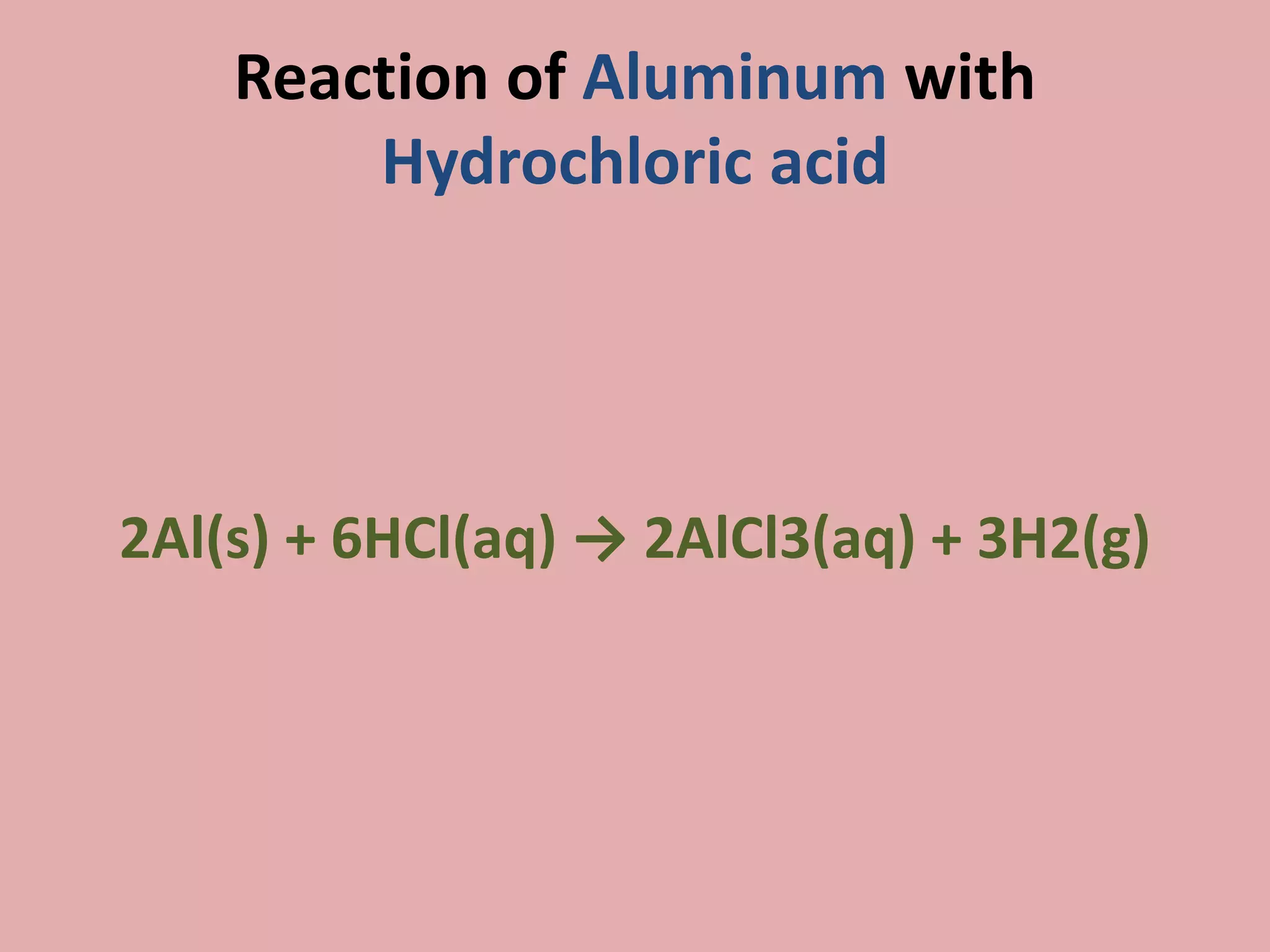
When aluminum metal reacts with hydrochloric acid, it undergoes a single-displacement reaction to produce aluminum chloride and hydrogen gas. The process is highly exothermic and is visually characterized by rapid effervescence as hydrogen bubbles escape the solution. This reaction is a fundamental example of redox chemistry and metal-acid interactions in laboratory and industrial settings.
Chemical Fundamentals and Balanced Equations
The interaction between aluminum (Al) and hydrochloric acid (HCl) is a classic example of a single-displacement reaction, specifically a redox (reduction-oxidation) process. In this reaction, the aluminum metal displaces hydrogen from the acid. Because aluminum is a reactive metal located above hydrogen in the reactivity series, it readily loses electrons to hydrogen ions provided by the acid.
The Balanced Molecular Equation
To understand the stoichiometry of the reaction, we must look at the balanced chemical equation. Aluminum has a valency of +3, while chlorine has a valency of -1. Therefore, the resulting salt is aluminum chloride ($AlCl_3$). The balanced molecular equation is:
$2Al (s) + 6HCl (aq) \rightarrow 2AlCl_3 (aq) + 3H_2 (g)$
This equation indicates that two atoms of solid aluminum react with six molecules of aqueous hydrochloric acid to produce two units of aqueous aluminum chloride and three molecules of diatomic hydrogen gas. The coefficients are essential for maintaining the law of conservation of mass, ensuring that the number of atoms for each element is identical on both the reactant and product sides.
The Net Ionic Equation
For a deeper technical understanding, we analyze the reaction through its ionic components. Hydrochloric acid is a strong acid that dissociates completely in water into $H^+$ and $Cl^-$ ions. Aluminum chloride also exists as dissociated ions in an aqueous solution. The complete ionic equation is:
$2Al (s) + 6H^+ (aq) + 6Cl^- (aq) \rightarrow 2Al^{3+} (aq) + 6Cl^- (aq) + 3H_2 (g)$
By removing the spectator ions—those that appear unchanged on both sides of the equation (in this case, the chloride ions)—we arrive at the net ionic equation:
$2Al (s) + 6H^+ (aq) \rightarrow 2Al^{3+} (aq) + 3H_2 (g)$
This clarifies the redox nature of the event: aluminum is oxidized (loses electrons), and hydrogen ions are reduced (gain electrons). Specifically, each aluminum atom loses three electrons to become an $Al^{3+}$ cation, while six hydrogen ions each gain one electron to form three molecules of $H_2$ gas.
The Role of the Aluminum Oxide Layer
One of the most distinct characteristics of aluminum is its immediate reaction with atmospheric oxygen to form a thin, tough, and transparent layer of aluminum oxide ($Al_2O_3$) on its surface. This phenomenon is known as passivation. Under normal circumstances, this oxide layer protects the underlying metal from further corrosion.
When aluminum is first submerged in hydrochloric acid, the reaction does not always begin instantly. There is often a brief "induction period." During this time, the hydrochloric acid is reacting with the aluminum oxide layer rather than the metal itself:
$Al_2O_3 (s) + 6HCl (aq) \rightarrow 2AlCl_3 (aq) + 3H_2O (l)$
Only after the acid has successfully dissolved or "penetrated" this protective oxide coating can the $HCl$ reach the raw aluminum metal beneath. Once the acid contacts the metal, the reaction proceeds vigorously and rapidly. This is why observers may notice a delay of several seconds or even minutes—depending on the thickness of the oxide and the concentration of the acid—before the characteristic bubbling of hydrogen gas begins.
Energy Changes: An Exothermic Process
The reaction between aluminum and hydrochloric acid is strongly exothermic, meaning it releases a significant amount of energy in the form of heat. In a laboratory setting, the reaction vessel (such as a test tube or beaker) will become noticeably hot to the touch.
The enthalpy change ($\Delta H$) for this reaction is negative, signifying that the chemical potential energy of the products is lower than that of the reactants. The "excess" energy is transferred to the surroundings. This thermal release is a critical safety consideration; if the reaction is performed on a large scale or with highly concentrated acid, the solution can reach boiling temperatures, potentially splashing corrosive liquid or accelerating the release of flammable hydrogen gas beyond controllable limits.
Factors Affecting the Reaction Rate
Several variables dictate how quickly aluminum will react with hydrochloric acid. Understanding these factors is vital for both controlling laboratory experiments and industrial metal processing.
1. Concentration of Hydrochloric Acid
The molarity of the $HCl$ solution is the primary driver of reaction speed. In a more concentrated solution, there is a higher frequency of collisions between the $H^+$ ions and the aluminum surface. According to collision theory, increasing the concentration increases the rate of reaction. A 6M $HCl$ solution will react far more violently with aluminum foil than a 1M solution.
2. Surface Area of the Aluminum
The reaction occurs at the interface between the solid metal and the liquid acid. By increasing the surface area of the metal, more aluminum atoms are exposed to the acid simultaneously. Consequently, aluminum powder reacts almost instantaneously and explosively, while a thick aluminum rod reacts much more slowly. Aluminum foil provides a high surface-area-to-mass ratio, making it a common choice for demonstrating rapid gas production.
3. Temperature
As with most chemical reactions, increasing the temperature provides the reactant particles with more kinetic energy. This leads to more frequent and more energetic collisions that exceed the activation energy required for the reaction. If the acid is pre-heated, the induction period (the time taken to strip the oxide layer) is shortened, and the subsequent evolution of gas is much more rapid.
4. Presence of Catalysts or Impurities
Certain impurities in the aluminum or the presence of specific ions in the solution can act as catalysts. For instance, the presence of copper ions can accelerate the corrosion of aluminum through galvanic effects. Conversely, highly pure aluminum (99.99%) may react more slowly than commercial-grade aluminum alloys because the impurities in the latter create "active sites" where the oxide layer is more easily breached.
Laboratory Observations and Identification
When performing this experiment in a controlled environment, there are several sensory cues that confirm the reaction is occurring.
- Effervescence: The most immediate observation is the formation of vigorous bubbles. These bubbles are hydrogen gas. To verify the identity of the gas, a "pop test" can be performed: a lit wooden splint held at the mouth of the reaction vessel will produce a distinctive "squeaky pop" as the hydrogen reacts explosively with oxygen in the air to form water vapor.
- Dissolution of Metal: As the aluminum atoms are converted into aqueous aluminum chloride ions, the solid metal appears to "disappear" or dissolve into the solution.
- Temperature Rise: As noted previously, the reaction vessel becomes hot.
- Color Changes: While the resulting aluminum chloride solution is typically clear and colorless, the solution may appear grey or cloudy during the reaction due to the suspension of fine metal particles or the presence of alloying elements (like silicon or manganese) that do not dissolve as readily in the acid.
Safety Considerations and Chemical Hazards
Working with aluminum and hydrochloric acid requires strict adherence to safety protocols, as both the reactants and the products pose specific risks. As of 2026, safety guidelines emphasize the prevention of inhalation and the management of thermal runaway.
Corrosive Nature of HCl
Hydrochloric acid is a strong, corrosive mineral acid. It can cause severe chemical burns upon contact with skin or eyes. The vapors from concentrated $HCl$ are respiratory irritants. Always work in a well-ventilated area or under a fume hood.
- PPE Requirements: Chemical splash goggles, acid-resistant gloves (nitrile or neoprene), and a laboratory coat are mandatory.
- First Aid: In case of skin contact, flush the area with copious amounts of water for at least 15 minutes.
Hydrogen Flammability
The hydrogen gas produced is highly flammable and forms explosive mixtures with air. In a confined space, even a small amount of hydrogen can pose a significant explosion hazard.
- Mitigation: Ensure no open flames or spark sources (including static electricity or non-intrinsically safe electronics) are near the reaction site.
Reaction Management
Because the reaction is exothermic, it can become self-accelerating. As the heat increases the reaction rate, more heat is produced, potentially leading to a "boil-over."
- Protocol: Always add the metal to the acid in small increments. Never perform this reaction in a sealed container, as the pressure build-up from the hydrogen gas will cause the vessel to rupture.
Comparison of Metal Reactions with HCl
The reactivity of aluminum in hydrochloric acid is best understood when compared to other common metals. The following table illustrates how different metals behave when exposed to 2M $HCl$ at room temperature (approximately 25°C).
| Metal | Reactivity Rank | Observation | Main Product (Salt) |
|---|---|---|---|
| Magnesium (Mg) | Very High | Violent bubbling, immediate reaction, high heat. | Magnesium Chloride ($MgCl_2$) |
| Aluminum (Al) | High | Delayed start (oxide layer), then vigorous bubbling. | Aluminum Chloride ($AlCl_3$) |
| Zinc (Zn) | Moderate | Steady stream of bubbles, moderate heat. | Zinc Chloride ($ZnCl_2$) |
| Iron (Fe) | Low | Slow bubble formation, requires time to see change. | Iron(II) Chloride ($FeCl_2$) |
| Copper (Cu) | None | No reaction; copper is below hydrogen in reactivity. | N/A |
This table highlights that while aluminum is very reactive, the presence of its oxide layer makes its initial behavior distinct from magnesium, which lacks such a robust protective coating in acidic conditions.
Industrial and Educational Applications
The reaction between aluminum and $HCl$ is not merely a laboratory curiosity; it has practical applications across various sectors.
1. Chemical Etching
In the manufacturing of certain electronic components and decorative metalwork, hydrochloric acid is used to etch aluminum. By masking certain areas of the metal with an acid-resistant material, the $HCl$ can be used to "cut" or "carve" precise patterns into the exposed aluminum surfaces.
2. Production of Aluminum Chloride
Aluminum chloride is a vital industrial chemical, particularly used as a catalyst in Friedel-Crafts reactions in organic chemistry and as a coagulant in water treatment facilities. While industrial production often uses the reaction of chlorine gas with molten aluminum, the acid-metal reaction is a common route for producing small-scale laboratory reagents.
3. Hydrogen Gas Generation
In historical contexts and small-scale field applications, reacting aluminum with acid was a method for generating hydrogen gas. However, due to the corrosive nature of the reactants, this has largely been superseded by electrolysis or steam reforming of natural gas for large-scale needs.
4. Qualitative Analysis
In chemistry education, this reaction serves as a primary tool for teaching students about the reactivity series, stoichiometry, and the properties of gases. It provides a clear, visual demonstration of how chemical bonds are broken and reformed.
Frequently Asked Questions
Why does the reaction produce bubbles?
The bubbles are diatomic hydrogen gas ($H_2$). During the reaction, hydrogen ions from the hydrochloric acid gain electrons from the aluminum atoms. Once the hydrogen atoms pair up to form molecules, they are no longer soluble in the water and escape the solution as a gas. This process is known as effervescence.
Is the reaction between aluminum and HCl a redox reaction?
Yes. It is a redox reaction because there is a transfer of electrons. Aluminum is oxidized as its oxidation state increases from 0 (in the solid metal) to +3 (in the $AlCl_3$ salt). Hydrogen is reduced as its oxidation state decreases from +1 (in $HCl$) to 0 (in $H_2$ gas).
What is the residue left after the reaction?
If the reaction goes to completion and the acid was in excess, the remaining liquid is a solution of aluminum chloride dissolved in water. If the water is evaporated, white or yellowish crystals of aluminum chloride hexahydrate ($AlCl_3 \cdot 6H_2O$) will remain. If the aluminum contained alloying elements like silicon, a small amount of dark, insoluble sediment may be visible at the bottom of the container.
Can I use this reaction to clean aluminum?
While $HCl$ will remove oxidation and dirt from aluminum, it is generally not recommended for cleaning. Because the acid reacts directly with the metal itself, it will pit and dissolve the surface of the item, potentially ruining its structural integrity and finish. Commercial aluminum cleaners usually use much weaker acids or specialized surfactants that target the grime without aggressively attacking the base metal.
What happens if the acid is very dilute?
If the hydrochloric acid is very dilute (e.g., less than 0.1M), the reaction may be so slow that it is barely perceptible. The acid may struggle to break through the oxide layer, or the hydrogen bubbles may form so slowly that they dissolve into the liquid rather than forming visible effervescence.
Final Recommendations for Safe Experimentation
For those planning to observe or utilize the reaction between aluminum and hydrochloric acid in 2026, the following steps ensure a safe and successful outcome:
- Verification of Materials: Ensure the aluminum is clean of oils or heavy greases, which can impede the acid's access to the metal surface.
- Controlled Environment: Always perform the reaction in a high-quality fume hood to manage the release of hydrogen and acid mists.
- Waste Disposal: The resulting aluminum chloride solution is acidic and contains dissolved metal ions. It should be neutralized with a base (like sodium bicarbonate) and disposed of according to local 2026 environmental regulations for laboratory waste. Never pour concentrated or unneutralized metal-acid mixtures directly down a standard drain.
- Scale Management: Start with small quantities (e.g., a 2cm x 2cm square of foil and 10ml of 2M acid) to gauge the vigor of the reaction before attempting larger scales.
For further technical data on the thermodynamic properties of this reaction, refer to resources like the NIST Chemistry WebBook or the PubChem database for Aluminum Chloride.