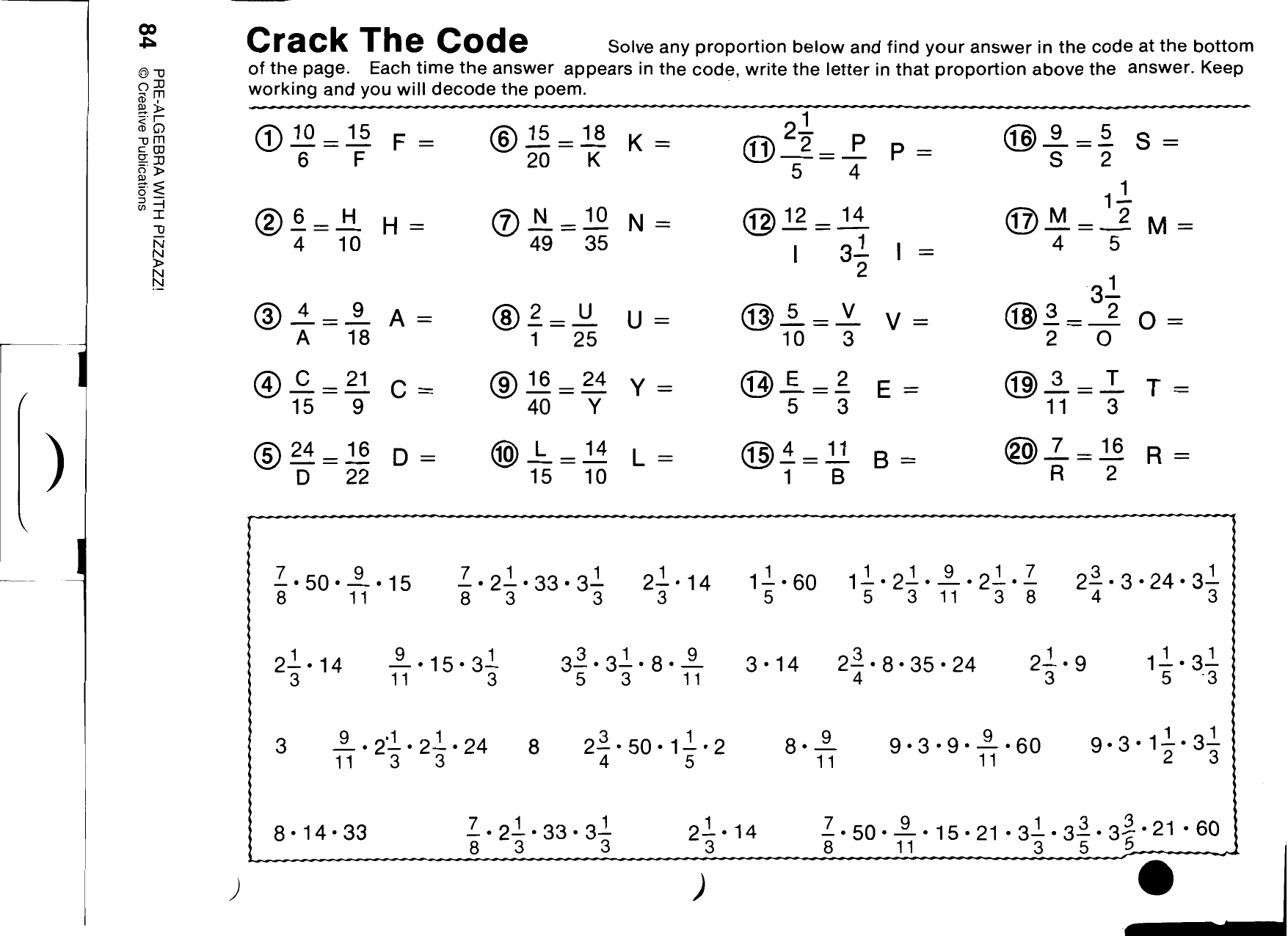
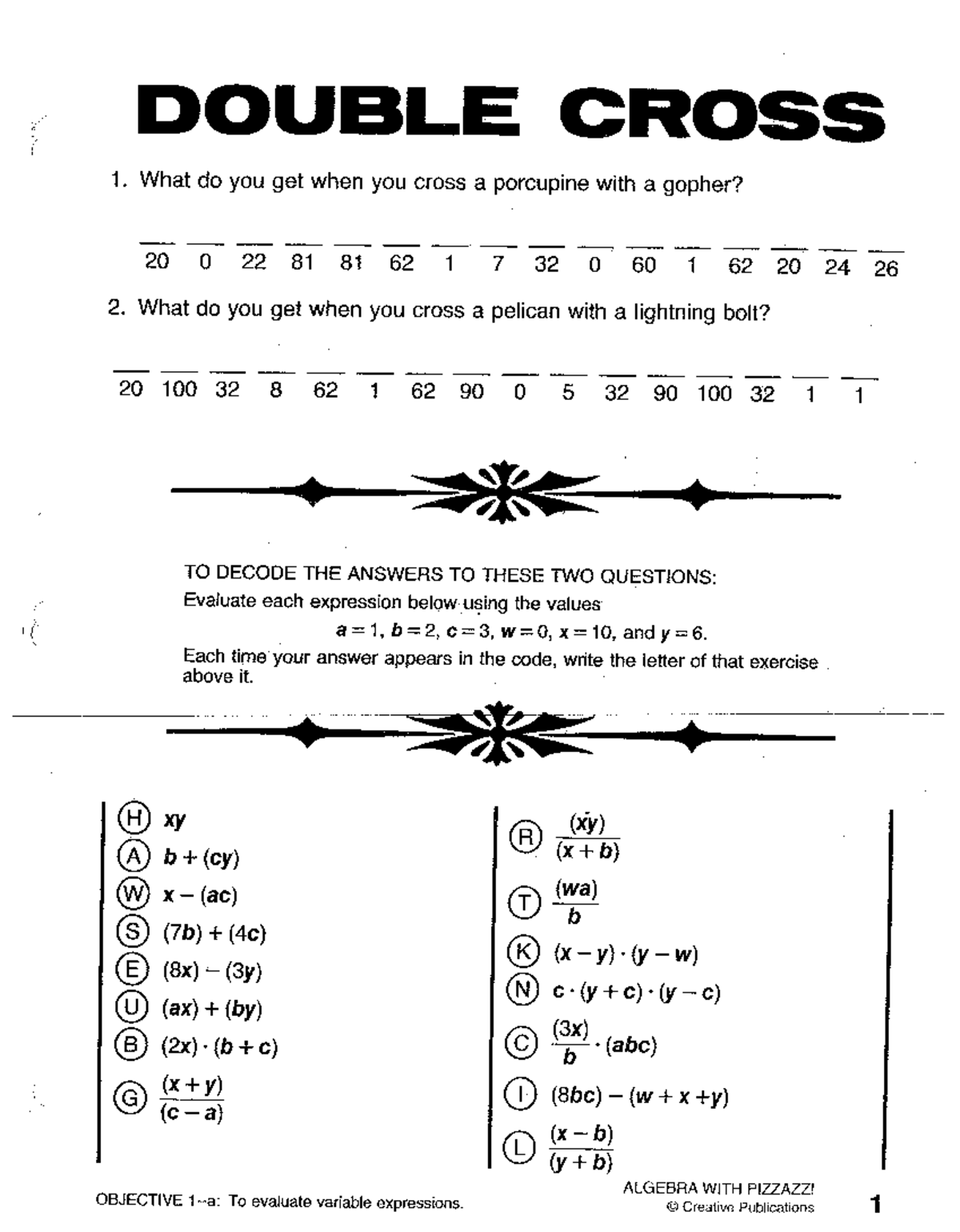
Algebra with Pizzazz! is a classic series of puzzle-based mathematics worksheets created by Steve Marcy and Janis Marcy. Distributed widely in printable PDF format, the collection reinforces middle and high school algebra skills through self-correcting riddles, jokes, and coded messages that allow students to independently verify their mathematical calculations.
Originally published by Creative Publications, the Pizzazz series remains one of the most recognizable supplemental resources in secondary mathematics education. Decades after its introduction, educators, homeschoolers, and tutors continue to rely on these materials to convert routine skill drills into engaging problem-solving sessions. Understanding how the curriculum is structured, why its self-checking mechanism works pedagogically, and how to deploy it alongside modern standards ensures that learners build procedural fluency without burnout.
The Origins and Purpose of the Pizzazz Series
During the late 1970s and 1980s, educators Steve Marcy and Janis Marcy developed a sequence of supplementary practice binders designed to address a persistent instructional challenge: repetitive math drills often led to student disengagement, while delayed grading prevented students from catching conceptual errors early.
The Marcy team authored several targeted collections under the "Pizzazz" umbrella:
- Pre-Algebra with Pizzazz! (foundational arithmetic, fractions, decimals, and basic integers)
- Algebra with Pizzazz! (introductory to intermediate high school algebra)
- Middle School Math with Pizzazz! (a five-book series spanning grades 6 through 8)
- Bridge to Algebra (transition curricula for struggling students)
- Punchline Bridge to Algebra and Punchline Problem Solving (later iterations featuring refined graphic layouts and word problems)
The primary goal of Algebra with Pizzazz! is procedural fluency. While modern mathematics curricula rightly emphasize conceptual understanding and inquiry-based discovery, learners still require sufficient repetitive practice to automate computational subroutines—such as clearing denominators, combining like terms, and applying exponent rules. The Pizzazz worksheets embed routine calculation inside an interactive puzzle framework that softens math anxiety.
How the Self-Correcting Puzzle Engine Works
The core instructional innovation of Algebra with Pizzazz! is its instant-feedback loop. Each page presents an overarching question, riddle, or humorous premise at the top, such as "What do you call an elephant that never washes?" or "Did you hear about the farmer who fed his cows dynamite?"
To solve the puzzle, students execute a three-stage workflow:
Solve the Mathematical Item: The student works through a numbered problem listed on the sheet (for example, solving a multi-step linear equation like $3(2x - 4) = 18$).
Locate the Solution in the Code Key: Around the perimeter or at the bottom of the worksheet, candidate answers are paired with letters, symbols, or phrases. If the student calculates $x = 5$, they search the answer key for the number 5.
Decode the Punchline: Finding the matching answer reveals a corresponding letter, which the student writes into the numbered blank corresponding to that specific problem.
Math Problem: #4
Calculated Value: x = 5
Matching Key: 5 = "E"
Riddle Letter: Blank #4 gets "E"
Why This Mechanics Prevents Common Learning Pitfalls
This mechanical design provides psychological and pedagogical advantages over traditional textbook drill sets:
- Immediate Error Detection: If a student solves a quadratic equation and their calculated roots do not appear anywhere in the answer bank, they immediately recognize that an error occurred. They can re-examine their arithmetic or sign distribution on the spot rather than waiting days for a graded paper.
- Reduced Teacher Bottlenecks: In a classroom of thirty students, an instructor cannot check every calculation in real time. The self-checking key absorbs baseline verification, freeing the educator to deliver targeted interventions to students struggling with prerequisite concepts.
- Built-in Motivation to Correct Mistakes: In standard worksheets, students frequently leave difficult problems blank or abandon incorrect attempts. In a Pizzazz activity, leaving a blank prevents the student from deciphering the joke, creating a natural incentive to reconcile calculation discrepancies.
Core Curricular Scope and Topic Sequence
Algebra with Pizzazz! spans standard first-year algebra (Algebra I) coursework. The book is organized into thematic sections, moving sequentially from foundational operations to complex polynomial analysis.
1. Operations on Real Numbers and Integers
The opening sections review directed numbers, absolute value, arithmetic operations with signed values, order of operations, and the evaluation of algebraic expressions given specific variable substitutions. These sheets target sign-change errors, which represent the single most common failure point for beginning algebra students.
2. Solving Linear Equations and Inequalities
The curriculum advances through:
- One-step equations involving additive and multiplicative inverses.
- Two-step equations requiring students to isolate terms before isolating variables.
- Multi-step equations featuring the distributive property and variables on both sides.
- Literal equations and formula rearrangement (such as solving $A = \frac{1}{2}bh$ for $h$).
- Graphing simple and compound inequalities on a number line.
3. Polynomial Operations and Factoring
A substantial portion of the resource focuses on working with polynomials:
- Adding, subtracting, and multiplying monomials and polynomials (FOIL method).
- Factoring out the greatest common factor (GCF).
- Factoring differences of squares ($a^2 - b^2$).
- Factoring trinomials of the form $x^2 + bx + c$ and the more complex $ax^2 + bx + c$.
- Solving quadratic equations by factoring and applying the zero-product property.
4. Linear Relations, Functions, and Systems
Later chapters address coordinate geometry:
- Determining coordinates in all four quadrants.
- Calculating slope from two points or from linear equations in slope-intercept form ($y = mx + b$).
- Finding $x$- and $y$-intercepts.
- Solving systems of linear equations using graphing, substitution, and elimination methods.
5. Radicals and Rational Expressions
The final segments challenge students with:
- Simplifying square roots and radical expressions.
- Performing operations with radicals.
- Simplifying, multiplying, and dividing rational algebraic fractions.
- Solving rational equations and proportion problems.
Comprehensive Reference: Worksheet Organization and Target Skills
The table below outlines how common units within Algebra with Pizzazz! map to core computational objectives and standard puzzle formats.
| Unit Focus | Key Mathematical Skills | Puzzle Format Example | Primary Pedagogical Benefit |
|---|---|---|---|
| Integers & Expressions | Adding/subtracting signed numbers; order of operations; evaluating expressions | Letter-to-blank matching riddle | Eliminates negative sign misconceptions early in the term. |
| Linear Equations | Combining like terms; distributive property; variables on both sides | Word-bank decoding / scrambled answer grids | Forces rigorous multi-step organization on scratch paper. |
| Factoring Trinomials | Identifying binomial factors; handling signs in $(x \pm p)(x \pm q)$; solving for roots | Cross-out puzzles (remaining letters reveal mystery statement) | Provides immediate confirmation when factors are chosen correctly. |
| Linear Systems | Solving simultaneous linear equations via elimination and substitution | Coordinate plotting or coded punchline letter replacement | Confirms both $x$ and $y$ values simultaneously within the key. |
| Radicals & Exponents | Simplifying non-perfect squares; quotient/product rules for exponents | Cryptic quotation or visual matching | Prevents invalid operations (e.g., treating $\sqrt{a+b}$ as $\sqrt{a}+\sqrt{b}$). |
| Rational Expressions | Factoring numerators/denominators; canceling common factors; restrictions | Joke answer key with distractor options | Highlights common cancellation errors before summative testing. |
Pedagogical Strengths and Operational Limitations
While Algebra with Pizzazz! is widely celebrated, balanced instructional design requires evaluating both its strengths and its structural limitations.
| STRENGTHS | LIMITATIONS |
|---|---|
| • Immediate self-correction | • Low conceptual inquiry |
| • Lowered anxiety / high buy-in | • Punchline guessing risks |
| • High procedural density | • Limited real-world context |
| • Print-and-go accessibility | • Requires scratch paper |
Strengths
- Durable Procedural Retention: Mathematics requires automaticity. The high density of calculations per sheet ensures that students repeat mechanics enough times to achieve muscle memory.
- Psychological Accessibility: The visual presentation, cartoon illustrations, and lighthearted tone make 20-problem algebra sets feel significantly less intimidating than standard textbook pages.
- Low Barrier to Entry: The PDF format requires no software subscriptions, device logins, or internet access, ensuring parity for students who lack access to digital learning platforms.
Limitations
- Minimal Conceptual Scaffolding: Pizzazz worksheets focus almost entirely on procedural execution rather than conceptual derivation. A student can master the mechanics of factoring on a worksheet without understanding the underlying geometric area model or function behavior.
- Punchline Guessing: Clever students occasionally deduce the punchline after solving only four or five problems. Once they guess the phrase (e.g., "A walkie-talkie"), they can work backward to map letters to answers without completing the algebraic calculations.
- Constrained Scratch Work Area: The original page designs prioritize placing the puzzle key, illustrations, and problem statements on a single standard page. Consequently, there is rarely enough physical space on the sheet for students to neatly show multi-step algebraic steps.
Best Practices for Teachers and Parents
To maximize learning outcomes and prevent students from cutting corners, implement the following classroom-tested strategies:
Enforce the "Scratch Paper Protocol"
Never permit students to turn in a completed Pizzazz worksheet with only the letters filled into the blanks. Require that a numbered, organized sheet of scratch paper be stapled to the puzzle page. Specify that credit is awarded based on the written algebraic steps, with the completed riddle serving merely as a verification mechanism.
Use Worksheets as Formative Warm-Ups or Station Work
Rather than assigning an entire 24-problem sheet for homework where students might reverse-engineer the answer key using online solvers, deploy specific halves of worksheets:
- Station Rotations: Laminate select pages and have students work through them with dry-erase markers during small-group rotations.
- Exit Tickets: Select three problems from a page; solving them correctly unlocks the snippet of the puzzle displayed on the classroom board.
- Partner Verification: Have two students work on alternating problems. If their combined letters complete the puzzle sequence correctly, both receive confirmation that their steps were accurate.
Guard Against Punchline Reverse-Engineering
If students tend to guess the riddle early, obscure the punchline blanks before photocopying or printing the PDF. Direct the students to solve all problems and write the corresponding code letter directly next to each problem number. Once their scratch paper is verified, provide the puzzle solution strip as a reward.
Digital Access, Copyright, and Fair Use Considerations
Because the Pizzazz series originated in physical binder form under Creative Publications and later permissions were managed under McGraw-Hill Education, navigating digital access requires attention to licensing and intellectual property.
- Classroom Duplication Rights: The original printed teacher binders generally granted the purchasing teacher or school site a limited license to reproduce pages for single-classroom instructional use.
- Online PDF Availability: Numerous school districts, university resource libraries, and educational archives host public PDF scans of specific Algebra with Pizzazz! pages. While these are frequently used by educators under fair-use educational exceptions, institutional users should verify whether their school or district holds an institutional license or archival copy of the original physical binders.
- Modern Successors: For educators looking for commercially active, modern resources developed by the same authors, the Punchline series published by Marcy Mathworks represents the direct, updated continuation of the Pizzazz pedagogy, offering updated typeset pages, refreshed puzzles, and formal alignment with modern state standards.
Frequently Asked Questions
What is the difference between Pre-Algebra with Pizzazz! and Algebra with Pizzazz!?
Pre-Algebra with Pizzazz! covers foundational arithmetic, negative integers, fractions, decimals, simple ratios, and elementary one-step equations suitable for grades 6 through 8. Algebra with Pizzazz! focuses on standard high school Algebra I concepts, including multi-step linear equations, systems of equations, polynomial operations, factoring trinomials, quadratic formula applications, and radical operations.
Can students use calculators with Pizzazz worksheets?
Calculator policy depends on the instructional target of the specific sheet. For pages focusing on polynomial factoring, coordinate graphing, or linear system substitution, scientific calculators can reduce arithmetic friction. However, for sheets designed around integer arithmetic, order of operations, or fraction reduction, using calculators defeats the procedural fluency purpose of the activity.
How do I prevent students from finding the answer keys online?
Because the Pizzazz series has existed for several decades, complete answer keys and solved punchlines are easily accessible via web searches. To preserve the utility of the worksheets, require students to submit complete, step-by-step scratch paper showing algebraic derivations. Alternatively, alter the problem constants on the master sheet while preserving the overarching puzzle mechanism.
Are Pizzazz worksheets aligned with Common Core Mathematics Standards?
While created prior to the advent of the Common Core State Standards (CCSS), the underlying procedural skills directly support CCSS domains such as Seeing Structure in Expressions (HSA.SSE), Creating Equations (HSA.CED), and Reasoning with Equations and Inequalities (HSA.REI). They should be paired with conceptual tasks and performance activities to satisfy modern conceptual and modeling standards.
How does the puzzle format help students with learning differences?
The self-correcting feedback loop provides immediate reassurance, reducing anxiety for students who struggle with working memory or executive functioning. Knowing that their answer must match one of the provided options eliminates the fear of the unknown, while the discrete, bounded nature of the puzzle tasks prevents students from feeling overwhelmed by undifferentiated blocks of textbook text.
Recommended Next Steps
To incorporate Algebra with Pizzazz! effectively into an instructional sequence, begin by auditing your current unit to identify where students experience procedural bottlenecks—such as negative sign distribution or factoring quadratics where $a > 1$. Select one targeted worksheet from the collection to serve as a guided, in-class practice set following direct instruction. Ensure each student receives a dedicated calculation worksheet alongside the puzzle page, establish clear expectations for showing work, and use the built-in self-checking key to let students monitor and celebrate their own computational accuracy.