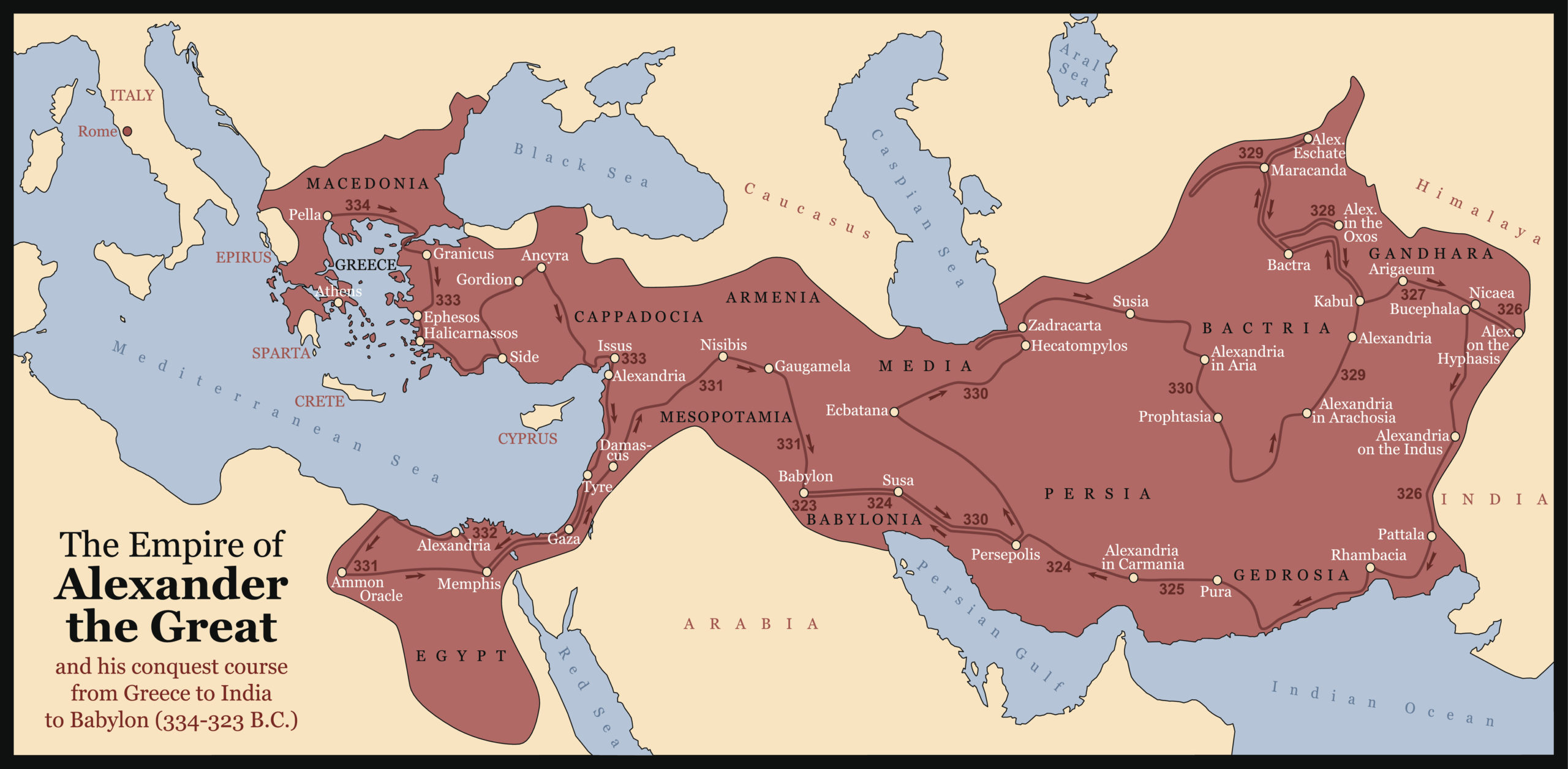
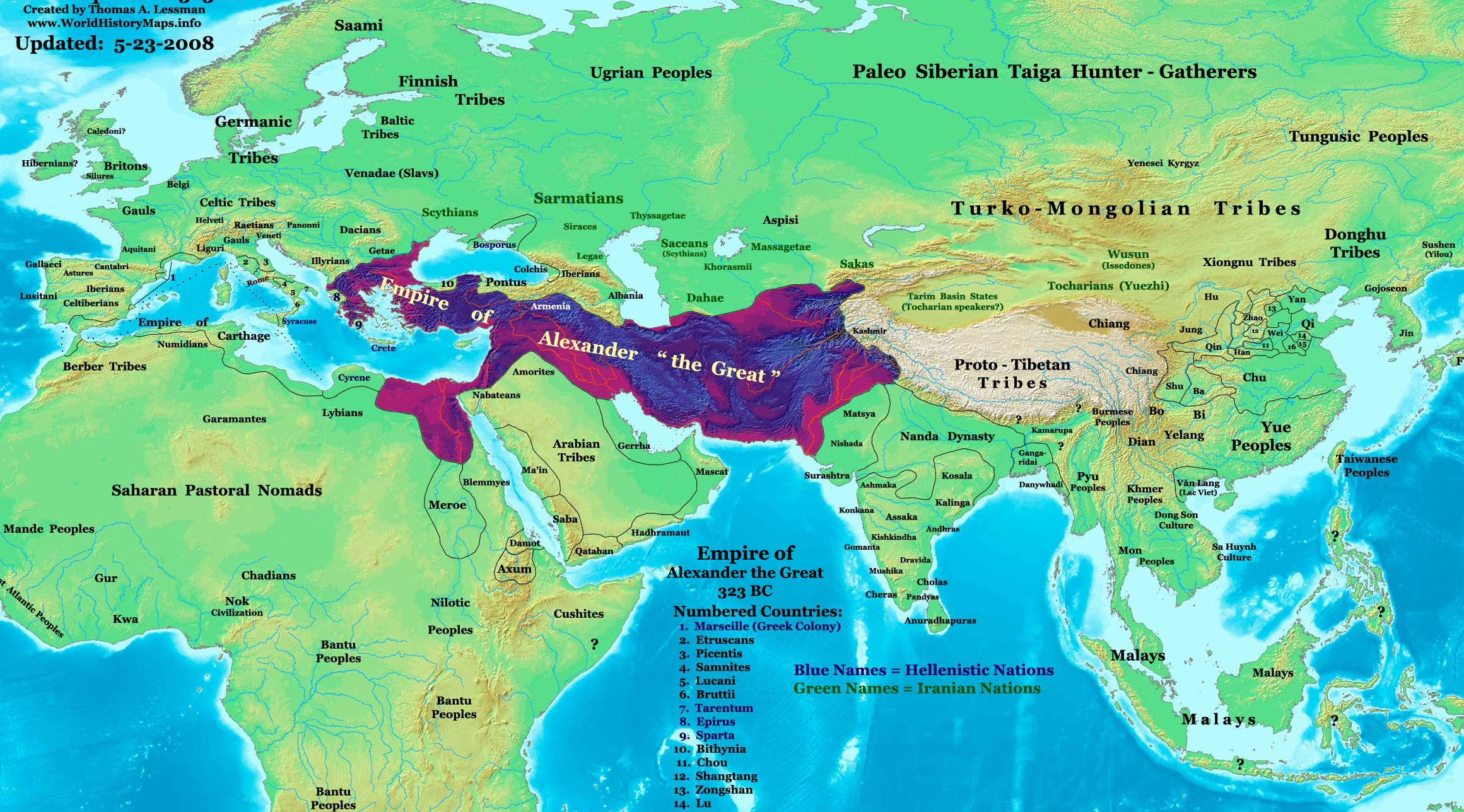
Alexander the Great, or Alexander III of Macedon, was the ancient Greek king who, by the age of thirty, created one of the largest empires in history. His conquests stretched from the Ionian Sea to the Himalayas, effectively dismantling the Persian Empire and spreading Hellenistic culture across three continents.
Alexander the Great remains a figure of immense historical fascination, not merely for the scale of his empire but for the unprecedented speed of his military campaigns. To understand how a young king from a relatively small northern Greek kingdom could overthrow the most powerful empire of his time—the Achaemenid Empire of Persia—one must examine the convergence of his specialized education, the military reforms of his father, Philip II, and Alexander’s own tactical genius. In 2026, historians continue to view his reign as the definitive bridge between the Classical Greek era and the Hellenistic age, a period that fundamentally reshaped the Mediterranean and Near Eastern worlds.
The Foundation of a Conqueror: Early Life and Education
Alexander was born in 356 BCE in Pella, the capital of Macedonia. He was the son of King Philip II and Queen Olympias. From birth, his life was structured toward leadership and warfare. While his father provided the physical and political infrastructure of the Macedonian state, his intellectual foundation was laid by one of history’s greatest thinkers: Aristotle.
Between the ages of 13 and 16, Alexander was tutored by Aristotle in the village of Mieza. This education was not limited to philosophy or rhetoric; it included medicine, botany, zoology, and geography. Aristotle’s influence is evident in Alexander’s later campaigns, where he often brought scientists and historians with him to document new species and lands. Furthermore, Alexander’s deep-seated belief in his own divine or heroic lineage—claiming descent from Achilles on his mother’s side and Heracles on his father’s—fueled a psychological drive that made him nearly impossible to deter on the battlefield.
By the time Philip II was assassinated in 336 BCE, Alexander had already served as a regent and a commander at the Battle of Chaeronea. At just 20 years old, he inherited a professionalized army and a vision for the invasion of Asia that his father had already begun planning.
The Macedonian Military Machine
Alexander did not succeed through sheer numbers; in fact, he was almost always outnumbered by his enemies. His success relied on the Macedonian Phalanx and the Companion Cavalry.
The Sarissa and the Phalanx
The core of the Macedonian infantry was the phalanx, a dense block of soldiers armed with the sarissa, a pike measuring between 13 and 20 feet (4 to 6 meters) in length. This weapon was significantly longer than the traditional Greek dory (spear), allowing Macedonian soldiers to strike their enemies before the opponents could even reach them. The phalanx acted as an "anvil," holding the enemy line in place while the "hammer"—the cavalry—delivered the decisive blow.
The Companion Cavalry
The Hetairoi, or Companion Cavalry, were the elite shock troops of the Macedonian army. Alexander personally led these units, often positioning himself at the head of a wedge formation. Their primary role was to exploit gaps in the enemy’s line, specifically targeting the enemy commander. This aggressive, lead-from-the-front style of leadership cemented the absolute loyalty of his troops, though it frequently put Alexander’s life at extreme risk.
The Campaign Against Persia: From Granicus to Gaugamela
Alexander crossed the Hellespont into Asia Minor in 334 BCE with approximately 37,000 troops. This was the beginning of a decade-long expedition that would never see him return to Macedonia.
The Battle of the Granicus
The first major engagement took place at the Granicus River. The Persian satraps (regional governors) attempted to stop Alexander at the riverbank. Alexander’s narrow victory here opened the gates to Asia Minor, allowing him to "liberate" Greek cities along the coast. It was during this period that he encountered the Gordian Knot. According to legend, whoever untied the complex knot would rule Asia; Alexander simply sliced it with his sword, signaling his pragmatic and decisive approach to obstacles.
The Battle of Issus
In 333 BCE, Alexander met the Persian King Darius III for the first time at Issus. Despite the Persians' superior numbers, the narrow coastal plain neutralized their advantage. Alexander’s charge toward Darius caused the Persian King to flee the field, leaving his family and treasury behind. Rather than pursuing Darius immediately, Alexander turned south toward Egypt to secure the Mediterranean coastline, preventing the Persian navy from threatening his supply lines in Greece.
The Siege of Tyre and the Liberation of Egypt
The seven-month Siege of Tyre (332 BCE) showcased Alexander’s mastery of siegecraft. He built a massive causeway (mole) through the sea to reach the island city. Following the fall of Tyre and Gaza, Alexander entered Egypt, where he was welcomed as a liberator from Persian rule. He was crowned Pharaoh and founded the first and most famous of many cities named Alexandria. During his visit to the Oracle of Siwa in the Libyan desert, the priests reportedly addressed him as the son of the god Amun (Zeus-Amon), a title Alexander embraced to solidify his legitimacy among his diverse subjects.
The Decisive Victory: The Battle of Gaugamela
The climax of the war against Persia occurred in 331 BCE on the plains of Gaugamela. Darius III had chosen this flat terrain specifically to utilize his scythed chariots and a massive army gathered from every corner of his empire.
Alexander employed a brilliant tactical maneuver: he led his cavalry toward the right flank, drawing the Persian line thin. When a gap opened between the Persian center and left, Alexander formed his cavalry into a giant wedge and charged directly at Darius. Once again, Darius fled, and the Achaemenid Empire effectively collapsed. Alexander was soon after named the "King of Asia" and took possession of the great capitals: Babylon, Susa, and Persepolis.
Expansion into Central Asia and India
After the death of Darius III (assassinated by his own satrap, Bessus), Alexander’s goal shifted from revenge to total world dominion. He pushed into the rugged territories of Bactria and Sogdiana (modern-day Afghanistan and Uzbekistan), where he faced years of grueling guerrilla warfare.
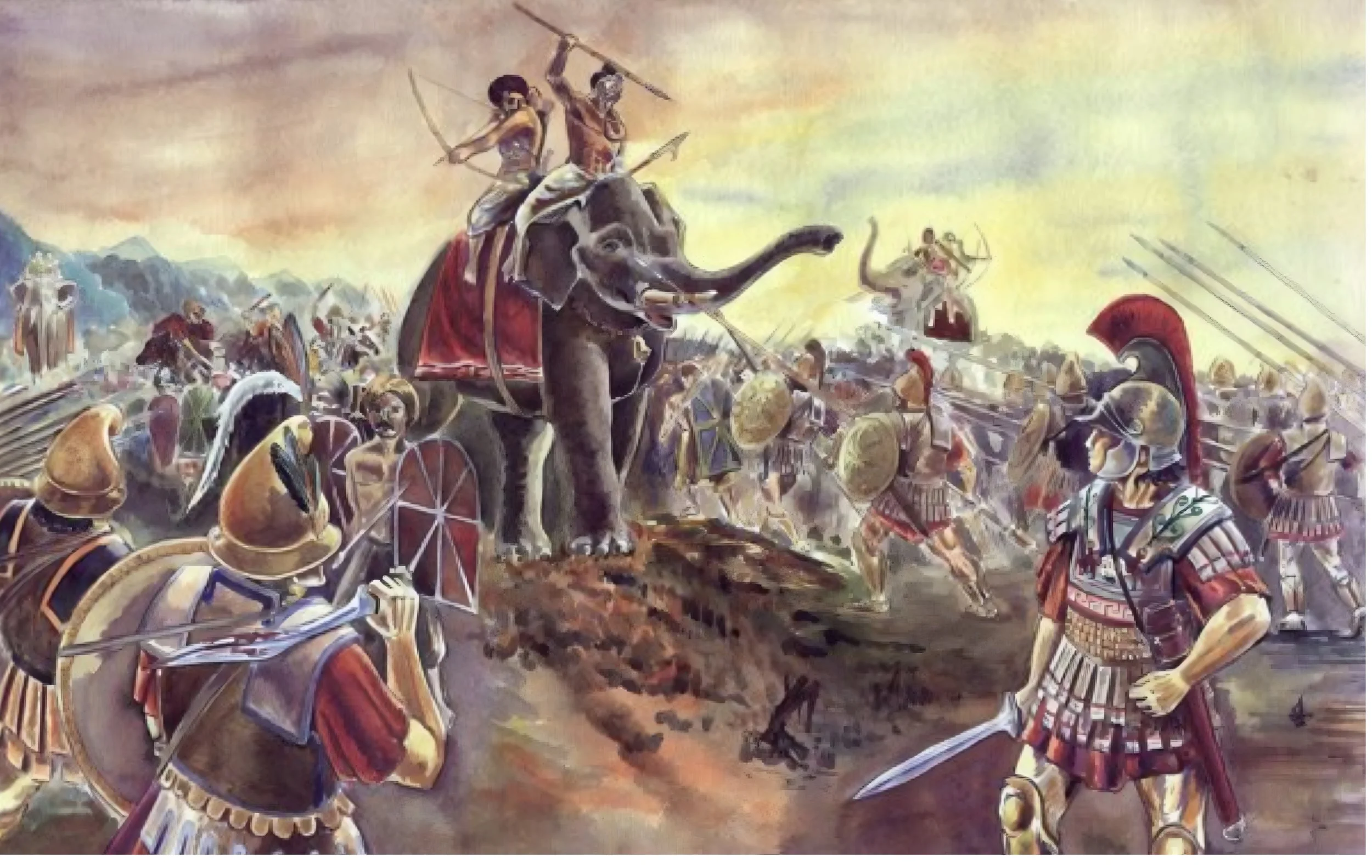
In 326 BCE, Alexander crossed the Indus River into the Indian subcontinent. At the Battle of the Hydaspes, he faced King Porus and a terrifying new weapon: war elephants. Although Alexander won the battle, the psychological and physical toll on his men reached a breaking point. At the Hyphasis River, his soldiers staged a peaceful mutiny, refusing to march further east toward the Ganges. For the first time in his career, Alexander was forced to turn back.
A Legacy of Hellenism and Cultural Fusion
Alexander's conquests did more than shift political borders; they initiated the Hellenistic Period. Unlike many conquerors before him, Alexander encouraged a policy of "fusion" between Greek and Eastern cultures.
- Urbanization: He founded over 70 cities, most named Alexandria, which served as hubs for Greek administration, language, and trade.
- The Susa Weddings: In an attempt to merge the Macedonian and Persian nobilities, Alexander organized a mass wedding in Susa where he and 80 of his officers married Persian noblewomen.
- Governance: He retained the Persian system of satrapies but often appointed Greeks or Macedonians to oversee finances and the military.
- Proskynesis: Alexander attempted to introduce the Persian custom of proskynesis (bowing or prostrating oneself before the king). This caused significant friction with his Macedonian officers, who viewed it as a form of religious worship reserved for gods, not men.
| Aspect | Macedonian Style | Persian/Eastern Style | Alexander’s Synthesis |
|---|---|---|---|
| Kingship | "First among equals" | Absolute, divine monarch | Adopted Persian dress and court ritual |
| Military | Phalanx and Heavy Cavalry | Archery and Chariots | Integrated Persian archers and cavalry |
| Language | Macedonian/Attic Greek | Aramaic and regional dialects | Greek became the lingua franca of trade |
| City Life | Poleis (City-states) | Imperial Administrative Hubs | Founded cities with Greek layout and Persian trade |
The Sudden End and the Wars of the Diadochi
Alexander died in Babylon in June 323 BCE at the age of 32. The cause of death remains a subject of intense debate in 2026, with theories ranging from malaria and typhoid to poisoning or complications from heavy drinking and old battle wounds.
Because he died without a clear heir (his son, Alexander IV, was born posthumously), his empire was almost immediately plunged into chaos. His generals, known as the Diadochi (Successors), spent the next several decades fighting for control. This resulted in the division of the empire into several major Hellenistic kingdoms:
- The Ptolemaic Kingdom in Egypt (which lasted until the death of Cleopatra VII).
- The Seleucid Empire in Persia and Mesopotamia.
- The Antigonid Dynasty in Macedonia and Greece.
Despite the fragmentation of his political empire, the cultural "empire" Alexander created lasted for centuries. Greek became the language of the New Testament, Greek philosophy influenced early Christian and Islamic thought, and the trade routes he opened eventually paved the way for the Silk Road.
Frequently Asked Questions
Did Alexander the Great ever lose a battle?
No, historical records indicate that Alexander never lost a pitched battle. He was a master of adapting his tactics to different terrains and opponents, from the riverbanks of the Granicus to the mountain fortresses of the Sogdian Rock and the elephant charges in India.
How much of the world did Alexander actually conquer?
While often described as "conquering the world," Alexander conquered the Persian Empire, which was the "known world" to the Greeks. In modern terms, his empire covered roughly 2 million square miles (5.2 million square kilometers), including parts of modern-day Greece, Turkey, Egypt, Israel, Jordan, Lebanon, Syria, Iraq, Iran, Afghanistan, Pakistan, and India. He did not reach China, the Americas, or most of Europe and Africa.
Why was he called "The Great"?
The epithet "The Great" was first attributed to him by the Romans, specifically in the plays of Plautus, and later solidified by historians like Arrian and Plutarch. It refers to his unprecedented military success, his ability to lead diverse peoples, and the lasting impact of the Hellenistic culture he spread.
What happened to Alexander’s tomb?
After his death in Babylon, his body was hijacked by Ptolemy I and taken to Egypt. It was eventually housed in a magnificent tomb in Alexandria. While several Roman emperors, including Julius Caesar and Augustus, visited the tomb, its exact location was lost to history around the 4th century CE due to earthquakes, rising sea levels, and urban redevelopment.
How did Alexander's conquests affect the spread of science?
Alexander’s campaigns were as much about exploration as they were about conquest. He employed "bematists" to measure distances by paces, which significantly improved the accuracy of world maps. The samples of flora and fauna sent back to Aristotle and the establishment of the Great Library of Alexandria by his successor, Ptolemy, are direct results of his interest in global knowledge.
Recommendations for Further Study
To gain a deeper understanding of Alexander the Great’s impact in 2026, researchers should focus on the archaeological findings from the various "Alexandrias" across Central Asia, which provide physical evidence of the cultural synthesis he promoted. Reading the primary sources—specifically Arrian’s Anabasis of Alexander and Plutarch’s Life of Alexander—remains essential, though they should be balanced with modern Persian perspectives to understand the "conqueror" from the viewpoint of the conquered. For those interested in military science, a study of the Battle of Gaugamela provides the most comprehensive look at his tactical brilliance and use of combined arms.