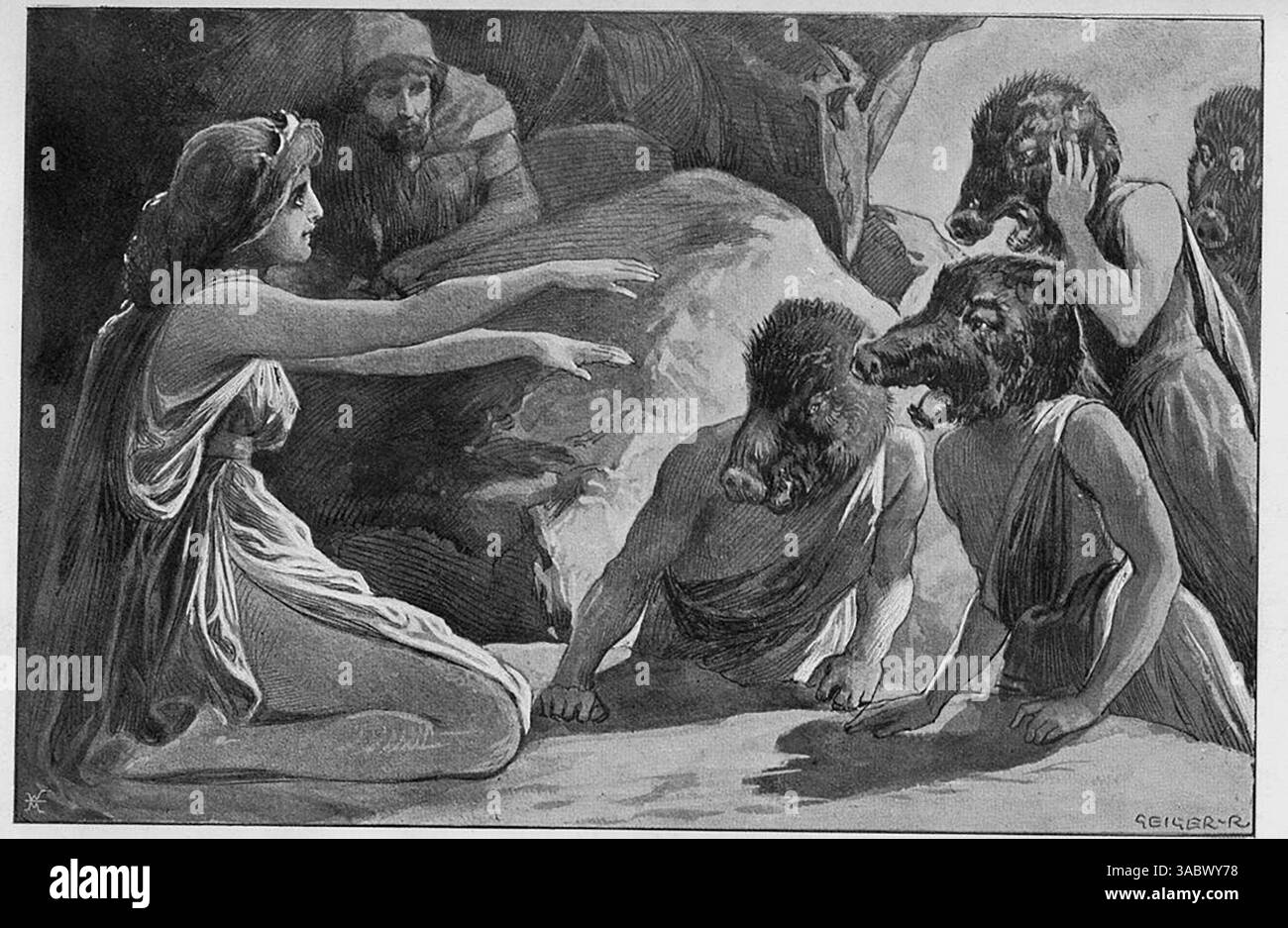
Aeaea is the mythical island home of the enchantress Circe, described in Homer’s Odyssey as a secluded, forested isle located at the edge of the known world. It serves as a pivotal setting where Odysseus’s crew is transformed into swine and where the hero receives the essential prophecies required to navigate his return to Ithaca.
In the vast geography of the Homeric epics, few locations carry as much mystery and symbolic weight as Aeaea (also spelled Aiaia). As of 2026, scholars and enthusiasts continue to analyze this location not just as a fictional backdrop, but as a site where ancient geography, botanical science, and complex gender dynamics intersect. To understand Aeaea is to understand the turning point of the Odyssey, the moment where the narrative shifts from external survival against monsters to an internal struggle with temptation, memory, and the divine.
The Etymology and Origins of Aeaea
The name "Aeaea" is deeply rooted in the phonetic expressions of grief and the celestial heritage of its most famous inhabitant. Linguistically, many scholars believe the name derives from the Greek word aiai, a traditional cry of lamentation or mourning. This linguistic connection suggests that the island is inherently a place of sorrow or a site where the human condition is stripped away, leaving only the "wailing" of the transformed.
From a genealogical perspective, Aeaea is inextricably linked to the sun. Circe is the daughter of Helios, the titan of the sun, and the oceanid Perse. In the earliest versions of the myth, Aeaea was positioned in the far east, where Helios rises each morning. This "eastern" Aeaea was often associated with Colchis (modern-day Georgia), where Circe’s brother, Aeëtes, guarded the Golden Fleece. However, as the Greeks expanded their maritime routes westward, the perceived location of the island shifted, eventually settling in the Tyrrhenian Sea off the coast of Italy.
The dual nature of the island—being both a place of divine luxury and a trap for the unwary—reflects Circe’s own character. She is a pharmakeia (a mistress of drugs and herbs), and her island is her laboratory. The soil of Aeaea is described as being exceptionally fertile, not for crops, but for the potent, magical flora that allows Circe to manipulate the physical forms of those who land on her shores.
Geographical Identification: Is Aeaea a Real Place?
For centuries, historians and geographers have attempted to pin Aeaea to a map. The most widely accepted identification is Mount Circeo, located on the western coast of Italy, approximately halfway between Rome and Naples. While Mount Circeo is currently a peninsula, geological evidence and historical records suggest a different reality in antiquity.
The Transformation of the Pontine Marshes
Thousands of years ago, the area surrounding Mount Circeo consisted of the Pontine Marshes. During periods of higher sea levels or before significant siltation occurred, the mountain would have appeared from the sea as a distinct island. Even today, when viewed from the Tyrrhenian Sea, the profile of the mountain strikingly resembles a reclining woman or a solitary peak rising out of the water, matching Homer’s description of a "low-lying" island surrounded by an "endless sea."
Archaeological Evidence
The Cape Circeo area is home to the Grotta della Maga Circe (Cave of the Sorceress Circe). While there is no definitive proof that a historical Circe lived there, the site has been a place of cult worship since at least the 5th century BCE. Archaeologists have found remains of a temple dedicated to Circe (or a syncretic version of her) on the summit of the mountain. In the Roman era, the site became a fashionable retreat, further cementing the link between the literary myth and the physical Italian landscape.
The Role of Aeaea in the Odyssey
The arrival of Odysseus at Aeaea marks a period of profound transition. Having lost the majority of his fleet to the Laestrygonians, Odysseus arrives with only one ship and a traumatized crew. The island initially appears as a sanctuary—a place of "thick woods and coppice" where a great stag is killed for food—but it quickly reveals its predatory nature.
The Transformation of the Crew
When Eurylochus leads a scouting party to Circe’s stone palace, they find it surrounded by wolves and lions that behave like domesticated pets, wagging their tails and fawning over the visitors. This uncanny behavior is the first clue to the island’s secret: these animals are former men. Circe invites the men in, feeds them a mixture of barley, cheese, and honey spiked with "vile drugs," and then uses her wand to turn them into pigs.
This specific transformation into swine is philosophically significant. In Greek thought, the pig represented gluttony and the loss of rational control. By turning the men into animals while allowing them to retain their human memories, Circe subjects them to the ultimate horror of the Odyssey: the loss of nostos (the drive to return home) through the degradation of the self.
The Intervention of Hermes and Moly
Odysseus is saved from a similar fate by the intervention of the god Hermes, who provides him with a preventative medicine: the herb Moly. Hermes describes Moly as having a "black root and a flower as white as milk," noting that it is difficult for mortals to dig up.
Equipped with Moly, Odysseus is immune to Circe’s drugs. When she attempts to transform him, he draws his sword, forcing her to swear a "great oath" not to harm him. This encounter shifts the power dynamic of the island. Circe restores his men to human form—making them younger and taller than before—and Aeaea transforms from a prison into a place of rest and preparation.
Comparing the Islands of the Odyssey
Aeaea is often compared to Ogygia (the island of Calypso) and Scheria (the land of the Phaeacians). Understanding the differences between these locations helps clarify the specific "lesson" of Aeaea.
| Feature | Aeaea (Circe) | Ogygia (Calypso) | Scheria (Alcinous) |
|---|---|---|---|
| Inhabitant | A Goddess/Witch (Active power) | A Nymph (Passive/Stagnant) | A Civilized Human Society |
| Duration of Stay | 1 Year | 7 Years | A few days |
| Primary Danger | Loss of physical form/identity | Loss of time and purpose | Temptation to settle and forget |
| Role of Hero | Reclaims agency and wisdom | Suffers in captivity | Tells his story to regain status |
| Key Symbol | The Wand and Moly | The Loom and Grotto | The Ship and the Orchard |
The Botanical Mystery of Moly
One of the most enduring "explanations" regarding Aeaea involves the identity of the herb Moly. In 2026, the consensus among ethnobotanists points toward Galanthus nivalis, commonly known as the snowdrop.
Galanthus nivalis contains galantamine, a compound that acts as an acetylcholinesterase inhibitor. In medical terms, this can counteract the effects of anticholinergic poisoning. It is hypothesized that Circe’s "vile drugs" were derived from Datura stramonium (Jimson weed) or Atropa belladonna (Deadly Nightshade), which cause hallucinations, confusion, and memory loss—symptoms that might make a man feel and act like a beast. By consuming the snowdrop (Moly), Odysseus would have possessed a natural chemical defense against Circe’s brew, allowing him to remain lucid while his companions succumbed to the "magic."
The Symbolism of Isolation and Feminine Power
Aeaea is an island without a king, a city, or a traditional Greek social structure. It is a gynocentric space where Circe reigns supreme. This isolation is a prerequisite for her power. In the patriarchal world of the Bronze Age, a woman with Circe’s agency could only exist on the "fringe" of the world.
The Weaver and the Singer
Like many female figures in the Odyssey, Circe is introduced while weaving at a loom and singing. This is a domestic mask for her wilder powers. On Aeaea, the act of weaving is a metaphor for the spinning of fates. Circe "weaves" the men into animals, and later, she "weaves" the directions that will take Odysseus to the Underworld.
The Transition to Guide
Unlike the monsters Scylla or Charybdis, Circe is not a static threat. Once her power is neutralized by Odysseus, Aeaea becomes a site of education. Circe provides the crucial instructions for visiting Tiresias in the Land of the Dead. She warns Odysseus about the Sirens, the Wandering Rocks, and the Cattle of Helios. In this sense, Aeaea is the "briefing room" for the final, most dangerous leg of the journey. Without the year spent on Aeaea, Odysseus would likely have perished shortly after leaving.
Aeaea in Modern Culture and Literature
The interpretation of Aeaea has undergone a massive shift in the early 21st century, peaking with the sustained popularity of Madeline Miller’s novel Circe. In modern retellings, Aeaea is viewed not as a place of evil, but as a place of self-actualization.
For contemporary readers, the island represents a space where one can define themselves away from the expectations of society. In Miller’s work, the transformation of men into pigs is framed as a defensive measure against the violence of sailors. This "explained" version of Aeaea resonates with 2026 audiences who value the deconstruction of classical villains and the exploration of the "witch" as a figure of independence rather than malice.
Frequently Asked Questions
Is Aeaea the same as Ogygia?
No. Aeaea is the home of Circe, where Odysseus stays for one year and regains his strength to continue his journey. Ogygia is the home of the nymph Calypso, where Odysseus is held captive for seven years against his will, longing for home. While both are islands ruled by powerful women, Aeaea is a place of learning and transformation, whereas Ogygia is a place of stagnation.
Where is Aeaea located on a modern map?
The most common geographical identification is Mount Circeo on the west coast of Italy (the Lazio region). Although it is now a peninsula, it was historically an island or perceived as one due to the surrounding marshes. Some older traditions place it in the Black Sea near Colchis.
What is the meaning of the word "Aeaea"?
The name is likely derived from the Greek "aiai," a cry of grief or wailing. It is also related to "Aea," the city of her brother Aeëtes. The name emphasizes the island's isolation and its connection to the divine, often sorrowful, lineages of the Titans.
Why did Circe turn men into pigs specifically?
In the context of the Odyssey, pigs were symbols of unbridled appetite and lack of discipline. By transforming the sailors into swine, Circe was physically manifesting their internal character—their tendency to consume without thought or restraint. It also served as a way to neutralize potential threats to her solitude.
Can you visit the "real" Aeaea today?
Yes. You can visit the Circeo National Park in Italy. It features hiking trails up Mount Circeo, where you can see the ruins of the ancient cyclopean walls and the remains of the Temple of Circe. The "Grotta della Maga Circe" is accessible by boat and remains a popular destination for those interested in the physical locations of the Odyssey.
Practical Recommendation for Further Exploration
To truly understand the "Aeaea" experience, readers should engage with both the primary text and the historical landscape. If you are studying the literature, focus on Book 10 of the Odyssey, paying close attention to the description of the island's topography and the specific herbs mentioned.
For those interested in the physical reality of the myth, a visit to San Felice Circeo in Italy is highly recommended. As of 2026, the local museums have expanded their exhibits on the "Odyssean circuit," providing detailed maps that overlay Homeric descriptions onto the Tyrrhenian coastline. Exploring the ruins at the peak of Mount Circeo during the golden hour provides a tangible sense of why ancient mariners associated this majestic, isolated peak with the daughter of the Sun.