When shopping for financial protection on a strict budget, understanding the core differences between an accidental life insurance policy and traditional life insurance is essential. For most households facing tight financial constraints, traditional term life insurance emerges as the clear winner due to its comprehensive coverage, while accidental policies carry high risks and narrow payouts.
Navigating the world of financial protection can feel overwhelming, particularly when household budgets are stretched thin. Inflation, rising housing costs, and daily living expenses force many consumers to reevaluate every line item on their monthly statements. In an effort to secure loved ones against the unthinkable without breaking the bank, shoppers frequently encounter two distinct financial products: traditional life insurance and accidental life insurance.
At first glance, accidental life insurance policies appear remarkably attractive. They boast lower monthly premiums, require no medical exams, and feature guaranteed acceptance regardless of pre-existing health conditions. For a consumer trying to maximize every dollar, these marketing points can make accidental coverage seem like a clever shortcut. However, a deeper examination reveals critical limitations. Understanding the structural differences between these two options allows budget-conscious buyers to make a secure, informed decision that truly protects their family's financial future.
Defining the Contenders: Traditional Life Insurance vs. Accidental Coverage
To understand why traditional life insurance consistently outperforms accidental coverage for budget-driven consumers, one must first examine how each policy operates under the hood.
Traditional life insurance—most commonly structured as term life insurance—is designed to replace lost income, pay off large debts, and cover final expenses if the policyholder dies from nearly any cause. This includes natural causes, illnesses such as cancer or heart disease, chronic medical conditions, and accidental deaths. Underwriters determine eligibility and pricing through a process known as underwriting. This process typically evaluates the applicant’s age, medical history, family health background, lifestyle habits (such as tobacco use), and driving record. While this sounds rigorous, it is precisely this underwriting diligence that allows insurers to offer lower rates to healthy individuals and predictable payouts to beneficiaries.
Conversely, an accidental life insurance policy—often sold as accidental death and dismemberment (AD&D) insurance—does not care about your health history. It strictly pays out a benefit if the insured person dies or suffers specific severe physical dismemberment strictly as a direct result of a covered accident. Natural deaths, heart attacks, strokes, terminal illnesses, and chronic health failures are entirely excluded from coverage. Because the insurer assumes zero mortality risk from illness, they can offer the policy without a medical exam and at a very low cost.
| Feature | Traditional Term Life Insurance | Accidental Life Insurance (AD&D) |
|---|---|---|
| Cause of Death Covered | Illness, natural causes, accidents | Accidents ONLY |
| Medical Exam Required | Often required (varies by policy) | Never required |
| Premium Stability | Typically fixed for term length | Typically fixed, may rise with age |
| Approval Odds | Dependent on health underwriting | Guaranteed acceptance |
| Main Financial Risk | Higher monthly cost | High risk of unpaid claims |
The Statistical Reality of Mortality: Why Accidents Tell Only a Fraction of the Story
The foundational flaw of relying on an accidental life insurance policy as a primary safety net lies in mortality statistics. When consumers buy life insurance, they are purchasing peace of mind against the statistical probabilities of death.
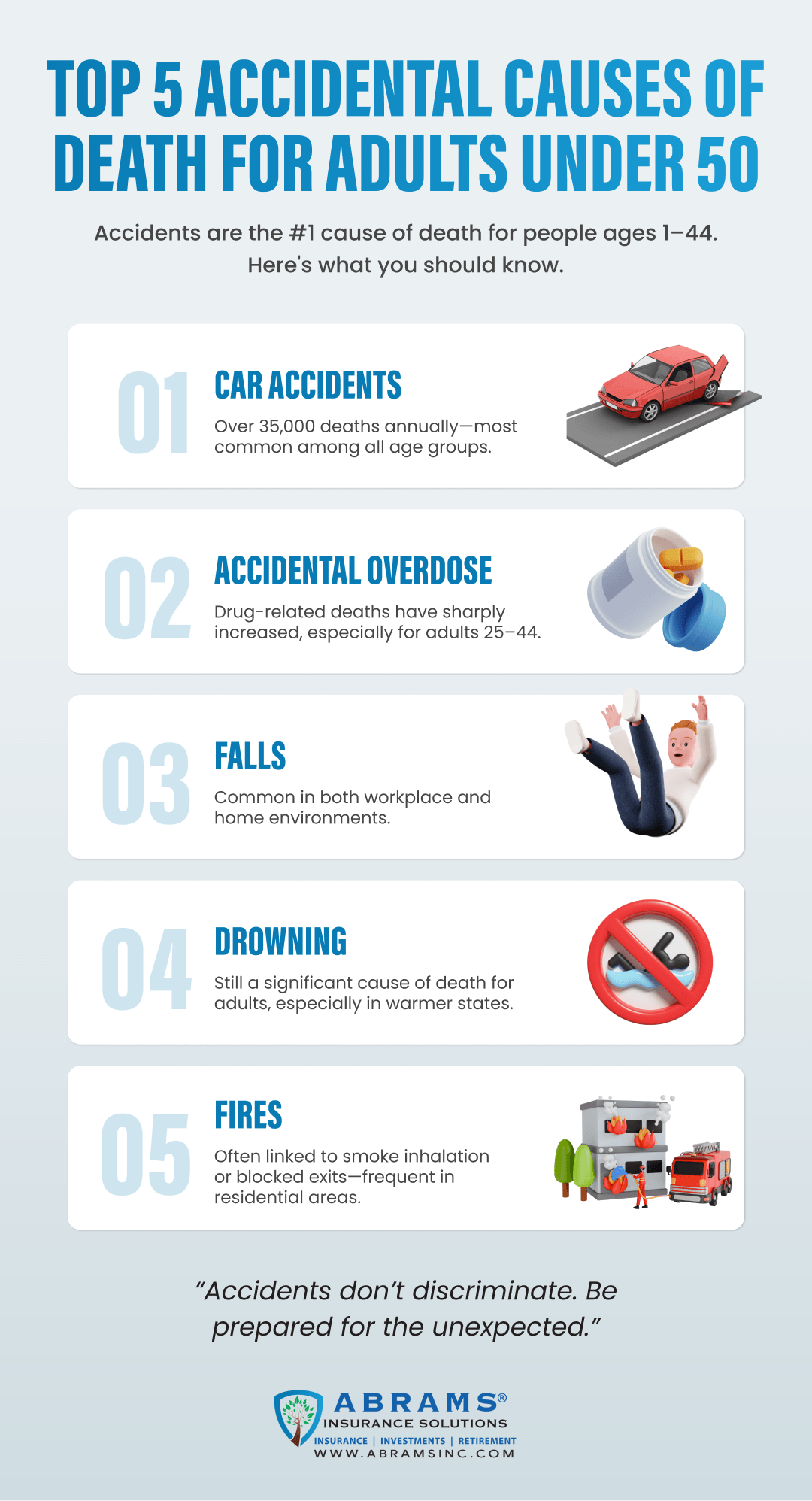
According to data compiled by public health agencies and mortality analysts, the vast majority of deaths in modern society stem from medical conditions and natural causes rather than sudden external accidents. Heart disease, malignant neoplasms (cancer), cerebrovascular diseases, and chronic lower respiratory diseases account for a massive percentage of overall mortality in populations. Accidental deaths—which include motor vehicle collisions, accidental poisoning, falls, and drowning—represent a distinct minority of total annual fatalities.
When a consumer purchases an accidental life insurance policy, they are betting that if they die during the policy term, their cause of death will fit into a very narrow statistical window. If a policyholder suffers a fatal heart attack, develops an aggressive form of cancer, or succumbs to an organ failure, their accidental policy pays out exactly zero dollars.
For a tight budget, wasting money on a policy that excludes the most common causes of mortality is a high-stakes gamble. Saving a few dollars a month on premiums provides little comfort if the policy fails to trigger when a family actually needs financial relief.
Cost Analysis: Comparing Premiums and Value per Dollar
Budget constraints are the primary driver behind the popularity of accidental coverage. It is vital to break down the actual monetary differences between a cheap accidental policy and a standard term life insurance policy to see which option delivers superior value.
Accidental policies are inexpensive because the insurer's statistical exposure is remarkably low. A consumer might pay $10 to $15 per month for a $250,000 accidental death policy. To a cash-strapped buyer, this feels like an economical win.
However, evaluating value requires looking at the probability of a payout. Consider a healthy 30-year-old buyer purchasing a 20-year term life insurance policy with a $250,000 death benefit. Depending on gender and basic lifestyle factors, a standard term policy for this demographic often ranges between $15 and $25 per month.
When comparing a $12 accidental policy to a $20 term policy, the price difference is a mere $8 per month—roughly the cost of two cups of coffee. For that small incremental increase, the buyer unlocks protection against all causes of death, including illnesses, medical emergencies, and unexpected health declines. When viewed through the lens of cost-per-potential-payout, traditional term life insurance offers exponentially superior value for tight budgets compared to a strictly limited accidental policy.
The Illusion of Guaranteed Acceptance and Underwriting Hurdles
One of the most appealing features of accidental life insurance is guaranteed acceptance. Advertisements for these policies frequently emphasize that nobody can be turned down due to health issues, age, or pre-existing medical conditions. For consumers with chronic health problems who have been denied traditional coverage, accidental policies look like the only remaining door.
However, consumers must separate the ease of acquisition from the actual utility of the product. While traditional term life insurance requires underwriting, many insurers now offer accelerated underwriting or simplified issue term policies that do not require a physical medical exam. Instead, underwriters review electronic databases, prescription history, and motor vehicle reports to approve applicants within days.
Furthermore, if an individual has severe health conditions that completely disqualify them from traditional term life insurance, an accidental policy may still leave their primary financial vulnerabilities unaddressed. If someone dies from their pre-existing health condition, the accidental policy provides nothing. For individuals with health complications, alternative products like graded-benefit or guaranteed-issue whole life insurance—though more expensive—provide actual coverage for natural death after a waiting period, making them a more reliable tool than accidental insurance.
Unpacking Policy Restrictions and Claim Denials
Insurance contracts are legally binding documents filled with precise definitions, exclusions, and limitations. Accidental life insurance policies are particularly notorious for strict definitions regarding what constitutes a qualifying "accident."
In the legal and insurance industries, an accident is generally defined as an unforeseen, unexpected, and unintended event caused by external violent means. If a policyholder passes away under ambiguous circumstances, beneficiaries often face grueling investigations before a claim is paid. Common contentious areas in accidental policies include:
- Medical Complications: If an insured person undergoes routine surgery and passes away due to an unexpected surgical error or adverse anesthesia reaction, insurers frequently dispute whether the event qualifies as a pure accident or a medical mishap.
- Intoxication Clauses: Many accidental policies contain strict exclusions if the insured has any trace of alcohol or unprescribed drugs in their system at the time of the fatal event, regardless of whether the substance was the direct cause of the accident.
- Dangerous Hobbies and Occupations: Engaging in recreational activities like skydiving, rock climbing, or operating heavy machinery often voids accidental coverage entirely or spikes the premium.
- Self-Inflicted Harm: Distinguishing between an accident and self-harm can lead to prolonged legal battles and denied claims during moments of acute family grief.
Traditional term life insurance policies do contain contestability periods (usually the first two years of the policy) and exclusions for suicide, but they offer vastly more straightforward payouts for the vast majority of natural and accidental deaths alike.
Strategic Budgeting: How to Secure Affordable Traditional Coverage
For consumers operating on tight budgets who want to secure traditional life insurance without financial strain, strategic planning is essential. Securing a policy does not require purchasing the most expensive permanent life insurance on the market; it requires choosing the right vehicle tailored to current financial realities.
1. Opt for Term Life Insurance Over Whole Life
Whole life insurance builds cash value and lasts a lifetime, but its premiums can be five to ten times higher than term life insurance. For tight budgets, term life insurance (such as a 10-, 20-, or 30-year term) provides maximum death benefit protection at the lowest possible monthly cost.
2. Lock in Rates Early
Age is the single biggest factor influencing life insurance premiums. Buying a policy at age 30 locks in a rate that remains level for the entire term, whereas waiting until age 40 or 50 substantially increases the baseline cost due to age-related mortality adjustments.
3. Match Coverage to Financial Obligations
Budget-conscious buyers should calculate their actual financial need rather than guessing. Evaluate major liabilities like mortgage balances, projected costs for children's education, and income replacement needs over a specific timeframe. Buying only the coverage amount truly required prevents overspending on unneeded benefits.
4. Maintain Healthy Habits
Insurers reward non-smokers and individuals with controlled blood pressure and cholesterol with preferred rate classes. Even minor lifestyle improvements prior to applying can drop an applicant into a cheaper pricing tier.
Frequently Asked Questions
Can I combine an accidental policy with a traditional term life policy?
Yes, many insurers offer accidental death riders that can be added to a standard term life insurance policy for a small additional fee. However, standalone accidental policies are generally inferior to simply purchasing a higher face value of traditional term life insurance if budget allows.
Are accidental life insurance policies ever a smart financial choice?
They can serve as a supplementary safety net for individuals who work in hazardous occupations or participate in high-risk travel, but they should never be used as a replacement for standard life insurance that covers all causes of death.
What happens if I outlive a term life insurance policy?
Term life insurance provides pure protection for a specified period. If you outlive the term, the coverage expires, and no payout is made, much like auto or homeowners insurance. This is why term insurance remains affordable compared to permanent life insurance.
Is a medical exam mandatory to get traditional term life insurance?
Not always. Many carriers offer accelerated underwriting programs that use digital health databases, eliminating the need for a physical nurse visit or blood draw for qualified healthy applicants.
Does accidental death insurance cover acts of war or terrorism?
Most accidental death and dismemberment policies contain strict exclusions for acts of war, military service hostilities, and declared or undeclared military actions, meaning beneficiaries would not receive a payout if death occurs under those circumstances.
Conclusion and Final Recommendation
When weighing an accidental life insurance policy against traditional life insurance for a tight budget, the choice becomes clear upon examining risk, coverage breadth, and financial value. While accidental policies market themselves as cheap and accessible fixes, their restrictive definitions and exclusion of illness-related deaths leave families dangerously vulnerable to the most common financial risks.
For budget-conscious consumers seeking reliable protection, traditional term life insurance stands as the definitive winner. By selecting a properly sized term policy, buyers secure comprehensive protection against both illness and accidents, ensuring that loved ones remain financially protected regardless of how life’s unpredictable challenges unfold.