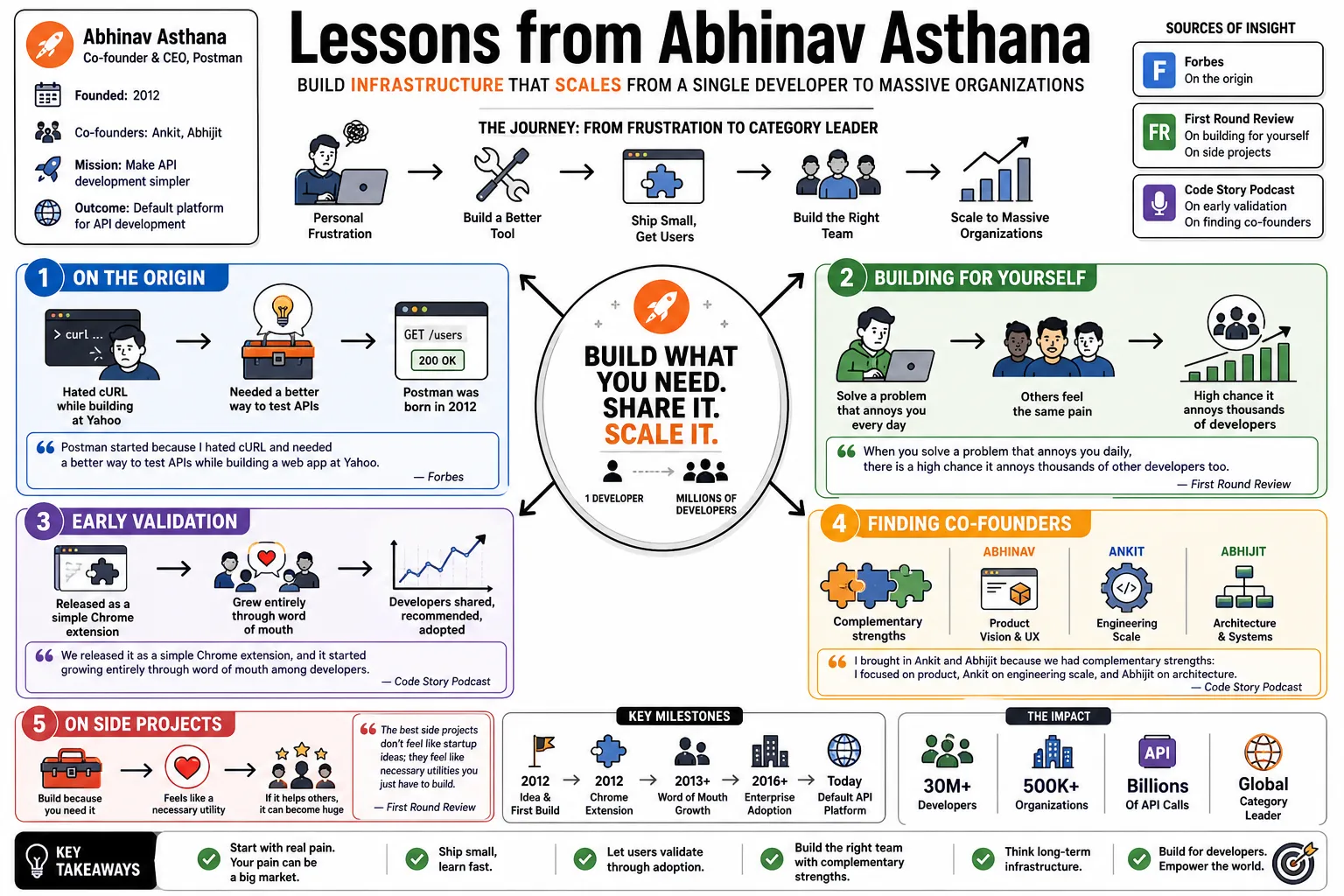
Evaluating Abhinav Asthana net worth requires looking beyond simple public asset estimates to understand the broader economics of developer-first software startups, venture capital funding rounds, and the modern API economy. As the co-founder and CEO of Postman, Asthana built a developer tool used by millions of software engineers worldwide, transforming a side project into an enterprise giant valued at billions of dollars during peak market cycles. Because Postman is a privately held company rather than a publicly traded corporation, precise, real-time figures for individual founder wealth remain private, making contextual analysis of equity distribution, secondary share sales, and startup dilution essential for understanding his financial standing.
The Genesis of Postman: From Chrome Extension to Enterprise Pillar
To understand the financial trajectory of Abhinav Asthana, one must trace the origins of Postman. Founded in 2014 by Asthana, Ankit Sobti, and Abhijit Kane in Bengaluru, India (later shifting its primary operational headquarters to San Francisco, California), Postman began as a simple Google Chrome extension. At the time, developers building and testing Application Programming Interfaces (APIs) lacked an intuitive, centralized client to send HTTP requests, inspect responses, and manage environments.
Asthana, who worked as an intern at Yahoo and later co-founded TeliportMe, recognized this friction firsthand. The tool he built to solve his own workflow challenges quickly gained organic adoption across the global software engineering community. This bottom-up adoption model—where individual developers install a tool for free, love it, and eventually convince their enterprise IT departments to buy paid team and enterprise tiers—formed the foundation of Postman's commercial strategy.
For years, the product operated with minimal monetization, focusing entirely on user acquisition, community building, and product refinement. This deliberate choice meant that initial founder wealth was tied entirely to potential rather than cash flow. However, the sheer ubiquity of the tool eventually caught the attention of institutional venture capital firms seeking exposure to the booming developer tools and SaaS (Software-as-a-Service) sectors.
Venture Capital Funding and Valuation Trajectory
Private company net worth calculations for startup founders depend heavily on funding rounds, valuation caps, and secondary market transactions. Postman raised successive rounds of capital from prominent venture capital firms, culminating in massive valuations during the tech funding boom of 2020 and 2021.
| Funding Round | Announced Date | Estimated Valuation | Lead Investors & Notable Participants |
|---|---|---|---|
| Series A | October 2019 | ~$165 Million | Nexus Venture Partners |
| Series B | June 2020 | ~$2 Billion | Insight Partners, CRV, Nexus Venture Partners |
| Series C | August 2021 | ~$5.6 Billion | Battery Ventures, Bond, CRV, Insight Partners, Nexus Venture Partners |
During the Series C funding round in August 2021, Postman secured $225 million, vaulting its valuation to $5.6 billion and cementing its status as one of the most valuable private software-as-a-service companies in the world.
Equity Dilution and Founder Ownership
A common misconception in financial journalism is that a founder's net worth equals their company's valuation multiplied by their initial equity percentage. In reality, multiple rounds of venture capital financing dilute early equity stakes.
- Dilution Mechanics: Every time a startup issues preferred stock to new investors, the common stock held by founders and early employees represents a smaller percentage of the total outstanding shares.
- Option Pools: To attract top-tier engineering, product, and sales talent, founders routinely set aside portions of equity into employee stock option pools (ESOPs), further reducing their individual ownership percentages.
- Primary vs. Secondary Capital: While primary funding goes directly into the company bank account to fuel product development, hiring, and global expansion, founders occasionally participate in secondary share sales. Secondary sales allow founders and early employees to sell a portion of their vested equity to later-stage private equity or venture funds, realizing liquid cash without altering the company's operating capital.
While exact cap table details for Postman remain confidential, founders of successful Series C and post-revenue tech giants typically retain single-digit to low double-digit equity percentages by the time their companies reach multi-billion-dollar valuations, supplemented by any liquidity events achieved through secondary transactions.
The Macroeconomic Context: Valuations in 2026
Evaluating tech founder net worth requires factoring in the dramatic shift in public market multiples and private market valuations between the zero-interest-rate policy era of 2020–2021 and the normalized interest rate environment of 2026.
During the peak of the 2021 tech boom, private software companies routinely traded at forward revenue multiples of 50x to 100x. By 2026, public market corrections and a renewed emphasis on profitability over unbridled growth have compressed these multiples across the SaaS landscape. Consequently, private market valuations for late-stage venture-backed companies have undergone internal recalibrations.
For private firms like Postman, which have maintained strong enterprise retention, expanded their API management platforms to include advanced security, mocking, and automated testing, and adapted to the artificial intelligence integration wave by introducing AI-assisted API development assistants, enterprise value remains substantial. Nevertheless, paper wealth calculated during 2021 valuation highs differs significantly from realizable liquidity in secondary markets or eventual public offerings.
Comparative Analysis of Developer Tool Founders
Understanding Abhinav Asthana net worth in context involves looking at peer benchmarks within the developer infrastructure and API economy. Founders of infrastructure companies often face a different wealth accumulation curve compared to consumer-facing application founders.
| Founder / Executive | Company | Core Product Niche | Funding & Market Context |
|---|---|---|---|
| Abhinav Asthana | Postman | API Development & Testing | Multi-billion-dollar private SaaS; bottom-up developer adoption. |
| Guillermo Rauch | Vercel | Frontend Cloud & Hosting | High-growth web infrastructure platform backed by tier-one VCs. |
| Mitchell Hashimoto | HashiCorp | Infrastructure Automation | Publicly traded company history prior to private acquisition (IBM). |
| Evgeniy Khoroshilov / Team | JetBrains | Developer IDEs | Bootstrapped, highly profitable, privately owned with no external VC dilution. |
Unlike bootstrapped companies where founders retain 80% to 100% of equity, venture-backed infrastructure companies trade equity ownership for hyper-growth capital, global sales infrastructure, and rapid enterprise market penetration. Asthana’s financial profile reflects this institutional scaling model.
Frequently Asked Questions
What is Abhinav Asthana's exact net worth?
Exact net worth figures for Abhinav Asthana are not publicly disclosed because Postman is a privately held company. While media outlets and wealth trackers occasionally publish speculative estimates ranging in the tens or hundreds of millions of dollars based on Postman’s peak $5.6 billion valuation, these figures remain unverified approximations that do not account for private tax liabilities, exact cap table dilution, or secondary market transaction details.
How did Abhinav Asthana make his money?
Asthana accumulated his primary financial stake through equity ownership in Postman, the API platform he co-founded in 2014. As the company scaled through multiple venture capital funding rounds led by institutional investors like Insight Partners and Nexus Venture Partners, his equity value grew in tandem with the company's enterprise valuation.
Is Postman a publicly traded company?
No. Postman operates as a privately held Delaware corporation. Because it is not listed on public stock exchanges like the NASDAQ or NYSE, it is not required to disclose detailed insider ownership reports, executive compensation packages, or quarterly financial statements to the general public.
What is Postman's current business model?
Postman monetizes through a tiered SaaS subscription model. While individual developers can use the core desktop and web clients for free, teams and enterprises pay per-user fees for advanced collaboration features, security compliance controls, private API networks, workspace governance, and enterprise-grade support.
How do venture capital rounds affect a founder's wealth?
Venture capital funding increases a company's headline valuation, which increases the theoretical value of a founder's shares. However, issuing new preferred stock dilutes the percentage ownership of common stockholders. Wealth realization typically occurs when founders participate in secondary share sales or when the company executes an IPO or acquisition.
Practical Takeaways and Financial Realities of Startup Equity
For observers analyzing tech entrepreneurship, the valuation of founders like Abhinav Asthana highlights several immutable laws of modern venture-backed enterprise creation:
- Paper Wealth vs. Liquid Assets: High valuations in private funding rounds do not translate directly into cash in a bank account. Founders often live on standard executive salaries while the vast majority of their net worth remains locked in illiquid private stock.
- The Power of Bottom-Up Adoption: Postman's success demonstrates that building an indispensable tool for individual practitioners creates a defensible moat that enterprise sales teams can later monetize at scale.
- Market Cyclicality: Economic conditions dictate whether private valuations can be sustained or realized through liquidity events. Long-term founder wealth ultimately depends on durable revenue generation, customer retention, and free cash flow rather than temporary market hype.