Navigating auto insurance in Florida requires understanding the state’s mandatory minimum coverage laws, unique environmental risks, and high rates of uninsured drivers. To protect your finances and vehicle, you must carry minimum Personal Injury Protection (PIP) and Property Damage Liability (PDL), purchase Uninsured Motorist coverage, secure Comprehensive coverage for storm damage, leverage Florida's zero-deductible windshield repair law, and avoid coverage lapses.
The Landscape of Auto Insurance in Florida
Florida presents one of the most complex auto insurance markets in the United States. Factors such as high population density, tourist traffic, legal structures, severe weather events, and litigation trends contribute to insurance premiums that consistently rank among the highest nationally.
Florida operates under a "No-Fault" insurance model. This system was designed to reduce civil litigation by requiring drivers' own insurance policies to pay for their initial medical treatments after an accident, regardless of who caused the collision. However, the system also creates unique coverage gaps that can leave unprepared drivers exposed to severe personal liability and out-of-pocket expenses.
Whether you are relocating to the Sunshine State or reviewing your existing policy, the following seven tips outline essential strategies for optimizing coverage, remaining legally compliant, and controlling policy costs.
7 Essential Florida Auto Insurance Tips
FLORIDA COVERAGE STRATEGY
| Mandatory Minimums | Recommended Protections |
|---|---|
| - PIP: $10,000 | - Bodily Injury (BI): $100k/$300k |
| - PDL: $10,000 | - Uninsured Motorist (UM): Stacked |
| - Comprehensive (Flood/Storm/Zero-Deductible Windshield) |
Tip 1: Look Beyond the Mandatory State Minimum Requirements
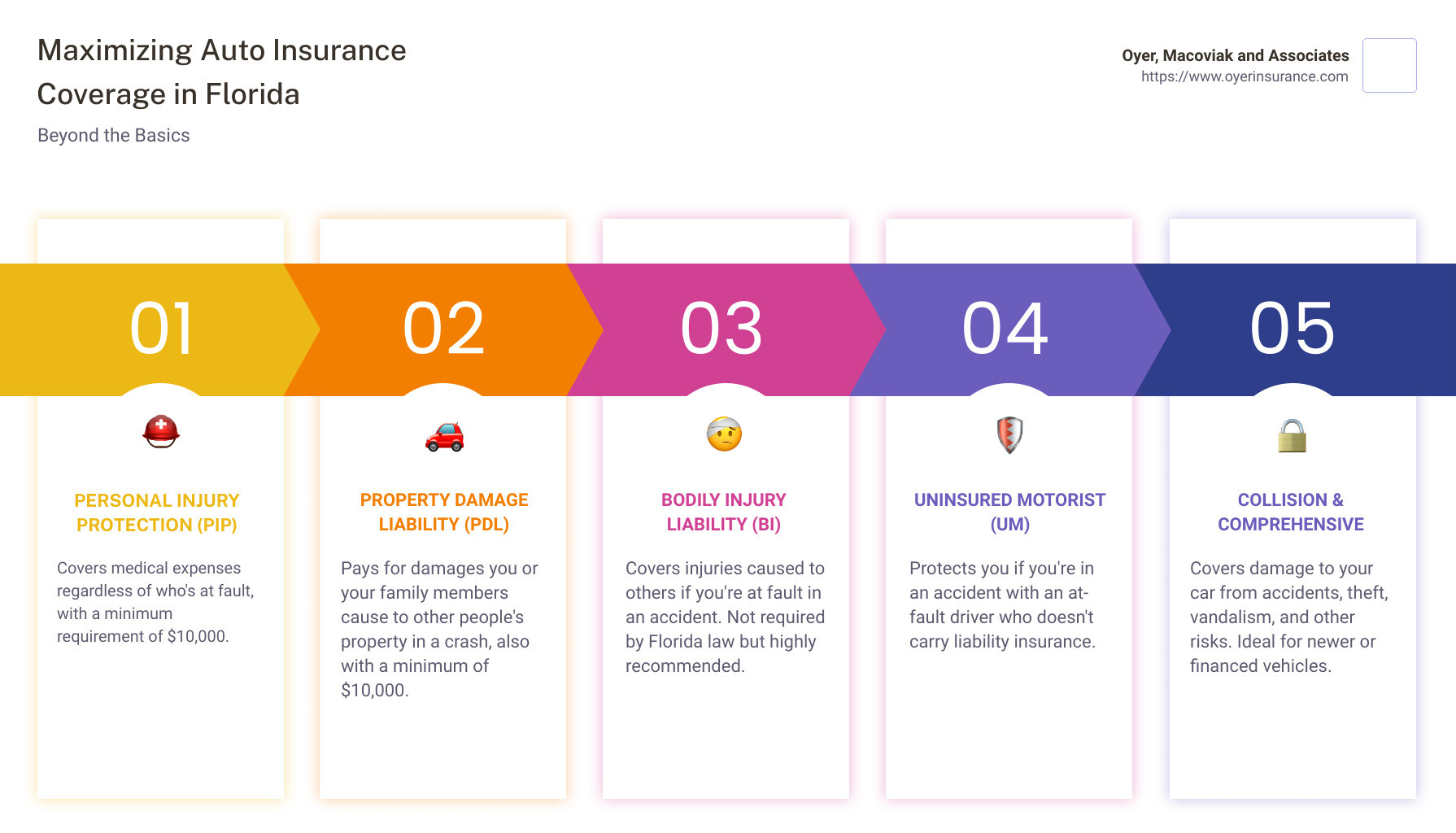
Florida state law requires drivers to carry only two basic auto insurance coverages to register and operate a four-wheeled motor vehicle:
- Personal Injury Protection (PIP): Minimum of $10,000.
- Property Damage Liability (PDL): Minimum of $10,000.
Crucially, Florida is one of the few states that does not mandate Bodily Injury Liability (BI) for all private passenger drivers (unless a driver has been convicted of a DUI or involved in specific serious traffic violations requiring an SR-22 or FR-44 filing under the Florida Department of Highway Safety and Motor Vehicles).
Carrying only the mandatory minimum coverage of $10,000 PIP and $10,000 PDL poses significant financial risks:
- Personal Injury Protection Limitations: Under Florida Statutes § 627.736, PIP covers only 80% of medical expenses and 60% of lost wages resulting from a covered injury, up to the $10,000 limit. Furthermore, the full $10,000 benefit is accessible only if a qualified medical provider determines that the injured person suffered an Emergency Medical Condition (EMC). If an EMC is not diagnosed, the medical benefit limit drops to $2,500.
- Property Damage Vulnerability: Modern vehicles, electric cars, and commercial trucks frequently cost far more than $10,000 to repair or replace. If you cause an accident resulting in $35,000 of damage to another vehicle, your mandatory $10,000 PDL leaves you personally liable for the remaining $25,000.
- Lack of Injury Defense for Other Parties: Without Bodily Injury Liability coverage, your insurer is not obligated to pay for medical costs, pain and suffering, or legal fees if an injured third party files a lawsuit against you after a severe accident.
Actionable Advice: Carry Bodily Injury Liability insurance with minimum limits of $50,000 per person / $100,000 per accident, or $100,000 per person / $300,000 per accident if you own real estate or significant personal assets.
Tip 2: Add Uninsured/Underinsured Motorist (UM/UIM) Coverage
Data from the Insurance Information Institute indicates that Florida routinely ranks among the top states for uninsured drivers, with roughly 1 in 5 drivers operating vehicles without auto liability coverage. Additionally, because Florida law does not require drivers to carry Bodily Injury Liability, many drivers who do have insurance still lack coverage for medical injuries they cause to others.
If an uninsured or underinsured driver collides with your vehicle and causes severe physical injuries, your PIP policy will cover only up to $10,000 in medical bills (subject to the 80% rule and EMC requirements). Uninsured Motorist (UM) coverage steps in to pay for your remaining medical costs, lost income, ongoing rehabilitation, and non-economic damages like pain and suffering.
When selecting UM coverage in Florida, policyholders must choose between two formats:
- Non-Stacked UM Coverage: Coverage limits apply strictly per vehicle. If you have two vehicles insured for $50,000/$100,000 UM non-stacked, your maximum coverage for an accident in one vehicle is $50,000 per person.
- Stacked UM Coverage: Allows you to combine the UM coverage limits for all vehicles on your policy or household. If you insure two vehicles with $50,000/$100,000 in stacked UM, your total available coverage increases to $100,000 per person / $200,000 per accident. Stacked UM also follows you if you are injured as a passenger in someone else's vehicle or as a pedestrian.
Florida law requires insurers to offer stacked UM coverage by default. To choose non-stacked coverage or reject UM entirely, you must sign an official rejection form. In most cases, maintaining stacked UM coverage provides essential protection against local coverage gaps.
Tip 3: Protect Vehicles Against Severe Weather with Comprehensive Coverage
Standard collision insurance pays for physical damage to your car if you hit another vehicle, tree, or guardrail. However, Florida’s tropical climate introduces environmental risks that collision insurance does not cover:
- Tropical Storms and Hurricanes: Wind damage, falling tree limbs, and flying debris.
- Rising Water and Flooding: Coastal storm surges, overflowing canals, and sudden flash floods.
- Vandalism and Theft: Increased vehicle theft rates in high-density metropolitan areas.
To protect against non-collision property loss, you must add Comprehensive Coverage (sometimes referred to as "Other Than Collision" coverage) to your auto policy.
COLLISION VS. COMPREHENSIVE
| COLLISION COVERAGE | COMPREHENSIVE COVERAGE |
|---|---|
| - Vehicle-to-vehicle impacts | - Flooding and water immersion |
| - Single-vehicle rollovers | - Windstorm and hail damage |
| - Striking trees, poles, fences | - Falling tree branches/objects |
| - Pothole damage | - Theft, vandalism, and fire |
Note on Vehicle Flooding: If a rising tide or flash flood submerges your car, it is almost always declared a total loss due to electrical system corruption. Collision insurance will not cover flood damage; only Comprehensive coverage pays for vehicle water damage.
Tip 4: Leverage Florida's Zero-Deductible Windshield Replacement Law
Windshield cracks and chips are common hazards on major corridors like Interstate 4, Interstate 95, and the Florida Turnpike due to highway construction, loose gravel, and severe weather.
Under Florida Statute § 627.7288, policyholders who carry Comprehensive coverage on their vehicles are legally exempt from paying a deductible for repairs or replacements of safety glass on their front windshields.
Key Facts Regarding Florida's Windshield Law:
- Applicable to Windshields Only: The zero-deductible requirement applies specifically to the front windshield. Side windows, rear glass, and sunroofs are subject to your standard comprehensive deductible unless separate glass endorsement coverage is added.
- Comprehensive Prerequisite: You must have active Comprehensive coverage on the vehicle at the time of the damage. If you carry only PIP and PDL, the zero-deductible replacement benefit does not apply.
- No Premium Penalty for Necessary Repair: Florida insurers cannot cancel or non-renew a policy solely because a policyholder files a claim to repair a damaged windshield.
- Calibration Costs: Modern vehicles equipped with Advanced Driver Assistance Systems (ADAS)—such as lane departure warnings and automatic emergency braking—require camera recalibration after a windshield replacement. Under Florida regulation, proper recalibration services associated with windshield replacement are included as part of the safety glass repair process.
Tip 5: Prevent Coverage Lapses to Avoid FLHSMV Penalties
The Florida Department of Highway Safety and Motor Vehicles (FLHSMV) uses an automated electronic system to track driver insurance statuses continuously. Florida-licensed insurance companies are required by law to report policy activations, cancellations, non-renewals, and lapses directly to the state database in real time.
If an insurer reports that your policy has lapsed or been canceled, and no replacement policy is logged immediately:
- State Notice: The FLHSMV sends a formal notice requiring proof of new insurance coverage.
- License and Tag Suspension: If proof of insurance is not provided by the deadline, the state will suspend your driver's license, motor vehicle registration, and license plate for up to three years.
- Reinstatement Fees: To restore your driving privileges, you must provide valid proof of Florida insurance and pay a reinstatement fee ranging from $150 for a first offense, $250 for a second offense, to $500 for subsequent offenses within a three-year window.
To prevent accidental lapses:
- Never cancel an existing policy before the effective date of a new policy.
- If selling a vehicle, return the license plate and registration tags to a local Florida Tax Collector’s office before canceling your insurance coverage.
- Set up automated payments or electronic policy renewal alerts to ensure installment payments are never missed.
Tip 6: Utilize Approved Discounts and Telematics Programs
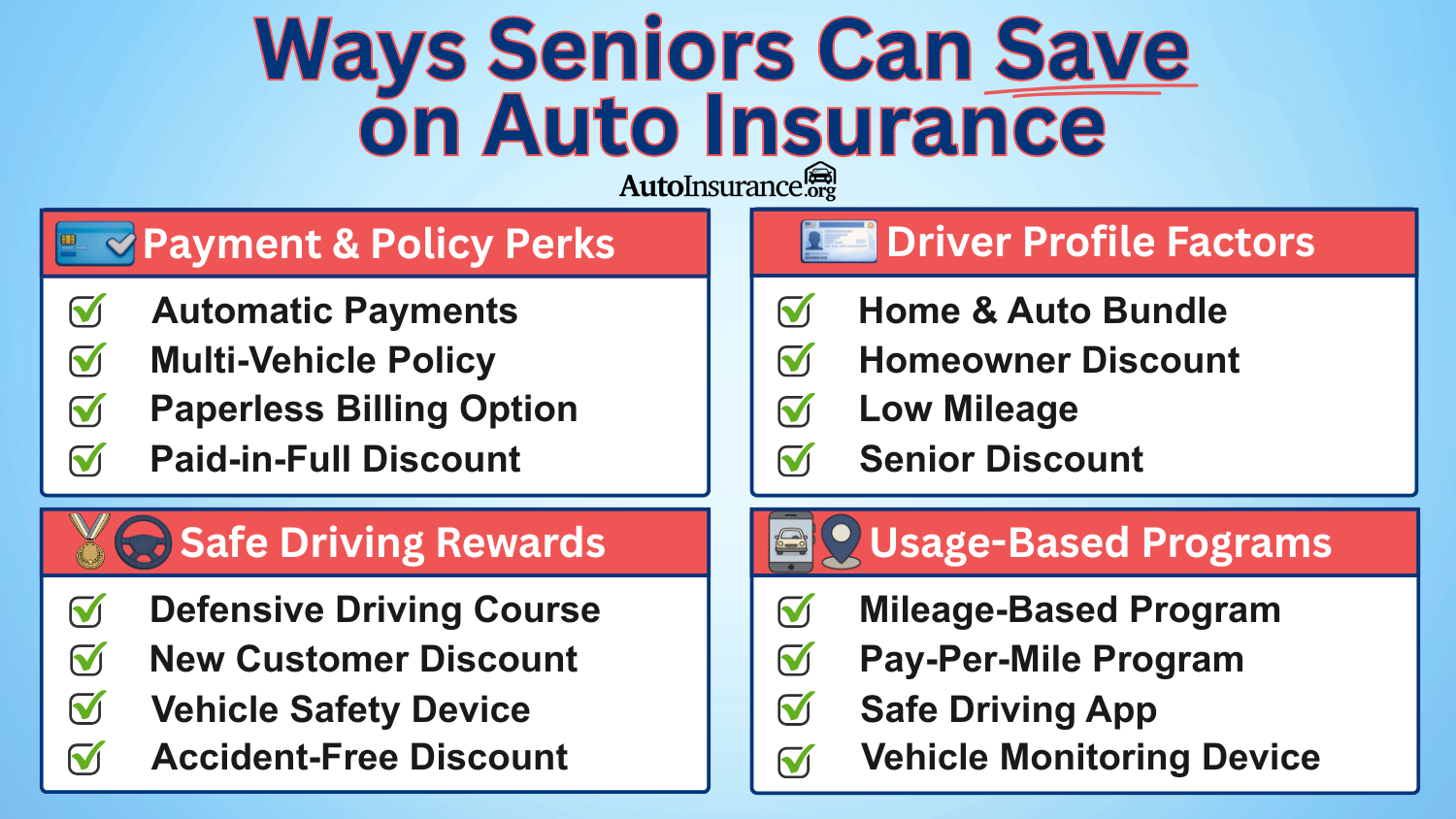
Given Florida's elevated baseline insurance rates, applying all eligible policy discounts is critical to managing costs. Florida drivers can reduce premiums through several statutory and carrier-specific programs:
- Mature Driver Improvement Courses: Under Florida law, drivers aged 55 and older who complete a state-approved defensive driving course are eligible for a mandatory policy discount from their insurer, typically valid for three years.
- Telematics and Usage-Based Insurance (UBI): Most major insurers offer smartphone apps or plug-in OBD-II devices that monitor driving habits—including braking speed, acceleration, night driving, and mileage. Safe drivers in Florida can unlock discounts ranging from 10% to 30% by enrolling in these tracking programs.
- Policy Bundling: Combining your auto policy with your Florida homeowners, renters, condo, or umbrella policy frequently yields cross-product discounts on both policies.
- Student and Military Discounts: Drivers enrolled full-time in school maintaining a "B" average (3.0 GPA) or higher qualify for Good Student discounts. Active-duty military personnel stationed in or originating from Florida are eligible for specific military rate structures through specialized carriers.
Tip 7: Re-Evaluate Coverage and Re-Quote Across Regional and National Carriers
Auto insurance pricing in Florida varies dramatically based on your specific geographic location (ZIP code), driving record, credit history, and vehicle model. A policy in Miami-Dade County or Broward County can cost significantly more than an identical policy in Leon County or Escambia County due to differing accident statistics, litigation volumes, and theft rates.
To ensure your rates remain competitive:
- Re-Quote Annually: Insurance carriers revise their rate filings with the Florida Office of Insurance Regulation regularly. A company that offered the lowest rates two years ago may no longer be competitive today.
- Compare National vs. Regional Carriers: Look at both large national insurers and regional carriers operating specifically within the Southeast. Regional companies sometimes maintain more stable pricing models for specific Florida demographics.
- Audit Your Annual Mileage: If your commuting habits have changed—such as transitioning to remote or hybrid work—update your policy's annual mileage estimate. Reducing estimated annual driving from 15,000 miles to 7,500 miles can result in significant premium reductions.
- Evaluate Deductible Thresholds: If you maintain an emergency reserve fund, increasing your Collision and Comprehensive deductibles from $500 to $1,000 can reduce your annual comprehensive and collision premiums by 10% to 20%.
Breakdown of Florida Auto Insurance Coverages
The following reference table outlines the differences between mandatory requirements and recommended coverage levels for Florida drivers:
| Coverage Type | Required by Florida Law? | Statutory Minimum | Recommended Limit | Key Function & Protection |
|---|---|---|---|---|
| Personal Injury Protection (PIP) | Yes | $10,000 per person | $10,000 (Statutory Max) | Pays 80% of medical bills and 60% of lost wages for you and household members, regardless of fault. |
| Property Damage Liability (PDL) | Yes | $10,000 per accident | $50,000 to $100,000 | Pays for structural and vehicle damage you cause to others in an accident. |
| Bodily Injury Liability (BI) | No (Except after certain severe offenses/convictions) | $0 (None) | $100,000 / $300,000 | Pays for legal fees, serious injury, or death claims you cause to others. Protects personal assets. |
| Uninsured / Underinsured Motorist (UM) | No | $0 (None) | $100,000 / $300,000 (Stacked) | Covers your medical expenses, pain, and lost wages if hit by an uninsured or underinsured driver. |
| Comprehensive Coverage | No | $0 (None) | Actual Cash Value ($500 Deductible) | Covers non-collision losses: floods, hurricanes, theft, fire, animal collisions, and zero-deductible windshields. |
| Collision Coverage | No | $0 (None) | Actual Cash Value ($500 Deductible) | Pays to repair or replace your vehicle after an impact with another vehicle or object, regardless of fault. |
| Medical Payments (MedPay) | No | $0 (None) | $5,000 to $10,000 | Fills the 20% gap that PIP does not cover for medical treatments; pays out without deductible restrictions. |
Common Florida Insurance Pitfalls to Avoid
Missing the 14-Day Medical Treatment Window
Under Florida PIP regulations, an injured individual must seek medical treatment within 14 days of a motor vehicle accident. If you wait until day 15 to visit a physician, chiropractor, or urgent care facility, your insurer is legally permitted to deny PIP medical benefits entirely.
FLORIDA PIP CLAIM TIMELINE & EMERGENCY REQUIREMENT
- Accident Occurs
- Days 1 to 14: MUST receive initial medical care (Failure to seek care = 0% PIP payout)
- Medical Provider Evaluation:
- Diagnosed with EMC?: Full $10,000 PIP Limit
- NO Emergency Medical Condition: Benefit Capped at $2,500
Assuming Out-of-State Policies are Valid
If you move to Florida, relocate permanently, or reside in the state for more than 90 consecutive or non-consecutive days per calendar year, you are required to register your vehicle and obtain a Florida-specific auto insurance policy. Out-of-state auto policies do not satisfy Florida's legal requirements, and failing to register can result in administrative driver's license suspensions.
Dropping Comprehensive Coverage During Hurricane Season
Some drivers attempt to lower premiums by canceling comprehensive coverage during certain months. Doing so leaves the vehicle completely unprotected against flooding, storm surges, windborne debris, and fallen trees associated with tropical weather events. Once a named storm approaches the state, insurance carriers routinely institute underwriting bindings, which prohibit drivers from adding or altering comprehensive coverage limits until the storm threat passes.
Frequently Asked Questions
Is Florida still a no-fault auto insurance state in 2026?
Yes, Florida operates as a no-fault auto insurance state. Drivers are required to carry Personal Injury Protection (PIP) to cover their own immediate medical bills and lost wages up to $10,000 following an accident, regardless of who caused the collision.
What is the 14-day rule for Florida PIP coverage?
Florida’s 14-day rule mandates that anyone injured in a motor vehicle accident must seek professional medical care within 14 calendar days of the event to qualify for PIP benefits. Failing to receive initial medical attention within this timeframe results in a total loss of PIP coverage for that accident.
Does Florida law really cover windshield replacement for free?
Yes, provided you have Comprehensive coverage on your policy. Under Florida Statute § 627.7288, insurance companies cannot apply a deductible for claims involving the repair or replacement of a vehicle's front safety glass (windshield).
What happens if I drive in Florida without auto insurance?
If you drive without active PIP and PDL insurance in Florida, the FLHSMV can suspend your driving privileges, vehicle registration, and license plates for up to three years. Reinstating your license requires proof of valid insurance and payment of an administrative fee between $150 and $500.
Should I choose stacked or non-stacked Uninsured Motorist coverage?
Stacked Uninsured Motorist coverage is generally recommended. It combines the limits of your coverage across multiple vehicles or policies, offering greater financial protection if you suffer severe injuries caused by an uninsured or hit-and-run driver.
Strategic Next Actions for Drivers
To ensure your policy provides adequate protection at a reasonable cost, take the following steps:
- Review Your Policy Declarations Page: Check whether you carry Bodily Injury Liability and Uninsured Motorist coverage. If your policy shows only $10,000 PIP and $10,000 PDL, contact your agent to request updated liability limits.
- Verify Windshield and Weather Coverage: Confirm that Comprehensive coverage is listed for all operational household vehicles to maintain flood damage protection and zero-deductible windshield benefits.
- Compare Quotes Annually: Request competitive quotes from at least three licensed Florida insurers or an independent insurance agent to assess market rates across your county.
- Audit Drivers and Vehicles: Remove inactive drivers, update commute distances, and confirm student or mature driver defensive course completion certificates with your insurer.
Disclaimer: This guide is provided for educational and informational purposes regarding Florida auto insurance rules. Insurance statutes, carrier guidelines, and administrative regulations are subject to change. Consult a licensed Florida insurance agent or qualified legal professional for advice regarding specific policy configurations and individual legal liability.