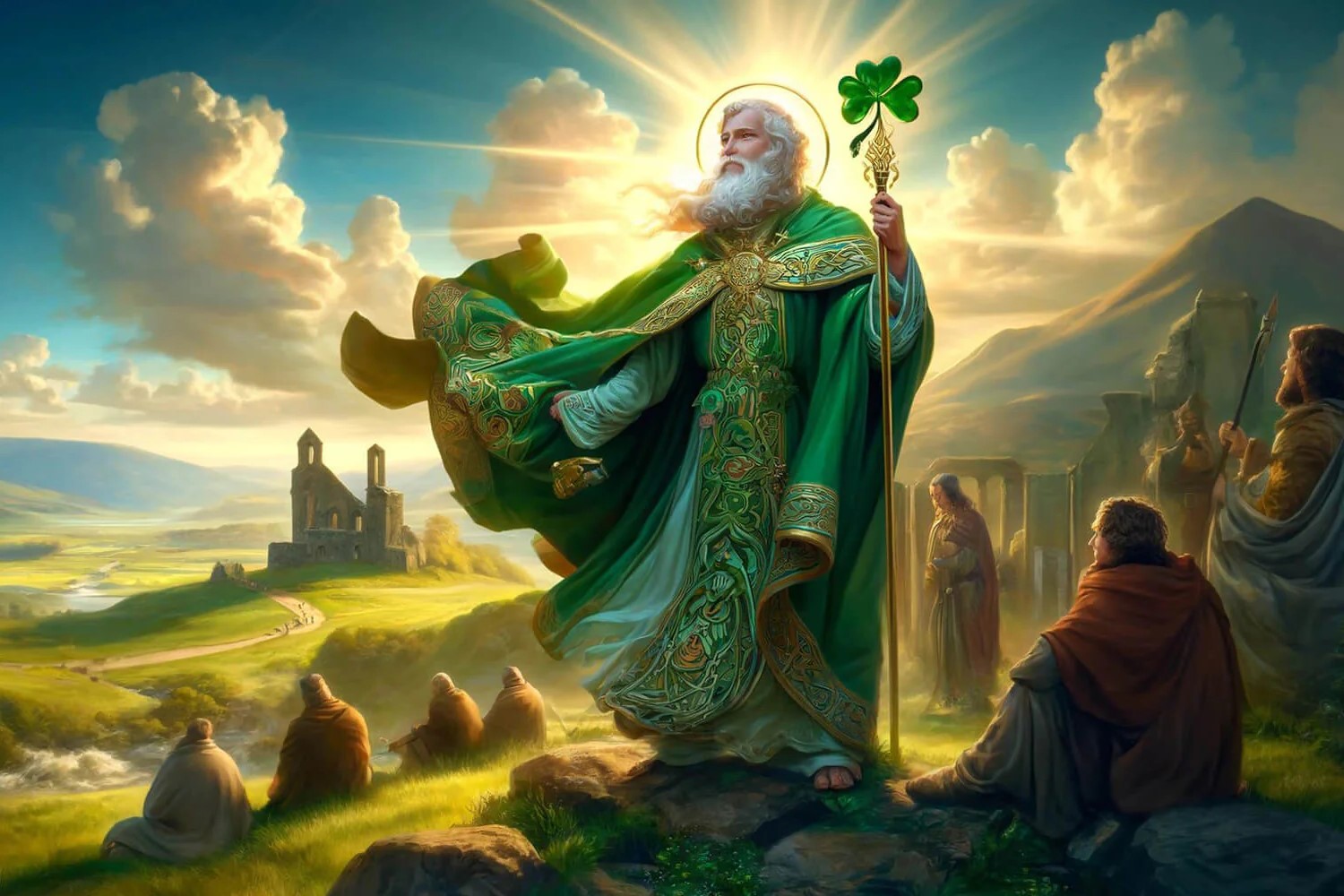
The popular narrative of St. Patrick portrays him as a miracle-working bishop who single-handedly drove all snakes out of Ireland and used the three-leaf shamrock to explain the Holy Trinity. Historical and hagiographical analysis, however, reveals a much more complex figure: a Romano-British citizen, a former slave, a self-doubting writer, and a missionary operating in a fractured Iron Age society long before modern Catholic traditions took root.
Introduction: Separating History from Hagiography
Few figures in global culture enjoy the widespread recognition of Saint Patrick, yet few historical icons are as heavily obscured by layers of folklore, national mythmaking, and hagiography—the writing of the lives of saints. Modern celebrations of St. Patrick’s Day often focus on parades, green apparel, and Irish heritage, leaving little room for the actual historical individual behind the holiday. To understand what the legend hides, historians rely primarily on two surviving authentic documents written by Patrick himself: the Confessio (his spiritual autobiography) and the Epistola ad Milites Corotici (a letter condemning the mistreatment of Irish Christians by a British warlord).
These primary sources paint a picture that contrasts sharply with popular folklore. Patrick was not a smooth-talking master of rhetoric, nor was he the very first Christian missionary to set foot on Irish soil. By examining the historical record, it becomes possible to dismantle popular misconceptions and uncover the genuine historical context of fifth-century Ireland. The following five facts explore the lesser-known realities of Patrick's life, stripping away centuries of accumulated myth to reveal what the legend truly hides.
1. Patrick Was Not Irish (He Was Romano-British)
One of the most persistent misconceptions about Saint Patrick is that he was a native-born Irishman who rose through local ranks to evangelize his own people. In reality, Patrick was a Romano-British aristocrat. He was born around the late fourth century—likely between 387 and 390 AD—somewhere in Britain, which was then under the waning control of the Roman Empire.
His family was part of the Romanized elite. His father, Calpurnius, was a decurion (a municipal council member and tax collector), and his grandfather, Potitus, was a Christian priest. Despite this religious lineage, Patrick notes in his Confessio that he was remarkably unreligious in his youth, admitting that he did not truly know the living God until his circumstances changed drastically.
At the age of sixteen, Patrick's life was upended when raiding parties from Ireland attacked his family's estate. He was captured, torn from his comfortable background, and forcibly transported across the Irish Sea to be sold into slavery in a pagan land. This forced migration marks the true beginning of his transformation. His British origins meant he spoke Brittonic Celtic and Latin, requiring him to learn the native Irish tongue (Gaeilge) during his years of enslavement—a linguistic foundation that would later prove crucial to his mission.
2. He Spent Years as an Enslaved Shepherd in Ireland
The legend of St. Patrick often skips seamlessly from his comfortable youth to his triumphant return as a bishop. It glosses over the brutal reality of his six-year enslavement, which served as the crucible for his spiritual awakening.
Captured by Irish raiders, Patrick was put to work as a herdsman, tending sheep and swine in the rugged countryside of Gaelic Ireland—traditionally associated with the slopes of Slemish Mountain in County Antrim. Isolation, hunger, cold, and mistreatment defined these formative years. Cut off from his family, his social status, and his native language, Patrick turned inward and toward prayer. In the Confessio, he writes that he would pray up to a hundred times a day and often at night, enduring harsh weather and rough terrain without bitterness.
This period of forced labor also gave him intimate, firsthand knowledge of Irish culture, language, and pagan religious practices. Slaves in fifth-century Ireland lived on the margins of society, giving Patrick an outsider's perspective on the tribal, clan-based structure of the island. After six years, fueled by a vivid dream or vision that he interpreted as divine guidance, he escaped. He walked roughly two hundred miles to the Irish coast, where he convinced sailors on a cargo ship—likely carrying Irish wolfhounds or enslaved humans—to take him back across the sea to Britain, eventually reuniting with his astounded family.
3. He Was Not the First Christian in Ireland
Popular imagination often casts Patrick as the lone spiritual pioneer who single-handedly brought Christianity to a completely pagan Ireland. While Patrick was undoubtedly the most successful and historically impactful missionary to the island, he was far from the first.
Prior to Patrick’s mission, Christian communities and trading contacts already existed along the eastern and southern coasts of Ireland, facilitated by Roman trade, returning slaves, and traveling merchants. Historical evidence confirms this prior presence. In 431 AD, a full decade or more before Patrick’s major missionary push, Pope Celestine I consecrated a bishop named Palladius and sent him "to the Irish believing in Christ."
| Missionary Figure | Historical Timeline & Scope |
|---|---|
| Early Coastal Believers | Pre-431 AD: Informal trading contacts and small enclaves |
| Palladius | 431 AD: Officially dispatched by Pope Celestine |
| Patrick | c. 432–461 AD: Extensive inland evangelization |
Palladius's mission met with mixed results and a relatively short tenure, after which Patrick stepped into a broader role across the midlands and western regions. Patrick’s genius lay not in introducing a wholly foreign concept, but in skillfully navigating the complex network of Irish tuatha (local kingdoms), negotiating with high-ranking chieftains, and contextualizing Christian theology within a society bound by oral law, kinship, and honor.
4. The Legend of the Snakes Is Pure Metaphor
No element of Saint Patrick lore is more famous—or more scientifically impossible—than the legend that he banished all snakes from Ireland by driving them into the sea with a wooden staff.
Modern zoology and paleontology confirm that snakes never inhabited Ireland in the post-glacial era. When the last ice age ended approximately 10,000 years ago, Ireland became completely covered in glacial ice sheets, making it entirely uninhabitable for cold-blooded reptiles. As the ice melted and the land warmed, rising sea levels cut Ireland off from the European mainland via the Irish Sea before land-dwelling reptiles like snakes could migrate northward from Britain or continental Europe. Britain retained a few native snake species (such as the adder), but Ireland remained completely isolated.
If snakes were never on the island, what does the legend hide? In early Christian hagiography, snakes and serpents were potent, universal symbols of paganism, evil, and the devil. When hagiographers wrote centuries after Patrick's death to elevate his status, they transformed a spiritual victory—his successful displacement of native druidic traditions and pagan rituals—into a dramatic, physical miracle. Driving out the "snakes" was a vivid allegory for purging idolatry and establishing Christian monastic networks across the island.
5. The Shamrocks and Miracles Were Later Additions
The association between Saint Patrick, the three-leaf shamrock, and theatrical miracles is an essential part of St. Patrick’s Day celebrations today, yet none of these elements appear anywhere in Patrick’s own authentic writings.
- The Shamrock Legend: The story that Patrick used a three-leaf shamrock to explain the Christian doctrine of the Trinity (three persons in one God) first appears in written literature much later, in 1726, within a biography written by botanist and writer Caleb Threlkeld. While early Irish Christians certainly appreciated botany and natural imagery, the specific anecdote linking Patrick to the shamrock as a pedagogical tool is a product of later folklore rather than fifth-century fact.
- The Resurrection Claims: Medieval biographers, seeking to rival the legendary exploits of continental saints, attributed dozens of dramatic miracles to Patrick, including raising the dead, glowing with divine light, and miraculously surviving poison.
- Patrick’s Real Self-Image: By contrast, Patrick’s actual voice in the Confessio is remarkably humble, self-deprecating, and defensive. He readily acknowledges his lack of formal education, his stumbling rhetoric, and his deep feelings of inadequacy in the face of his critics within the British church who questioned his qualifications.
FAQ
Did Saint Patrick write any surviving books? Yes. Two undisputed texts written by Patrick survive today: his spiritual memoir, the Confessio, and his fierce condemnation of a British warlord, the Epistola ad Milites Corotici. Both are written in idiosyncratic, unpolished Latin and provide raw insight into his internal motivations and daily struggles.
When did Saint Patrick die? While the exact year of his death is debated by historians, traditional chronology places it around 461 AD. March 17, the widely observed date of St. Patrick’s Day, is traditionally held to be the anniversary of his death at Saul, County Down.
Why is the color green associated with St. Patrick? Originally, the color associated with Saint Patrick in official heraldry and early modern commemorations was "Saint Patrick’s Blue." The shift toward green occurred gradually over centuries, driven by Ireland's lush landscape, the symbolism of the rebellion of 1798, and the rise of green as a nationalist symbol in Irish-American culture.
Was Saint Patrick officially canonized by the Pope? No. In the modern sense of the word, formal papal canonization processes did not exist during the fifth century. Patrick attained sainthood through popular acclaim, local veneration, and his enduring reputation as a foundational pillar of the early Irish church, later recognized universally by the Christian church.
Did Patrick perform baptisms and ordinations on a massive scale? Yes. Although he faced immense danger and hostility from local druids and hostile chieftains, Patrick notes in his writings that he baptized thousands of people and ordained numerous clerics, helping to transform a tribal society into a vibrant center of Christian scholarship that would later preserve literacy during the Early Middle Ages.
Conclusion and Next Action
Stripping away the layers of folklore reveals Saint Patrick to be a deeply human, resilient figure whose historical contributions far outstrip the myths of snakes and shamrocks. To deepen your understanding of this era, read primary translations of Patrick's Confessio alongside scholarly histories of fifth-century Britain and Ireland to appreciate how a former slave helped reshape European culture.