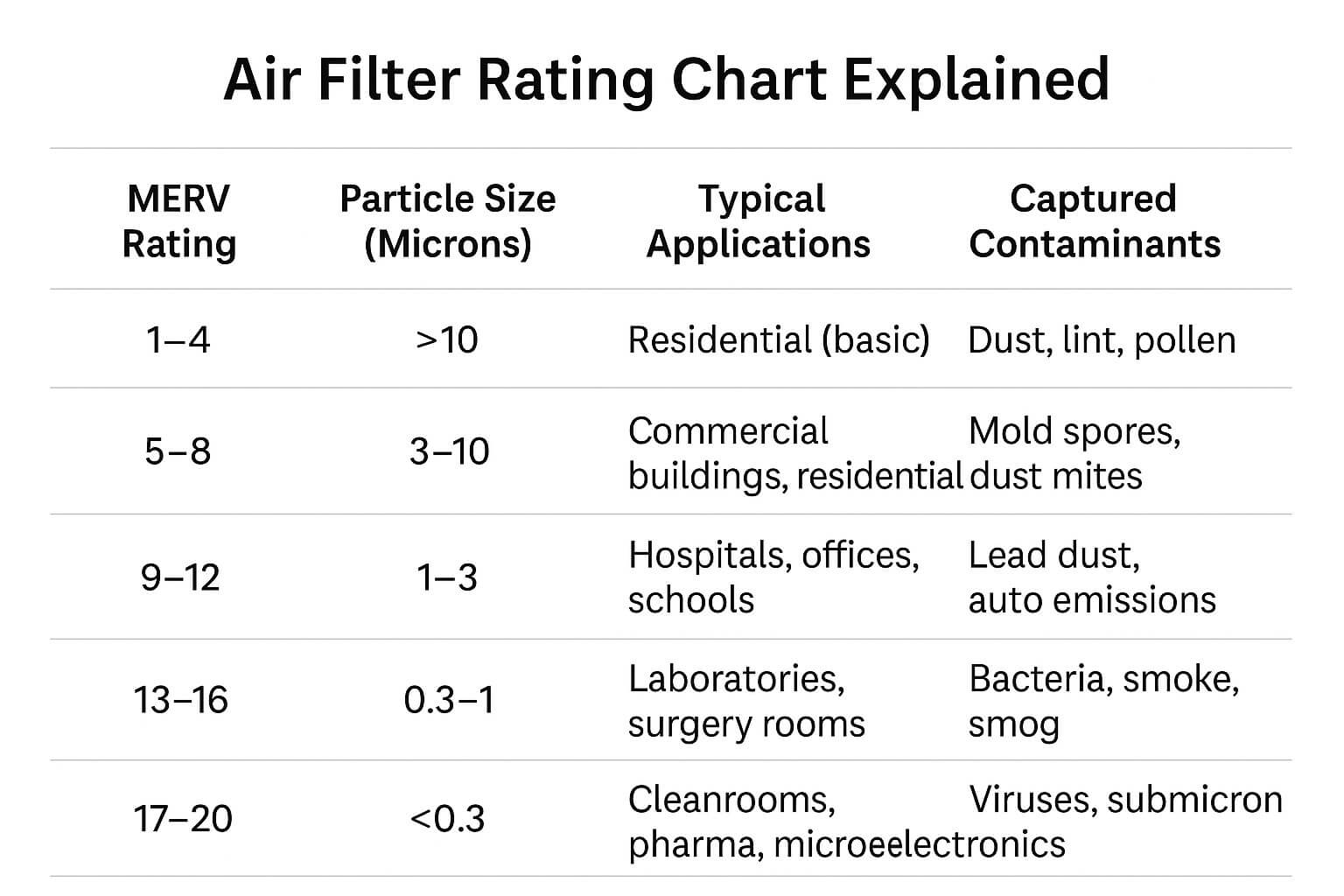
The Minimum Efficiency Reporting Value (MERV) remains the primary industry standard for measuring the effectiveness of HVAC air filters in 2026. This rating, ranging from 1 to 16, determines how well a filter captures particles between 0.3 and 10 microns. Selecting the appropriate MERV rating requires balancing air purification needs with the airflow requirements of your specific HVAC system to prevent mechanical strain.
The Technical Foundation: What is a MERV Rating?
The MERV rating system was established by the American Society of Heating, Refrigerating and Air-Conditioning Engineers (ASHRAE) under Standard 52.2. Its purpose is to provide a universal language for consumers and professionals to compare the efficiency of different air filters. In the landscape of 2026, where indoor air quality (IAQ) has become a primary health concern for homeowners and facility managers alike, understanding the nuances of these ratings is more critical than ever.
A filter’s MERV rating is determined by its ability to capture particles of varying sizes during rigorous testing. These particles are categorized into three distinct ranges:
- E1: Very fine particles (0.3 to 1.0 microns), such as viruses, bacteria, and smoke.
- E2: Fine particles (1.0 to 3.0 microns), including lead dust, humidifier dust, and coal dust.
- E3: Large particles (3.0 to 10.0 microns), such as pollen, dust mites, and carpet fibers.
The higher the MERV rating, the more efficient the filter is at capturing smaller particles. However, a higher rating often equates to a denser filter material, which can restrict airflow if the HVAC system is not designed to handle the increased resistance.
The 2025-2026 Filter Landscape: Why Ratings Matter Now
As we move through 2026, the data gathered throughout 2025 highlights a significant shift in filtration priorities. Increasing incidents of wildfire smoke and a heightened awareness of airborne pathogens have pushed the "standard" residential recommendation from MERV 8 toward MERV 13.
Health organizations and environmental agencies now emphasize the removal of PM2.5 (particulate matter smaller than 2.5 microns). These particles are small enough to enter the bloodstream via the lungs, posing long-term health risks. Consequently, the 2025 MERV rating overview focuses heavily on the "Sweet Spot"—filters high enough to capture PM2.5 without causing the HVAC system to fail due to excessive static pressure.
Comprehensive MERV Rating Scale Breakdown
To select the right filter, one must understand what each tier of the MERV scale actually accomplishes.
MERV 1–4: Basic System Protection
These filters are typically made of disposable fiberglass or permanent washable mesh. In 2026, these are rarely recommended for residential air quality improvement. Their primary function is not to clean the air you breathe, but to protect the internal components of the HVAC system (the blower motor and evaporator coil) from large lint and dust buildup.
- Efficiency: Captures less than 20% of E3 particles.
- Common Uses: Older window AC units and basic furnace protection.
MERV 5–8: Standard Residential Filtration
Most residential homes traditionally used MERV 8 filters. They are usually pleated and made from synthetic fibers. They provide a baseline level of filtration that handles common household allergens.
- Efficiency: Captures roughly 70% to 85% of E3 particles.
- Common Uses: Homes without pets or significant allergy concerns.
MERV 9–12: Superior Residential and Commercial
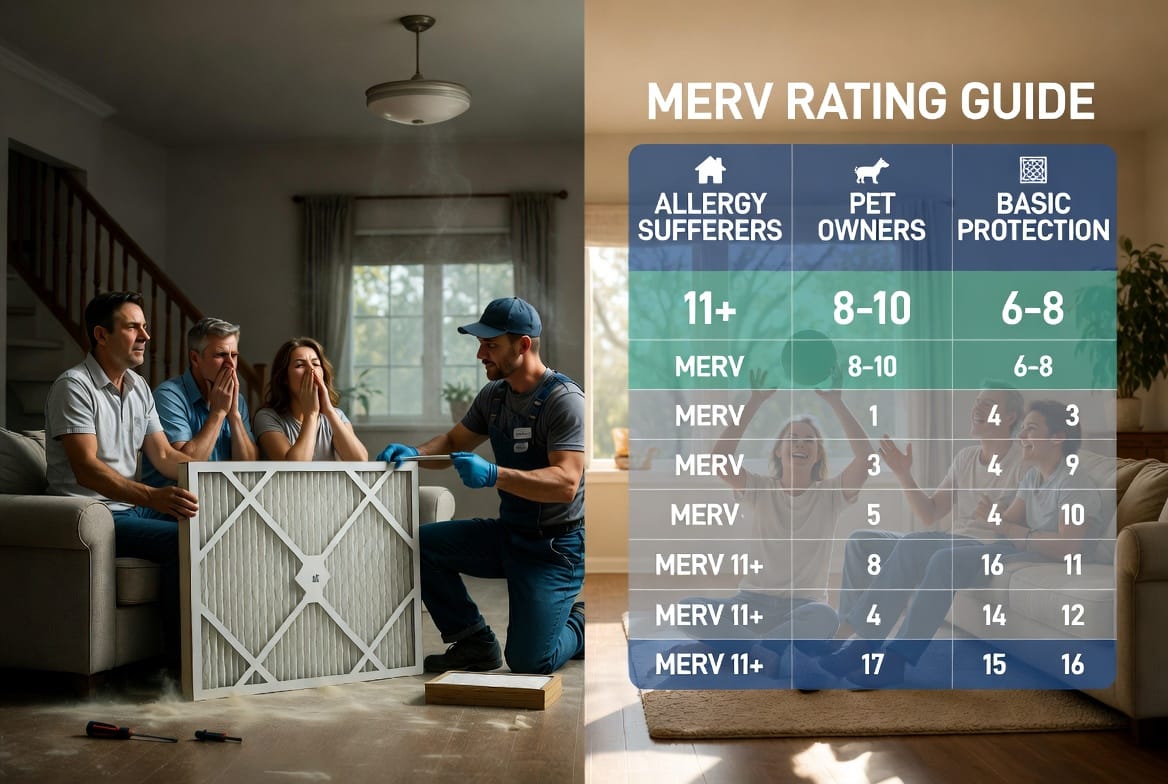
This range is where air quality begins to significantly improve. These filters are capable of capturing smaller allergens like mold spores and finer dust. For families with pets or mild asthma, MERV 11 is often the recommended baseline.
- Efficiency: Captures 80% to 90% of E2 particles and up to 35% of E1 particles.
- Common Uses: Superior residential systems, hospital laboratories, and high-end commercial buildings.
MERV 13–16: Hospital Grade and High-Efficiency
In 2025, MERV 13 became the benchmark for mitigating smoke and virus-carrying droplets. These filters are dense and often require deeper 4-inch or 5-inch housings to maintain adequate airflow.
- Efficiency: MERV 16 can capture over 95% of E1, E2, and E3 particles.
- Common Uses: Inpatient care, general surgery suites, and "smart" homes with high-performance HVAC systems.
Comparative Efficiency Table
The following table outlines the minimum percentage of particles trapped by various MERV ratings based on the ASHRAE 52.2 standard.
| MERV Rating | E1 (0.3–1.0 µm) | E2 (1.0–3.0 µm) | E3 (3.0–10.0 µm) | Typical Contaminants Filtered |
|---|---|---|---|---|
| MERV 1-4 | N/A | N/A | < 20% | Large dust, lint, carpet fibers |
| MERV 5-8 | N/A | < 50% (at MERV 8) | 70% – 85% | Dust mites, pollen, mold spores |
| MERV 9-12 | < 35% (at MERV 12) | 80% – 90% | > 90% | Lead dust, auto emissions, humidifier dust |
| MERV 13 | > 50% | > 85% | > 90% | Bacteria, most smoke, virus nuclei |
| MERV 14 | 75% – 85% | > 90% | > 90% | Most tobacco smoke, fine droplets |
| MERV 16 | > 95% | > 95% | > 95% | All bacteria, microscopic allergens |
Disambiguation: MERV vs. MPR vs. FRP
One of the most confusing aspects of purchasing filters in 2026 is the presence of proprietary rating systems. While MERV is the industry standard, major retailers and manufacturers use their own scales.
MPR (Microparticle Performance Rating)
Developed by 3M (Filtrete), this scale focuses specifically on the filter's ability to capture particles smaller than 1 micron (E1 particles). For example, a MERV 11 filter might correspond to an MPR of 1000 to 1200.
FRP (Filter Performance Rating)
Used exclusively by The Home Depot, this scale ranges from 4 to 10. It considers the weighted average of the filter's ability to capture both large and small particles. A MERV 13 filter typically aligns with an FRP 10 rating.
When comparing filters, it is best to look for the MERV rating in the fine print on the filter frame, as it allows for an "apples-to-apples" comparison across all brands.
The Critical Factor: Static Pressure and Airflow
A common mistake is assuming that "higher is always better." As filter density increases, the resistance to airflow—known as static pressure—also increases. If your HVAC system was designed for a MERV 8 filter and you install a MERV 16 filter without modifications, you may encounter several problems:
- Reduced Efficiency: The blower motor must work harder to pull air through the filter, increasing your electricity bill.
- Mechanical Wear: Over time, the strain can lead to motor burnout or a cracked heat exchanger.
- Frozen Coils: In the summer, restricted airflow can cause the evaporator coils to freeze, leading to a complete system shutdown.
- Poor Air Distribution: Rooms further from the air handler may not receive enough conditioned air, leading to "hot spots" or "cold spots" in the house.
Before upgrading to a MERV 13 or higher, consult your HVAC manual or a professional to ensure your system's Total External Static Pressure (TESP) remains within safe limits.
Filter Maintenance and Best Practices in 2026
The effectiveness of a 2025 MERV-rated filter is only as good as its maintenance schedule. In 2026, many homeowners have integrated smart sensors to monitor filter health.
- Replacement Frequency: While 90 days is the standard suggestion, homes with pets or those in high-pollution areas should check filters every 30 days. A MERV 13 filter will "load" (fill up) faster than a MERV 8 because it captures more material.
- The "Sealing" Factor: Ensure the filter fits snugly in the rack. Air will follow the path of least resistance; if there are gaps around the filter, "bypass" occurs, and unfiltered air enters your home and your HVAC equipment.
- Directional Flow: Always check the arrow on the filter frame. Installing a pleated filter backward can significantly increase static pressure and reduce its structural integrity, potentially causing the filter to collapse into the blower.
Considerations for Specific Indoor Hazards
When evaluating the 2025 MERV rating overview, consider your specific environment. Different ratings are optimized for different hazards:
Wildfire Smoke and Urban Pollution
Wildfire smoke consists largely of fine particulate matter. To effectively clear smoke from indoor air, a MERV 13 filter is the minimum recommended level. Filters with lower ratings will allow the smell and the microscopic hazardous particles to circulate freely.
Allergies and Asthma
For those suffering from seasonal allergies (pollen) or pet dander sensitivity, a MERV 11 filter usually provides sufficient relief. It captures the vast majority of allergens without the high price tag or airflow resistance of hospital-grade filters.
Viral and Bacterial Pathogens
While no standard HVAC filter can "kill" viruses, a MERV 13 or 14 can trap the respiratory droplets that carry viruses like influenza or SARS-CoV-2. According to the Environmental Protection Agency (EPA), when used in conjunction with other best practices, high-MERV filtration is a key component of a healthy building strategy.
Frequently Asked Questions
Can I use a MERV 16 filter in my standard furnace?
Most standard residential furnaces are not designed for the air resistance of a MERV 16 filter. Using one could damage your blower motor unless your system has been specifically modified with a high-velocity return or a 5-inch media cabinet.
Does a higher MERV rating mean a higher energy bill?
Potentially, yes. If the filter is too restrictive, the fan motor runs longer and harder to achieve the desired temperature. However, if the system is designed for high-efficiency filters, the difference in energy consumption is often negligible compared to the health benefits.
Is MERV the same as HEPA?
No. HEPA (High-Efficiency Particulate Air) filters are a separate category. To be labeled HEPA, a filter must trap 99.97% of particles at 0.3 microns. Most residential HVAC systems cannot handle the extreme resistance of a true HEPA filter. MERV 17-20 are often considered "HEPA-like," but they are usually found in industrial or surgical settings.
Why do some filters have the same MERV rating but different prices?
Price differences often stem from the quality of the frame, the amount of pleating (more surface area equals better airflow and longer life), and whether the filter includes specialized materials like activated carbon for odor removal.
How do I know what MERV rating my system can handle?
Check the manufacturer's plate on your indoor air handler or furnace. It will list the maximum static pressure. You can also look for a "MERV" label on the original filter supplied by the installer. If in doubt, a MERV 11 is generally a safe "high-performance" upgrade for most systems built within the last 15 years.
Final Recommendation
For the average household in 2026, a MERV 11 pleated filter offers the best balance between air quality, system longevity, and cost-effectiveness. It provides excellent protection against pollen, pet dander, and dust. However, if you live in an area prone to wildfires or have occupants with compromised immune systems, upgrading to a MERV 13 is advisable, provided you verify your HVAC system can handle the increased static pressure. Always prioritize a regular replacement schedule over a higher rating; a clean MERV 8 filter will always outperform a clogged MERV 13.