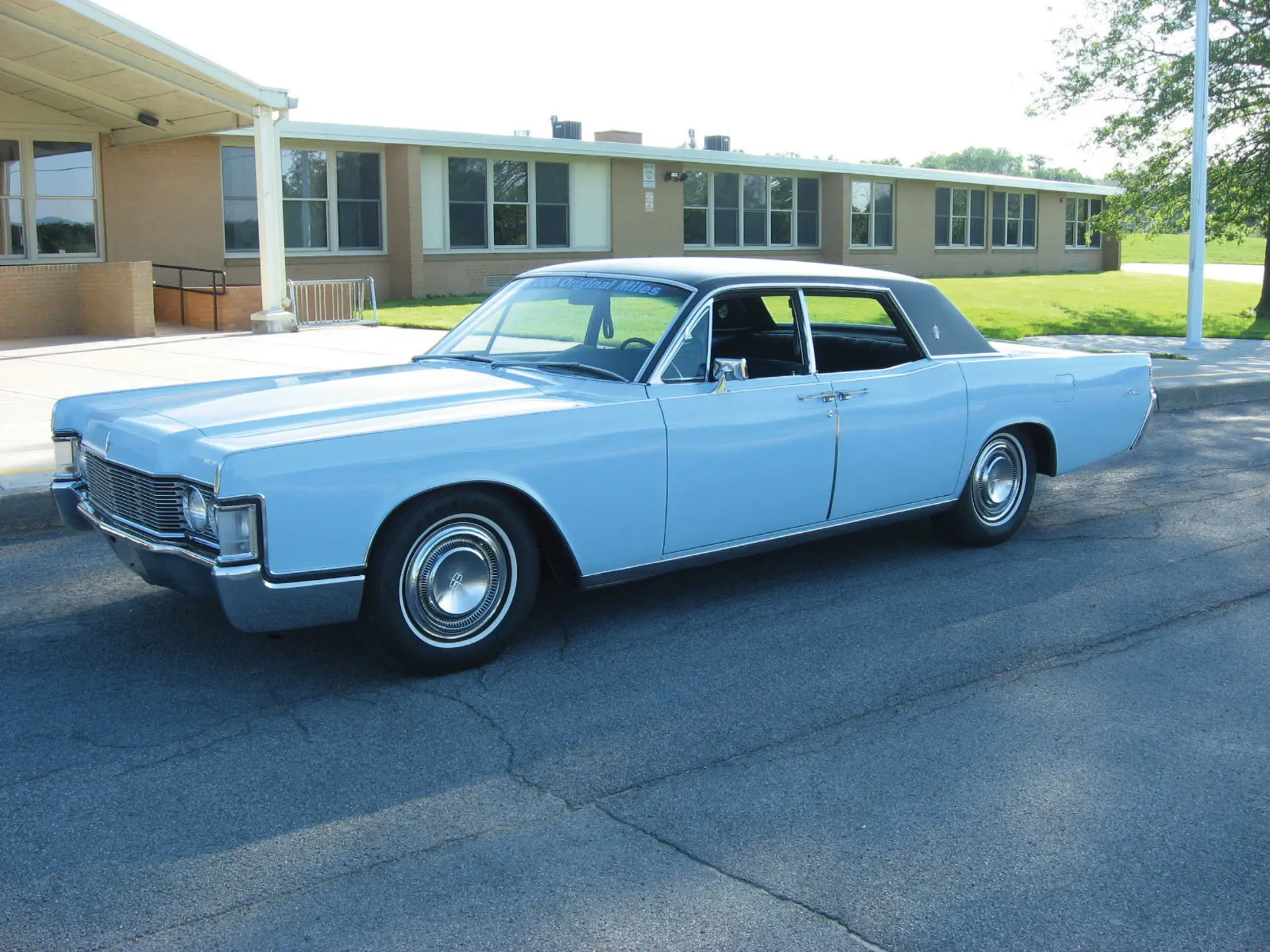
The 1968 Lincoln Continental 2-Door Hardtop is a landmark luxury automobile defined by its sharp-edged styling, concealed headlights, and massive proportions. Powered by a 460-cubic-inch V8 engine, this luxury cruiser represents the final era of classic, full-size American automotive engineering, offering collectors a striking blend of mid-century modern design and effortless highway performance.
Evolution of the Continental: The 1968 Redesign Context
The late 1960s marked a transitional period for Ford Motor Company's luxury division. Following the iconic suicide-door sedan and convertible models that defined the early 1960s, Lincoln introduced a heavily revised body style for the 1967 and 1968 model years. While the four-door models retained the rear-hinged doors until 1969, the two-door hardtop variant of the 1968 Lincoln Continental forged its own visual identity. It embraced the long-hood, short-deck proportioning that would come to dominate American luxury car design for the next decade.
The 1968 model year introduced subtle yet important revisions to comply with emerging federal safety regulations. Most notably, side marker reflectors were integrated into the front fenders and rear quarter panels, altering the clean sweep of the body lines mandated by earlier styling briefs. Despite these regulatory additions, Elwood Engel’s design team maintained a minimalist approach to exterior trim. The vehicle relied on sheer sheet-metal expanse, crisp character lines, and an authoritative, slab-sided profile to project status and permanence.
Exterior Styling and Dimensional Profile
Examining the exterior of a 1968 Lincoln Continental 2-door reveals an exercise in architectural restraint. Measuring over 220 inches in length and weighing in the neighborhood of 5,000 pounds, the car possessed a commanding road presence that few contemporary European imports could match. The front fascia featured a full-width grille with vacuum-operated concealed headlights that blended seamlessly into the grille pattern when deactivated.
Key design elements of the 1968 two-door hardtop include:
- The Formal Roofline: A distinct, rectangular C-pillar treatment that gave the cabin a private, formal character, often paired with a vinyl top finish.
- Hidden Headlamps: Vacuum-actuated doors that maintained the unbroken horizontal motif of the front end.
- Slab-Side Flank: Minimal chrome ornamentation, allowing the light to play across expansive door panels and quarter panels.
- Rear Deck Design: A subtle peak in the trunk lid—a stylized nod to the continental spare tire hump of earlier generations—flanked by linear vertical tail lamps.
Powertrain and Mechanical Specifications
Underneath the expansive hood of the 1968 Lincoln Continental 2-door lies the powerhouse that defined Ford's heavy-duty luxury lineup: the 460-cubic-inch (7.5-liter) 385-series V8 engine. Introduced for the 1968 model year to replace the older MEL (Mercury-Edsel-Lincoln) engine family, this powerplant was engineered for quiet operation, high torque output, and effortless sustained highway cruising.
| Specification Category | 1968 Lincoln Continental 2-Door Details |
|---|---|
| Engine Type | 460 cu in (7.5L) OHV V8 |
| Horsepower | 360 hp @ 4,600 rpm |
| Torque | 485 lb-ft @ 2,600 rpm |
| Transmission | C6 Select-Shift 3-speed automatic |
| Suspension | Independent coil-spring front, live axle with leaf springs rear |
| Brakes | Power front disc brakes, rear drums |
| Wheelbase | 126.0 inches |
| Curb Weight | Approx. 4,950 – 5,100 lbs |
The engine breathed through a four-barrel carburetor and delivered its substantial torque low in the rev range. This allowed the heavy coupe to accelerate smoothly without demanding high engine speeds. Power was routed through a robust Ford C6 three-speed automatic transmission to a conventional rear axle, ensuring seamless gear changes suited to a luxury grand tourer.
Interior Accommodations and Comfort Features
Stepping inside a 1968 Lincoln Continental 2-door reveals an interior environment heavily influenced by contemporary mid-century furniture design. Ford marketed the cabin as a personal sanctuary, utilizing high-grade materials, simulated walnut wood appliques, and deep-pile carpeting.
Front passengers typically enjoyed split bench seats with individual fold-down center armrests, or optional bucket seats depending on the specific trim package selected. Rear-seat passengers benefited from the car's immense length, enjoying generous legroom that surpassed many modern full-size sedans. Instrument panels were laid out horizontally, placing vital gauges directly in the driver’s line of sight, while ancillary controls for climate and audio were integrated into the central dash.
Factory and optional comfort amenities frequently included:
- Automatic temperature control systems (AC and heating)
- Power windows and power-adjustable front seating
- Tilt steering column and power steering
- AM radio with optional stereo multiplex and eight-track tape player
- Acoustic insulation packages designed to minimize wind and road noise
Collector Market and Purchasing Considerations
In the current collector car market, the 1968 Lincoln Continental 2-door occupies a unique space. While four-door suicide-door models from the early sixties command significant attention, the two-door hardtop offers a compelling alternative for enthusiasts seeking classic 1960s styling with the improved reliability and parts availability of the later 460 V8 engine.
When evaluating a potential purchase, prospective buyers should pay close attention to several vehicle-specific vulnerabilities:
- Rust Inspection: Inspect the lower quarter panels, rocker panels, floor pans, and trunk drop-offs. Replacement sheet metal is scarce compared to mainstream muscle cars, making rust repair expensive.
- Vacuum System Integrity: The concealed headlights, hidden windshield wipers, and certain interior climate control doors rely on engine vacuum. Cracked lines or failing actuators are common points of failure that require systematic troubleshooting.
- Electrical Accessories: Power windows, seat mechanisms, and the intricate dashboard switches require thorough testing, as sourcing correct replacement switches can prove challenging.
- Brakes and Suspension: Due to the vehicle's immense weight, heavy-duty suspension bushings, ball joints, and power brake boosters must be inspected regularly to maintain safe handling characteristics.
Frequently Asked Questions
What engine came in the 1968 Lincoln Continental 2-door?
The 1968 model year marked the debut of the 460-cubic-inch V8 engine in Lincoln passenger cars. This motor produced 360 horsepower and 485 lb-ft of torque, providing high low-end pulling power designed specifically for smooth, quiet acceleration in heavy luxury chassis configurations.
Are parts difficult to find for a 1968 Lincoln Continental?
While standard mechanical components—such as brake parts, suspension rebuild kits, and engine internals—are readily available due to sharing platforms with other Ford products, specific trim items, glass, and interior upholstery can be difficult to source and often require specialized salvage yards or dedicated marque clubs.
How does the 1968 two-door differ from the four-door models?
Aside from the obvious door count, the two-door hardtop featured a unique roofline, unique quarter panels, and distinct glass configurations. Furthermore, while the four-door sedans retained rear-hinged suicide doors until 1969, the two-door utilized conventional forward-hinged doors.
What is the fuel economy of a 1968 Lincoln Continental?
Fuel efficiency was rarely a priority for buyers of 1960s luxury cruisers. Real-world fuel consumption typically ranges between 8 and 12 miles per gallon, depending on driving habits, carburetor tuning, and rear axle ratios.
Is the 1968 Lincoln Continental suitable for daily driving?
While mechanically robust and exceptionally comfortable on the highway, using a 1968 Continental as a daily driver presents practical challenges. Its massive physical dimensions make parallel parking difficult in modern urban environments, and replacement parts for unique systems require patience and specialized maintenance knowledge.
Practical Next Steps for Enthusiasts
For those looking to acquire or restore a 1968 Lincoln Continental 2-door, the best initial step is joining specialized registries such as the Lincoln and Continental Owners Club (LCOC). Engaging with experienced owners provides access to regional technical advisors, verified parts sources, and reliable pre-purchase inspection networks. Prioritizing a rust-free, mechanically complete example will save considerable time and expense over undertaking a full frame-off restoration of a neglected project car.