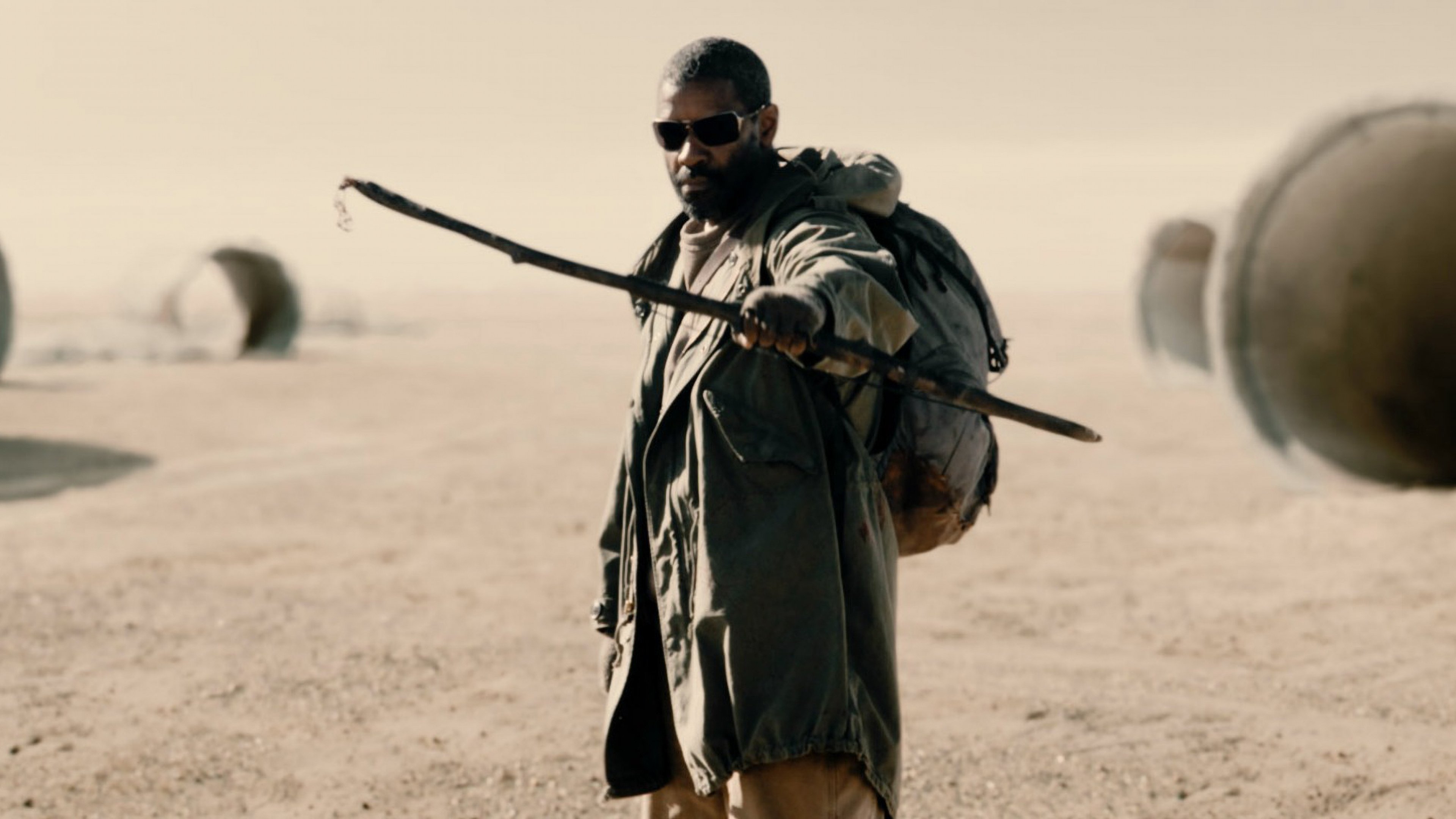
The Book of Eli is a 2010 post-apocalyptic action film directed by the Hughes Brothers, starring Denzel Washington as a lone wanderer named Eli. Tasked by a divine voice to deliver a sacred book to a safe location in the West, Eli navigates a desolate, violent America thirty years after a nuclear catastrophe. The story explores themes of faith, the power of literacy, and the duality of religion as both a tool for control and a source of hope.
The Post-Apocalyptic Setting and Eli’s Journey
Set in 2043, three decades after a global nuclear war referred to as "the flash," the world of The Book of Eli is a sun-bleached wasteland. The atmosphere is characterized by a desaturated color palette, reflecting a world where the ozone layer is decimated and water is the most precious commodity. Survivors live in scavenged ruins, and basic literacy has become a rarity, as most books were burned in the aftermath of the war by those who blamed religion for the world's destruction.
Eli is introduced as a highly skilled survivalist and warrior. He spends his days traveling on foot, hunting for food, and maintaining his gear. Despite the harsh environment, he possesses an eerie calm and a lethal proficiency with a machete and firearms. He is guided by a singular purpose: to carry a leather-bound book to the "West." He claims to be guided by a voice that told him where to find the book and promised him protection until his task was complete.
The early sequences of the film establish Eli’s character through action rather than dialogue. We see him outsmarting and defeating a group of "hijackers"—bandits who prey on travelers. These scenes emphasize that while Eli is a man of peace and faith, he is not a pacifist. He views his survival and the protection of the book as a divine mandate that justifies extreme force.
The Conflict in Carnegie’s Town
The narrative gains momentum when Eli arrives in a ramshackle town ruled by an ambitious and literate warlord named Carnegie (played by Gary Oldman). Unlike the typical wasteland survivors, Carnegie remembers the world before the flash. He is obsessed with finding a specific book—the Bible—which he believes is a "weapon" that will allow him to expand his influence and control the minds of the desperate populace.
Carnegie employs "crews" to scavenge for books, but they only return with trash. When Eli enters the town to trade for supplies and water, Carnegie notices Eli’s ability to read and his stoic demeanor. Recognizing that Eli is different from the illiterate scavengers he employs, Carnegie attempts to recruit him.
The tension escalates when Carnegie sends Solara (Mila Kunis), the daughter of his blind consort Claudia (Jennifer Beals), to seduce Eli and discover what he is carrying. Instead of falling for the trap, Eli shares his food with Solara and teaches her a prayer. Through this interaction, Solara discovers that Eli possesses the very book Carnegie has been searching for. When Carnegie realizes Eli has the last remaining copy of the Bible, the conflict shifts from a clash of wills to a violent pursuit.
Philosophical Foundations: Eli vs. Carnegie
The core of the film’s summary lies in the ideological battle between the protagonist and the antagonist. This isn't just an action movie about a chase; it is a debate about the nature of sacred texts and their role in society.
| Feature | Eli’s Perspective | Carnegie’s Perspective |
|---|---|---|
| View of the Book | A sacred trust to be preserved for humanity. | A psychological tool for social engineering. |
| Source of Authority | Divine guidance and internal faith. | External power, fear, and control of resources. |
| Ultimate Goal | To deliver the word to those who can save it. | To use the word to build an empire. |
| Methodology | Self-sacrifice and protection of the innocent. | Exploitation, coercion, and violence. |
Eli views the Bible as a source of healing and spiritual guidance. He treats the text with reverence, reading it every day to maintain his resolve. Conversely, Carnegie views the Bible as a manual for sovereignty. He understands that people in the wasteland are looking for something to believe in, and he wants to provide that belief structure so he can sit at the top of the hierarchy. Carnegie’s pursuit of the book highlights his belief that "knowledge is power," but a specific type of knowledge that can be used to manipulate the masses.
The Escape and the Journey West
Eli manages to fight his way out of the town, leaving several of Carnegie's henchmen dead. Solara, inspired by Eli’s kindness and his sense of purpose, escapes the town and follows him. Initially, Eli is reluctant to take her along, fearing she will slow him down or put his mission at risk. However, after he saves her from a group of rapists, he allows her to accompany him.
As they travel west, Eli begins to mentor Solara, explaining his history and the origins of his mission. He reveals that he was once a worker in a warehouse and heard a voice that led him to the book buried under rubble. This backstory adds a layer of mysticism to the character; Eli isn't just a survivor, but a prophet-like figure.
Their journey leads them to a seemingly idyllic house in the middle of the wasteland, inhabited by an elderly couple, George and Martha. The couple appears hospitable, but Eli quickly realizes they are cannibals who survive by luring and eating travelers. This sequence serves as a grim reminder of how far humanity has fallen. Carnegie’s forces eventually catch up to them at this location, leading to a massive shootout. George and Martha are killed, and Eli is eventually cornered.
The Climax and the Great Reveal
The climax of the film occurs when Carnegie finally gains possession of the book. During the confrontation at George and Martha's house, Carnegie shoots Eli in the stomach and takes the leather-bound volume. He leaves Eli for dead and returns to his town with Solara in tow. However, Solara manages to escape Carnegie’s convoy and returns to find Eli.
Miraculously, Eli is still alive and walking toward the West. The film then moves toward its most significant plot twist. When Carnegie returns to his town, he discovers that the book is locked with a clasp. He forces a locksmith to open it, only to find that the entire Bible is printed in Braille.
Carnegie, who is not blind, cannot read the book. Furthermore, his consort Claudia, who is blind and could have read it for him, refuses to help, mocking his failure and noting that his empire is collapsing due to the losses sustained during the chase. Carnegie’s leg wound, suffered during the battle with Eli, has become infected, signaling his physical and political downfall.
The Resolution at Alcatraz
Eli and Solara finally reach their destination: the ruins of Alcatraz Island in San Francisco. There, they find a small community of survivors dedicated to preserving human culture, led by a man named Lombardi (Malcolm McDowell). The community has a printing press and a collection of artifacts, but they lack a copy of the Bible.
Lombardi is disappointed when Eli tells him he doesn't have the physical book. However, the true nature of Eli’s "reading" is revealed. Eli has spent thirty years reading the Braille Bible every day, and he has memorized every word from Genesis to Revelation. Eli begins to dictate the entire Bible to Lombardi, who records it by hand.
The final scenes reveal the extent of Eli’s condition. Close-up shots of his eyes during the dictation process confirm what the Braille book suggested: Eli was blind the entire time. His ability to fight, navigate, and survive was entirely dependent on his heightened senses and his faith in the divine protection he was promised.
Eli dies shortly after finishing the dictation, his mission finally complete. The film ends with the printing press producing a new copy of the King James Bible. It is placed on a shelf alongside other major religious texts, such as the Torah and the Quran, suggesting a rebirth of human knowledge and the possibility of a more balanced civilization. Solara chooses to head back into the wasteland, carrying Eli's gear and his spirit of resilience.
Technical Elements and Cinematic Impact
The Book of Eli is notable for its distinct visual style. The Hughes Brothers used a high-contrast, "bleached-out" look to simulate the harshness of the post-nuclear sun. This technical choice serves the narrative by making the environment feel as hostile as the people inhabiting it.
The fight choreography is also a significant element. Because the ending reveals Eli is blind, a second viewing of the film reveals the subtle cues in Denzel Washington’s performance. Eli often waits for his opponents to make a sound before he strikes, and he frequently touches objects to orient himself. These details provide a layer of technical depth that rewards repeat viewings and reinforces the "miracle" of his journey.
The film's score, composed by Atticus Ross, utilizes industrial and ambient electronic sounds that complement the desolate setting. The music builds tension during the action sequences but becomes more melodic and ethereal during moments of spiritual reflection, mirroring Eli’s internal state.
Summary of Key Character Outcomes
| Character | Final Status | Significance |
|---|---|---|
| Eli | Deceased | Successfully preserved the Bible via memory and delivered it to the West. |
| Carnegie | Alive (Injured/Failing) | Lost his influence and his health; gained the book but could not read it. |
| Solara | Alive | Becomes a wanderer like Eli, carrying on his legacy of faith and survival. |
| Lombardi | Alive | Oversees the restoration of the Bible and the preservation of human history. |
Frequently Asked Questions
Was Eli actually blind throughout the entire movie?
Yes, Eli was blind. This is confirmed by the reveal of the Braille Bible and the physical appearance of his eyes in the final scenes. Throughout the film, there are subtle hints: he sniffs the air to detect enemies, he stays in the shade, and he relies on sound during combat. His ability to navigate was attributed to his faith and divine intervention.
What happened to the world before the movie started?
The movie takes place 30 years after "the flash," a nuclear war that scorched the earth and tore a hole in the ozone layer. This led to extreme solar radiation, making sunglasses a necessity for survival. In the aftermath, survivors burned all the Bibles because they believed religion was the cause of the war.
Why did Carnegie want the Bible so badly?
Carnegie grew up in the pre-apocalyptic world and remembered how religion could be used to motivate and control people. He didn't want the book for spiritual guidance; he wanted it as a political tool to expand his town into an empire, using its verses to justify his authority.
Where is the "West" that Eli was traveling to?
The "West" is revealed to be Alcatraz Island in San Francisco. Because it is an island, it served as a natural fortress for a group of survivors who were attempting to preserve human knowledge, including books, music, and art.
What is the significance of the ending?
The ending signifies hope and the restoration of civilization. By placing the newly printed Bible on a shelf with the Torah and the Quran, the film suggests that while religion can be misused (as Carnegie intended), it is also a fundamental part of the human story that must be preserved for future generations to learn from.
Practical Recommendations for Viewers
If you are watching The Book of Eli for the first time or revisiting it, pay close attention to the sound design. Because the protagonist is blind, the film uses audio cues—such as the clicking of a lighter, the crunch of gravel, or the whistling of the wind—to signal changes in the environment. This sensory-heavy approach is a masterclass in "showing, not telling."
Furthermore, the film serves as an excellent case study in the "Hero's Journey" archetype. Eli represents the "Prophet" figure, while Carnegie represents the "Shadow" who seeks to corrupt the hero's mission. For those interested in film analysis, comparing the lighting used for Eli (often backlit or in silhouettes) versus Carnegie (often in harsh, artificial light) provides deep insight into their moral alignment.