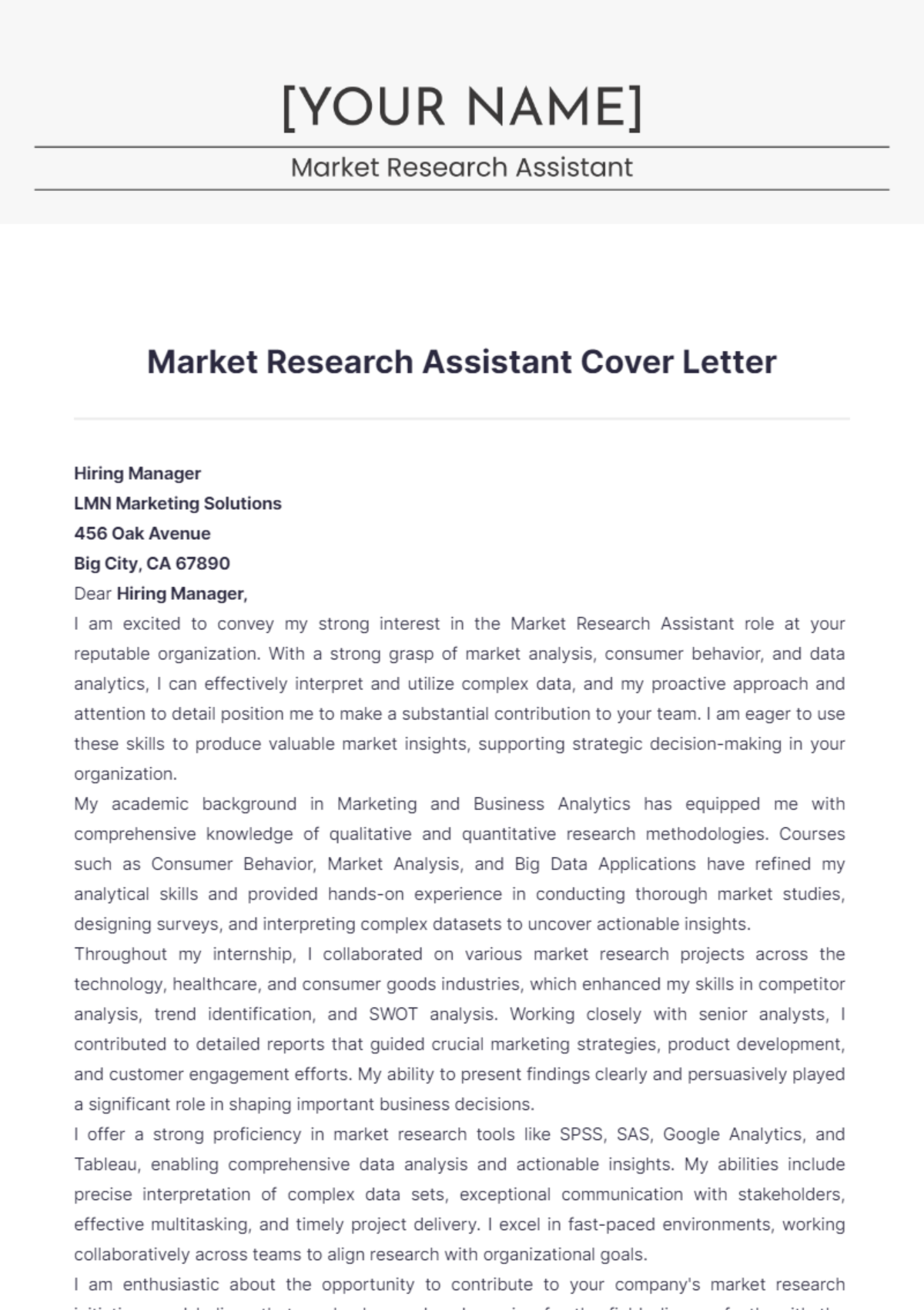
A successful research assistant cover letter functions as a bridge between your academic achievements and the specific needs of a principal investigator or laboratory team. It should clearly synthesize your technical proficiency, relevant methodological experience, and long-term research interests, demonstrating how your unique skill set aligns with the ongoing projects and institutional goals of the hiring organization.
The Strategic Importance of the Research Assistant Cover Letter
The cover letter for a research assistant position is not a redundant summary of your curriculum vitae (CV). While your CV outlines the "what"—the degrees earned, software mastered, and experiments performed—the cover letter explains the "why" and the "how." In the competitive world of academic and industrial research, hiring managers often sift through dozens of applications from candidates with similar GPA profiles and coursework. Your cover letter serves as your primary narrative tool to distinguish yourself through context, motivation, and professional communication skills.
In 2026, the demand for research assistants remains high across biotechnology, social sciences, and engineering sectors. Because research labs and institutes function as high-stakes, collaborative environments, investigators are not just looking for technical competence; they are looking for reliability, intellectual curiosity, and the ability to troubleshoot complex problems without constant supervision. Your cover letter is the first test of these soft skills.
Core Prerequisites Before You Begin
Before drafting your letter, gather the necessary documentation to ensure accuracy and relevance. Writing a generic letter is a common failure point; successful applicants treat the job description as a roadmap for their response.
- The Job Posting/Laboratory Brief: Identify the specific methodologies, statistical packages, or instrumentation mentioned (e.g., Python, R, CRISPR, qualitative coding, or specific mass spectrometry equipment).
- The Principal Investigator’s Recent Publications: Spend time reading at least two recent papers from the lab to which you are applying. Referencing their specific focus demonstrates that you are not sending a blanket application.
- Your Transcript and Lab Reports: Refresh your memory on specific projects where you encountered a technical challenge and successfully solved it.
- Reference List: Ensure your list of potential recommenders is updated and that they are prepared to speak to your laboratory performance rather than just your classroom attendance.
Anatomy of a High-Impact Cover Letter
A standard, effective cover letter structure consists of four distinct phases. Following this format ensures you cover all requirements while maintaining a concise, professional tone.
The Header and Professional Salutation
Always use a formal, standard business letter format. Include your contact information at the top, followed by the date, and then the recipient’s contact information. If you can identify the specific person making the hiring decision—the Principal Investigator (PI) or Lab Manager—address the letter to them directly (e.g., "Dear Dr. Aris," rather than "To Whom It May Concern").
The Opening: The Hook
State clearly which position you are applying for and why you are interested in this specific lab. Briefly highlight one major achievement that directly pertains to the lab's mission. For example, if the lab focuses on climate modeling, open with a sentence about your experience in longitudinal data cleaning for environmental studies.
The Middle: Technical Alignment and Evidence
This is the heart of the document. Dedicate two paragraphs to your technical experience. Do not simply list skills; narrate them.
- Methodological Proficiency: Detail a project where you applied a technique the lab uses.
- Problem-Solving: Describe a time an experiment failed or data looked anomalous, and how you performed troubleshooting to rectify the situation.
- Collaborative Impact: Mention any experience working in a team or assisting a PhD candidate or senior researcher.
The Closing: Future-Facing Commitment
Reiterate your enthusiasm and state clearly that you look forward to the possibility of an interview. Provide your contact information again and thank the reader for their time and consideration.
Sample Research Assistant Cover Letter Structure
While you must customize your content, the following template illustrates the required professional tone and flow.
[Your Full Name] [Your Address] [Your Phone Number] [Your Email]
[Date: October 26, 2026]
[Hiring Manager/PI Name] [Title] [Department Name] [Institution/Company Name]
Dear [Dr. Last Name],
I am writing to express my strong interest in the Research Assistant position within the [Name of Lab] as advertised on the [University/Platform Name] careers portal. Having followed your lab’s recent work on [mention a specific paper or project] in the [Journal Name], I am eager to contribute my skills in [specific methodology, e.g., longitudinal analysis or protein purification] to your team.
During my undergraduate tenure at [University Name], I served as a lead assistant in the [Name of previous lab]. My primary responsibility involved [brief, one-sentence description of duties]. I successfully managed the collection of [type of data], ensuring a 99% data integrity rate through the implementation of [name of a software or process]. One of the most significant challenges I encountered was [describe a brief technical difficulty], which I resolved by [describe your analytical action], ultimately allowing the team to conclude the study on schedule.
My proficiency in [Software A], [Software B], and [Technical Skill C] has allowed me to thrive in fast-paced lab environments. I am particularly drawn to your lab because of your focus on [mention the lab's niche goal]. I am prepared to dedicate the necessary time to contribute to ongoing data entry, sample preparation, and literature reviews as the project demands.
I am available for an interview at your earliest convenience to discuss how my background aligns with your research goals. Thank you for your time and for the vital work you are conducting in [Field of Study].
Sincerely,
[Your Name]
Comparative Analysis: What Makes a Letter Stand Out
The difference between an application that gets ignored and one that gets an interview often comes down to the specificity of the content.
| Feature | The "Average" Candidate | The Competitive Candidate |
|---|---|---|
| Lab Knowledge | States generic interest in the field. | Mentions specific recent publications by the PI. |
| Skills | Lists "Python" or "Excel." | Mentions specific libraries (Pandas) or workflows (VBA automation). |
| Experience | "I did data entry." | "I streamlined the data cleaning pipeline using SQL." |
| Motivation | "I need lab hours for my CV." | "I am eager to contribute to [Specific Project] findings." |
Common Mistakes to Avoid
- Over-relying on GPA: Unless you are applying for a highly academic fellowship, your research potential matters more than your grades. Focus on what you did in the lab rather than your scores in theory-based courses.
- Generic "Filler" Phrases: Avoid overusing buzzwords like "hard-working," "motivated," or "detail-oriented." Instead, show these traits through concrete examples of your work history.
- Ignoring Formatting: Research requires precision. A cover letter with grammatical errors, inconsistent font sizes, or incorrect laboratory names signals that you may lack the attention to detail required for the position.
- Length Incoherence: A cover letter should never exceed one page. If you have more to say, put it in a separate addendum or ensure the core message is more concise.
- Failure to Connect: Do not assume the PI knows why your previous experience is relevant. Explicitly link your past tasks (e.g., cell culturing) to their present needs (e.g., maintaining a new line of samples).
Frequently Asked Questions
Should I mention why I want to work with a specific PI?
Yes. Mentioning why you respect a particular investigator's methodology or recent findings signals that you have done your homework. It transforms you from a "job seeker" to a "researcher interested in this specific niche."
What if I have limited formal lab experience?
If your experience is limited, focus on relevant classroom project work or transferrable skills. If you have done an advanced analytical course or a technical capstone project, treat that as your "lab experience." Highlight the methodologies you mastered during these courses and how they translate to the lab environment.
How do I address the cover letter if I don't know the PI's name?
Always try to find it. Check the department website, the institution’s directory, or the author list on the lab's recent publications. If it is genuinely impossible to find a name, address it to the "Search Committee" or the "Lab Manager." Avoid "To Whom It May Concern" if possible, as it feels impersonal.
How much technical jargon should I use?
Use enough to demonstrate you understand the field's language, but do not use it to obfuscate. If the PI is a specialist, they will recognize the jargon. If the HR department is the first screen, they will look for keywords found in the job description. Aim for a balance where you identify the tools used without losing the narrative flow of the letter.
Is it acceptable to mention my long-term career goals?
Yes, but only briefly. If you intend to pursue a PhD or a career in industry, mentioning this can show you are committed to the long-term development of your skills, which is a positive trait for an assistant role. Do not, however, make the letter about your future rather than the PI's current research needs.
Final Recommendation: The "Proof-by-Action" Approach
Your final action should be to perform a "gap analysis" between the job description and your letter. Read the job description again. Every requirement listed—whether it is a software skill, a soft skill like "ability to work in a team," or a specific regulatory compliance standard—should be addressed in your letter through a concrete, verified anecdote from your past. Do not simply state you have a skill; provide the context of where and how you deployed it. By framing your application around these specific markers, you demonstrate not only your technical readiness but also your ability to think systematically, which is the hallmark of a high-performing research assistant.