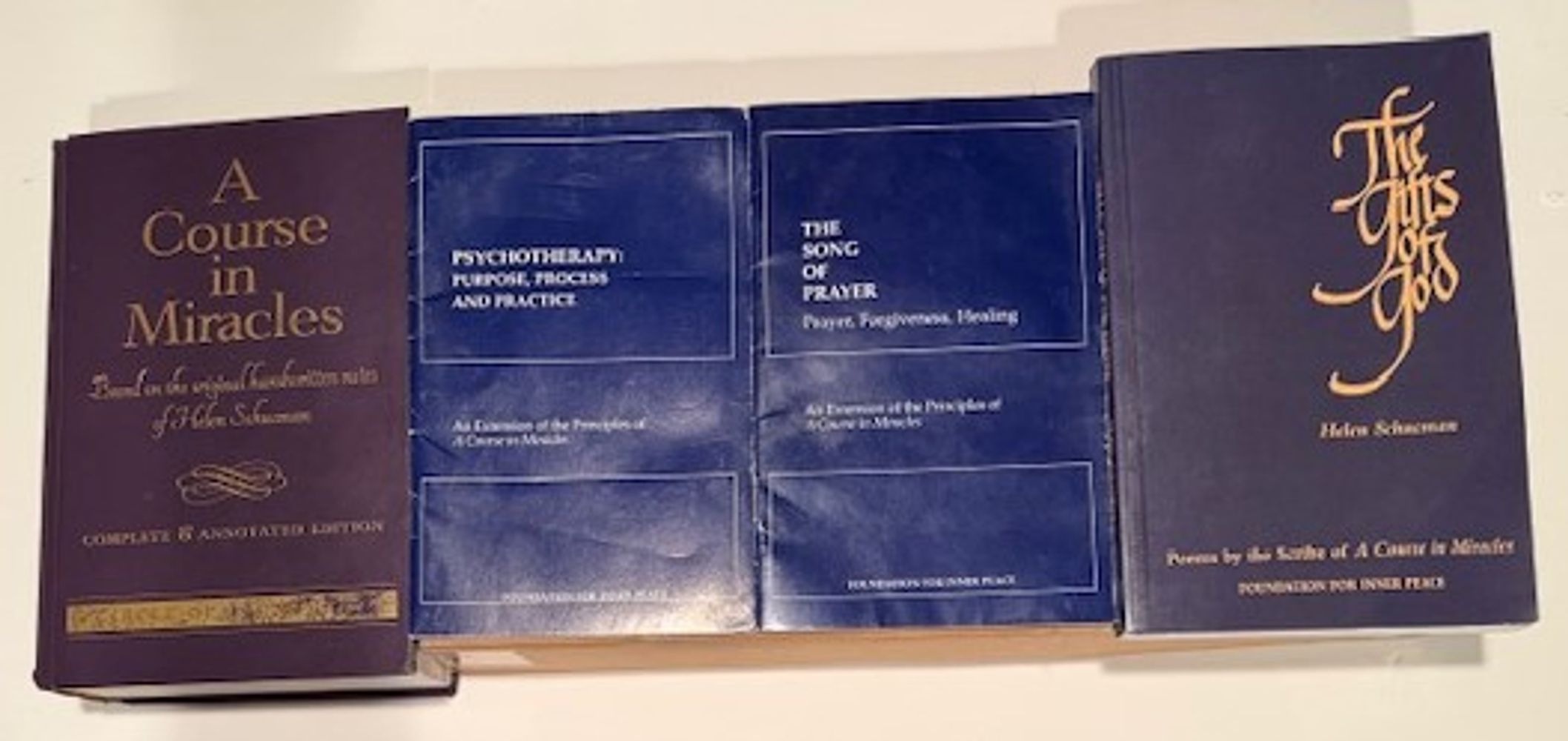
A Course in Miracles (ACIM) is a comprehensive self-study spiritual thought system designed to assist students in achieving spiritual transformation through the practice of forgiveness. By shifting one’s perception from fear to love, the curriculum aims to remove the "blocks to the awareness of love’s presence," which it defines as our natural inheritance.
Since its initial publication in 1976, A Course in Miracles has remained one of the most influential and challenging spiritual texts of the modern era. As of 2026, it continues to serve as a foundational pillar for millions of seekers worldwide, transcending traditional religious boundaries while utilizing a unique blend of Christian terminology and non-dualistic Eastern philosophy. This review and overview examines the book’s complex structure, its radical core teachings, and the practical application of its 365-day curriculum.
The Origins and Authorship of A Course in Miracles
The story of how A Course in Miracles came to be is as significant to its legacy as the content itself. The text was not "authored" in the traditional sense but was "scribed" between 1965 and 1972. The process involved two psychology professors at Columbia University’s College of Physicians and Surgeons in New York City: Dr. Helen Schucman and Dr. William Thetford.
Schucman, a self-described "militant atheist" at the time, began receiving a series of vivid internal visions and a distinct "inner voice" that identified itself as Jesus. Despite her professional skepticism and personal discomfort, she recorded the dictation in shorthand, which Thetford then typed. This collaboration lasted seven years, resulting in a three-volume work that claims a divine origin.
It is important to note that while the voice identifies as Jesus, the Course is not a religion. It does not advocate for a church structure or a specific creed. Instead, it presents itself as a curriculum for those seeking a "universal theology" that emphasizes individual experience over dogma. The Foundation for Inner Peace became the original publisher, and the text has since been translated into over 25 languages, maintaining its status as a global spiritual phenomenon through 2026.
Structural Breakdown of the Curriculum
A Course in Miracles is typically published as a single volume containing three distinct sections, along with two supplements that were scribed later. Understanding the function of each section is vital for any prospective student.
1. The Text
The Text comprises the first 669 pages of the combined volume. It provides the theoretical foundation for the entire system. It is written in a dense, poetic style, often utilizing iambic pentameter—the same meter used by Shakespeare. This section explores the nature of reality, the origin of the ego, the meaning of the atonement, and the mechanics of the "separation" from God. It is largely philosophical and serves to deconstruct the reader's current belief system.
2. The Workbook for Students
The Workbook consists of 365 lessons, one for each day of the year. This is the practical heart of the Course. It is designed to train the mind to perceive the world differently. The first half of the lessons focuses on "undoing" the way we currently see the world (e.g., Lesson 1: "Nothing I see in this room... means anything"). The second half focuses on the acquisition of true perception. The lessons require only a few minutes of focus each day but demand total commitment to the process.
3. The Manual for Teachers
The Manual is written in a question-and-answer format. It addresses specific concerns that students may have as they progress and provides definitions for some of the more technical terms used in the Text. It also clarifies the role of a "teacher of God," which ACIM defines not as someone with a title, but as anyone who chooses to follow the Holy Spirit’s guidance in their daily interactions.
4. The Supplements
Most modern editions include "Psychotherapy: Purpose, Process and Practice" and "The Song of Prayer." These extensions apply the principles of the Course to the fields of healing and communication, further refining the concept of "true prayer" as a state of gratitude rather than a list of requests.
Core Philosophical Principles: The Architecture of Forgiveness
The central theme of A Course in Miracles is the distinction between Reality (Knowledge) and the Illusion (Perception). To understand the book, one must grasp its radical definition of these terms.
The Ego vs. The Holy Spirit
In the framework of ACIM, the "Ego" is the false belief in separation—the idea that we are individual, private bodies competing for resources in a hostile universe. The Ego thrives on guilt, fear, and "specialness." Conversely, the "Holy Spirit" is the "Voice for God" within the mind that reminds the individual of their inherent oneness with the Creator and all living things. The goal of the Course is to help the student learn to choose the Holy Spirit’s interpretation of events over the Ego’s interpretation.
Radical Forgiveness
Forgiveness in ACIM differs significantly from the traditional "forgive and forget" model. In the worldly sense, forgiveness often implies that someone did something "wrong" and we are "graciously" overlooking it. ACIM argues that this reinforces the reality of the error.
Instead, ACIM teaches "forgiveness-to-destroy-judgment." It involves realizing that what you thought your brother did to you has not occurred in reality because the world of form is a dream. By seeing that the "sin" was merely an "error" or a "call for love," the student releases their own guilt. This is the "miracle"—the shift in perception from seeing a sinner to seeing a brother.
The Nature of Miracles
The title can be misleading for those expecting supernatural events like water turning into wine. In ACIM, a miracle is defined as a "shift in perception." It is the moment an individual chooses to see through the eyes of love rather than the eyes of fear. The Course states that "miracles are natural" and that when they do not occur, something has gone wrong. They are not intended to change the physical world, but rather to change the mind of the person perceiving the world.
Practical Comparison: ACIM vs. Other Spiritual Paths
To better understand the niche ACIM occupies in 2026, it is helpful to compare its approach with other major spiritual and religious frameworks.
| Feature | Traditional Christianity | New Age Spirituality | A Course in Miracles |
|---|---|---|---|
| Primary Goal | Salvation through Christ | Personal Manifestation | Peace through Forgiveness |
| Nature of the World | Real, created by God | Real, a place for growth | An illusion/dream state |
| Concept of Sin | Real transgression | Low vibration/Karma | An unreal error in thought |
| Role of Jesus | Savior and Son of God | Ascended Master | Elder brother/Scribe |
| Daily Practice | Prayer and Worship | Meditation/Law of Attraction | Systematic Mind Training |
| View of the Body | Temple or source of sin | Vessel for the soul | A neutral learning device |
Critical Review: Strengths and Challenges
As a literary and spiritual work, A Course in Miracles is polarizing. Its strengths are often the very source of its challenges for new students.
Strengths
- Logical Consistency: Once the initial premises are accepted (e.g., God is Love, and anything not of God is not real), the entire 1,300-page system follows with rigorous logic.
- Psychological Depth: Long before modern cognitive behavioral therapy (CBT) became mainstream, ACIM was using sophisticated psychological techniques to help people identify and dismantle self-sabotaging thought patterns.
- Empowerment: The Course places the power of peace entirely within the individual’s mind. It teaches that nothing outside of you can make you unhappy, which provides a profound sense of agency in a chaotic world.
Challenges
- The Language Barrier: The use of traditional Christian terms (Atonement, Holy Spirit, Salvation) often alienates secular readers or those with "religious trauma." However, the Course redefines these terms so radically that they bear little resemblance to their orthodox meanings.
- Density and Length: It is not a book one "reads"; it is a book one "studies." Many people find the Text nearly impenetrable on a first pass without a study group or a commentary.
- The Requirement of Practice: Many readers enjoy the theory but struggle with the Workbook. The discipline required to complete 365 consecutive days of mental exercises is a significant barrier to entry.
Implementation: How to Begin Study in 2026
For those interested in exploring A Course in Miracles, the following steps are recommended to ensure a productive experience.
- Obtain the "Combined Volume": Ensure you have the Third Edition (or later) published by the Foundation for Inner Peace. This version contains the most accurate text as authorized by the original scribes and includes the clarifying supplements.
- Start with the Workbook: While the Text provides the "why," the Workbook provides the "how." Many successful students start by doing one lesson a day while slowly reading a few pages of the Text each evening.
- Use Supporting Resources: In 2026, there are numerous digital resources, including apps that send daily lesson reminders and podcasts that explain each lesson in contemporary language.
- Adopt a "Beginner’s Mind": The Course explicitly asks students not to try to "understand" the lessons but simply to "do" them. The understanding comes through the experience of the shift in perception, not through intellectual mastery.
Troubleshooting Common Obstacles
Students frequently encounter "resistance" when studying ACIM. This is often manifested as boredom, anger at the text, or a sudden conviction that the book is "cultish" or "nonsense."
- Intellectual Fatigue: The iambic pentameter can be hypnotic but also tiring. If the Text feels too dense, switch focus to the Manual for Teachers, which is written in a more direct, conversational prose.
- Feeling "Behind": There is no such thing as being behind in ACIM. If you miss a day of the Workbook, simply pick up where you left off. The goal is consistency, not speed.
- Religious Resistance: If the word "God" is a trigger, many students find success by mentally substituting "Universal Intelligence," "The One," or "Love." The Course itself notes that the words are just symbols.
Frequently Asked Questions
Is A Course in Miracles a cult?
No. A Course in Miracles lacks the hallmarks of a cult: there is no central leader, no requirement for financial tithing, no social isolation, and no central organization that monitors its students. It is a self-study curriculum that emphasizes the student's internal relationship with their own "Inner Teacher." While study groups exist, participation is voluntary and decentralized.
Do I have to be a Christian to study ACIM?
Absolutely not. While the Course uses Christian terminology, its underlying philosophy is closer to Advaita Vedanta (Hindu non-dualism) or certain forms of Buddhism. Many practitioners identify as Jewish, Buddhist, atheist, or "spiritual but not religious." The book uses Christian metaphors as a way to "undo" traditional religious guilt.
How long does it take to see results?
The "results" of ACIM are internal peace and a reduction in conflict. Some students report a sense of relief and clarity within the first few weeks of the Workbook lessons. However, the complete "unlearning" of the ego's thought system is considered a lifelong process. The Course is often described as a "journey without distance" to a goal that has never changed.
Can I skip the Text and just do the Workbook?
While it is possible, skipping the Text often leads to confusion regarding the purpose of the lessons. The Workbook provides the "experience," but the Text provides the necessary framework to interpret that experience. Without the theory, the lessons can seem arbitrary or even nonsensical.
Who is the "Teacher of God" mentioned in the Manual?
In ACIM terms, a teacher of God is anyone who has made a deliberate choice to look for the good in others rather than focusing on their faults. It is not a professional designation. It refers to someone who has committed to the practice of forgiveness in their daily life, whether they are a parent, a businessperson, or a traditional educator.
Final Recommendation
A Course in Miracles is not a light read, nor is it a traditional "self-help" book. It is a rigorous, demanding, and ultimately rewarding system for those who are tired of conflict and seeking a deep, sustainable sense of inner peace. If you are willing to question your entire perception of reality and dedicate a year to systematic mind training, this book offers a profound path toward spiritual awakening. In 2026, as the world faces increasingly complex challenges, the Course’s message that "peace is possible" remains a vital resource for the modern seeker.