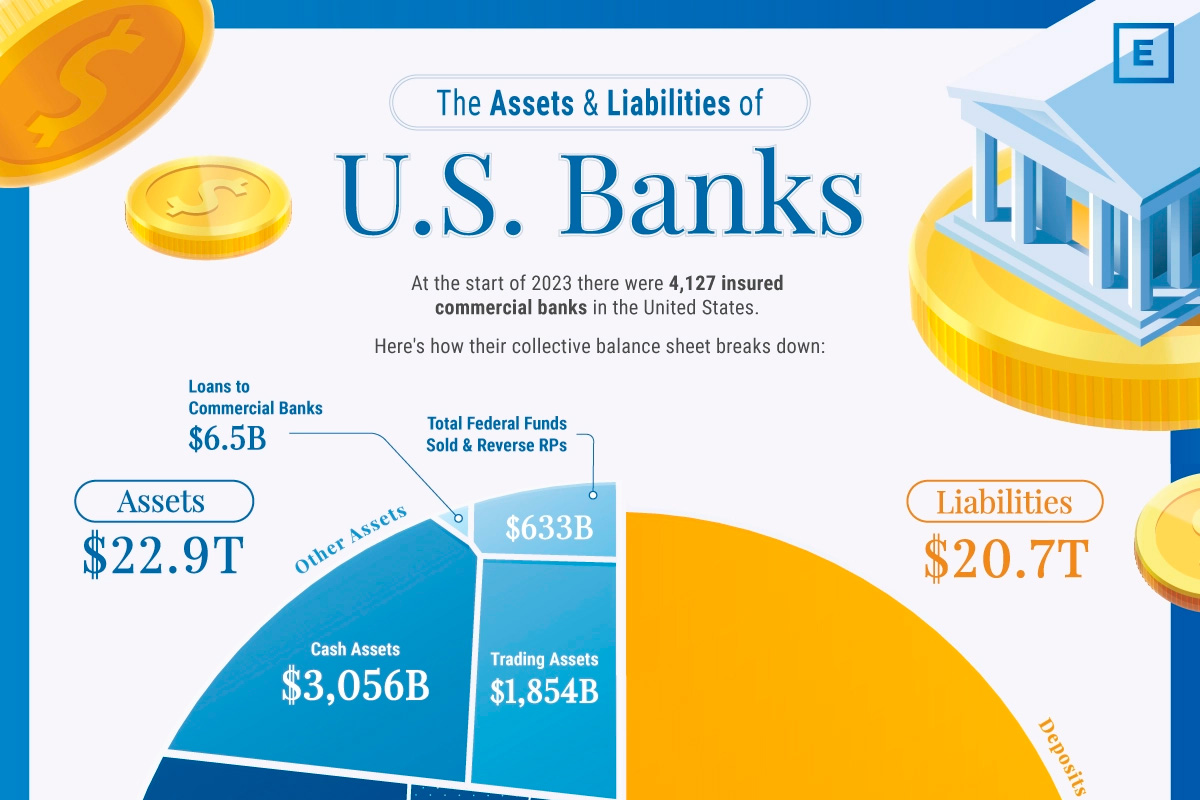
A bank's net worth, often referred to as equity or capital, is the residual value remaining after all its liabilities are subtracted from its total assets. This figure represents the financial cushion available to absorb losses, protecting depositors and ensuring the institution remains solvent during periods of economic volatility or credit stress.
In the complex world of global finance, a bank’s balance sheet serves as the primary document for assessing its health. Unlike a typical manufacturing company or a retail business, a bank’s "inventory" consists almost entirely of financial instruments. To understand why a bank's net worth is the difference between its assets and its liabilities, one must first deconstruct what these categories actually mean within the context of a regulated financial institution in 2026.
The Fundamental Accounting Identity of Banking
At its most basic level, the financial structure of any corporation follows the fundamental accounting equation: Assets = Liabilities + Equity. When we rearrange this to solve for equity, we find that Equity (or Net Worth) = Assets - Liabilities.
For a bank, this equity is the "owners' stake." It is the money provided by shareholders plus any profits the bank has kept over the years (retained earnings). If a bank were to cease operations today, sell all its buildings, collect all the money owed to it by borrowers, and pay off all its depositors and creditors, the amount left over would be its net worth.
In 2026, maintaining a robust net worth is not just a matter of good business practice; it is a strict regulatory requirement. Following the lessons learned from various banking stresses in the early 2020s, global regulators have placed even greater emphasis on "Tier 1 Capital," which is the core measure of a bank's net worth from a regulator's point of view.
Deconstructing Bank Assets: What the Bank Owns
To calculate net worth, we must first accurately value a bank's assets. In a bank, assets are generally items that generate income or represent cash on hand.
1. Loans (The Primary Asset)
For most commercial banks, the largest portion of their assets consists of loans. This includes mortgages, auto loans, credit card balances, and commercial loans to businesses. While a consumer views a loan as a liability (money they owe), the bank views it as an asset because it represents a legal claim to future principal and interest payments.
2. Securities and Investments
Banks do not simply let cash sit idle. They invest in highly liquid, interest-bearing securities. This often includes government bonds (such as U.S. Treasuries), municipal bonds, and mortgage-backed securities. These are considered assets because they can be sold for cash and provide a steady stream of income.
3. Cash and Central Bank Reserves
Banks must keep a certain amount of physical cash in their vaults and ATMs to meet daily withdrawal demands. Additionally, they maintain "reserves" at the central bank (such as the Federal Reserve in the United States). These are the most liquid assets a bank possesses.
4. Physical and Intangible Assets
This category includes the bank's headquarters, branch buildings, furniture, and technology infrastructure. While these are "hard" assets, they usually represent a small fraction of a large bank's total asset base compared to its financial holdings.
Deconstructing Bank Liabilities: What the Bank Owes
The other side of the equation consists of liabilities. In banking, the definition of a liability can be counterintuitive for those outside the industry.
1. Deposits (The Largest Liability)
The money you keep in your checking or savings account is a liability for the bank. This is because the bank owes that money to you. You have the right to demand it back at any time (for demand deposits) or at a specified date (for time deposits like CDs). Because the bank is essentially "borrowing" this money from you to fund its loans, it appears on the liability side of the balance sheet.
2. Short-Term and Long-Term Borrowings
Banks often borrow money from other banks or from the central bank to manage their daily liquidity. They may also issue corporate bonds to investors to raise capital. These debts must be repaid with interest, making them significant liabilities.
3. Other Obligations
This includes taxes owed to the government, wages owed to employees, and accounts payable to vendors.
Why the Difference Matters: Solvency vs. Liquidity
The primary reason we focus on the fact that a bank's net worth is the difference between assets and liabilities is to determine solvency.
- Solvency: A bank is solvent if its assets are worth more than its liabilities. In other words, it has a positive net worth. If a bank’s assets drop in value (perhaps because many people default on their loans) to the point where they are worth less than the bank owes its depositors, the bank is insolvent.
- Liquidity: This is different from solvency. A bank might have a high net worth (plenty of assets) but not enough cash to meet immediate withdrawal demands. This is why regulators monitor both net worth and liquidity ratios.
In 2026, the distinction between these two is critical. A bank can be "wealthy" on paper but still fail if its assets are tied up in long-term loans while its depositors are demanding cash immediately.
The Role of Retained Earnings and Capital Buffers
Net worth is not a static number; it grows and shrinks based on the bank’s performance.
- Profits and Retained Earnings: When a bank earns interest on loans and pays out less interest on deposits, it makes a profit. After paying expenses and dividends to shareholders, the remaining profit is added to "Retained Earnings," which directly increases the bank's net worth.
- Asset Impairment: If a bank realizes that a large number of its loans will not be paid back, it must "write down" the value of those assets. This reduction in asset value directly reduces the bank's net worth.
The Federal Deposit Insurance Corporation (FDIC) and other global regulators require banks to maintain a certain percentage of net worth relative to their "risk-weighted assets." This ensures that if a bank's assets lose value, there is enough of a net-worth "cushion" to pay back depositors in full.
Comparative Overview: Asset and Liability Categories
The following table summarizes the typical components that determine a bank's net worth as of 2026.
| Category | Item | Classification | Impact on Net Worth |
|---|---|---|---|
| Assets | Cash & Vault Reserves | High Liquidity Asset | Positive |
| Assets | Mortgage & Consumer Loans | Earning Asset | Positive |
| Assets | Government Securities | Liquid Investment | Positive |
| Liabilities | Customer Deposits | Short-term Liability | Negative |
| Liabilities | Interbank Borrowings | Short-term Debt | Negative |
| Liabilities | Issued Corporate Bonds | Long-term Debt | Negative |
| Equity | Common Stock | Paid-in Capital | Component of Net Worth |
| Equity | Retained Earnings | Accumulated Profit | Component of Net Worth |
Regulatory Standards and the "Basel" Framework
In 2026, the banking industry continues to operate under the refined standards of the Basel Committee on Banking Supervision. These international standards dictate exactly how a bank's net worth must be calculated and how much of it must be held.
The Common Equity Tier 1 (CET1) ratio is the gold standard. It measures a bank's core equity capital compared to its total risk-weighted assets. If a bank has $10 billion in net worth and $100 billion in risk-weighted assets, its CET1 ratio is 10%. Regulators generally require this to be well above 4.5%, with many institutions aiming for 10% to 13% to ensure market confidence.
Common Risks to a Bank's Net Worth
Maintaining a positive difference between assets and liabilities is a constant challenge for bank management. Several risks can erode net worth quickly:
- Credit Risk: The risk that borrowers will default on their loans. This is the most direct threat to the asset side of the balance sheet.
- Interest Rate Risk: If interest rates rise, the market value of existing fixed-rate bonds (assets) falls. If the bank has to pay higher interest to its depositors (liabilities) while receiving the same low interest from its old loans, its profit and net worth suffer.
- Market Risk: For banks with large trading desks, fluctuations in stock prices, commodity prices, or foreign exchange rates can reduce the value of their investment assets.
The Importance of Net Worth for the General Public
For the average consumer in 2026, a bank’s net worth is a primary indicator of safety. While deposit insurance (like the FDIC in the U.S. or similar schemes in the E.U.) protects individual accounts up to certain limits, the systemic stability of the economy depends on banks remaining solvent.
When banks have high net worth, they are more willing to lend money to small businesses and homebuyers. When net worth is low, banks become "capital-constrained," leading to credit crunches where it becomes difficult for anyone to get a loan, which can trigger or worsen economic recessions.
Frequently Asked Questions
Is "Net Worth" the same as "Market Capitalization" for a bank?
No. Net worth (or book value) is based on the accounting value of assets and liabilities as recorded on the balance sheet. Market capitalization is the total value of the bank's shares as traded on the stock market. Investors often pay more than the book value (Price-to-Book ratio > 1) if they believe the bank will be highly profitable in the future.
Can a bank have a negative net worth?
Technically, yes, but this usually results in immediate regulatory intervention. A negative net worth means the bank's liabilities exceed its assets, making it insolvent. In such cases, regulators typically shut down the bank or force a merger with a healthier institution to protect depositors.
Why are deposits considered liabilities?
Deposits are liabilities because the bank does not "own" that money; it is borrowing it from the depositor. The bank has a legal obligation to return those funds upon request. While the bank uses those funds to create assets (loans), the deposits themselves remain a debt owed to the customers.
How does inflation affect a bank's net worth?
Inflation can have a mixed impact. It may lead to higher interest rates, which can decrease the value of fixed-income assets but increase interest income on new loans. However, if inflation leads to widespread defaults because borrowers cannot keep up with rising costs, the bank's net worth could be severely damaged.
What is the difference between Tier 1 and Tier 2 capital?
Tier 1 capital is a bank's core capital, including common stock and retained earnings—the most reliable forms of net worth. Tier 2 capital includes "supplementary" capital, such as subordinated debt and certain loan loss reserves, which are less secure than Tier 1.
Summary and Next Actions
Understanding that a bank's net worth is the difference between its assets and its liabilities is the first step in evaluating financial stability. In 2026, with the integration of more sophisticated risk-modeling and tighter regulatory oversight, this "capital cushion" remains the most important metric for both regulators and investors.
If you are an investor or a depositor interested in the health of a specific institution, you should:
- Review the Balance Sheet: Look for the "Total Equity" line item in the annual report.
- Check the CET1 Ratio: Ensure the bank’s capital ratio meets or exceeds regulatory requirements.
- Monitor Loan Quality: Look for the "Non-Performing Loan" (NPL) ratio, which indicates what percentage of assets might be at risk of disappearing.
By maintaining a significant gap between what it owns and what it owes, a bank ensures it can withstand economic shocks and continue to serve as a pillar of the financial system.