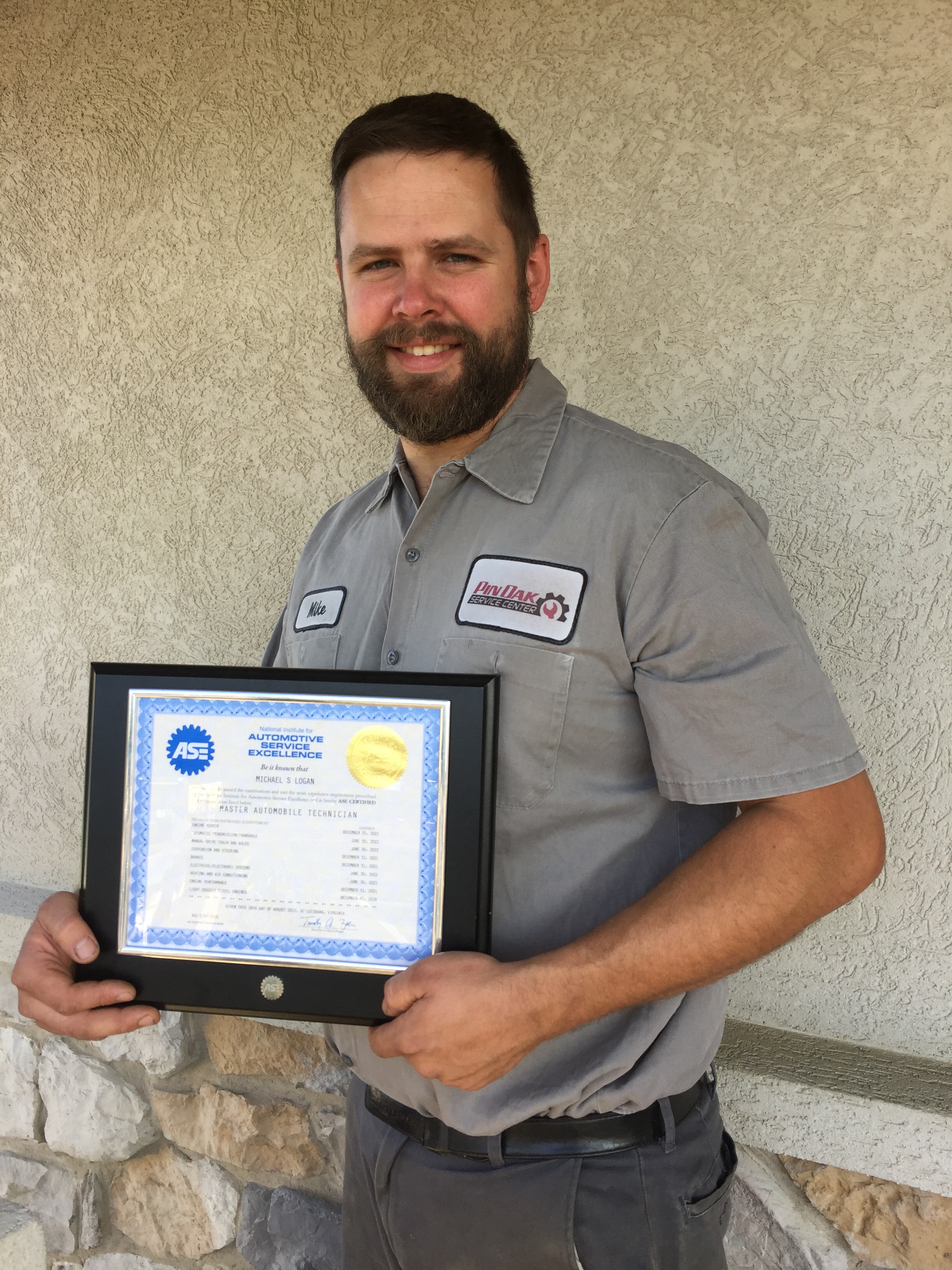
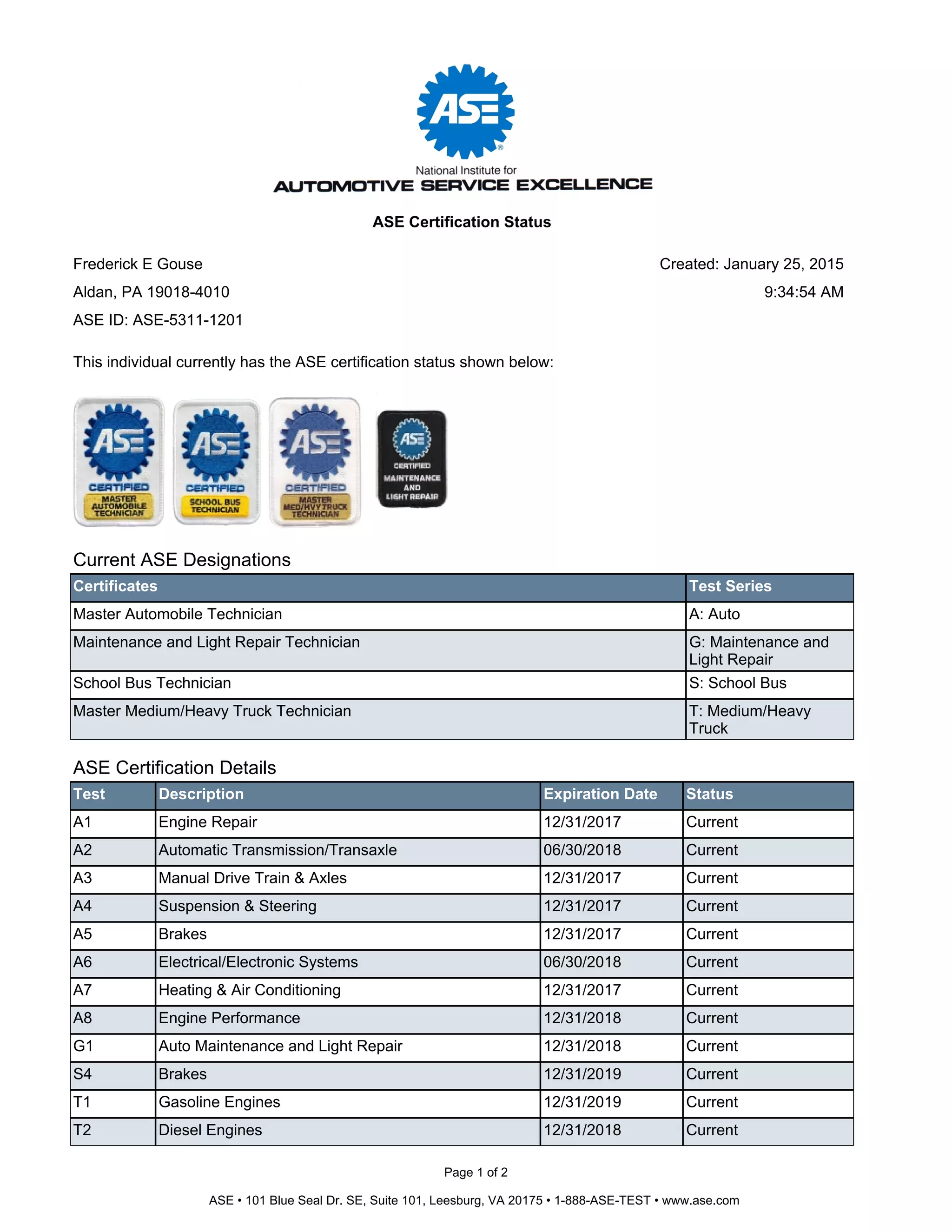
The ASE Master Mechanic certification is a professional credential awarded by the National Institute for Automotive Service Excellence. To earn it, technicians must pass a specific series of exams—such as the A1 through A8 tests for automobiles—and document two years of relevant work experience. Recertification is required every five years to maintain status.
In the automotive industry, the term "Master Mechanic" is the gold standard for technical proficiency. Formally known as an ASE Certified Master Technician, this designation signals to employers and customers alike that a professional has mastered the diverse and complex systems found in modern vehicles. As we progress through 2026, the complexity of automotive technology—ranging from high-voltage electric drivetrains to sophisticated Advanced Driver Assistance Systems (ADAS)—makes the Master status more relevant than ever for career advancement and consumer trust.
Understanding the ASE Master Status
The National Institute for Automotive Service Excellence (ASE) was established in 1972 as an independent, non-profit organization. Its mission is to improve the quality of vehicle repair and service through the testing and certification of repair and service professionals. Unlike a generic "mechanic" title, which is often self-applied, the ASE Master designation is an earned title that requires rigorous testing and verified field experience.
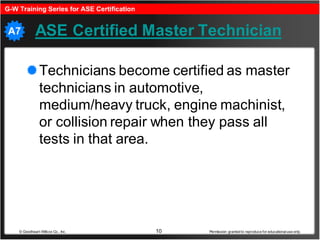
A technician does not become a Master by passing a single, comprehensive exam. Instead, they must successfully complete a "series" of individual certifications. For example, in the Automobile & Light Truck category, there are eight core tests (A1 through A8). Only after a technician has passed all eight and met the professional experience requirements are they granted the "Master" title. If a technician passes only one or two tests, they are simply "ASE Certified" in those specific areas.
The Core Master Certification Tracks
ASE offers several tracks for Master certification, depending on the technician’s area of specialization. While the Automobile & Light Truck (A-Series) is the most common, other tracks exist for heavy machinery, collision repair, and transit systems.
Automobile and Light Truck (A1–A8)
To become a Master Automobile Technician, you must pass all of the following exams:
- A1 - Engine Repair: Focuses on the diagnosis and repair of cylinder heads, valve trains, engine blocks, and cooling systems.
- A2 - Automatic Transmission/Transaxle: Covers hydraulic systems, shifting logic, and electronic controls.
- A3 - Manual Drive Train & Axles: Includes clutches, manual transmissions, universal joints, and four-wheel-drive components.
- A4 - Suspension & Steering: Deals with steering systems, suspension types, wheel alignment, and related electronics.
- A5 - Brakes: Covers hydraulic systems, drum/disc brakes, and the complexities of Anti-lock Braking Systems (ABS).
- A6 - Electrical/Electronic Systems: Generally considered one of the most difficult, focusing on battery, starting, charging, lighting, and CAN bus communication.
- A7 - Heating & Air Conditioning: Focuses on HVAC diagnosis, including modern R-1234yf refrigerant systems.
- A8 - Engine Performance: Covers fuel, ignition, and emission control systems, including the complex electronics that manage engine efficiency.
Other Master Designations
Technicians can also earn Master status in specialized sectors. Each has its own set of required exams:
| Master Designation | Required Exams | Focus Area |
|---|---|---|
| Collision Repair | B2, B3, B4, B5 | Painting, Structural Analysis, Non-structural Repair, Mechanical/Electrical. |
| Medium-Heavy Truck | T2, T3, T4, T5, T6, T7, T8 | Diesel Engines, Drivetrains, Brakes, Steering, HVAC, and Systems. |
| School Bus | S1, S2, S3, S4, S5, S6 | Body Systems, Diesel/Gas Engines, Brakes, Steering, and HVAC. |
| Transit Bus | H1, H2, H3, H4, H5, H6, H7, H8 | Specialized transit systems, including Compressed Natural Gas (CNG). |
Educational and Experience Requirements
Passing the exams is only half of the journey. ASE requires documented evidence of relevant work experience to award the Master credential.
The Two-Year Rule
The standard requirement is two years of full-time, hands-on work experience. This experience must be relevant to the series in which you are seeking certification. For instance, time spent purely in a tire and lube shop might not count toward the full depth required for an A2 (Automatic Transmission) Master credential unless specific repair tasks were performed.
Educational Substitutions
Recognizing the value of formal technical training, ASE allows for certain educational substitutions to satisfy a portion of the two-year requirement:
- Graduation from a high school automotive program: Can count for one year of experience.
- Graduation from a post-secondary (college/trade school) program: Can count for one year of experience.
- Short-term training: Specific accredited programs may count for 6 months of credit.
Technicians must submit a completed Work Experience Form to ASE for verification. In 2026, many of these submissions are processed digitally through the ASE portal, allowing for faster verification than in previous decades.
The Testing Process: Registration and Environment
ASE tests are administered year-round at secure testing centers, primarily through Prometric. Since 2023 and into 2026, ASE has also expanded options for remote proctoring for certain renewal tests, though initial Master certification often requires an in-person visit to a testing facility to ensure the highest integrity of the credential.
Registering for Exams
Technicians must create a "myASE" account on the official ASE website. Here, you can select your exams, pay the fees, and then schedule your testing window. Testing is available in several windows throughout the year, but the flexibility of modern computer-based testing means you can often find an appointment within a few days of registration.
The Exam Format
All ASE exams are computer-based and primarily consist of multiple-choice questions. These are not "trick" questions, but they are designed to be challenging. They often utilize "Technician A and Technician B" scenarios, where you must determine which technician’s diagnosis is correct. This format tests not just factual knowledge, but the ability to apply logic to diagnostic problems.
Costs and Fees (2026 Estimates)
While pricing can adjust slightly year-to-year, the current fee structure generally consists of a registration fee plus a per-test fee.
- Registration Fee: Approximately $34 per order.
- Standard Test Fee: Approximately $56 per test (A1–A8).
- Advanced Level Tests (L1, L2, L3): Approximately $112 per test.
For a technician pursuing the full A-series Master status for the first time, the total investment in testing fees is roughly $482 (8 tests at $56 each plus the registration fee). Many dealerships and independent repair shops reimburse their employees for these fees upon successful completion.
Strategies for Exam Preparation
Earning a Master status requires significant study, even for experienced mechanics. The "A-series" exams cover a breadth of technical data that few technicians encounter every single day.
- Official Study Guides: ASE provides free study guides on their website that outline the "Task List" for each exam. This list identifies exactly what percentage of the test is devoted to specific systems (e.g., 20% on Clutch Diagnosis, 30% on Transmission Repair).
- Practice Tests: The ASE Practice Tests are the most accurate way to gauge readiness. They use the same logic and question style as the actual exams.
- Third-Party Training: Companies like Motor Age Training, Delmar Cengage Learning, and various YouTube technical channels offer deep dives into ASE-style questions.
- Focus on Electrical (A6): Statistics consistently show that A6 has one of the lower pass rates. In 2026, the integration of high-voltage systems and networking means technicians should spend extra time studying Ohm’s Law, digital multimeters (DMM), and oscilloscope patterns.
The 5-Year Recertification Rule
One of the reasons the ASE Master Mechanic certification is respected is that it does not last a lifetime. Vehicle technology moves too quickly for a 1995 certification to remain valid in 2026.
Technicians must recertify every five years in each area they hold. If a Master Technician lets even one of their eight core certifications expire, they lose their "Master" status until that specific test is retaken and passed.
The ASE Renewal App
To make recertification less burdensome, ASE introduced the ASE Renewal App. This allows eligible technicians to maintain their certifications by answering questions on a mobile device throughout the year. Instead of going to a testing center every five years, you can prove your ongoing knowledge through monthly "mini-tests." This is a significant convenience for busy professionals who want to avoid the stress of an 80-question proctored exam.
The Professional Value of Master Certification
Why go through the stress and expense of becoming an ASE Master Technician? The benefits extend beyond a patch on a uniform.
Increased Compensation
Most data from the Bureau of Labor Statistics and industry surveys indicate that ASE-certified technicians earn higher hourly rates or flat-rate commissions than their uncertified counterparts. Many shops offer "tier-based" pay, where your hourly rate increases for every ASE certification you earn, with a significant "bump" once you achieve Master status.
Employer Requirements
For a shop to become "ASE Blue Seal of Excellence" recognized, a high percentage of their staff must be certified. Consequently, the most reputable shops—those that charge higher labor rates and work on high-end vehicles—prioritize hiring Master Technicians.
Consumer Confidence
Modern consumers are more educated than ever. Seeing the ASE Master Technician seal on a shop's wall or a technician's sleeve provides immediate reassurance. It suggests that the person working on a $60,000 vehicle with complex safety sensors actually knows how those systems interact.
Advanced Specialized Master Designations
Once you achieve Master status, the journey doesn't have to end. ASE offers "Advanced Level" certifications that are highly prized in 2026:
- L1 (Advanced Engine Performance Specialist): Focuses on sophisticated powertrain diagnostics.
- L3 (Light Duty Hybrid/Electric Vehicle Specialist): Essential for working on EVs, which dominate the market in 2026.
- L4 (Advanced Driver Assistance Systems): Covers the calibration and repair of cameras, radar, and LIDAR used in autonomous driving features.
While these are not required for the initial "Master" status, they are the logical next step for any professional looking to stay at the top of the field.
Common Mistakes and Troubleshooting the Certification Path
Many technicians struggle not because of a lack of skill, but because of procedural errors:
- Lapsed Certifications: Forgetting the five-year expiration is the most common way to lose Master status. Use the myASE portal to set alerts.
- Incomplete Experience Documentation: Ensure your employer signs off on your work experience. If you are self-employed, you must provide alternative documentation, such as tax records or business licenses.
- Overconfidence: Many "old school" mechanics fail the A8 or A6 tests because they rely on outdated methods rather than the specific diagnostic steps ASE tests for. Always review the current Task Lists.
Frequently Asked Questions
What happens if I fail an ASE exam?
If you fail an exam, you must wait 30 days before you are eligible to retake it. You will have to pay the test fee again, though you do not usually have to pay the registration fee if you are within the same one-year registration period. Use the diagnostic report provided after your failed attempt to see which areas (e.g., "Diagnosis" vs. "Repair") you need to study more.
Can I take all eight "A" tests at once?
Technically, yes, you can schedule multiple tests in one day. However, it is not recommended. Each test is mentally taxing. Most successful technicians recommend taking two or three tests per session to maintain focus and high scores.
Is there an "ASE Master Mechanic" for Electric Vehicles?
In 2026, there is not yet a standalone "EV Master" track in the same way there is for Automobile or Truck. Instead, technicians earn their Master status in the A-series and then add the L3 Hybrid/Electric Vehicle Specialist certification. This L3 credential is the industry-recognized mark of an EV expert.
How do I prove my Master status to an employer?
Once you pass your exams and your work experience is verified, ASE provides a certificate and a wallet card. You can also log into your myASE account to show a digital transcript of your current certifications. Most employers will verify this through the official ASE Status Verification tool.
Do ASE certifications expire if I leave the industry?
Yes, the five-year expiration clock continues regardless of your employment status. If you leave the automotive field for six years and then return, you will need to retake the exams to regain your certification status.
Practical Recommendation
If you are just starting your journey toward becoming an ASE Master Mechanic, start with the A6 (Electrical) and A8 (Engine Performance) exams. These are the "heavy hitters" that form the foundation of modern vehicle repair. Passing these early will give you the confidence—and the most immediate technical boost—needed to tackle the mechanical components of the other six exams. Register for your first two tests today and download the official Task Lists to ensure your study time is aligned with the actual exam content.