Ambetter Broker Services provides licensed health insurance agents with the administrative tools, contracting pipelines, digital portals, and sales resources required to quote, enroll, and manage clients on Ambetter Health Insurance Marketplace plans. Offered by Centene Corporation, these services enable independent brokers and agency partners to maintain books of business across state and federal health exchanges.
Understanding Ambetter Broker Services and Market Position
Ambetter Broker Services serves as the primary operational gateway between Centene Corporation—the largest provider of Affordable Care Act (ACA) Marketplace plans in the United States—and independent health insurance brokers. Through its dedicated broker support divisions, Ambetter delivers contracting management, commission processing, compliance monitoring, and client portal architecture across more than two dozen state markets.
For insurance agents operating in the individual and family health market, contracting with Ambetter provides access to On-Exchange plans categorized under standard ACA metal tiers: Bronze (Essential Care), Silver (Balanced Care), and Gold (Secure Care). Many regional markets also feature integrated dental and vision riders, optional adult wellness programs, and specialized plan structures like Ambetter Health Select.
- Centene Broker Services Admin
- Contracting & Compliance
- State Licensing Verification
- FFM / SBE Certification
- AHIP / Annual Recertification
- E&O Insurance Validation
- Broker Portal Architecture
- Quoting & Direct Enrollment
- Book of Business Management
- Commission Statements & Direct Deposit Tracking
- Contracting & Compliance
The health insurance landscape requires brokers to balance rigorous regulatory compliance with swift client onboarding. Ambetter Broker Services addresses this by providing centralized management platforms—frequently accessed via the Centene Broker Portal or regional Ambetter agent dashboards—where producers can monitor pending applications, track binder payments, process renewals, and download state-specific marketing collateral.
Eligibility and Prerequisites for Ambetter Broker Contracting
Before gaining access to the Ambetter Broker Portal or writing business in any state, insurance producers must satisfy baseline legal, regulatory, and corporate prerequisites. Centene enforces strict verification standards to maintain compliance with the Centers for Medicare & Medicaid Services (CMS) and state departments of insurance.
1. Active State Accident & Health License
Brokers must hold an active resident or non-resident Accident and Health (or Life & Health) insurance license in every state where they intend to solicit, quote, or enroll Ambetter clients. Licensing details are validated against the National Insurance Producer Registry (NIPR) database during the contracting workflow.
2. Marketplace Certification (FFM or SBE Training)
Because Ambetter plans are sold primarily through Qualified Health Plan (QHP) exchanges, brokers must complete annual training prescribed by exchange authorities:
- Federally-Facilitated Marketplace (FFM): Agents operating in FFM states must complete the CMS Marketplace training via the CMS Enterprise Portal / Marketplace Learning Management System (MLMS) or an authorized third-party vendor (such as AHIP) prior to the start of the Open Enrollment Period (OEP).
- State-Based Exchanges (SBE): In states operating their own exchange platforms (such as Covered California, Pennsylvania’s Pennie, or GetCoveredNJ), brokers must complete state-specific exchange certifications in addition to carrier onboarding.
3. Errors and Omissions (E&O) Insurance
Ambetter requires all contracted brokers and agencies to maintain active Errors and Omissions coverage. The standard policy requirement mandates minimum liability limits—typically $1,000,000 per occurrence and $1,000,000 aggregate—with proof of coverage uploaded directly into the broker portal during initial setup and annual renewal cycles.
4. Background and Tax Documentation
Producers must provide standard tax documentation, including a Form W-9 for individual producers or corporate entities, along with banking details for electronic funds transfer (EFT) commission payouts. Background screenings are conducted during the appointment process to verify legal eligibility.
Step-by-Step Onboarding and Appointment Workflow
Getting contracted with Ambetter can occur either directly with Centene Broker Services or through a Field Marketing Organization (FMO), General Agency (GA), or Managing General Agency (MGA). The workflow generally follows these sequential steps:
- Step 1: Onboarding Request
- Step 2: Legal & E&O Review
- Step 3: Exchange Certification Verification
- Step 4: Writing Number & Portal Access
Step 1: Requesting a Contracting Link
Producers registering directly submit an inquiry via the Ambetter producer registration portal. Producers aligning under an agency or FMO request a custom contracting link generated by their upline. This link pre-populates commission hierarchy structures and routing rules.
Step 2: Submission of Background Data and License Verification
Using the secure online contracting platform (often powered by tools like SureLC or Centene's proprietary onboarding software), agents complete their background questionnaires, input their National Producer Number (NPN), and attach proof of E&O insurance.
Step 3: Verification of Annual Carrier Training
Brokers must complete the annual Ambetter product training module. This carrier-specific training covers regional plan options, formulary tiers, provider network changes, wellness program benefits (such as the My Health Pays program), and binding payment deadlines.
Step 4: Writing Number Issuance and Portal Access
Once Centene validates license status, background clearance, exchange certification, and product training, a unique Ambetter Producer Writing Number is assigned. The broker receives login credentials for the official Ambetter Broker Portal, allowing them to quote, write, and service clients immediately.
Essential Features of the Ambetter Broker Portal
The Ambetter Broker Portal serves as the primary operational hub for writing agents. Designed to handle high transaction volumes during the annual Open Enrollment Period as well as ongoing Special Enrollment Periods (SEPs), the portal integrates core administrative functions into a unified dashboard.
| Client Management | Quoting & Enrollment | Commissions & Accounting |
|---|---|---|
| Active Book Review | Subsidy Calculator | Monthly Pay Statements |
| Binder Payment Status | Plan Comparison Tool | Production Level Tracking |
| Document Uploads | Direct Electronic App | Adjustment & Chargebacks |
1. Client and Book of Business (BOB) Management
Brokers can search, filter, and export their active client lists. The portal displays critical status indicators for every policyholder, including:
- Application Status: Pending, Approved, Terminated, or Cancelled.
- Payment Status: Paid to date, Binder Outstanding, or Grace Period (1st, 2nd, or 3rd month of delinquency).
- Demographic Details: Address updates, household income changes, and dependent adjustments.
2. Quoting and Direct Enrollment Integration
The portal features an integrated quoting engine that estimates Advance Premium Tax Credits (APTC) and Cost-Sharing Reductions (CSR) based on estimated household income, ZIP code, family size, and age. Agents can send custom quotes directly to clients via email or text, or execute end-to-end e-applications with digital client signatures.
3. Integrated Third-Party Web-Broker Entities (WBEs)
Ambetter supports integration with leading industry Web-Broker Entities such as HealthSherpa. Brokers using third-party platforms can link their Ambetter Writing Number to execute enrollments on external interfaces while ensuring production credits and commissions auto-route to their Centene broker account.
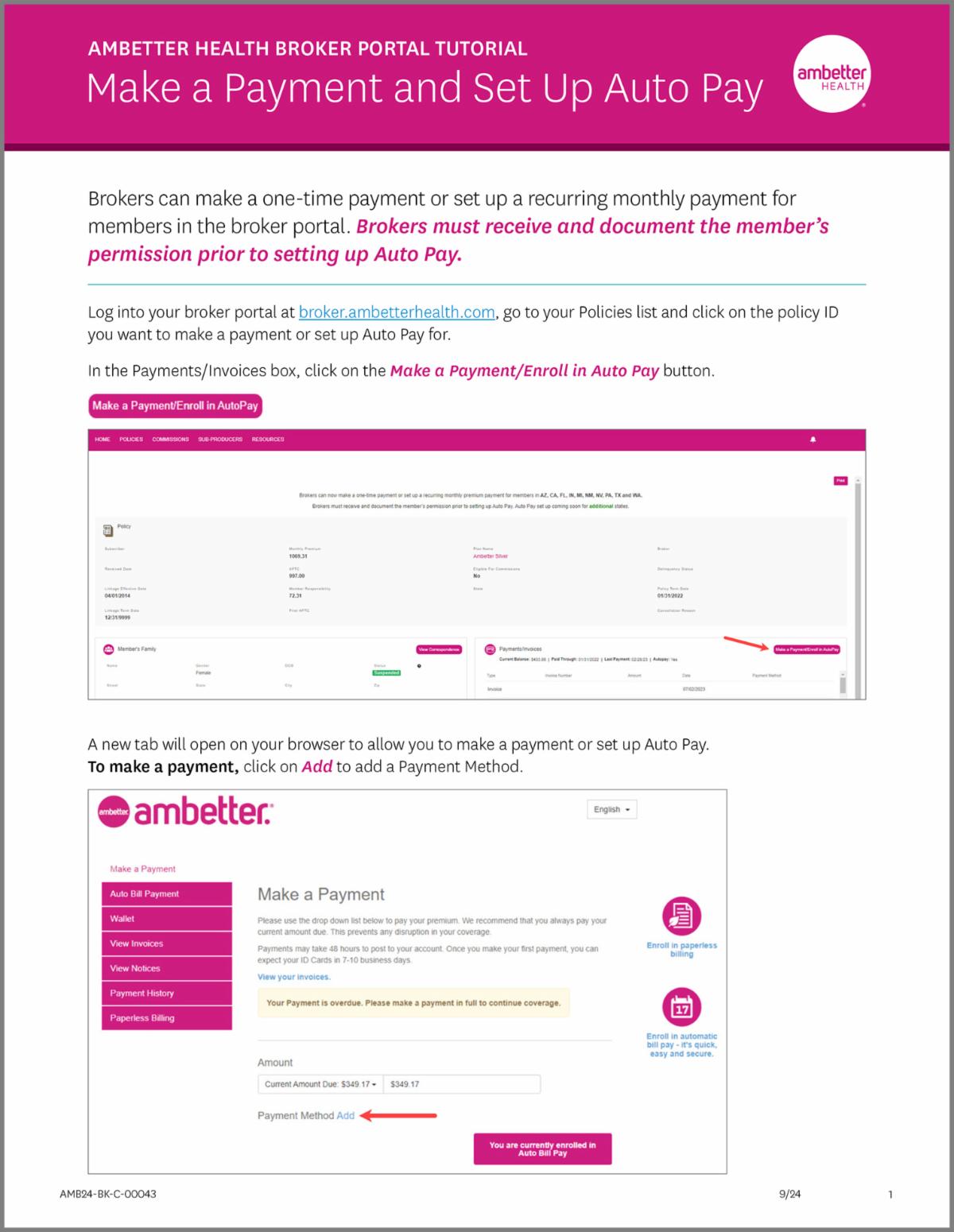
4. Binder Payment Processing
A common point of friction in ACA sales is initial payment collection. The broker dashboard enables agents to track whether a client has submitted their initial "binder payment." Many state portals allow brokers to trigger payment reminder links directly to policyholders via SMS or email, reducing drop-off rates before the effective date.
Platform Technical Comparison: Portal Options for Brokers
Brokers selling Ambetter have multiple technological pathways for submitting applications. Selecting the appropriate portal workflow depends on agency size, software integrations, and client interaction preferences.
| Feature / Operational Capability | Native Ambetter Broker Portal | HealthSherpa (WBE Integration) | State-Based Exchange (SBE) Portals |
|---|---|---|---|
| Primary Focus | Ambetter-only plan management | Multi-carrier ACA enrollment | State-regulated exchange compliance |
| Direct Application Processing | Full native integration | Accelerated FFM processing | Direct state submission |
| Binder Payment Tracking | Real-time native tracking | Integrated tracking for FFM states | Varies by state platform |
| Document Upload (Data Matching) | Direct carrier submission | Fast-track CMS upload | Direct state portal upload |
| Client Self-Enrollment Links | Available via agent micro-sites | Highly customizable agent URLs | Varies by state exchange |
| Commission Ledger Visibility | Native detailed commission reports | Production metrics only | No carrier commission data |
| Multi-Carrier Quoting | No (Ambetter plans only) | Yes (All connected ACA carriers) | Yes (All state marketplace plans) |
Commission Structures, Payment Mechanics, and Vesting
Understanding how commissions are calculated, paid, and audited is essential for managing a profitable health insurance agency. Ambetter broker commissions vary by state market, contract level (Direct vs. Sub-Agent), enrollment type (Open Enrollment vs. SEP), and policy lifespan.
Calculation Methodologies: Per Member Per Month (PMPM) vs. Flat Rates
Ambetter primarily calculates producer compensation using a Per Member Per Month (PMPM) framework or a flat per-policy fee schedule, determined by state regulations and regional competitive dynamics:
- PMPM Structure: Agents earn a fixed dollar amount monthly for every active member covered under a single policy. For example, a policy covering a family of four at a $20 PMPM rate yields $80 monthly, provided all members remain active and premium-paid.
- Flat Rate / Tiered Schedules: Certain markets utilize tiered commission schedules, rewarding brokers who achieve higher volume thresholds (e.g., higher compensation per member once writing over 100 or 500 active lives).
- Active Client Pays Monthly Premium
- Centene Accounting Audits Binder/Status
- Commission Statement Generated (Mid-Month)
- Electronic Funds Transfer (EFT) Deposited
Open Enrollment vs. Special Enrollment Period (SEP) Compensation
Commission schedules published annually by Centene outline specific rates for business written during the standard Open Enrollment Period (typically November 1 through January 15 in most states). Business written under a Special Enrollment Period (SEP)—triggered by qualifying life events such as loss of minimum essential coverage, marriage, or moving—may carry distinct commission rates based on carrier guidelines for that plan year.
Commission Payment Timelines
Ambetter processes commission payments on a monthly cadence. Payments are typically issued around the middle of the month following the month of coverage (e.g., commissions earned for active coverage in January are processed and paid in mid-February).
To ensure timely payments, brokers must verify that:
- The client’s premium for the active month has fully posted.
- The broker’s license and E&O status are current in the carrier system.
- The National Producer Number (NPN) is correctly attached to the policy record at the exchange level.
Marketing Compliance, Co-op Support, and Client Retention
Operating as a successful ACA producer requires adhering to federal marketing standards while utilizing carrier-supplied marketing tools. Ambetter Broker Services provides collateral and marketing support tailored to regional demographics.
Marketing Compliance Guidelines
All advertising materials mentioning Ambetter or using carrier logos must comply with strict brand guidelines and CMS marketing regulations. Key guidelines include:
- CMS Marketing Rules: Disclaimers regarding exchange availability must accompany print, digital, and television media.
- Prohibition of Misleading Income Claims: Advertisements targeting low-income consumers cannot promise unverified government cash benefits or "free money" cards alongside zero-dollar premium health plans.
- Pre-Approval Requirements: Co-branded materials generated independently by agencies must be submitted to Centene's compliance team prior to public distribution.
Utilizing Pre-Approved Marketing Collateral
Brokers can access the Ambetter Asset Library via the broker portal. This repository contains approved promotional materials:
- Customizable digital banners and social media graphics.
- Print-ready flyers explaining silver plan Cost-Sharing Reductions (CSR).
- Educational brochures on the My Health Pays rewards program, which incentivizes members to complete wellness activities to earn points usable for healthcare costs.
- Spanish-language and multi-lingual marketing collateral tailored to local populations.
Managing Client Retention and Auto-Renewals
Retaining clients year-over-year is vital for building residual income. Ambetter provides brokers with automated renewal rosters ahead of the annual Open Enrollment Period.
- Annual Retention Lifecycle
- Pre-OEP Plan Audits
- Review Auto-Re-enrollment Mapping
- Compare Year-Over-Year Rates
- Validate Income & APTC Status
- Post-Enrollment Servicing
- Verify First Month Binder Pay
- Confirm Primary Care Doctor
- Explain Wellness Rewards Program
- Pre-OEP Plan Audits
Effective strategies for maintaining high retention rates include:
- Pre-OEP Income Verification: Contacting clients in October to update projected household income, preventing unexpected tax reconciliation issues on IRS Form 8752 (Form 8962 Premium Tax Credit).
- Formulary and Provider Network Audits: Reviewing annual changes to regional provider networks and prescription drug formularies to verify that preferred doctors and medications remain covered under the client's existing plan structure.
- Automated Binder Payment Reminders: Assisting clients in setting up auto-pay during enrollment to reduce early-year policy lapses.
Troubleshooting Common Ambetter Broker Operational Issues
Even experienced agents encounter administrative or technical roadblocks. Resolving these quickly requires knowing the proper operational workflows and support escalation paths.
1. Missing NPN / Unassigned Book of Business
- Problem: A policy was successfully enrolled, but it does not appear on the broker’s monthly statement or portal dashboard.
- Cause: The broker’s NPN was dropped during the exchange transfer, or the client enrolled directly on HealthCare.gov without entering the agent’s writing details.
- Resolution: Submit a Broker of Record (BOR) Correction Request through the Ambetter Broker Support desk, accompanied by a signed client attestation form and NPN documentation, within the carrier's designated retroactive window.
2. Portal Access and Credential Lockouts
- Problem: Access to the Centene Broker Portal is blocked or shows "Invalid Credentials / Account Suspended."
- Cause: Expiration of annual state licenses, missing E&O renewal documentation on file, or failed annual Ambetter carrier product training.
- Resolution: Check license records in NIPR, ensure updated E&O certificate PDFs are submitted to broker compliance, and confirm that all required carrier recertification modules are marked complete.
3. Policy Lapses Due to Unpaid Binder Premiums
- Problem: Applications remain in "Pending Binder" status and risk cancellation.
- Cause: The policyholder missed the initial payment deadline (often 30 days from application or by the 1st of the effective month).
- Resolution: Use the broker portal’s direct binder payment feature to trigger an instant payment portal link to the client, or guide the client to pay via Ambetter’s automated phone payment line.
4. Commission Discrepancies and Reconciliations
- Problem: Commission payouts do not match expected member counts.
- Cause: Mid-year member terminations, unpaid grace-period months, or delayed payment postings by the exchange.
- Resolution: Download the detailed CSV commission statement from the portal, cross-reference active policy status codes against client ledger entries, and submit a formal commission inquiry ticket to Centene Agent Services with supporting proof of payment.
Contact and Broker Support Resource Guide
When escalation is required, brokers should use dedicated carrier channels rather than general customer service numbers. Centene maintains separate support teams specifically for broker inquiries.
- Ambetter Broker Support Hotline: Dedicated phone line for agent inquiries regarding contracting, commission statements, and portal technical assistance (accessible via the agent portal dashboard).
- Broker Services Email Desk: Specialized email queues dedicated to contracting updates, BOR processing, and commission auditing.
- Carrier Account Executives (Sales Representatives): Local and regional Centene Sales Managers provide direct field support, training workshops, and market-specific sales updates for agency owners and independent producers.
Strategic Recommendations for Insurance Brokers
To maximize productivity and compliance when leveraging Ambetter Broker Services, agents should establish standard operating procedures that streamline administrative tasks and protect their client base:
- Complete Recertification Early: Finish annual FFM/SBE training and Ambetter carrier product modules as soon as they open in late summer. Waiting until the start of Open Enrollment risks portal credential delays during peak sales periods.
- Leverage Integrated WBE Software: Utilize tools like HealthSherpa connected directly to your Ambetter Writing Number to execute enrollments swiftly while preserving native backend tracking in the Centene Broker Portal.
- Implement Systematic Binder Tracking: Assign agency administrative staff to review "Pending Binder" reports daily during Open Enrollment. Unpaid binder premiums are the leading cause of early policy cancellations.
- Conduct Mid-Year Book Audits: Audit active client rosters in June and July to capture income changes, address moves, or qualifying life events. This maintains accurate records ahead of the fall renewal season.
- Secure Direct Deposit and E&O Autorenewals: Set up automated reminders for E&O insurance renewals to prevent temporary holds on commission distributions due to lapse of liability coverage.
EDITORIAL CATEGORY METADATA: